Simon Says: Daily Food Quote, February 20, 2012

Published by Monday, February 20, 2012 Permalink 0

by Simón de Swaan

One can say everything best over a meal.–George Eliot

Mary Anne Evans, better known by her pen name George Eliot, was an English novelist, journalist and translator, and one of the leading writers of the Victorian era. She was the author of seven novels, including Adam Bede (1859), The Mill on the Floss (1860), Silas Marner (1861), Middlemarch (1871–72), and Daniel Deronda (1876), most of them set in provincial England and well known for their realism and psychological insight.


Related articles
Never miss a post
Name: 
Your email address:*
Please enter all required fields
Correct invalid entries

This Week’s Top 10 Food Photos

Published by Friday, February 17, 2012 Permalink 0

February 17, 2012

We’ve started a food photography album! Every time we fall in love with a food photo, we add it to our gallery.

We’re busy lining up authorizations and until that is all safely in place, we will not display the photos directly here, but will direct you straight to our gallery.

In the coming weeks, we hope to be able to get authorizations from each photographer so we can display the photos as a gallery/slideshow right here on the site.


Related articles
Never miss a post
Name: 
Your email address:*
Please enter all required fields
Correct invalid entries

New EU Labeling for Organic Wines

Published by Thursday, February 16, 2012 Permalink 0

by Jonell Galloway

On February 8, 2012, the EU organic farming committee passed new rules regarding the labeling of organic or “biologique” wines. The rules become effective as of the 2012 grape harvest.


Organic wine producers will be required to label their wine as being organic and labels must be marked with the EU’s organic logo as well as the code number of the certifier, but must continue to follow existing rules regarding wine labeling.

Rules for wine obtained using organic raisins already exist, they do not cover wine making practices, covering the entire production process, from raisin to wine.

Sorbic acid and desulfurication will not be allowed. “The level of sulfites in organic wine must be at least 30-50 mg per liter lower than their conventional equivalent and the general wine-making rules defined in the Wine CMO regulation will also apply. As well as these wine-making practices, ‘organic wine’ must of course also be produced using organic grapes,” says the European Commission.

Wine is the only sector to be covered by EU rules regarding organic agriculture.


Never miss a post
Name: 
Your email address:*
Please enter all required fields
Correct invalid entries

Is Focaccia Pizza’s Rival?

Published by Thursday, February 16, 2012 Permalink 0

by Diana Zahuranic

“It’s the most dangerous competitor of pizza,” said the president of Recco’s Consorzio near Genova. What could possibly pose a risk to the hallowed Italian dish? The risk lies in a similar bread known as focaccia, an olive-oily, salt-crunchy, inch-thick fluffy white dough often cut into squares in the piazza’s panetteria, or bakery. Tomato sauce and ciliegini cherry tomatoes, may be dropped on top, as well as anchovies, thin potato slices with rosemary sprigs, zucchini, eggplant, olives and tomato – basically any ingredient that goes on a pizza sits comfortably on its fluffy focaccia pillow, too. And like pizza, mozzarella cheese is basically a given.


If focaccia is pizza’s most serious contender, then Focaccia di Recco is the Achilles of this battle – but Recco’s focaccia has no weak spot.

I went with my class from the University of Gastronomic Sciences, a Slow Food-founded school based in Piemonte, Italy, to the 150-year old Ristorante Vitturin. The owner applied for the IGP label for his focaccia, and is now waiting for it to pass. If the bread earns this Indicazione di Geografica Protetta, or Protected Geographic Indication, that will make it the first restaurant product with that label. Naples’ pizza likely regrets not applying for one every time a new “Napoletano style” pizzeria erects its greasy walls in small suburbs and big cities. If it gains the IGP label, then that’s Point One for Focaccia di Recco.

We walked down a flight of steps into a moodier section of the restaurant and the kitchen, open with a line of windows framing the working chefs who flip paper-thin focaccia dough in the air and mix potions of ingredients to create pestos and sauces. The bustle of a restaurant kitchen was unapparent, non-existent, at 2:30 in the afternoon. The chef had time to show us how to make Focaccia di Recco.

Three long tables were set up in a U at the end of the room, set with dough, flour and long, thin rolling pins that were more like sticks. The chef was cheerful and energetic and even a bit cheeky to the very sincere Consorzio leader/ restaurant owner, who explained to us why the Focaccia di Recco deserved the IGP label.

“We use a farina di forza,” he explained. This “flour of strength” is 100% Manitoba flour, its forza derived from the high gluten content. The chef let us feel the fine, fine flour. He began to roll out soft, warm piles of dough very quickly into a thin layer on the table.

“The cheese must be this kind,” he said, showing us the Formaggio fresco latte ligurie tracciato. It was a big, white, squishy brick. The chef laid out the first layer over the tray, and then pinched off chunks with his hands of this fresh goat’s cheese from Liguria and plopped them evenly onto the pie.

“We’ve used the same recipe since 1800,” said the owner. The recipe is also written on the brochure of the restaurant (although the cheese is described as crescenza, an Italian-style Philadelphia cream cheese, because few people will ever get their hands on the crucial ligurie tracciato cheese). We were pinching off moist bits of this rich, creamy cheese and popping them into our mouths as we watched the chef toss his next piece of dough high into the air until it was so thin it was transparent.

Formaggio fresco di latte ligurie tracciato

The chef gently laid the fragile dough over the cheesy bottom layer. Some cheese chunks broke through, which would burst through in an exquisite, oily sizzle when in the oven. He drizzled it with extra virgin olive oil, cut off the excess dough in one deft motion using the rolling pin, and smashed the leftovers into another dough ball. “We don’t waste anything,” he said. In fact, we ate hand-rolled corkscrew-shaped pasta later, called trofie or trofiette, made out of that very dough ball.

The focaccia was carefully cooked on hot coals, the traditional method, especially for us. When it was ready, it was sent up to the ground level by a veritable focaccia carousel – a large wheel with level platforms where focaccia was placed, sent up, up, up and lifted off by the waiter to be served, pizza-style, at the table. The place is known as the “restaurant of the wheel.”

The cheesy Focaccia di Recco was crunchy in all the right places, soft and gooey where you wanted it, and underlined by the wholesome nuttiness and vegetal taste of the extra virgin olive oil. My preference was the Focaccia di Recco covered in zesty, herby, house-made pesto. Interestingly, they proudly deemed this una ricetta nuova, a new recipe. Tradition runs strong in Italy, where changes are tested slowly and considered seriously.
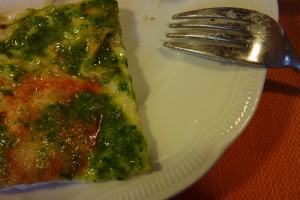
The pesto version of focaccia

Perhaps this answers the questionable “difference” between a focaccia and pizza. Focaccia is often thicker, and it is sometimes sold as “pizza a taglio,” “pizza by the slice,” even though everyone knows it is focaccia. In Italy, pizza is never one slice – it is a pie per person. And in Recco, the focaccia is thin and served on a round dish, one per person. These qualifications bring it dangerously close to pizza. When I asked the question, I was told that the ingredients in the dough are different than that of pizza dough.

And so it seems that pizza will remain pizza, focaccia will remain focaccia, and they will continue to be sold alongside one another for a long, long time as they always have. Don’t worry, pizza. Focaccia isn’t out to get you. Just don’t set up shop in Recco.

Related articles

Never miss a post
Name: 
Your email address:*
Please enter all required fields
Correct invalid entries

Chocolate News: iPhone application, 6-ton chocolate bar, chocolate as medicine, chocolate myths debunked

Published by Tuesday, February 14, 2012 Permalink 0

by Jonell Galloway

At the New York Botanical Garden, the Medicine Hunter takes a close look at the tree that can help boost your mood, heart health and brain power in the video Chocolate as Medicine.

Continue Reading…

Never miss a post
Name: 
Your email address:*
Please enter all required fields
Correct invalid entries

Culinary Chemistry: Tempered Chocolate for Valentine’s

Published by Tuesday, February 14, 2012 Permalink 0

by Jenn Oliver

I love to make food creations as gifts for holidays, because I communicate through food (definitely better than through words). With words I find myself trying to be very precise, searching rather unsuccessfully for the most succinct way to express a thought. However, with cooking, I let loose a little more – I find the constraints and structures of recipes to actually encourage a bit of play. It’s one of the reasons why I have come to love gluten-free cooking, because the restriction in effect serves as an impetus for ingenuity; so amidst all of the rules surrounding the preparation of food, I find the freedom to express myself. Today, I tempered chocolate to tell my husband, “I love you” for Valentine’s.

Tempering chocolate is one of those techniques that is all about rules. It takes care, patience, and most of all, constant attention. A bit of a hassle if you don’t have a temperature controlled device – but, if dipping fruit or other chocolaty Valentine’s confections, there are definitely some advantages to using tempered chocolate. For one, the melting point of the chocolate is higher, so it doesn’t melt as easily, making it less messy to eat. Tempered chocolate is also prettier. It has a more glossy sheen to it, and snaps a bit when you break it apart. Besides aesthetics, tempered chocolate is less likely to bloom – the process where fat rises to the surface giving chocolate unattractive gray splotches.

Continue Reading…

Never miss a post
Name: 
Your email address:*
Please enter all required fields
Correct invalid entries

Simon Says: Daily Food Quote, February 13, 2012

Published by Monday, February 13, 2012 Permalink 0

 by Simón de Swaan

We never repent of having eaten too little.–Thomas Jefferson

Thomas Jefferson — author of the Declaration of Independence and the Statute of Virginia for Religious Freedom, third president of the United States, and founder of the University of Virginia — voiced the aspirations of a new America as no other individual of his era.


Continue Reading…

Never miss a post
Name: 
Your email address:*
Please enter all required fields
Correct invalid entries

Simon Says: Daily Food Quote, February 10, 2012

Published by Friday, February 10, 2012 Permalink 0

by Simón de Swaan

The further I travel in search of the ideal slimming method the more I am convinced that food is one of the oldest and greatest comforters… a secret return to the womb…–Roy Andries de Groot

Baron Roy Andries de Groot was a British-born American culinary writer and wine critic. He was born in London, the son of a Dutch artist and a French noblewoman. During the 1930s, de Groot worked as a news and feature writer, film writer, and director. When World War II broke out, he joined the British Ministry of Information and worked for the BBC, where, during The Blitz of London, he suffered eye injuries that would leave him totally blind within 20 years.


Continue Reading…

Never miss a post
Name: 
Your email address:*
Please enter all required fields
Correct invalid entries

Simon Says: Daily Food Quote, February 9, 2012

Published by Thursday, February 9, 2012 Permalink 0

by Simón de Swaan

Eating well gives a spectacular joy to life.–Elsa Schiaparelli

Elsa Schiaparelli (1890–1973) was an Italian fashion designer. Along with Coco Chanel, her greatest rival, she is regarded as one of the most prominent figures in fashion between the two World Wars. Starting with knitwear, Schiaparelli’s designs were heavily influenced by Surrealists, such as her collaborators Salvador Dalí and Alberto Giacometti.

Click here to see examples of her designs.

Continue Reading…

Never miss a post
Name: 
Your email address:*
Please enter all required fields
Correct invalid entries

Simon Says: Daily Food Quote, February 8, 2012

Published by Wednesday, February 8, 2012 Permalink 0

by Simón de Swaan

Food Haiku

A man that eats
his meals amidst morning glories—
that’s what I am!

–Matsuo Bashō

Matsuo Bashō was the most famous poet of the Edo period in Japan. During his lifetime, Bashō was recognized for his works in the collaborative haikai no renga form; today, after centuries of commentary, he is recognized as a master of brief, clear haiku.

Continue Reading…

Never miss a post
Name: 
Your email address:*
Please enter all required fields
Correct invalid entries

UA-21892701-1