
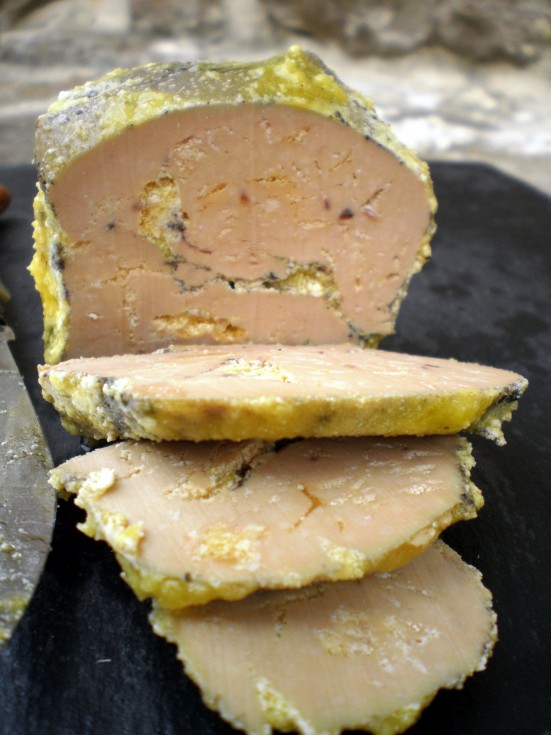
WHAT TO EAT IN FRANCE: FOIE GRAS

Published by Tuesday, May 19, 2015 Permalink 0

WHAT IS FOIE GRAS? READ THE FINE PRINT!

by Jonell Galloway

The French eat 90% of the foie gras they make themselves. That’s how much they like it, but they didn’t invent it. Although the Egyptians might have force-fed their birds, we’re not sure that they ate foie gras. The Greeks probably did, since the 4th-century Greek poet Archestratus wrote about it in his Gastronomy. The liver is the soul of the goose, he said.

Foie gras is made using a process called gavage, which consists of force-feeding ducks or geese through a feeding tube to fatten them. The Romans stuffed dried figs down their throats. In Latin, the word for liver even comes from fig, ficus. Scipio Metellus, a Roman chef, had the idea of soaking still warm livers in honey and milk to swell them even more before cooking.

Apart from the region of Béarn in the southwest, this practice disappeared in medieval France, coming back to life in the southwest and Alsace during the Renaissance.

French foie gras is made by force-feeding corn to geese and ducks, and still, occasionally, figs, which swells the livers.


Goose foie gras has traditionally been the most cherished because it is fattier, but it cannot be produced year round. Duck liver is less fatty, and can be produced year round and industrially, meeting the ever-increasing demand.

The fattened liver can be made into terrine, pâté, mousse, parfait, and a host of other things, and, in more recent times, there is a trend of cutting fresh foie gras into thin slices and pan-searing it. It can be eaten fresh or preserved in glass jars, and can be seasoned with truffles, port, Armagnac or Sauternes. Southwesterners prefer a simple, less perfumed foie gras, while Alsacians like to add flavor.

When purchasing, there are legal distinctions in names that indicate the purity and therefore determine the price:

  1. Foie gras entier means that it contains the actual lobes of the liver. The only legally allowed addition is truffles. As it’s solid, you cut it with a knife, just like you do extra-tender beef filet.
  2. Foie gras consists of pieces of liver that are put back together and pressed.
  3. Bloc de foie gras is reconstituted liver combined with other ingredients, but containing at least 50% foie gras for goose, and 30% for duck .
  4. Parfaits are preparations containing 75% foie gras and made by mechanical means, to which regular, unfattened liver is added.
  5. Médaillon or pâte de foie de canard or d’oie contains 50% duck or goose foie gras or bloc de foie gras in the middle, surrounded by forcemeat.
  6. Galantine is a butcher’s mixture of meats and other forcemeats, with no defined percentage of foie gras.
  7. Mousse contains 50% foie gras mixed with forcemeat, giving it the texture of foie gras.

Terrine is pure foie gras pressed into pâté shape.

Forcemeat can consist of one or several ingredients, including pork, veal or chicken fat; pork or chicken liver; scraps from deveining; poaching fat; eggs; milk; lactoproteins; flour, and starch.

Foie gras comes in a jar, plastic package or can or fresh from the butcher. When purchasing, be aware of the different cooking preparations, since the temperature at which it is cooked and the method of cooking change the flavor and shelf-life. Generally speaking, fresh is better.

It is important to make sure you are being sold what you ask for in both restaurants and shops. As a consumer, you have a legal right.

The French don’t eat foie gras every day. Traditionally, it is for special occasions and holiday meals, especially Christmas and New Year’s celebrations.

Coming soon: What to Eat with Foie Gras

Continue Reading…

Never miss a post
Name: 
Your email address:*
Please enter all required fields
Correct invalid entries

Food Art: White Chocolate & Speculoos Mousse, food photography by Meeta Khurana Wolff

Published by Wednesday, June 12, 2013 Permalink 0

Food Art: White Chocolate & Speculoos Mousse, food photography by Meeta Khurana Wolff

See more food photo compositions at Meeta K. Wolff or in our Food Art category.

Bio of Meeta Khurana Wolff

Meeta, that’s my name given to me by my dad. I was born back in the summer of 1972, one beautiful day in Bombay, India. I was practically delivered in a hotel. That’s where my father has worked for most of his life and it’s what injected the hotelier’s blood into my veins. This hotel lifestyle enabled me to travel the world, get close to many cultures, learn a few languages, and experience many great adventures.

Knowing only a hotel life, I decided to follow my dad’s footsteps and studied Hotel Management, specializing in Marketing and Guest Relations. I trained in one of the finest luxury hotels of this world in Doha, Qatar. That is when a tiny spark for food was ignited in my soul.

I now have settled down in Germany, with the two men I adore, Tom, my loving partner for almost 10 years, and Soeren my adorable son of 5 6 7 years.

Hotels are not a part of my life in Germany. After graduating I came to Germany and worked in an advertising firm, an architecture and design firm and a couple of software firms. Don’t ask how that came about – it just happened. Glad it did too because along this path I bumped into and fell in love with Tom.

We are now in Weimar and you’ll laugh when I tell you this my traveling feet have begun to itch again! Let’s see where life takes us.

I love photography, always have, but it was with the start of this blog that I discovered the world of Foodography. Since then the passion for photography I developed has taken a complete new angle and opened so many exciting doors. I try to capture shots that speak a thousand words, that makes one feel as if they were a part of the scene and experience the photo with their senses. You tell me if I am succeeding!

You can see more of Meeta’s work at What’s For Lunch Honey.


Never miss a post
Name: 
Your email address:*
Please enter all required fields
Correct invalid entries

Switzerland: Swiss Food: Rhubarb Cream Recipe

Published by Monday, May 27, 2013 Permalink 0

by Jonell Galloway

Cherry-Rhubarb Fool

When you talk about rhubarb cream in Switzerland, you mean rhubarb cream, not pudding or custard. This naughty dessert is one of the easiest rhubarb desserts around, and is so thoroughly Swiss.

Recipe for Rhubarb Cream

Ingredients

Photo courtesy of Robin Stewart


1 lb. / 500 g rhubarb
3/4 cup / 200 g cane sugar
 2 egg yolks
 Cinnamon or lemon juice, according to which taste you prefer
3/4 cup / 0.2 l whipping cream

Directions

  1. Scrape or cut off any hard outer surface of rhubarb.
  2. Dice rhubarb and put into saucepan. Add sugar. Cover with water. Cook until tender but firm, 5 to 10 minutes.
  3. While rhubarb is cooking, beat the yolks until smooth.
  4. Run cooked rhubarb through food processor or chinois to purée.
  5. Add hot rhubarb purée to beaten egg yolks. Beat until thoroughly blended and eggs start to cool.
  6. Mix in cinnamon or lemon juice. Set aside to cool.
  7. Beat whipping cream. When it starts to form hard peaks, fold in cooled rhubarb and egg mixture.
  8. Cool in refrigerator, either in individual serving dishes or in a large bowl.
  9. Serve cool.


Never miss a post
Name: 
Your email address:*
Please enter all required fields
Correct invalid entries

UA-21892701-1