How to Eat Gourmet on a College Student’s Budget

Published by Monday, March 14, 2011 Permalink 0

by Jonell Galloway

When I was in college in the U.S. and France in the 70s and 80s, my kitchen was about the size of an American half-bath. I was already well on my way to gourmet snobbery, but since I couldn’t afford to eat in gourmet restaurants every night, I was forced to find novel ways to satisfy my taste buds.

Photo courtesy of Carlos Porto.

When I traveled, I was totally without shame. I went to the best French restaurants with my friends and brazenly ordered an assortment of dishes, which we proceeded to share. We would ask for extra eating utensils and split a dozen snails or a soufflé among three, or share a glass of expensive Bordeaux. Amazingly, the French waiters never once ran us out of the restaurant.

Where there is a will there is a way to eat gourmet every day, as the cliché goes. At home, I stocked up on pasta, and once a week I would go to the farmers market and load up on fresh vegetables and make a variation of Bolognese, which was about the only Italian sauce popular at the time.

But my Bolognese took a different twist every day and every week, depending on the vegetables in season and the meat on sale. Sometimes I used ground pork and beef; sometimes bacon. In the winter, I used more root vegetables; in the spring, peas. As commonplace as that may seem today, my friends were always in awe of my culinary skills, so that just encouraged me.

Today’s gourmet college student is not limited to Bolognese and has a wider choice of vegetables. There are a million things you can do with a package of pasta.

Start by stocking up. Pasta, olive oil, tomato paste and sauce, onions, garlic, Parmesan, Balsamic vinegar and a mixture of dried Italian herbs should always be plentiful in your larder.

If there’s a farmers market near you, make it a weekly pilgrimage. Buy seasonal, local vegetables and herbs if possible. They will taste better and contain more nutrients. If you see tomatoes and eggplants in December, turn the other way, no matter how tempting they may seem.

The first night after shopping, sauté a large batch of vegetables with garlic, onion and Italian herbs in olive oil, mix them with pasta and then sprinkle them with Parmesan. The second night, use the same vegetables, liven them up with a few drops of Balsamic vinegar, and serve them cold as a salad. The next day, add the tomato sauce and then a different vegetable every day, simmering it each time.  The last day, use it to make lasagne.

You can actually make a sauce that will last all week, varying it every night by adding different vegetables (or meat or beans) every day. The sauce will become better with time, rather like the “eternal pot” of the French, where they added different meats and vegetables every day to the same cauldron.

And you will have eaten gourmet every day of the week!

Never miss a post
Name: 
Your email address:*
Please enter all required fields
Correct invalid entries

David Downie: Awesome & Easy Seafood Pesto Recipe, Great Lunch at Da Mirin

Published by Wednesday, February 9, 2011 Permalink 0
by David Downie


(Photo shown: Alison Harris’ cover shot for Enchanted Liguria, which shows the church of San Rocco di Camogli)

The perched village of San Rocco di Camogli could fit in a picnic hamper, yet it boasts a famous bakery (Maccarini), a great butcher shop (Arturo Paolucci), a Michelin-praised restaurant (Nonna Nina) and a friendly little trattoria with fresh fish and a nice terrace and eager owners: Da Mirin. Co-owner Sandro does the cooking, while his wife and fellow proprietor, Elena, waits and runs the show.

Today Sandro whipped up some succulent fresh fish mousse with local olive oil, salt and pepper – not the creamy, heavy kind of mousse you get in fancy restaurants or in France. We nibbled on that with focaccia while waiting for the Pesto di Mare. This too is Sandro’s invention. First you clean and mince or process a bunch of fresh, fragrant basil, tossing in a fistful of plump pine nuts. Then you set the salsa aside. (Yes, salsa. In Italy, sugo = “sauce” and it is cooked, whereas salsa is raw, always). You take a handful of fresh, ripe tomatoes, simmer them at low heat in excellent olive oil, with a pinch each of salt and pepper. You prepare a couple of handfuls of fresh shrimp. You boil pasta like trenette or linguine or tagliolini or even fresh gnocchi. While the pasta is cooking, you toss the shrimp in with the tomatoes. A few seconds before the pasta is al dente, you take the sauce off the heat, put it in a serving bowl and stir in the salsa (the pesto of basil and pine nuts – no cheese, no garlic). Then you toss in the hot pasta and serve pronto. Awesome. Super, really, killer awesome.

Never miss a post
Name: 
Your email address:*
Please enter all required fields
Correct invalid entries

David Downie: World’s Best Tortellini in Paris?

Published by Wednesday, February 2, 2011 Permalink 0

by Pellegrino Artusi’

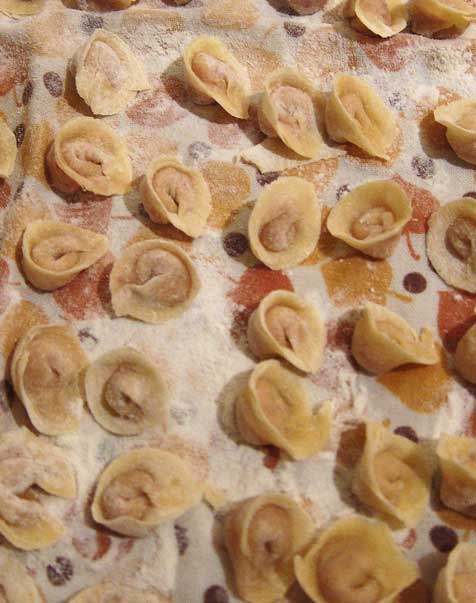
The other night, for our collective birthdays – three of us – our dear friend Daniela X (she is modest and does not wish to be identified) made classic tortellini alla bolognese in brodo. Anyone who has been to Bologna, Parma, Modena or the other great-eating-cities in the Emilia region, will know the authentic item.

Tortellini are a variety of navel-sized (and shaped) filled pasta — see the photo of Daniela’s tortellini, courtesy Kimmo Pasanen. They’re cooked in a sumptuous broth made from several types of meat (usually chicken or capon, veal, and, optionally, cotechino), and served in the broth, period. Purists don’t even sprinkle them with grated Parmigiano. But that may be going too far.

Continue Reading…

Never miss a post
Name: 
Your email address:*
Please enter all required fields
Correct invalid entries

Switzerland: Indelicato, A Hidden Corner of Sicily in the Heart of Geneva

Published by Sunday, December 5, 2010 Permalink 0

Indelicato: A Hidden Corner of Sicily in the Heart of Pâquis

The Indelicato fine food and wine shop is a Geneva institution.  Everyone in Pâquis knows Marguerite and Rosario, and the locals affectionately refer to Marguerite as “Mama”.

Continue Reading…

Never miss a post
Name: 
Your email address:*
Please enter all required fields
Correct invalid entries

UA-21892701-1