
Food is not about impressing people. It’s about making them feel comfortable.–Ina Garten
Ina Garten, The Barefoot Contessa Cookbook
Popular cookbook author and TV personality.
|
|

A Literary Culinary Journal
Food is not about impressing people. It’s about making them feel comfortable.–Ina Garten
Ina Garten, The Barefoot Contessa Cookbook
Popular cookbook author and TV personality.
|
|
Frying gives cooks numerous ways of concealing what appeared the day before and in a pinch facilitates sudden demands, for it takes little more time to fry a four-pound carp than to boil an egg.–Jean-Anthelme Brillat-Savarin
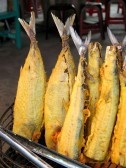
Jean-Anthelme Brillat-Savarin (1755-1826) was a French gastronome, lawyer, magistrate and author who helped to develop the art of food writing. His most famous and influential book, The Physiology of Taste, consists of 8 volumes and was published in December of 1825, two months before his death at the age of 71. His influence is so significant that a cow’s milk cheese, a rum yeast cake, and a ring mold are all named after him. He is considered by many to have been the best food critic ever.

|
|
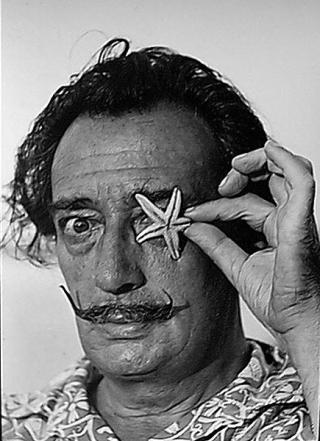
At the age of six I wanted to be a cook. At seven I wanted to be Napoleon. And my ambition has been growing steadily ever since.–Salvador Dalì
Salvador Dali (1904-1989) was a Spanish sculptor, painter and artist primarily known for being an innovator in the Surrealist movement. His theory of “critical paranoia” purported that an artist should cultivate genuine delusion, resembling that of clinical paranoia, while in reality remaining residually conscious that this release of reason was a deliberate and temporary suspension.
|
|
 Good bread is the most fundamentally satisfying of all foods; and good bread with fresh butter, the greatest of feasts.–James Beard

James Beard (1903-1985) was an American chef and food writer who authored 20 books and was instrumental in bringing French cooking to America in the 1950s. World Culinary Institute gives a brief biography. His legacy lives on through the James Beard Foundation.
|
|
The whole Mediterranean, the sculpture, the palm, the gold beads, the bearded heroes, the wine, the ideas, the ships, the moonlight, the winged gorgons, the bronze men, the philosophers -all of it seems to rise in the sour, pungent taste of these black olives between the teeth. A taste older than meat, older than wine. A taste as old as cold water.–Lawrence Durell
Lawrence Durrell (1912-1990), who wrote the modern classic Prospero’s Cell (1945) about time spent in Corfu, was born in India but spent most of his life abroad. Though educated in Britain, he resisted affiliation with Britain and preferred to be considered cosmopolitan. He was a novelist, poet, dramatist, and travel writer.

|
|
 Of course, the food is important. The quality and variety of food is so important to the Spanish generally that it is said they spend a higher percentage of their disposable income on food than any other industrial nation. It is not because the cost of the food is higher in Spain than it is in France, Canada or Australia, but because the Spanish expect better food and a greater variety of it.–Ann and Larry Walker, To the Heart of Spain
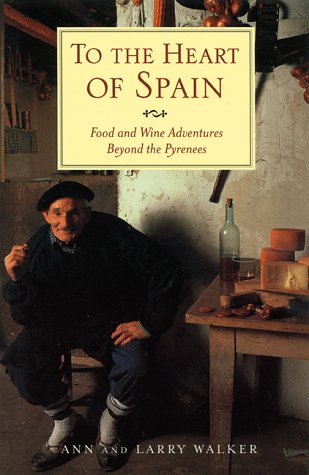
Ann and Larry Walker are the authors of 6 books on food and wine, and regular contributors to numerous publications in the U.S. and abroad. They live near San Francisco in California.
|
|
My favorite sayings are the ones that yoke together metaphorically sexual desire, or passionate love, with the act of eating. There is an earthiness about these expressions that to English ears sounds faintly embarrassing and possibly in bad taste. You might say of a sexually appealing person, Esta como un queso: “He (or she) is like a cheese.” (It would have to be a ripe, oozingly delicious cheese)…–Paul Richardson, A Late Dinner: Discovering the Food of Spain
Good Reads is an English writer and author of 6 books. He lives in Spain. Good Reads says of him: “He traces the roots of Spanish cooking to the landscape, the people, and the history of this beautiful and complex country.”

|
|
by Simon de Swaan
I don’t altogether agree that a plain green salad ever becomes a bore — not, that is, if it’s made with fresh, well-drained crisp greenstuff and a properly seasoned dressing of good-quality olive oil and a sound wine vinegar. But I do agree that all this talk about ‘tossed salads’ is a bore; it seems to me that a salad and its dressing are things we should take more or less for granted at a meal, like bread and salt; and not carry on about them.–Elizabeth David, in The Spectator, 1961
Elizabeth David, food writer (1913-1992) who with wit, wisdom, and various cookery ingredients the British were obviously suspicious of, she introduced the English to fresh, flavorful fare and a sensual approach to the art of eating.
Many of her books are available in the Penguin classics series.
|
|
Grilling, broiling, barbecuing – whatever you want to call it – is an art, not just a matter of building a pyre and throwing on a piece of meat as a sacrifice to the gods of the stomach.–James Beard

James Beard, in Beard on Food, (1974). Beard was an American chef and food writer who authored 20 books and was instrumental in bringing French cooking to America in the 1950s. World Culinary Institute offers a brief biography. His legacy lives on with The James Beard Foundation.
|
|
 Meet Jonell Galloway, a freelance writer and editor specialized in French cuisine.







 by
by 


