What to Eat in France: Mouclade de l’île de Ré

Published by Friday, August 28, 2015 Permalink 0

What to Eat in France: Mouclade de l’île de Ré, Curry and Cream Mussels from the Island of Ré

Moules de Bouchot, or Farmed Mussels

Humans have been eating mussels forever. Even the South American Indians left behind piles of millions of shells, and there is evidence that some prehistoric people used the shells as spoons.

Moules de bouchot are a specialty of this region, the Poitou-Charentes, where they are farmed. They are smaller than mussels brought in from the sea.

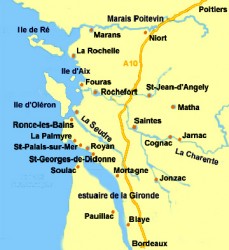
poitou-charentes map

Poitou-Charentes region showing Ile de Ré.

The story has it that this method of farming mussels was started by a shipwrecked Scotsman (or Irishman?), Patrick Walton, in 1235. Although the locals took him in, he was stranded and without money, so he decided to take up his usual occupation of hunting sea birds. He strung his nets along the coast, holding them in place with wooden posts stuck into the ground. To his great surprise he discovered that his posts were “invaded” by tiny mussels that multiplied at a phenomenal rate. He soon changed professions, and started trapping mussels and fattening them — they were a lot faster to fatten than birds — and in so doing invented the first mussel farms using young tree trunks (bouchot means young tree trunk). It is now common practice on the Atlantic Coast of France.

Continue Reading…

Never miss a post
Name: 
Your email address:*
Please enter all required fields
Correct invalid entries

Simple Sustenance: Herbal Warmth — Rosemary Potato Soup with Paprika Oil Recipe

Published by Wednesday, December 5, 2012 Permalink 0

Simple Sustenance: Herbal Warmth — Rosemary Potato Soup with Paprika Oil Recipe

by Renu Chhabra

Herbal Warmth — Rosemary Potato Soup with Paprika Oil

As for rosemary, I let it run all over my garden walls, not only because my bees love it but because it is the herb sacred to remembrance and to friendship, whence a sprig of it hath a dumb language.” — Sir Thomas More

Rosemary potatoes are my favorite all year long.

I always find myself circling around the oven when potatoes are roasting. Is it the intoxicating aroma of rosemary, or the anticipation of a warm bite of the potatoes?

I think it is both.

Hot from the oven on cool nights or at room temperature on warm days, they are always delicious. A cold nibble from the fridge does not disappoint me either. It is a classic combination that is very satisfying.

And who needs chips or french fries when oven-roasted spuds can treat our taste buds guilt free?

But today it’s about soup. My first pot of warm soup this season. And it’s rosemary potato soup.

A pot of familiar flavors simmered on stove top.

This soup has the same foundation of flavors. Fragrant rosemary perfumes the soup and garlic gives it pungency. In addition, I added  sauteéed onions and fresh scallions to it. Sautèed onions also used as garnish in this recipe, give a deep flavorful bite. A drizzle of paprika oil adds color and warmth to this soup.

This recipe is vegan, but you can add a little milk for creaminess. Also garnish with your favorite cheese, if you wish.

The basic soup can be dressed several ways with your choice of garnish. I have enjoyed a few combinations.

  • Kalamata olives, sun dried tomatoes, Pecorino cheese, and a drizzle of rosemary oil or plain extra virgin olive oil
  • Sauted or oven-roasted mushrooms with paprika oil
  • Basil pesto and bits of sun dried tomatoes
  • Caramelized onions, Parmesan cheese, and roasted hazelnuts.

Be creative and let your palate guide you. A basic soup with so many options to dress it with, See what you have in your pantry and fridge to brighten it to your liking.

I would love to hear your ideas.

Recipe

Paprika Oil

¼ cup olive oil
½ teaspoon paprika

  1. Warm olive oil in a small pot. Remove from heat. Stir in paprika. Whisk lightly to dissolve well. Set aside.
  2. If you like spicy, make chili oil instead.

Soup

3 tablespoons olive oil
2 cups onion, diced small
6 cups potatoes (3 large), diced small
5-6 large cloves of garlic, minced
1 teaspoon dried or 2 teaspoon fresh rosemary (or to taste)
Sea salt to taste
Pepper to taste
4-5 green scallions, chopped plus for garnish, chopped fine
3 cups water or vegetable stock

  1. Heat oil in a heavy-bottom pot and add onions. Sauté on medium-high heat for 8-10 minutes or until golden. You want some color, but be careful not to burn the onions.
  2. Set aside a tablespoon or so for garnish.
  3. Stir in garlic, potatoes, rosemary, salt, and pepper.
  4. Cook for a minute and add scallions and water or vegetable stock.
  5. Bring it to boil and cover the pot with a lid. Simmer for 25-30 minutes or until potatoes are cooked.
  6. Let it cool a little.
  7. Puree with immersion blender or in a blender to desired consistency according to your taste — smooth and creamy or rustic and chunky.
  8. Add a little water or stock if it is too thick. Adjust seasonings. Set aside.


To serve, heat the soup and ladle into bowls. Garnish with browned onions. scallions, and a drizzle of paprika oil. Serve hot.

Note: I used water but if you wish, you can use vegetable stock. Potatoes absorb a lot of flavors, so adjust flavors to your taste. Add as much or as little garlic, salt, pepper. Rosemary can be overpowering, if used in excess. Garnish to your taste. If you like spicy food, make chili oil instead of paprika oil.

Never miss a post
Name: 
Your email address:*
Please enter all required fields
Correct invalid entries

French Food Facts: What’s a Potée?

Published by Friday, July 6, 2012 Permalink 0

by Jonell Galloway

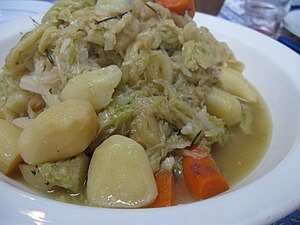
The term “potée” refers to dishes cooked in an earthenware pot, in particular soups and stews. Every region in France has its own version, and it can be compared to what the French refer as the “eternal pot.” Potée Lorraine from Alsace is the most widely known.

Most potées are made with pork and vegetables, the most frequent being cabbage and potatoes.


Potée is a French culinary term which, in gene...


Never miss a post
Name: 
Your email address:*
Please enter all required fields
Correct invalid entries

Spontaneous Cuisine: Parsnip Velouté with Aged Mimolette Cheese

Published by Thursday, December 15, 2011 Permalink 0

Itsy Bitsy History of the Parsnip

In the Middle Ages, Geneva was running over with parsnips, which they referred to as “white carrots”. It was almost always included in their “eternal pots” of soup, which consisted of seasonal vegetables that they just kept adding more vegetables to as needed, and a piece of meat once a week.

After World War II, many root vegetables went out of fashion in Europe, because people had had to survive on them and nothing else during the war, so farmers eventually stopped growing them. The same went for pumpkin. People in the north of France who had lived through the war and eaten pumpkin every day couldn’t bear the thought of eating pumpkin ever again.

In recent years, these old-fashioned vegetables, including parsnips, have again become available, and chefs are going crazy with new ideas on how to use them.

Parsnips are plentiful at the moment and there’s nothing better than soup to warm you up on a cold winter’s day. Eric Burkel, former financial analyst, entrepreneur and now president of his local food coop in Paris, got this recipe from one of the farmers who supplies vegetables to the coop.

Parsnip soup recipe

Continue Reading…

Never miss a post
Name: 
Your email address:*
Please enter all required fields
Correct invalid entries

Health Challenge: The Hot Soups of Winter, Nourishment of Body and Soul

Published by Monday, November 28, 2011 Permalink 0

by Tamar Chamlian

There are many reasons to love winter. For some, it might be gorgeous change of colors as the new seasons ease in; for others it’s festivities that bring celebration and lots of activity. I like both the colors and the festivities, but most of all I like the abundance and versatility of vegetables available that can be used in endless combinations to make hot soup.

Continue Reading…

Never miss a post
Name: 
Your email address:*
Please enter all required fields
Correct invalid entries

UA-21892701-1