
A Swiss Reader’s Tale of Knepfle

Published by Wednesday, April 2, 2014 Permalink 0

A Swiss Reader’s Tale of Knepfle

by Dee Rintoul

I grew up with “cheater” knepfle. I learned from my Oma, who had a Southern German background, but was Romanian-born. She made all kinds of noodles and pasta dishes — spatzle, real egg noodles that were dried and stored, but for everyday use. Knepfle were child’s play. In our own home, we made them for lunch and threw them into Lipton chicken noodle soup (which was not something we’d ever find in Oma’s kitchen!). God. That woman could cook…
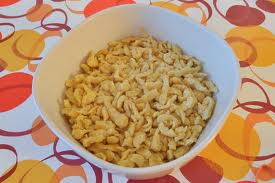
Knepfles, Alsacian and Swiss pasta, photo by http://www.tribugourmande.com/recette_76618_knepfle


Anyway. The way we did it was to beat an egg or two (depending on how greedy we felt at the time), add a pinch of salt and some dried parsley if we thought of it or wanted to impress schoolmates, then beat in all-purpose flour until it was so stiff it wouldn’t take any more and/or became too difficult to stir. Then we’d drop pieces in a pot of boiling water with a fork and a teaspoon, dipping both implements into the simmering soup in between to help the stiff dough drop. Once they were all in, we put the lid on, turned down the heat, and kept it covered for a few minutes.

When we finally lifted  the lid, we found gorgeous, fluffy-looking, but very chewy little dumplings, all floating together on top of the soup. We loved these so much that as kids we used to scorn dumplings as being “too soft”. To our minds, dumplings, or anything that remotely resembled knepfle, ought to be quite al dente.

I still make these for chicken soup (and I try not to rely on Lipton but make my own as often as possible!).

Never miss a post
Name: 
Your email address:*
Please enter all required fields
Correct invalid entries

Sauce for Thought: Coming in From the Cold – An Exploration of Soup

Published by Wednesday, October 3, 2012 Permalink 0

Sauce for Thought: Coming in From the Cold – An Exploration of Soup

by Alice DeLuca

We’re turning down the new thermostat daily, stubbornly staving off the inevitable start-up of the furnace for the coming home-heating season. It’s the hot soup season and the knitting season also, so there are reasons to celebrate. Animals are busy storing everything they can get their paws on, for a long winter of curled up dreaming. I picture them underground and know why some people covet their fur coats. My coat of choice is made from the knitted wool of sheep, and to the sheep I am grateful.

Our new Nest thermostat is “smart” in that it knows what we are doing, but we maintain the illusion of control by tweaking it via tablet technology, even from remote locations. The designers thought of everything, down to the specially designed stickers for labeling the wires during installation. We’re hoping we won’t have to fool this new thermostat in to turning on when the temperature dives like a submarine, the first week of January; nor will we be tempted to put a space heater under it to keep it warm so it won’t activate the furnace, as my father used to do with his mercury-switch driven thermostat from those days.

When the temperature drops, the Canada geese start making tracks. Often they are flying south, but sometimes they appear to be confused and fly east or north, which is because some of them winter-over. The V-formations of confused geese overhead is another clear indication that the time has come to consider hot soup.

Soup, japan dish, японская кухня, суп

Japanese soup


Continue Reading…

Never miss a post
Name: 
Your email address:*
Please enter all required fields
Correct invalid entries

Happy 99th Birthday, Julia Child!

Published by Monday, August 15, 2011 Permalink 0

by Julia Child

Julia Child would have turned 99 today.

Julia Child brought French food to post-war America. When her husband Paul was posted to Paris, she studied at L’Ecole du Cordon Bleu, and went on to form her own cooking school with fellow students Mastering the Art of French Cooking and Louisette Bertholle. The threesome went on to write the 2-volume classic Coq au Vin , which covered all the basic techniques and dishes of classic French cuisine.


And indeed she proved to be right. It is only now, 60 years later, that cooking has established itself as gastronomy, and only when referring to a few great American chefs.

This is Foodista’s list of their favorite Julia recipes.

Coq au Vin

Rooster cooked in red wine is a classic Burgundian dish made with red wine, mushrooms, onions, bacon and herbs.

Duck a l’Orange

Vichyssoise is actually the base of almost all French soups. This simple base — made of potatoes, leeks, and salt — is elaborated on in countless ways to make an endless variety of soup. When served cold in summer and cream is added, it is referred to as Vichyssoise.

Boeuf Bourguignon

Ratatouille brings all the flavors of the Southern sun together: red ripe tomatoes, eggplant, zucchini, bell peppers, garlic, onions and Provençal herbs. Today there are many other versions, many of them even in the oven, but this is the classic recipe.

Upside-Down Martini

The problem with duck is always the same: the fat spews all over the place and it is difficult to digest. The acid of the orange in this classic French dish helps digest the fat, and makes it tasty too. This is a favorite Julia Child recipe.

Custard Apple Tart

Boeuf Bourguignon is a fancy version of our classic beef stew. What makes it different is that it is cooked in red wine, and pearl onions and mushroom caps are added to it.

Plum Clafoutis

Not surprising that Julia loved Martinis. She added vermouth to just about any sauce she could work it in to.

Sabayon

Not all French pies are made with custard, but you often find this version in Normandy, the land of cream and butter. It can be served either cold or warm.

Lessons from Julia Child

Clafoutis can be made with many different fruits, but plus and cherries are all-time French favorites. This tart has a custard-like consistency, but also contains ground almonds, giving it a salty edge.

Sabayon is a a cousin of the light, egg-based Italian dessert zabaglione. It is light and custard-like, and a standard in French as well as British cuisine.

Never miss a post
Name: 
Your email address:*
Please enter all required fields
Correct invalid entries

UA-21892701-1