
What to Eat in France: Mouclade de l’île de Ré

Published by Friday, August 28, 2015 Permalink 0

What to Eat in France: Mouclade de l’île de Ré, Curry and Cream Mussels from the Island of Ré

Moules de Bouchot, or Farmed Mussels

Humans have been eating mussels forever. Even the South American Indians left behind piles of millions of shells, and there is evidence that some prehistoric people used the shells as spoons.

Moules de bouchot are a specialty of this region, the Poitou-Charentes, where they are farmed. They are smaller than mussels brought in from the sea.
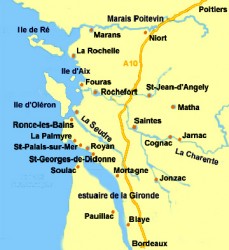
poitou-charentes map

Poitou-Charentes region showing Ile de Ré.

The story has it that this method of farming mussels was started by a shipwrecked Scotsman (or Irishman?), Patrick Walton, in 1235. Although the locals took him in, he was stranded and without money, so he decided to take up his usual occupation of hunting sea birds. He strung his nets along the coast, holding them in place with wooden posts stuck into the ground. To his great surprise he discovered that his posts were “invaded” by tiny mussels that multiplied at a phenomenal rate. He soon changed professions, and started trapping mussels and fattening them — they were a lot faster to fatten than birds — and in so doing invented the first mussel farms using young tree trunks (bouchot means young tree trunk). It is now common practice on the Atlantic Coast of France.

Continue Reading…

Never miss a post
Name: 
Your email address:*
Please enter all required fields
Correct invalid entries

The Many Names for Tamales

Published by Friday, February 28, 2014 Permalink 0


The Many Names for Tamales

by Lenny Karpman

Now that Christmas and the New Year have passed, my neighbors here in Costa Rica are putting away lights, ornaments, Styrofoam snowmen, straw reindeer and faux pine trees. For the family Sunday mid-day meal many are dining on tamales.


MasaHarine


Tamales are stuffed cakes of corn dough, masa harina, wrapped and steamed. In Costa Rica, they are an art form as well as a common food. Tamale making is a seasonal family affair. Multiple generations of family cooks assemble pork or chicken, vegetables – mostly carrots and peas, and herb fillings artistically in rectangular packets of freshly made cornmeal, wrap them in folded plantain leaves and tie them decoratively with reeds or twine. They are traditionally given to neighbors at Christmas. It is an economical and egalitarian way for friends to exchange similar thoughtful gifts without the adversarial “can you top this” attitude that pervades gift giving in some other cultures.

Homemade tamales


In Colombia and Venezuela, they are called hallacas and may contain raisins or olive pieces. In Mexico, they are wrapped in dry corn- husks. Cuban tamales are fluffier and spicy. When the same ingredients are layered and baked without a wrapper, the result is tamale pie. Tex-Mex tamale pie usually is laced with red and green chili peppers.

Hallaca Leaves Drying (CC)

Hallaca leaves drying to make Venezuelan version of tamales


Tico (Costa Rican) tamales freeze well. They are most often tied together in groups of four. Tamales are steamed or simmered before eating, but they can go from freezer to table via the microwave in about two minutes and rekindle holiday warm fuzzy feelings and a delicious sense of community. Buen provecho and a happy and healthy 2014.


Never miss a post
Name: 
Your email address:*
Please enter all required fields
Correct invalid entries

Serendipity: meus caminhos na cozinha e nas viagens…

Published by Saturday, July 6, 2013 Permalink 0
Exif_JPEG_422

Entre uma Serendipity e outra, um bom café!

SERENDIPITY: MEUS CAMINHOS NA COZINHA E NAS VIAGENS…

Translation coming soon in English – Introduction to Betina Mariante Cardoso’s new Brazilian food column

Olá!

Sou Betina Mariante Cardoso, brasileira, trinta e poucos anos. Nasci e moro em Porto Alegre, no Sul do Brasil, cidade que amo de coração e onde vivencio o apego, o calor da família e a constância, virtudes necessárias na minha vida. Paradoxo, tenho encantos por viajar, romper a linearidade rotineira, esquecer o mapa no hotel e perder-me pelas ruas dos lugares que visito. Por quê? Para ter a chance de conhecer aquela confeitaria antiga na rua lateral, coisa que só o acaso permite.  Tenho uma ligação forte com o conforto do cotidiano mas, quando me torno viajante, parto em busca das descobertas, do desconhecido. É quando  me entrego à Serendipity que as viagens propiciam.

E é com este mesmo estado anímico que venho para a cozinha: trazendo comigo a aventura, a curiosidade, o ímpeto pelo novo. Gosto de criar minhas receitas, mas sou também fã dos cadernos culinários, escritos à mão e com manchas de vida em suas páginas. Outro paradoxo.

Continue Reading…

Never miss a post
Name: 
Your email address:*
Please enter all required fields
Correct invalid entries

UA-21892701-1