
SandeeA is a top-notch food photographer and she runs the popular blog La Receta de la Felicidad, where you can find many of the recipes appearing in these photos.

|
|

A Literary Culinary Journal
SandeeA is a top-notch food photographer and she runs the popular blog La Receta de la Felicidad, where you can find many of the recipes appearing in these photos.
|
|
Left: Cross with Rocks, copyright Alison Harris.
Right: Forest Cathedral, copyright Alison Harris
Their 50th birthdays in sight, the acclaimed travel and food writer David Downie, and his wife, the photographer Alison Harris, decided that trekking from Paris to Spain, would be just the thing. They are based in Paris, so the Way of St. James, for a millennium one of the world’s most celebrated pilgrimage routes, was right at their back door. Neither Alison nor David is religious — the classical pilgrimage experience was not what they were seeking. What were they seeking? Renewal, changed perspectives. Perhaps to test themselves, over 72 days and 1100 km of — at times — very rough terrain. And thereby hangs a tale.
Paris to the Pyrenees: A Skeptic Pilgrim Walks the Way of St. James, launches this week. Scroll to the end to see book tour information. Permission to post on TRE the superb photos from the book was granted by Alison Harris.


ELATIA HARRIS: There has been a lot in the news lately on pilgrimage, however one understands the phenomenon. People who do it talk about needing to lose their routine and find themselves. Most set out alone, meeting others en route. You and Alison started together.
DAVID DOWNIE: Our choice to walk together happened organically. I had planned to do this on my own. Alison came along to keep me out of trouble. If you ask her, she’s likely to say it was her idea about 25 years ago, when she suggested we do something similar.
EH: Readers cannot but wonder how they would hold up, in these circumstances. I pictured a long leisurely walk through a French countryside movie. Cows, chateaux…oh, perhaps a few mildly strenuous stints. I was so wrong. This was a test of all your combined resources. It would be for any couple. 72 days of togetherness and real physical hardship. And you had already spent years collaborating on your books.
DD: Like some old couples, we have merged in mind and spirit — if such a thing exists — while remaining very different people, and very pig-headedly independent. So, while we were together on the pilgrimage, we were often apart both in our mental spheres and physically. Alison stopped constantly, ran ahead, took detours, disappeared, got lost—often, though not always, in pursuit of a photograph. She probably walked twice as many miles as I did. By the end of the pilgrimage, my regard for her had only deepened. I can’t speak for her, of course.
|
|

Zev Robinson is a Canadian-British artist and filmmaker currently living in Valencia in Spain. After finishing his B.F.A. in Montreal in 1983, he completed his M.F.A. in New York and subsequently moved to Italy and traveled around Europe, before settling in Spain in 1991. In Spain, he married Albertina Torres. The couple moved to London in 1995, where this series of chile peppers was created.
While in London, he also started working on videos and digital art projects as part of Art After Science, formed with Adrian Marshall, creating a variety of works that have been exhibited widely, including at ARCO in Madrid, the Venice Video Art Fair, and the LOOP Video Fair in Barcelona.
Robinson returned with his family to Spain in 2005, where his video work led to a series of documentaries on wine, food and rural life in Spain. That left him with little time to paint, but in 2012 he showed a series of newly created works of Amphorae at the Dinastia Vivanco Museum. Since then, he has restarted a series of images based on film noir and pulp fiction covers.
|
|
by Raquel Pardo
Translated into English and adapted by Jonell Galloway
Para leer la versión en español, pinche aquí
I risk sounding like a schoolteacher (or a wine snob), but I shall continue. My hair stands on end when I hear people confuse Champagne and Spanish cava, or bubbly (I hide my annoyance, of course).

I can no longer maintain my silence, so I will hastily scribble out a few lines to remove all doubts about the difference between cava and Champagne, and you can face up to the test. You only have to worry about perhaps finding yourself at a blind tasting with people who always know how distinguish one from the other, who never get it wrong. Otherwise, you’re set to roll.
|
|
//
 by David Downie
Truffles in Black and White: Part Two, Truffle Hunting in Piedmont, Italy
The scent of truffles is what draws trained dogs and pigs to them. Wild or cultivated, truffles grow at random around host trees and must be hunted out and carefully removed using a small pick or trowel.
Eighth-generation truffle hunter and dog trainer Renato Agnello, a wiry dynamo in his late 60s, teaches truffle hunting at Alba’s Centro Nazionale Studi Tartufi (CNST) and leads simulated hunts. In Alba’s main square, Piazza Risorgimento, Agnello opened the back hatch of a muddy FIAT Panda and introduced me to his aging truffle hound, Diana. We drove at breakneck speed into vineyards bordering the Tanaro River south of town. The smell of Diana, dirt and truffles was dizzying.
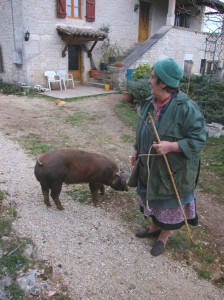 In Italy, truffle hunters must be registered, trained and licensed. Piedmont’s 10,000 are reputed to be secretive. Agnello was expansive. “I’ve been at it 61 years,” he laughed. “With people and dogs it’s genetic.”
Italian law states that truffles on public or private land belong to their finder. To keep truffle hunters out, private property must be fenced and posted “no trespassing.” Trespassing is common, however, particularly in central Italy’s commercial black truffle plantations (there are no white truffle plantations).
|
|

Food photographer Steve Homer of Sabor de Almería in the southeast of Spain is a regular contributor to our site.
|
|
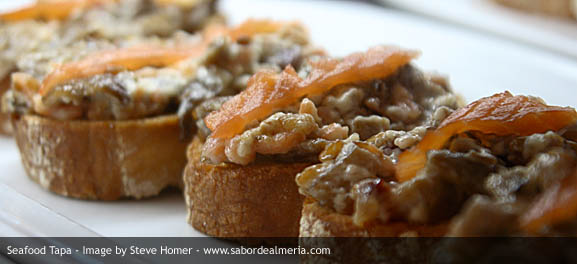
Our latest food artist discovery: food photographer Steve Homer of Sabor de Almería in the southeast of Spain.
|
|
by Jonell Galloway
The Guardian says Ferran and Albert Adrià, the culinary visionaries of El Bulli, will be performing the superstar restaurant’s cocktails at Tickets in Barcelona, paired with a “greatest hits collection” of food: Parmesan ice cream, Iberian ham “airbag-uette,” mango leaves with marigold, yogurt pistachulines, and steamed brioche with mozzarella. So what next, Ferran?
Click here to watch the video.

|
|

Our ongoing series of tapas photos from by food photographer Steve Homer of Sabor de Almería in the southeast of Spain.
|
|

You can find the bilingual Spanish-English recipes for these photos at La Receta de la Felicidad. To see more of her photography, look under the tab Food Art, SandeeA.
|
|
 Meet Jonell Galloway, a freelance writer and editor specialized in French cuisine.


