A Swiss Reader’s Tale of Knepfle

Published by Wednesday, April 2, 2014 Permalink 0

A Swiss Reader’s Tale of Knepfle

by Dee Rintoul

I grew up with “cheater” knepfle. I learned from my Oma, who had a Southern German background, but was Romanian-born. She made all kinds of noodles and pasta dishes — spatzle, real egg noodles that were dried and stored, but for everyday use. Knepfle were child’s play. In our own home, we made them for lunch and threw them into Lipton chicken noodle soup (which was not something we’d ever find in Oma’s kitchen!). God. That woman could cook…
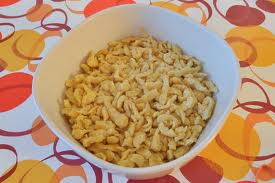
Knepfles, Alsacian and Swiss pasta, photo by http://www.tribugourmande.com/recette_76618_knepfle


Anyway. The way we did it was to beat an egg or two (depending on how greedy we felt at the time), add a pinch of salt and some dried parsley if we thought of it or wanted to impress schoolmates, then beat in all-purpose flour until it was so stiff it wouldn’t take any more and/or became too difficult to stir. Then we’d drop pieces in a pot of boiling water with a fork and a teaspoon, dipping both implements into the simmering soup in between to help the stiff dough drop. Once they were all in, we put the lid on, turned down the heat, and kept it covered for a few minutes.

When we finally lifted  the lid, we found gorgeous, fluffy-looking, but very chewy little dumplings, all floating together on top of the soup. We loved these so much that as kids we used to scorn dumplings as being “too soft”. To our minds, dumplings, or anything that remotely resembled knepfle, ought to be quite al dente.

I still make these for chicken soup (and I try not to rely on Lipton but make my own as often as possible!).

Never miss a post
Name: 
Your email address:*
Please enter all required fields
Correct invalid entries

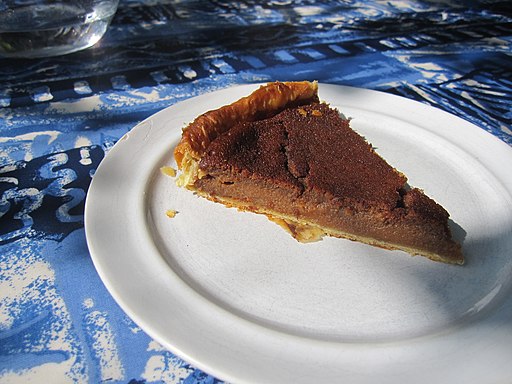
Swiss Food: Tarte à la Raisinée – Apple & Pear Syrup Pie

Published by Sunday, March 30, 2014 Permalink 0

Swiss Food: Tarte à la Raisinée – Apple and Pear Molasses Pie

What is Swiss Raisinée?

The French-Vaudois word raisinée refers to a syrup or molasses made of the must of apples and pears. It was originally cooked in grape juice, thus the name — raisin means grape in French. Often called vin cuit, or “cooked wine,” it is in the form of a dark brown, viscous liquid. In still other parts of Switzerland, another concoction similar in consistency to jam and using the same ingredients is called cougnarde and probably dates back to at least the Middle Ages. Raisinée was used as a sweetener in many regions in Europe, and the tradition has lingered in Switzerland, especially in the cantons of Vaud, Fribourg and Neuchâtel. Today, it is mainly used for cakes and pies, and is not fermented, so it not technically a wine.

The tart itself has numerous names — raisinée, vin cuit (literally cooked wine), cougnarde and Biresaassa, depending on the location.

Recipe: Tarte à la Raisinée – Apple and Pear Syrup Pie

This recipe is inspired by Concert des Casseroles and translated with their authorization

Use a pie ring or pie tin 24 cm in diameter
Sweet Pie Crust
  • 200 g of flour
  • 100 g butter
  • 3 g of fine salt
  • 15 g walnut or hazelnut nillon* (here a mixture in equal parts)
  • 1 small egg (less than 60 g)
  • 60 g white sugar
Filling
  • 3 eggs
  • 2 egg yolks
  • 200 g double cream
  • 150 g pear raisinée (click on link to see our recipe for making raisinée)
  1. Dough: Combine the butter and sugar. Add the beaten egg and walnut/hazelnut nillon, then flour, mix and form into a ball, then roll out or pat down to flatten. Wrap in plastic and chill for 30 minutes.
  2. Spread the dough on a sheet of baking paper and place it along with the sheet in a pie ring or pie pan. Shape the edges by pinching the dough between your thumb and forefinger. Prick the bottom and edges with a fork. Cool for 30 minutes to firm up and avoid sagging when cooking.
  3. Preheat oven to 180° C. Place baking paper and beans or ceramic beads on the dough to prevent it from swelling. Bake for 20 minutes: the dough should barely brown.
  4. Meanwhile, prepare the filling by mixing the eggs and yolks, the double cream and the raisinée.
  5. Remove dough from oven. Remove weights and parchment paper. Lower thermostat to 150°C.
  6. Pour the filling into the dough and cook for about 30 to 40 minutes. The filling must be taken when it is not too firm and must have a slightly caramelized smell. It will probably still appear liquid when it comes out of the oven, but do not prolong the cooking, as it gets much firmer while it is cooling.

*Nillon: Nillon (or nion), is a local product used in French-speaking Switzerland. It is the residue from pressing of nuts. It is found in sheets, grated or powdered form. There are walnut and hazelnut nillons packaged in small 160-gram bags. In the canton of Vaud (Switzerland), nillon is used to make a walnut cake and apple pie. In France, it is known as walnut flour or walnut meal.


Never miss a post
Name: 
Your email address:*
Please enter all required fields
Correct invalid entries

UA-21892701-1