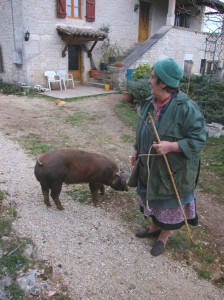
David Downie: Truffles in Black and White: Part Two, Truffle Hunting in Piedmont

Published by Thursday, February 23, 2012 Permalink 0

//
by David Downie

Truffles in Black and White: Part Two, Truffle Hunting in Piedmont, Italy

The scent of truffles is what draws trained dogs and pigs to them. Wild or cultivated, truffles grow at random around host trees and must be hunted out and carefully removed using a small pick or trowel.

Eighth-generation truffle hunter and dog trainer Renato Agnello, a wiry dynamo in his late 60s, teaches truffle hunting at Alba’s Centro Nazionale Studi Tartufi (CNST) and leads simulated hunts. In Alba’s main square, Piazza Risorgimento, Agnello opened the back hatch of a muddy FIAT Panda and introduced me to his aging truffle hound, Diana. We drove at breakneck speed into vineyards bordering the Tanaro River south of town. The smell of Diana, dirt and truffles was dizzying.

Photo courtesy of Alison HarrisIn Italy, truffle hunters must be registered, trained and licensed. Piedmont’s 10,000 are reputed to be secretive. Agnello was expansive. “I’ve been at it 61 years,” he laughed. “With people and dogs it’s genetic.”

Italian law states that truffles on public or private land belong to their finder. To keep truffle hunters out, private property must be fenced and posted “no trespassing.” Trespassing is common, however, particularly in central Italy’s commercial black truffle plantations (there are no white truffle plantations).

Continue Reading…

Never miss a post
Name: 
Your email address:*
Please enter all required fields
Correct invalid entries

New EU Labeling for Organic Wines

Published by Thursday, February 16, 2012 Permalink 0

by Jonell Galloway

On February 8, 2012, the EU organic farming committee passed new rules regarding the labeling of organic or “biologique” wines. The rules become effective as of the 2012 grape harvest.


Organic wine producers will be required to label their wine as being organic and labels must be marked with the EU’s organic logo as well as the code number of the certifier, but must continue to follow existing rules regarding wine labeling.

Rules for wine obtained using organic raisins already exist, they do not cover wine making practices, covering the entire production process, from raisin to wine.

Sorbic acid and desulfurication will not be allowed. “The level of sulfites in organic wine must be at least 30-50 mg per liter lower than their conventional equivalent and the general wine-making rules defined in the Wine CMO regulation will also apply. As well as these wine-making practices, ‘organic wine’ must of course also be produced using organic grapes,” says the European Commission.

Wine is the only sector to be covered by EU rules regarding organic agriculture.


Never miss a post
Name: 
Your email address:*
Please enter all required fields
Correct invalid entries

Spontaneous Cuisine: John Dory, Italian Green Wild Asparagus and Blood Orange Sauce

Published by Wednesday, February 8, 2012 Permalink 0

by Jonell Galloway

Italian Blood Oranges are in Season and Reasonably Priced Now!

One of my favorite ways of creating tasty but healthy dishes is using fruit and vegetables as sauce. There are millions of ways to do this, depending mainly on the season.


English: Slices of Blood Oranges Deutsch: Sche...


Oranges are abundant at the moment, so I’ve been using a lot of orange juice to liven up dishes. It adds a burst of flavor, yet requires no cream or butter, thus making it low in calories and high in fiber.

The season is short for wild Italian asparagus, so take advantage of it in April and May.

Continue Reading…

Never miss a post
Name: 
Your email address:*
Please enter all required fields
Correct invalid entries

Switzerland: Coop’s Pro Montagna Label: 5 Years of Protecting Traditional Swiss Food Products

Published by Wednesday, February 1, 2012 Permalink 0

Switzerland: Coop’s Pro Montagna Label: 5 Years of Protecting Traditional Swiss Food Products

by Jonell Galloway

In 2005, Andy Imfeld, a montagnard and organic food producer, started discussing the possibility of selling Swiss mountain products directly in Coop supermarkets. After long negotiations as to how it should work, it was decided that for each mountain product sold, a certain amount of the payment would go directly to the families of farmers or projects in mountain regions.


Coop labeled the products Pro Montagna, and the project has been a great success, with some 200 products to date, from yogurt to bread, and including meat products and wooden toys.

Continue Reading…

Never miss a post
Name: 
Your email address:*
Please enter all required fields
Correct invalid entries

Our favorite food books of 2011

Published by Friday, December 23, 2011 Permalink 0

by Jonell Galloway

Cookbooks:

Ancient Grains for Modern Meals, by Maria Speck

My favorite cookbook of the year. Maria Speck knows how to incorporate ancient whole grains from around the world into dishes that remain rustic on the edges, but healthy, original and elegant at the same time. The technical explanations about ancient grains are excellent, as well as her explanations about general cooking techniques. The food stories she incorporates here and there about growing up in Greece and Germany add a touch of charm.

A must for any health-conscious real food lover who wants to eat interesting food combinations and dishes with a touch more sophistication that can pleasantly surprise guests, but not take them totally away from their references, because the dishes are for the most part influenced by Mediterranean cuisine.

For poetry-loving foodies:

The Poet’s Cookbook: Recipes from Germany, poems by 33 American poets with German translations

The Poet’s Cookbook: Recipes from Tuscany, poems by 28 Italian and American poets

I love the original concept of these books, pairing a food poem with a recipe. A poem by our Food Poetry Editor, Christina Daub, “Wine“, appears in the Tuscany version.

Farming: A Hand Book, by Wendell Berry

As a Kentuckian, Wendell Berry has forever been my mentor. He is, in my mind, the precursor of the Slow Food philosophy in the U.S., through the philosophy he has cultivated and spread for over 50 years now, well before Petrini and company started the Slow Food movement. Whether writing prose or poetry, he is always eloquent, and the same message of integrity, respect for others and for the land is the central message. This is one more inspiring book of poetry to add to our shelves of books to keep forever, that will comfort us in times of trouble, that we will pick up time and time again when we’re losing faith in humanity, devastated by the disrespect shown to the land, losing touch with our roots. Berry always says what he thinks in all his eloquence and with true gentillesse, but more than that, he lives the life he preaches, and that is consoling.

For food lovers, wine lovers, and culinary travelers:

Food Wine Rome, by David Downie and Alison Harris, published by The Little Bookroom, part of The Terroir Guides series

Food Wine Burgundy, by David Downie and Alison Harris, published by The Little Bookroom, part of The Terroir Guides series

Paris, Paris: Journey into the City of Light, by David Downie

David Downie writes wonderful articles for The Rambling Epicure and Alison does exquisite food photo exhibits for our Food Art section. I can never get enough of their work, because the writing is exquisite and full of literary and historical references, and the photos are truly art. Downie always shows you the insider’s view of whatever he writes about, and Alison has a great eye for catching the very essence of what they’re covering, whether it be truffle hunting or discovering little out-of-the way restaurants in isolated villages. You can never go wrong with their books.

For bread lovers:

Dictionnaire Universel du Pain, by Jean-Philippe de Tonnac

Jean-Philippe de Tonnac also writes for The Rambling Epicure, and has recently become THE bread writer all bakers want to meet. This book should in my mind be translated into English immediately. It offers a wealth of information about bread from time immemorial, covering techniques and breads from around the world, as well as spirituality, sex, gluten intolerance, bakers as poets, bakers as prophets and much more. “Encyclopedia” would be a more appropriate term than “dictionary”.

Mindful eating:

The Self-Compassion Diet: Guided Practices to Lose Weight with Loving-Kindness by Jean Fain

Jean Fain has tried every diet out there, so she can speak with authority about the subject of weight loss. She is also affiliated with Harvard Medical School as a psychotherapist, so she has the credentials to talk about the subject. Her book takes a totally different approach to weight loss than any I’ve seen. She doesn’t count calories and restrict what you eat. Her approach is instead through the mind, to become mindful of what we eat, when we eat (when stressed or lonely, for example), why we eat (out of need to nourish ourselves or out of boredom or frustration); to appreciate what we eat, and above all to be conscious of our entire relationship with food.

The book teaches you how to take control of yourself and your relationship to food so that you can change the way you think about food in general, so that eating becomes a totally different experience. Jean does this through loving-kindness, self-hypnosis, meditation and numerous other weight-loss approaches, which you follow gradually, not all in one go. She also offers a CD including guided meditations to help patients after they have stopped therapy.

Her main thrust is self-love, that we must not be too hard on ourselves, or we’ll fall back in to our old and bad habits quickly. The beauty of the book and CD combination is that you can live half way around the planet and still follow her method.

For lovers of literature: food essays and prose:

Slow Food: Collected Thoughts on Taste, Tradition, and the Honest Pleasures of Food, by Carlo Petrini and Ben Watson

This book consists of an anthology of articles by the world’s top food writers, making me remember the old days when we’d visit the family in the countryside and how I thought it odd that they grew all their vegetables themselves and knew how to can them; how they drank milk straight from the cow (one of my fondest childhood memories), and how we relished in those meals, how it built bonds between us. “Drawn from five years of the quarterly journal Slow (only recently available in America), this book includes more than 100 articles covering eclectic topics from “Falafel” to “Fat City.” From the market at Ulan Bator in Mongolia to Slow Food Down Under, this book offers an armchair tour of the exotic and bizarre. You’ll pass through Vietnam’s Snake Tavern, enjoy the Post-Industrial Pint of Beer, and learn why the lascivious villain in Indian cinema always eats Tandoori Chicken.”

For pastry makers and lovers:

Mich Turner’s  Masterclass: The Ultimate Guide to Cake Decorating Perfection, by Mich Turner, published by Jacqui Small LLP, London

Mitch Turner’s cake decorating book is worthy of a fine art book in its presentation, and of an encyclopedia in terms of the detailed explanations about cake decorating. Her pastry and cakes are truly works of art. A must for all pastry makers, whether professional or amateur.

Food art:

From Plate to Pixel: Digital Food Photography, by Hélène Dujardin

This book is special for many reasons. There are lots of people out there trying to learn food photography without a clue as to even the basic techniques required and no possibility of taking a food photography workshop. This is the book for them, because all the basics plus quite a lot more are explained in a clear, direct manner. It also verges on being an art book, because it is illustrated by Dujardin’s beautiful food photography.



Never miss a post
Name: 
Your email address:*
Please enter all required fields
Correct invalid entries

Spontaneous Cuisine: Parsnip Velouté with Aged Mimolette Cheese

Published by Thursday, December 15, 2011 Permalink 0

Itsy Bitsy History of the Parsnip

In the Middle Ages, Geneva was running over with parsnips, which they referred to as “white carrots”. It was almost always included in their “eternal pots” of soup, which consisted of seasonal vegetables that they just kept adding more vegetables to as needed, and a piece of meat once a week.

After World War II, many root vegetables went out of fashion in Europe, because people had had to survive on them and nothing else during the war, so farmers eventually stopped growing them. The same went for pumpkin. People in the north of France who had lived through the war and eaten pumpkin every day couldn’t bear the thought of eating pumpkin ever again.

In recent years, these old-fashioned vegetables, including parsnips, have again become available, and chefs are going crazy with new ideas on how to use them.

Parsnips are plentiful at the moment and there’s nothing better than soup to warm you up on a cold winter’s day. Eric Burkel, former financial analyst, entrepreneur and now president of his local food coop in Paris, got this recipe from one of the farmers who supplies vegetables to the coop.

Parsnip soup recipe

Continue Reading…

Never miss a post
Name: 
Your email address:*
Please enter all required fields
Correct invalid entries

David Downie: Delving into the Heart of Genoa and its Food Shops and Cafés

Published by Tuesday, December 13, 2011 Permalink 0

by David Downie

genoa, genova, shrine, madonna, old town, medieval alleys

A Favorite, Fabulous Specialty Food Shop and Historic Café in Genoa

North of Genoa’s historic harbor — the celebrated Porto Antico — spreads the recently pedestrianized Piazza Caricamento. It’s most imposing and significant building is Sottoripa cafes in Genoa, for centuries the HQ of the Banco di San Giorgio — the bank that gave “banking” its name, and helped make Genoa one of the world’s richest cities. The frescoed palace — part medieval fortress, part baroque mansion — now houses Genoa’s port authority. Few visitors think to visit the interior, which is open to the public and worth a peak. Frescoes, high ceilings, antique furniture and plenty of salty atmosphere are to be found.

Sottoripa cafes in Genoa

Armanino

The square is backed by Sottoripa and Via Turati, two shopping arcades lined by mom-and-pop stores of all kinds: fry shops, cafes and bars.

One of my favorite shops along Sottoripa is Armanino, a specialty foods boutique founded in 1905. The Armanino family still runs this narrow, deep cavern. Celebrated for its wide variety of candied fruit, handmade by a candy-maker in Savona, Armanino also offers scores of highest-quality Ligurian specialty foods. You’ll find Santa Rita brand dry pasta, unfiltered extra virgin olive oil from the Frantoio di Borgomaro and many other small producers, Savona anchovies bottled in olive oil, authentic artisan-made bottled pesto and flours derived from chickpeas or chestnuts, perfect for traditional Ligurian recipes (and naturally gluten-free to boot).

Even older than Armanino (though a relative newcomer to the city’s medieval neighborhood) is nearby Klainguti, one of my favorite cafés in Genoa. Klainguti opened for business in 1826, the brainchild of a pair of Swiss brothers — which explains the utterly un-Genoese name. The Klainguti brothers were pastry makers. They had planned to sail to America from Genoa to make their fortune. But they literally missed their boat, opened a shop here instead, and the rest is history.

Klainguti’s is a tale of sweet success, from the archetypal Swiss butter cookies and rich cakes (including the caloric but irresistible “torta Zena” made with rum-flavored zabaglione cream, sponge cake and almond paste) on up. Another centuries’ old classic is the “torta Engadina” (a variety of German dark chocolate cake, filled with heavy cream and assembled from layers of light sponge cake made from almond flour).

Just over a decade ago two new, affable owners—also brothers—named Sauro and Fabrizio Ubaldi, plus Fabrizio’s son Luca, took over Klainguti. They trimmed the proverbial sails of this flagship café and got it flying along the Mediterranean circuit again after decades of doldrums.

Klainguti

Everything at Klainguti is made in house. The gobeletti are goblet-shaped apricot-jam cookies and they are very good. But there are also chocolate-dusted meringues made to look like miniature porcini mushrooms. The Falstaff is a croissant stuffed with hazelnut paste. Local legends claim it was one of composer Giuseppe Verdi’s favorites. Verdi was a regular at Klainguti whenever he was in Genoa, which was often.

The larger-than-life Verdi was a jumbo-sized individual and reportedly had no trouble dispatching giant portions of whatever he ordered. Those who can’t even imagine gobbling an entire torta Zena can get a fair idea of its excellent flavor by ordering a patatina rosa instead. These pink, baby potato-shaped confections explode with rummy zabaglione.

Klainguti’s outdoor tables are set up in the pocket-sized Piazza di Soziglia, a charming spot in the bull’s eye of the center of Genoa’s medieval alleyways. This is the perfect place from which to watch the multi-cultural, multi-racial Mediterranean world walk by. In case you’re hungry for the savory side before hitting the desserts, Klainguti also serves light lunches and many snacks. Don’t miss the cozy, handsome little backroom decorated with antique crystal chandeliers and colorful stone floors. It’s a good place to get out of the weather, whether hot or cold.

For addresses and opening hours, and much more on Genoa, its history, culture, food, wine, hiking trails, treks, guided tours, restaurants, food shops, best coffee, best focaccia and more, keep reading WanderingLiguria and pick up our books, Food Wine Italian Riviera & Genoa and Enchanted Liguria: A Celebration of the Culture, Lifestyle and Food of the Italian Riviera.

Never miss a post
Name: 
Your email address:*
Please enter all required fields
Correct invalid entries

Thankful Moments — Honey-Ginger and Pomegranate Salad

Published by Tuesday, November 29, 2011 Permalink 0

by Renu Chhabra

“For each new morning with its light,
For rest and shelter of the night,
For health and food, for love and friends,
For everything Thy goodness sends.”
– Ralph Waldo Emerson


Last Sunday, I went for a walk with my daughter in our neighborhood. It was a lovely autumn afternoon, and sunshine was gracing the landscape with its golden rays. Everywhere we looked, the view was stunning with trees dressed in red, green and golden tones. “Look at that red tree – it looks so majestic. Let’s take a picture of it,” I said. “And what about that wall covered with golden leaves? That’s very charming too,” she pointed out with excitement. Enjoying these simple moments was worth treasuring. We clicked several pictures of this beautiful scenery.

Continue Reading…

Never miss a post
Name: 
Your email address:*
Please enter all required fields
Correct invalid entries

Health Challenge: The Hot Soups of Winter, Nourishment of Body and Soul

Published by Monday, November 28, 2011 Permalink 0

by Tamar Chamlian

There are many reasons to love winter. For some, it might be gorgeous change of colors as the new seasons ease in; for others it’s festivities that bring celebration and lots of activity. I like both the colors and the festivities, but most of all I like the abundance and versatility of vegetables available that can be used in endless combinations to make hot soup.

Continue Reading…

Never miss a post
Name: 
Your email address:*
Please enter all required fields
Correct invalid entries

Not to miss: Bittman on Thanksgiving as a model for Sustainable Cooking

Published by Thursday, November 24, 2011 Permalink 0

Don’t miss Mark Bittman‘s “Thanksgiving as a model for sustainable cooking” in The New York Times.

Mark Bittman

The one thing that is different about Thanksgiving is that we are less wasteful. For the rest of the year, Americans have a record for throwing out at least 40% of their food, while even before Thanksgiving we are figuring out what do do with all the leftovers. Perhaps we should make this our model for the rest of the year.

…The holiday also contains a solution to one of our greatest problems today: our eating. We’re finding it incredibly hard to feed ourselves the way we want. It’s not, as many think, because food is so expensive or we’re so short on time, but because we have a perspective on cooking that impedes our getting real value from our ingredients, or the most from our time.

On Thanksgiving, though, we get it right.

Click here to read the rest of this very important article.

Continue Reading…

Never miss a post
Name: 
Your email address:*
Please enter all required fields
Correct invalid entries

UA-21892701-1