Thanksgiving Turkey News: Tips on Choosing, Buying and Cooking

Published by Tuesday, November 20, 2012 Permalink 0

by Jonell Galloway

How to Choose, Buy and Bake a Turkey in the U.S. and Europe

The USDA gives useful facts about about turkey hygiene and cooking, all based on the assumption that you’re cooking frozen turkey. If you live in the U.S., you’ll most likely be cooking a frozen turkey, so this information is spot-on.

Julia Child’s The Way to Cook still rates top on my list for detailed, illustrated explanations of how to prepare and cook a turkey and lots of other tips.

If you live in Western Europe, there are plenty of free-range, grain-fed turkeys. I order mine months ahead from a farmer near me, since in Europe they only eat turkey at Christmas and they won’t be fattened otherwise.

In Paris, in the 7th and 16th arrondissements in particular, many butchers have fattened turkeys for Thanksgiving, and they are often free range and natural. One of the most prized origins in France is dinde de Bresse, which of course comes from Bresse and is free range. In Geneva, you can buy these, stuffed or unstuffed, at La Boucherie Molard across from the Globus during the Thanksgiving period.

If you live in other cities in Western Europe, you may not have a lot of choice. I’ve had a number of bad experiences ordering turkeys through the butchers in the provinces. They are never sure whether they’ll actually receive a fattened turkey or a scrawny thing which was intended to be fat for Christmas. If you live in the country, however, try and find a turkey farmer near you. They will invariably be cheaper and often better.

Free-range, organic turkeys will never weigh as much as the supermarket variety, but the ratio of meat to bone is greater. It’s amazing how much meat there is on a 9 or 10 lb. turkey.

I have never tasted Mary’s Turkey in California, but they sound appetizing. Mary certainly takes her poultry seriously. They are free-range, vegetarian-fed, gluten-free, and free of all antibiotics, preservatives and hormones. They are also USDA-certified organic. You can order them online, or find a store near you that sells them.

Click here to watch an entertaining but helpful video about the dangers of frying turkeys.

Chowhound has a great discussion board about whether free-range, heritage turkeys are worth the price. I would always vote for free-range and natural. They have more meat and less bone, probably due to the fact that they’ve not been gorged with antibiotics, steroids and we probably don’t want to know what else. In addition, they don’t taste like meal.

The wild turkey population is growing in much of the U.S., so I’m sure many are tempted to shoot a big one for Thanksgiving. That’s all fine, but keep in mind: cooking a wild turkey is an entirely different bag of worms. If they are large, they risk tasting gamy. Here is some good common-sense advice for preparing and cooking them.

Truth About Turkey” gives an excellent layman’s explanation about how the various kinds of turkey in the U.S. are raised.

Have a Slow Food Thanksgiving” gives a list and directories of where to buy heritage, organic and free-range turkeys in the U.S.

Whenever possible, buy directly from a local farmer. When buying fresh turkey, always ask about the “use by” date. It will depend on packaging as well as when the turkey has been slaughtered. If bought fresh and unpackaged, The New York Times and Seattle Times suggest you can keep it one or two days maximum in the refrigerator, so plan your pick-up time carefully.


Related articles
Never miss a post
Name: 
Your email address:*
Please enter all required fields
Correct invalid entries

Switzerland: Raphael of Fribourg making Fribourg-style Swiss fondue using cheese he makes

Published by Friday, November 2, 2012 Permalink 0

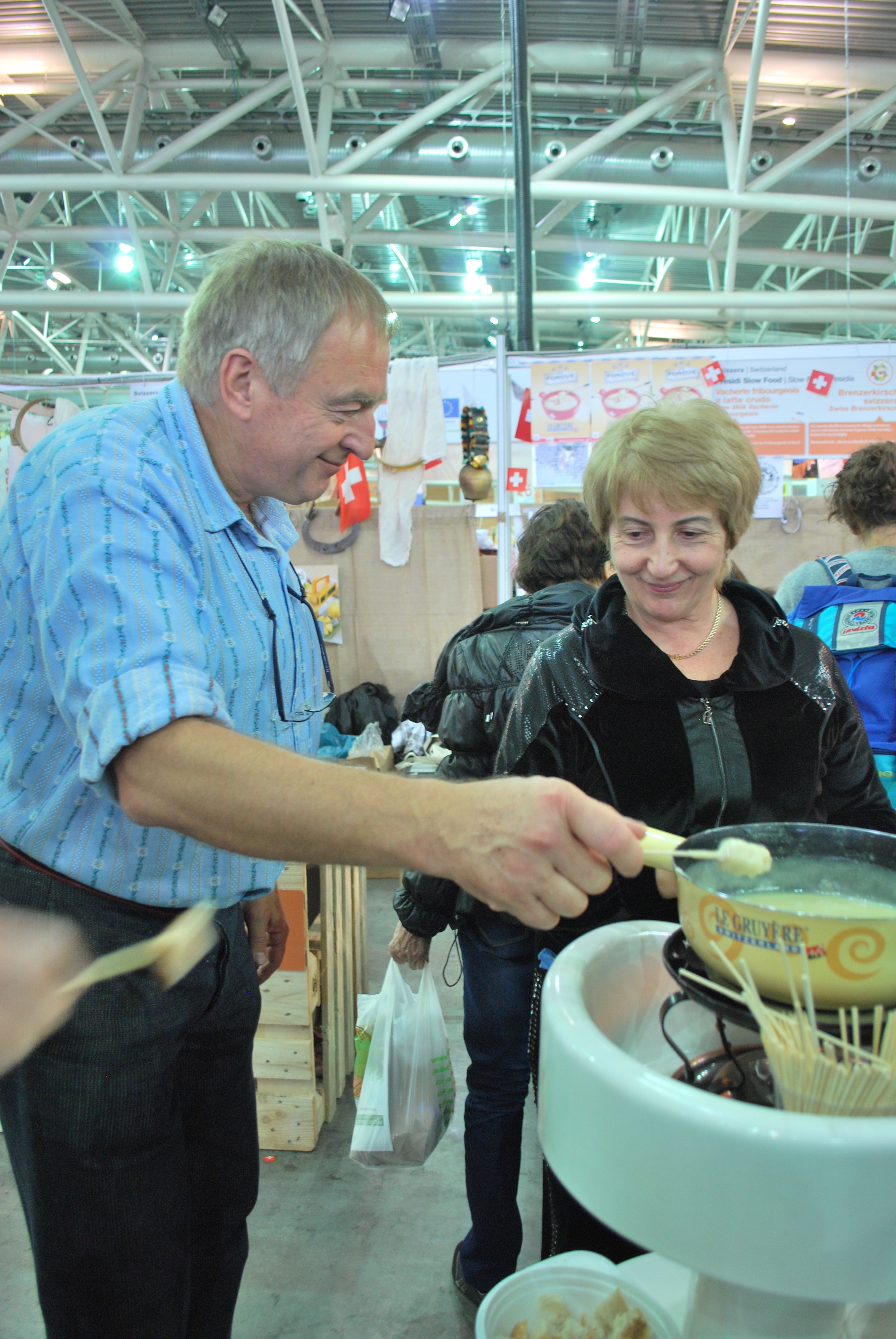
Fribourg-style Swiss fondue is referred to as moitié-moitié. Unlike fondues from other regions, it is made with a hard, cooked cheese native to Fribourg, known as Vacherin Fribourgeois (not to be confused with Vacherin or Mont d’Or). The recipe calls for half Vacherin Fribourgeois and half Swiss Gruyère.

In this photo, Raphael is making fondue using the handmade cheeses he makes himself, at the Slow Food Switzerland stand at the Salone del Gusto in Turin, Italy last week. The visitors ran to his stand every time he put a new pot of fondue out. Obviously, it was very good!


Never miss a post
Name: 
Your email address:*
Please enter all required fields
Correct invalid entries

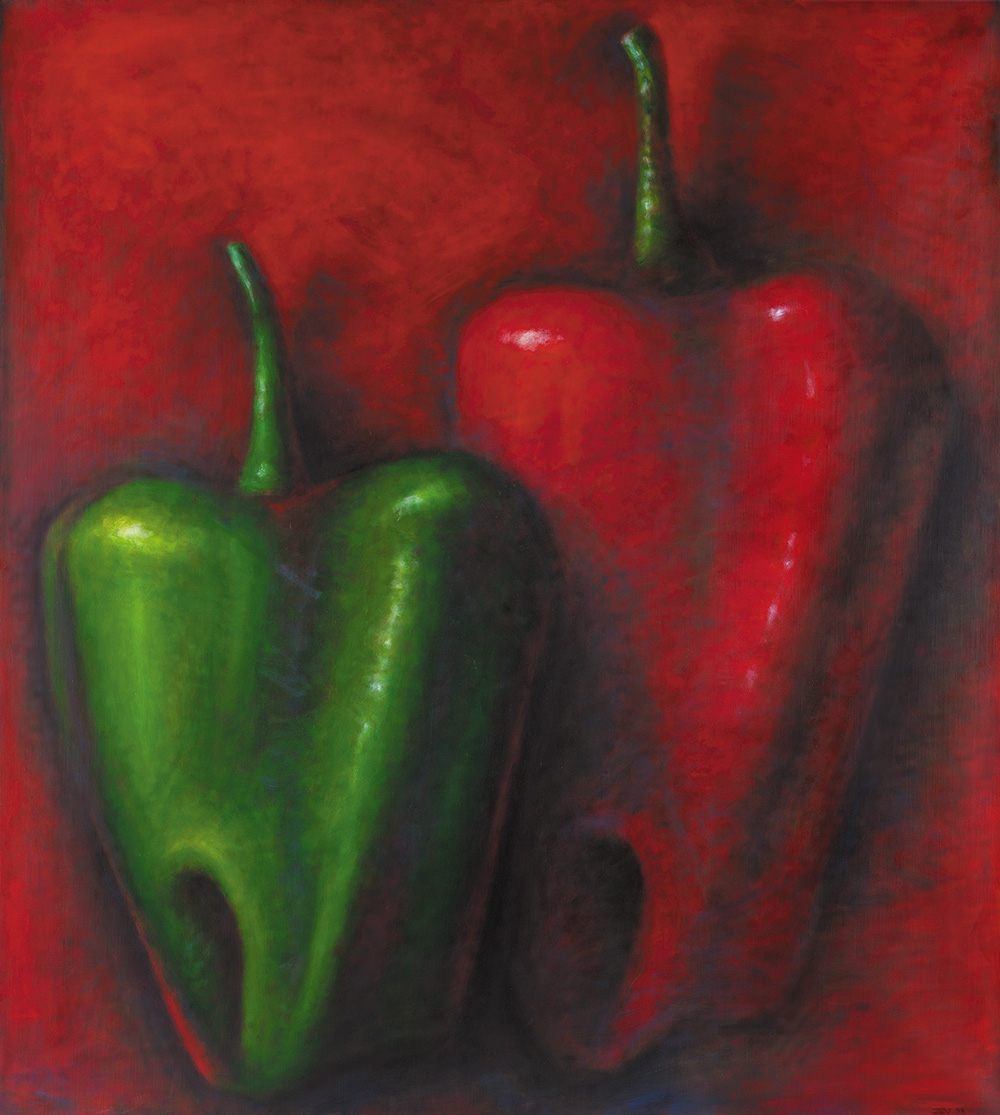
Food Art: The Many Colors of Chile Peppers, food paintings by Zev Robinson

Published by Monday, October 8, 2012 Permalink 0

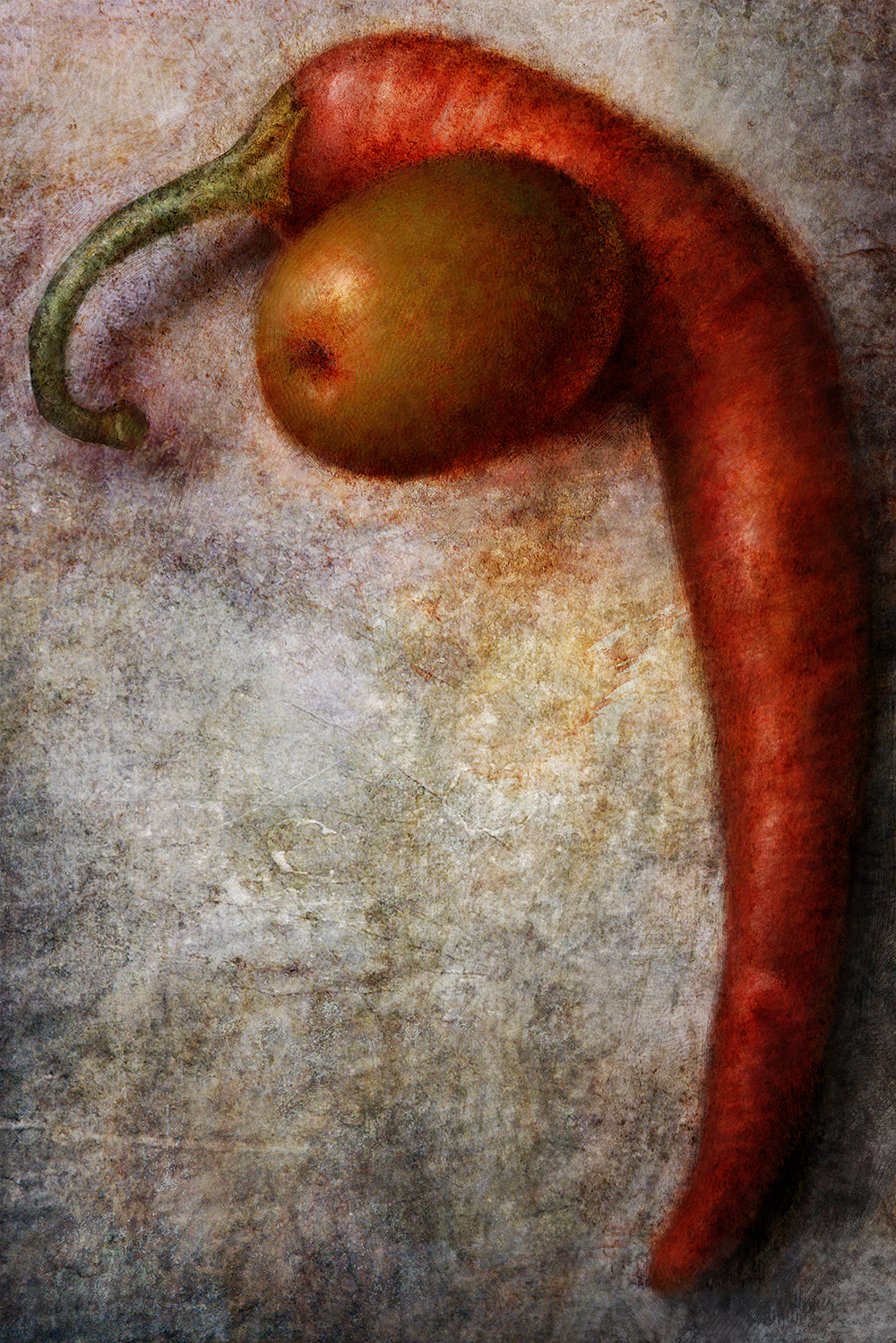
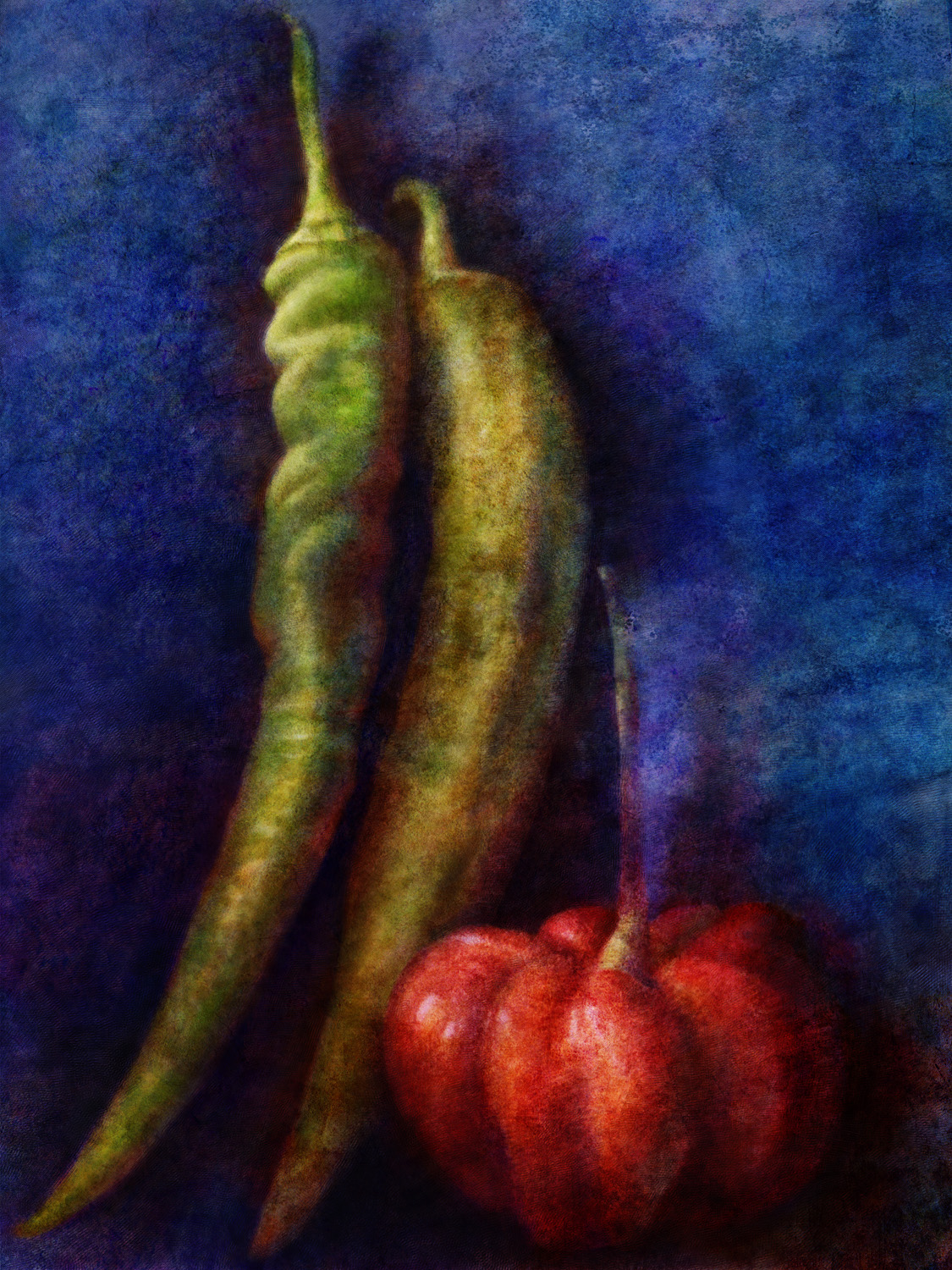
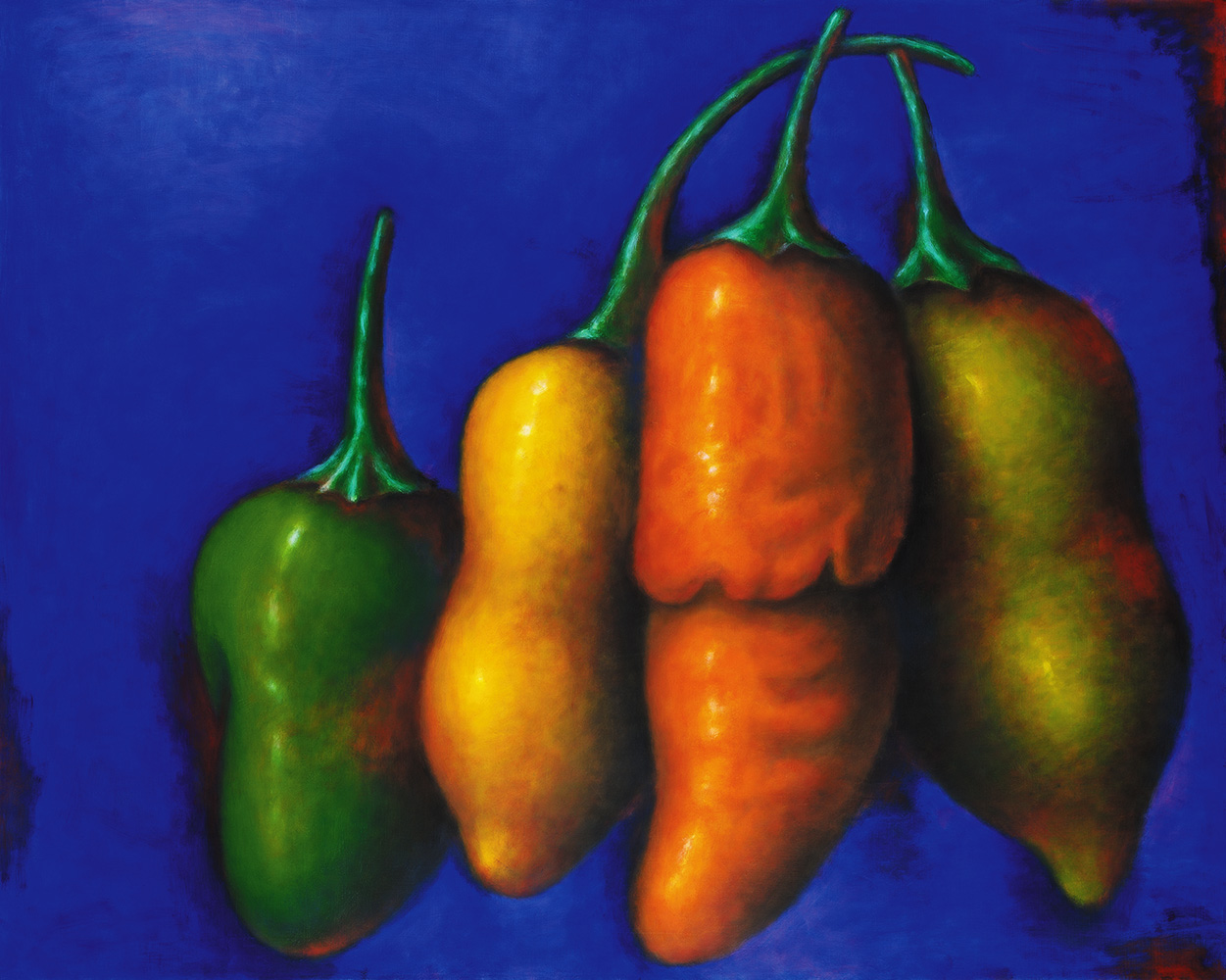
Zev Robinson is a Canadian-British artist and filmmaker currently living in Valencia in Spain. After finishing his B.F.A. in Montreal in 1983, he completed his M.F.A. in New York and subsequently moved to Italy and traveled around Europe, before settling in Spain in 1991. In Spain, he married Albertina Torres. The couple moved to London in 1995, where this series of chile peppers was created.

While in London, he also started working on videos and digital art projects as part of Art After Science, formed with Adrian Marshall, creating a variety of works that have been exhibited widely, including at ARCO in Madrid, the Venice Video Art Fair, and the LOOP Video Fair in Barcelona.

Robinson returned with his family to Spain in 2005, where his video work led to a series of documentaries on wine, food and rural life in Spain. That left him with little time to paint, but in 2012 he showed a series of newly created works of Amphorae at the Dinastia Vivanco Museum. Since then, he has restarted a series of images based on film noir and pulp fiction covers.

Never miss a post
Name: 
Your email address:*
Please enter all required fields
Correct invalid entries

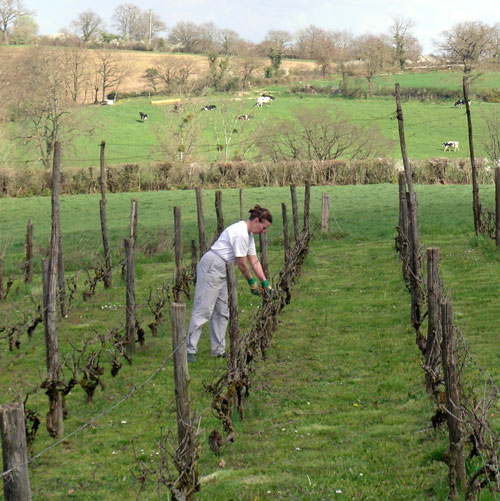
La Vendange: The Grape Harvest on a Small Country Estate in France

Published by Monday, September 24, 2012 Permalink 0

by Vendange

When we lived in the white wine we had vines. We were outrageously excited about the prospect of making our own wine. Of course, we were sure it would be wonderful. I mean, we had been drinking it for years, we should know how to do it, right?

Continue Reading…

Never miss a post
Name: 
Your email address:*
Please enter all required fields
Correct invalid entries

Rosa’s Musings: The Warrior Cook and Questch Plum Eton Mess

Published by Friday, September 21, 2012 Permalink 0


A cook, when I dine, seems to me a divine being, who from the depths of his kitchen rules the human race. One considers him as a minister of heaven, because his kitchen is a temple, in which his ovens are the altar.Marc Antoine Désaugiers

by Rosa Mayland

Even though being betrayed by your camera or computer, denied access to your blog platform, or lacking all inspiration is bad enough, having your cooker die on you is probably one of the worst things that any food blogger and pastry lover can experience, as it leaves you feeling completely lost and powerless. Without this essential home appliance (my personal favorite together with my KA), your major working tool, you are absolutely nothing! Well, that’s exactly what happened to me not long ago and it was one terrible and stressful nightmare, especially wince we were quasi-penniless and could not afford to buy a replacement straight away.

Continue Reading…

Never miss a post
Name: 
Your email address:*
Please enter all required fields
Correct invalid entries

Switzerland: Tasting Week (La Semaine du Goût) Program

Published by Thursday, September 20, 2012 Permalink 0

by Jonell Galloway

Click to see the Tasting Week program for the entire country. Tasting week runs from 13 to 23 September 2012.

This year many of the events are sponsored by Savoring a week of ‘slow food’ across the country.


Never miss a post
Name: 
Your email address:*
Please enter all required fields
Correct invalid entries

MarketDay: Swiss Farmers Market, Late August

Published by Tuesday, September 4, 2012 Permalink 0

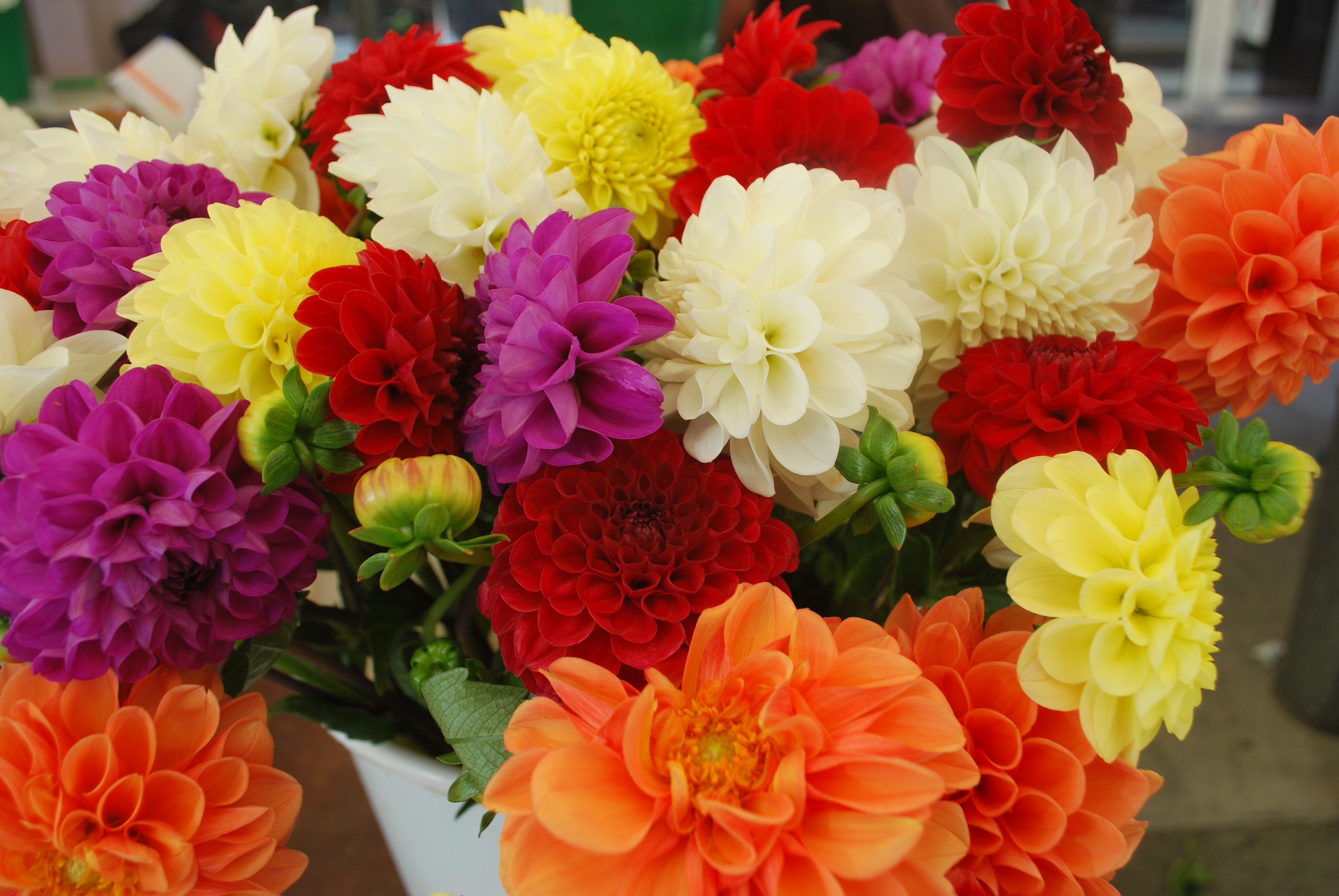
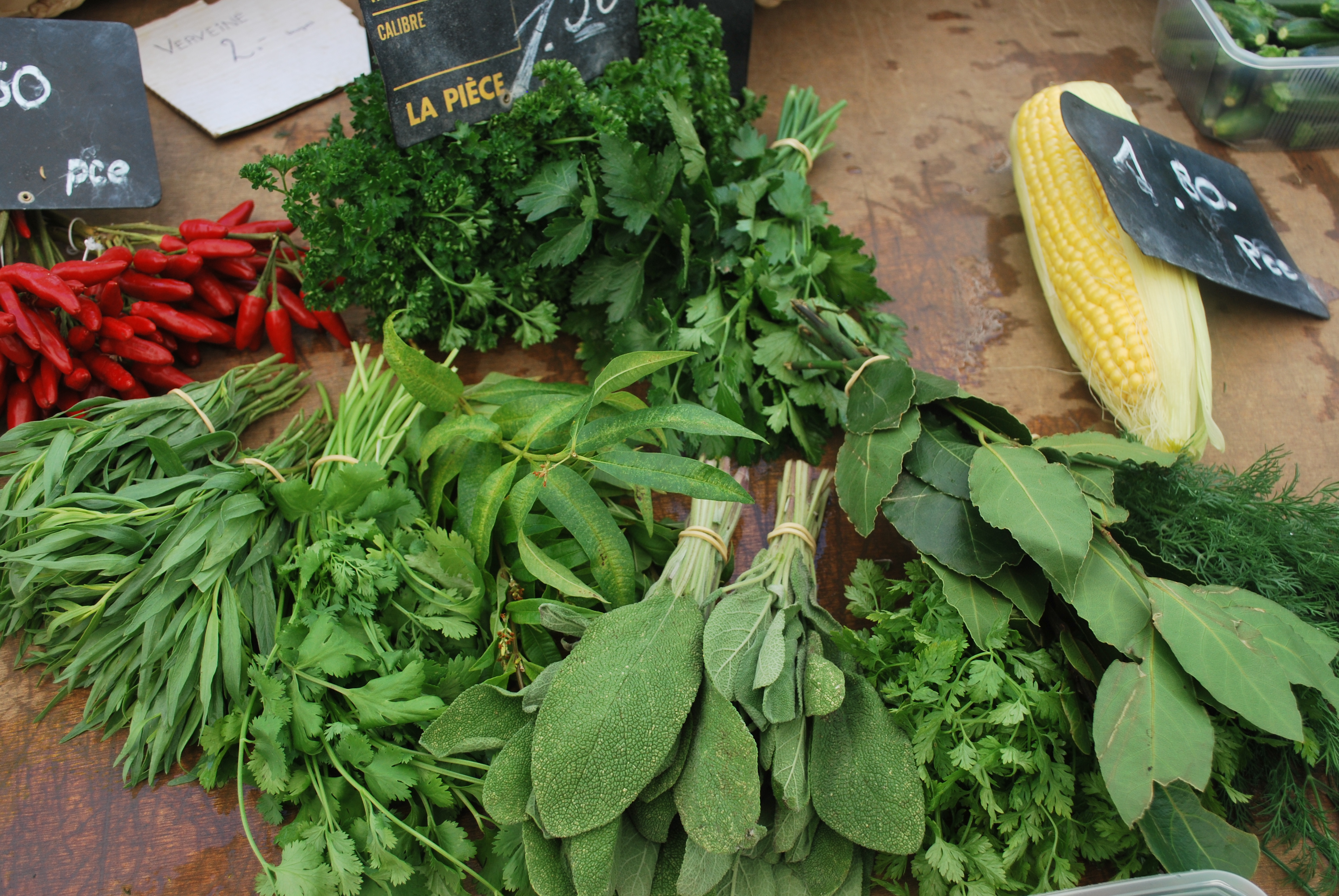
Take a walk through the late August farmers market in Switzerland with Jonell Galloway.

Never miss a post
Name: 
Your email address:*
Please enter all required fields
Correct invalid entries

Tasting Australia: The Internationally Recognised Aussie Food Fest

Published by Tuesday, July 3, 2012 Permalink 0

by Amanda McInerney

The stands have been taken down from the riverbanks in Elder Park; the visiting journalists and food writers have packed up their loot bags and flown home; PR bods are splinting their Tweeting/texting fingers, and exhausted, hardworking chefs, waiters, dishies and sommeliers all around Adelaide are breathing a huge sigh of relief as they slip into a restorative beverage or two. The Battle of the Chefs has been fought and won; celebrity dinners have been cooked and eaten; the master classes, kids cooking classes and celebrity demonstrations have been enjoyed, pearls of culinary literary wisdom have been dropped and retrieved at the Word of Mouth sessions, and the food-related exhibitions, workshops and competitions are done. The massive 8-day food and wine binge that is Tasting Australia is over for another two years.

A product of the fertile imagination of Western Australian chef and television personality Ian Parmenter, Tasting Australia has developed and grown since its very successful beginnings in 1997 to become one of the nation’s most influential and best attended culinary events. This year’s event has built upon this reputation and not only attracted more than 40,000 happy eaters to the two-day “Bank SA Feast of the Senses,” where the public can pick and choose food and wine from some of the state’s very best producers and chefs, but the informed eye would also have been able to spot flocks of interstate and international chefs, journalists and food writers. More than 150 high-profile gastronomic guests were being carefully herded about the state in manageable groups (not so simple a task as it might sound) as producers from Port Lincoln in the west, all the way down to the Coonawarra in the south-east took the opportunity to show off the culinary cachet for which this state has become noted.


Tasting Australia attracts an exceptional amount of international interest and food professionals from all areas of the culinary sphere, as well as journalists from all corners of the globe, who congregate in Adelaide for this time period.  I helped Mark Gleeson of the Providore conduct the very first formal event of Tasting Australia – a (very) quick walking tour of our prime food gem, Adelaide Central Market, followed by a cheese workshop conducted by Valerie Henbest of the Smelly Cheese Shop – with a group which included, among others, journalists from Singapore, Hong Kong, Italy and Sweden, author Matthew Fort and chef Mark Hix from London and Dublin-based food, wine and restaurant critic Ernie Whalley.  They were just one part of the international contingent which was here expressly to get to know South Australian and Australian food.

The kind of exposure this generates for us simply cannot be underestimated and I have heard it stated that this festival has generated in excess of $100 million worth of editorial PR for South Australia and Australia. The overseas guests who enjoy our hospitality are ushered around to some of our most talented and respected food producers – both in and around Adelaide and regionally. They get the chance to meet and engage with nationally and internationally recognised brands like Maggie Beer and Jacobs Creek, but also many of the smaller producers and food/wine businesses whose goods merit equal attention, but whose advertising budgets are more modest and thus are less well known. There are trips out to the oyster leases in the pristine waters off the Eyre Peninsula, visits to the free-range home of Minribbie Farm Berkshire pork and (no doubt happy) time spent at South Australia’s first boutique distillery on beautiful Kangaroo Island – all aimed at showing off what we enjoy here in the hopes it will be shared with the rest of the world.

Photo (C) Amanda McInenry, for The Rambling Epicure, Switzerland. Editor, Jonell Galloway.


The dust is settling on this year’s celebration and within a surprisingly short amount of time the planning for the next festival will begin.  Under fresh, new leadership things will change and the celebration may take on a different look, as it should after 16 years of much the same sort of format.  What won’t change is the remarkable wealth of great food and wine products which we enjoy in South Australia, and the enormous dedication, expertise and passion of the people who are behind the production and promotion of it. It is our local skills which make Tasting Australia the tremendous success it is today, so – South Australia, take a bow!

Never miss a post
Name: 
Your email address:*
Please enter all required fields
Correct invalid entries

Geneva, Switzerland: How to find food producers near you

Published by Tuesday, February 28, 2012 Permalink 0

The agricultural promotion office for the canton of Geneva (OPAGE) lets you fill out this A variety of punpkins at the Portland Farmers ..., telling them what you want, where, the producer’s or company’s name, etc. so you can find just about any local agricultural product you want. It makes it so easy!

A variety of punpkins at the Portland Farmers ...


Never miss a post
Name: 
Your email address:*
Please enter all required fields
Correct invalid entries

1.3 kg black truffle for sale in Perigord, France

Published by Thursday, February 23, 2012 Permalink 0

The Daily Mail in the U.K. says what is possibly the world’s biggest black truffle went on sale in the Sarlat truffle market last week.

Black truffles are the most sought-after and expensive mushrooms in existence, and are said to be an aphrodisiac, due to a “compound within the truffle similar to androstenol, the sex pheromone of boar saliva, to which the sow is keenly attracted.”

Click here to read more.

Truffle 3


Continue Reading…

Never miss a post
Name: 
Your email address:*
Please enter all required fields
Correct invalid entries

UA-21892701-1