It’s built in a marsh — thus the name, Château du Marais — and the water you see in front is the overflow from what you call the plan d’eau in French, meaning literally “water plane,” which is basically a mirror lake. As soon as there is sun, you can see a silvery reflection of the house, and sometimes the clouds, in the water. I lived in a bit of this house for 18 years. Because the little lake and the house are almost at the same level for the sake of aesthetics, and because the house is built on filled-in marsh, it takes very little to flood it. We always had our rubber boots ready and many the time I had to walk through knee-deep water and across the courtyard to get out. We’d park our cars on higher ground and wade to them if we truly had to go somewhere outside our little world. It was like being a princess locked inside a castle, except I wasn’t a princess. Maybe that’s why I sometimes feel peas under my mattress.
My adopted hometown of Chartres is in the Beauce region, the breadbasket of France. Large, flat wheat fields surround the single hill of Chartres, topped with the most beautiful Gothic Cathedral in the world. You can see the cathedral for miles when driving across the fields, and a quite magical view it is, its spires dominating the flat farmlands. No wonder people have been making pilgrimages here for at least 5,000 years.
Chartrains, as we call the people from here, come from the land. Everyone in the region has a farm or has family who owns one, and because of the abundance of grains of every kind — wheat, barley, corn, rye and many more — grains are an integral part of the local diet.
This traditional recipe is referred to as “bread from the mill,” but no one knows the exact origin of that name. In the past, the Beaucerons (the inhabitants of the Beauce region), of Celtic and Druidic origins, ate this on the Jour des Morts, the day of the dead, which fell on November 2 after All Saint’s Day, when the living were said to communicate with the dead, when tombs and graves were said to open so that the world of the visible and invisible could intermingle for a short period.
Early in the morning of November 2, local bakers made pain aux morts, or “bread to the dead” (this could even be translated in a more ghoulish manner, “bread (made from) the dead”), out of flour and milk, for a traditional 10 a.m. breakfast before going to the cemetery.
In the nineteenth century, the church decided that All Saints Day sufficed and such pagan customs were more or less done away with. Beaucerons continue to eat this bread during the All Saints celebrations, however, calling it “bread from the mill” instead of “bread to the dead.”
I often serve this recipe with apéritif, but it can also make a vegetarian dinner, and can, of course, be eaten year round.
Recipe
Ingredients
6 pains au lait or 3-4″-long milk breads
6 cups milk
3 eggs
1 1/2 cups Swiss cheese or similar, grated
Cooking oil
Kitchen string
Instructions
Cut the bread in half lengthwise.
Use a spoon to scrape the crumbs out of the crust, taking care to leave the crust intact, and put the crumbs in a bowl.
Pour milk over crumbs and mix.
Add the eggs and the grated cheese and mix well.
Fill the crusts with the bread crumb mixture.
Use kitchen string to tie the bread halves together.
Heat cooking oil in a deep pan or fryer. When the oil starts to bubble, drop in the bread and cheese preparations.
Cook until golden brown.
Drain on paper towels and serve immediately while hot.
En Art, j’aime la simplicité ; de même, en cuisine. / In art, I like simplicity; the same goes for cuisine.–Erik Satie (Honfleur 1866-Paris 1925), in Cahiers d’un Mamifère.
Kentucky is far from Chartres, but not so far as one might think. Biscuits and cornbread were the bond that held us together in Kentucky; wheatfields and bread do the same in Chartres. We like white gravy; the Chartrains, as they’re called, like sauce. Isn’t white gravy a sauce, after all?
Growing up in Kentucky, I embraced the Slow Food concepts without ever knowing it. Wendell Berry was my breakfast, lunch and supper, after all. The French have never fully embraced the official Slow Food concept of Good, Clean and Fair, since they consider that French cuisine and agriculture already embrace these values and do not need an organization – especially an Italian association with an English name – to teach them about their own time-honored traditions. One might say that the French are arrogant and chauvinist, which I would never totally deny, but it is this very pride that has maintained a high level of quality in the world of artisanal food and agriculture.
I have lived in the Beauce region, the bread basket of France, for over 15 years. The hill of Chartres is surrounded by wheat and grain fields and when you go to the bakers, they actually mark the name of the millers who provided the grain for particular breads. It’s all rather magical for those who have a holistic view of the world. The Beauce is all about farming, in particular, wheat, grain and sugar beets, but also goat cheese, pork products, rabbits, beer, apples and apple cider products, pears, chickens, rapeseed, etc. My goal has been to find all the best producers and growers and support them in every way possible.
Becoming a chef in France requires a long commitment, both in terms of schooling and on-the-job training. The program is similar to that of a vocational school, but requires many years of on-the-job experience before one can be called “chef.”
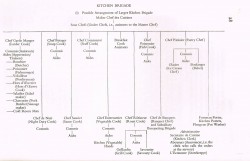
A typical French kitchen brigade looks like the diagram below. To become a chef, you basically have to work your way up from the bottom. Each level in the hierarchy may take a few years to master. It all looks rather daunting, but the French start young, around the age of 14, with chefs following what is referred to as a vocational track rather than a general high school.
French cuisine is much more than the haute cuisine inherited from the nobility. It is also the tasty, inexpensive cuisine that French families eat every day, called cuisine bourgeoise, or “bourgeois cuisine.”
We all learned in school that “bourgeois” was a social class. Originally, it was what we now call the “middle class,” as opposed to the nobility and the poor and working classes. The bourgeoisie, or middle class, grew rapidly in France after the French Revolution.
In terms of cooking, the bourgeois weren’t rich enough to use expensive ingredients and their cooking skills were not as highly developed as those of the aristocrats’ chefs, but they had sufficient means to entertain friends and family. This cuisine came to be known as cuisine bourgeoise, which today simply means family cooking, tasty but not pretentious, as opposed to the haute cuisine of the elite.
Etre le dindon de la farce. / To fall victim to dupery.
Une dinde. / A stupid, pretentious woman.
Anthelme Brillat-Savarin, perhaps France’s best-known gastronomic writer, said that the turkey was certainly one of the most beautiful gifts the New World had given to the Old. “…the fattest, and if not the most delicate, at least, the tastiest of all domesticated birds.” It’s not often that the New World gets such compliments from discerning French epicures.
Turkeys were originally called poules d’Inde, “Indian hens,” in France, because they were thought to have come from India, which they later learned was Mexico. The French were not the only ones to get the name wrong. In Hebrew a turkey is a tarnagol hodu, meaning literally “Indian chicken;” in Russian indiuk, Polish indyk and Yiddish indik.
There is some controversy over who brought turkeys to Europe. Columbus probably brought brought them back in the early sixteenth century, since records show that King Ferdinand had ordered that every ship to bring back ten turkeys before the Spanish explorer Cortés set out in 1519. In any case, by 1548, they were the rage in France. In 1549, Catherine de Medicis served 70 “Indian hens” and 7 “Indian roosters” at a banquet held in honor of the Bishop of Paris.
French aristocrats were accustomed to eating all sorts of feathered creatures, including chewy storks, herons, peacocks, swans, cranes and cormorants, so it wasn’t surprising that they fell in love with the less-chewy turkeys, and that in 1570, Charles IX and Elizabeth of Austria thought turkey noble enough to serve at their wedding feast.
By the seventeenth century, the French were raising turkeys as if they were their own and most cookbooks included turkey recipes. French chefs weren’t lacking in ideas: they made stews and ragouts; they larded, roasted and glazed it; they stuffed it and made it into soups and pâtés.
Marie-Antonin Carême preferred the wings, which he deboned, then stuffed with chicken and truffles. Alexander Dumas, in his Dictionary of Cuisine, included 27 recipes. Turkeys were well established in the Hexagon.
Christmas dinners usually meant lots of mouths to feed, so turkey, being the largest of the winged creatures available, eventually became the dish of choice for Christmas feasts. By the nineteenth century, it became customary to stuff the Christmas turkey with chestnuts, and the tradition continues today.
In France, the main Christmas meal is eaten on Christmas Eve. Every region in France approaches Christmas Eve meals differently, but that of Provence, known as Le Gros Souper in French and the Gros Soupa in the Provençal dialect, is perhaps the best known.
The table is set with three white tablecloths, one on top of the other, representing the Holy Trinity. Three candles light the table, representing past, present and future. The past is in memory of loved ones who are deceased; the present to express one’s loyalty to friends and family, and the future to express hope for children yet to be born. Three bowls of germinated wheat, planted on December 4th, St. Barbara’s Day, and decorated with red and yellow ribbons, are used as table decoration. Once again, the number three is symbolic of the Holy Trinity.
St. Barbara, a Middle Eastern Christian saint, was the beautiful and much sought after daughter of Dioscore, who locked her in a tower to keep her suitors away. Much to her pagan father’s chagrin, she managed to get baptized, inciting him to go after her with a sword. She managed to escape and hide under a cliff, but a shepherd saw her and informed on her. As a result, God punished him by turning his herd of sheep into grasshoppers. She was sent to prison, then forced to give up Christianity and marry a pagan. Refusing to renounce her God, she was tortured and her father finally slit her throat, so the heavens promptly sent down lightning and killed Dioscore in revenge. This miracle is recreated symbolically today by germinating and planting grains of wheat, and sometimes chickpeas.
Quand lou blad vèn bèn, tout vèn bèn ! or “when the wheat is doing well, everything is going well,” meaning that if it germinates, it will bring prosperity for the coming year. This tradition apparently dates back to the Romans. The direct connection between germination of the wheat and St. Barbara is not clear, nor how St. Barbara became a favorite saint in Provence.
Et pevent estre diz en francois gloutons et gourmans./ And can be said in French gluttons and gourmands.—Nicolas Oresme, fourteenth century
Les gourmands font leurs fosses avec leurs dents. / Gluttons dig their graves with their own teeth.–Henri Estienne, sixteenth century
Gourmandism is an impassioned, considered, and habitual preference for whatever pleases the taste. It is the enemy of overindulgence; any man who eats too much or grows drunk risks being expelled from the army of disciples.”–Jean-Antheleme Brillat-Savarin, The Physiology of Taste (1825)
The meaning of gourmand is now certainly closer to gourmet than it is to glutton, but our evidence shows clearly that gourmand and gourmet are still words with distinct meanings in the bulk of their use, and are likely to remain so.—Merriam-Webster’s Dictionary of English Usage, 1994
In English, there is confusion about the term gourmand. Technically, it means “one who is excessively fond of eating and drinking,” just like in French, but it is often used as a synonym for gourmet. Being a French speaker, I cringe every time I hear it used to mean “a connoisseur of food and drink.”
Yes, I’m a purist, and perhaps I’ve lived in France too long to find this acceptable, because being a gourmand has a pejorative connotation in French. It means someone who enjoys too much of a good thing and can’t quite control his appetites. It means “glutton”. It’s quite all right to be a gourmand of books or theatre, but not of food, as paradoxical as that may seem.
All major Western religions deem gluttony a sin. It is one of the Seven Cardinal Sins, with moderation being the virtue.
Gourmandizing means overeating or eatingimmodestly; it means eating like a refined pig or stuffing oneself with good food and drink.
Gourmand is extended to other sensual pursuits as well. You can have gourmandes lips; I’ll let you imagine the meaning of that. One can also be too gourmand about money, i.e. like in a little too much.
Then comes the question of whether gluttony includes pleasure, because gourmandise does, despite its negative connotation, contain an element of pleasure. Gourmands eat too much, but they do so with pleasure.
Gourmandise may be a sin in the eyes of religion, but thanks to Brillat-Savarin, probably France’s greatest gastronomic writer ever, it recovered its sense of finesse in his “meditations,” and he spent a good deal of time looking for evidence that it was a sin. He found none, he said. All the etymologists and theologians had gotten it wrong. He concluded that gourmandise is in reality a passionate, reasoned, regular preference for objects that please the taste buds. It is, he said, the enemy of excess and is only to be encouraged. That’s one writer’s opinion.
Some say the word gourmand probably comes from the Burgundian gorman, but that’s not clear. Gourmet is different, despite the fact that it may well have the same root, groumet, meaning “servant orvalet in charge of wines,” from the MiddleEnglishgrom, meaning boy orvalet (as in groom). Somehow along the way gourmand took on the meaning friand, often linked to glouton, meaning “greedy.” A gourmet is a person who cultivates a discriminating palate and knows how to appreciate both good food and wine. In French, its synonyms are gastronome, expert, connoisseur, or master. In English and used as an adjective, gourmet often means “fancy” food. It does not carry with it the connotation of excess or lack of self-control, either in French or in English.
It’s interesting to look at the origins of words, and they do change meaning over time, as we have seen, and when they are borrowed by other languages. Whether this is technically the case in English with regard to gourmet and gourmand is still questionable however, because one often sees the word gourmand used in lieu of gourmet.