What we’re reading at The Rambling Epicure

Published by Sunday, April 28, 2013 Permalink 0

Broccoli Spray, by Ilian Iliev ALL RIGHTS RESERVED (C)


Click here to catch up on your food-related reading for this week:

  • food art exhibit in Valencia, Spain
  • 3 books more filling than food
  • is French cuisine a victim of its own success?
  • Monsanto doesn’t want you to know what you’re eating
  • can eating healthy actually save you money

and much more.


Never miss a post
Name: 
Your email address:*
Please enter all required fields
Correct invalid entries

The Big Apple on a Budget: Mas (la grillade), a Restaurant Review

Published by Monday, March 18, 2013 Permalink 0

by Leonor White

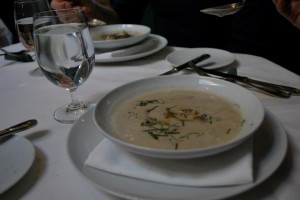
I recently discovered a farm-to-table restaurant in the West Village. I was looking for an upscale lunch at an affordable price to dine with my family. Mas (la grillade) is the sister restaurant to Mas (farmhouse), but, as the name indicates, focuses on grilled meats.

During lunch hours, a seasonal menu of locally grown foods cooked solely over wood fires of oak, apple and other hardwoods is served. This menu is comprised of three courses: appetizer, main course and desert, and it all comes at a very reasonable price, $27.  Lunch à la carte is also available, but I would recommend opting for the menu, as you get a chance to experience Chef Galen Zamarra’s seasonal favorites. The restaurant is also open for dinner, and just as for lunch, there is a prix fixe menu (but for a higher price, $68), as well as an à la carte dining.

We went for lunch on a Saturday, and it did not disappoint. The restaurant is simply but tastefully decorated, making a bold statement with regards to its farm-to-table concept. As the menus arrived, we all had our eyes fixed on the first item in the menu: “Grilled Pear and Sunchoke Soup with Mint, Black Truffle and Hen of the Woods Mushrooms.” Despite the fact that there were other appetizers to choose from, such as the “Grilled Trumpet Royale Mushrooms with a Salad of Mizuna, Grilled Onion Vinaigrette, and Croutons,” we all thought that the soup sounded divine, and it was indeed. The grilled pear and sunchoke flavors made for a distinctive taste; the soup was sprinkled with mint and black truffles and topped with mushroom croutons.

Continue Reading…

Never miss a post
Name: 
Your email address:*
Please enter all required fields
Correct invalid entries

Food Art: The Angel who Loves Wine, painting by Allison Strine

Published by Thursday, February 21, 2013 Permalink 0


Allison Strine is a former television editor turned painter. Her aim is to create art that gives pleasure to others. Read more about her work here.


Never miss a post
Name: 
Your email address:*
Please enter all required fields
Correct invalid entries

The Art of Tasting Wine with James Flewellen: The Waipara Wine Region

Published by Tuesday, February 19, 2013 Permalink 0

The Art of Tasting Wine with James Flewellen: The Waipara Wine Region

by James Flewellen

About 45 minutes drive north of my hometown of Christchurch, NZ, lies the North Canterbury wine region of the Waipara Valley. The valley is nestled between the Teviotdale Hills, which shelter the region from the cool Pacific, and the foothills of the Southern Alps. The everchanging interplay of light and shadow on these surrounding hills and the immense Cantabrian skies make this one of my favourite places to visit.

Hills in the Waipara wine region

New Zealand’s wine industry is still very young (about 30 years) by global standards, yet the Waipara region has been recognised for less than half of that. While there are some well-established names in the area (Pegasus Bay, for instance), many of the wineries have only been around a decade or so, and a whole host have sprung up in the last two or three years. I’ve long been impressed with the quality of wine issuing from Waipara’s small-scale, boutique wineries. A recent visit over the New Year reconfirmed for me why this spectacular region is receiving a surge of interest and that the future looks stellar for quality wine production.

Inasmuch as such a young region can be ‘known’ for a particular style of wine, Waipara is fast becoming a home to Riesling in New Zealand, an alternative base for Pinot Noir, and a lighter, less pungent style of Sauvignon Blanc. Chardonnay is also planted and there are small plantings of other reds including Syrah, Cabernet Sauvignon and Malbec.

Unfortunately, my visit coincided with a public holiday, so I was unable to see many of the region’s top wineries on this trip; however, we had a lovely tasting and lunch at well-established winery Waipara Springs, newcomer Black Estate wines opened their doors up especially for us, and a trip to a family friend’s farm at Limestone Hills resulted in a tasting of their very small-scale (and delicious) Syrah and seeing a champion truffle-sniffing dog in action!

Waipara Springs

Waipara Springs is one of the more established wineries in the region. They have a well-equipped tasting room and a charming garden restaurant serving delicious food designed to match with their own wines. Waipara Springs produces a wide variety of styles. I was most impressed with their 2012 Sauvignon Blanc, which was very smartly-made, melding fresh gooseberry and passion fruit flavours with a high-acid, dry palate and a long, lemony finish.

Their ‘Premo’ series wines all showed great character and were a significant step up in quality from the house wines. The Premo Riesling, 2008, showed toffee notes of bottle age, zesty lime fruit, and was medium-sweet. Quite a full, luscious  body for a lowish alcohol wine and a refreshing tartness to the finish. The Premo Chardonnay, 2011, I found to be a rather light, elegant wine. Perhaps not one for those who like their Chardonnays to be bold and assertive, but a very pleasing wine nonetheless. The Premo Pinot Noir, 2010, seemed to me to have a bit much oak on the nose; the wine is aged in French oak for about 15 months, 20% of the barrels are new wood. But this is something that will resolve with time. Otherwise, the wine showed lovely concentration of dark plum fruit on the nose, an appealing sour cherry palate with green, herbal notes, crisp acidity and finely-etched tannins.

You can find a list of their overseas distributors here.

image

A delicious light lunch at Waipara Springs

Black Estate

While the Black Estate winery and cellar door is reasonably new, the site was planted back in 1993 with Chardonnay and Pinot Noir. The purchase by the Naish family in 2007 has seen the estate extend its plantings, with a constant eye on terroir and what the soil and mesoclimate bring to the wine. Their first Riesling release was in 2008, and I tried their 2011 incarnation. A beautiful nose with lime blossom, cream, mint leaf and sage was followed up by a rather intense lime sorbet palate. Crisp acidity was balanced nicely by the off-dry sweetness; medium alcohol (11%) and a medium length, but very pleasant finish.

Interestingly, the winery releases two different Chardonnays and Pinot Noirs: Black Estate and Omihi Series. Each comes from separate plantings with artisanal winemaking techniques (such as foot treading, and avoiding pumping) designed to bring out the terroir character in each wine. I enjoyed all of the wines and it was fascinating to see the difference the vineyards made. The Omihi Series Chardonnay, 2011, was a lean, delicate and very well-balanced wine. I discerned lighter, floral notes, with apple, cream and some truffle hints on the nose. By contrast, the Black Estate Chardonnay, 2011, had more apricot and peach notes on the nose and a heavier, more rounded body.

The Omihi Series Pinot Noir, 2010, was very aromatic, with a bright slightly estery, raspberry note along with hints of mushroom. The palate began with this bright fruit character and evolved savoury, stemmy notes all the way through to a crunchy, firm yet quite finely-etched tannic finish. Delicious, though my one criticism was the finish came through a bit hot. The Black Estate Pinot Noir, 2010, had more boysenberry on the nose, was less estery, with appealingly Burgundian ‘cooked carrot’ and white pepper hints. The palate showed a riper entry than the Omihi, with less of a progression to savoury (at least at this stage in its evolution); however, a slightly fuller, ‘gutsier’ body I felt balanced the alcohol on the finish more.

Black Estate wines are imported to the UK by Lea & Sandeman.

Limestone Hills

A highlight of the day was seeing Rosie the truffle-snuffler unearth an enormous truffle at the Limestone Hills farm. Well, I thought it was enormous, though Gareth Renowden, our host, assured me it was probably only a about 200 grams and therefore just a ‘medium sized one’! Gareth also grows Pinot Noir and Syrah grapes for his own wine made in vanishingly small quantities. I tasted the 2011 Limestone Hills Syrah and found a very interesting complex nose: black plum and berry fruit with medicinal, peppery hints alongside lavender and manuka honey. The palate showed only a medium body – a far cry from the full-bodied Shiraz of much of Australia, and even lighter than many Northern Rhone examples. Green, herbal flavours came through on the palate with a rich concentration of spicy strawberry and peppery plum. The wine had moderate acid, well-integrated alcohol and the classic, ‘ragged’-textured tannin profile I associate with Syrah. Overall a fascinating and very palatable wine.

Rosie the champion truffle-snuffler unearths some black gold at Limestone Hills farm

Waipara certainly is a region to watch in the very near future. One of the risks with hyped-up new regions is that many people can flock to invest there, resulting in huge increases in quantity and a dramatic decrease in average quality. However, as Bob Campbell MW suggests in this article, the difficulty of securing reliable yields in Waipara means that viticulturists and winemakers really do need to focus on quality to bring about a return. Long may this continue!

Never miss a post
Name: 
Your email address:*
Please enter all required fields
Correct invalid entries

The Art of Tasting Wine with James Flewellen: Top 10 Wines of 2012

Published by Saturday, December 22, 2012 Permalink 0

by James Flewellen

recent post by my friend Tom Parker on his top wines of the last year inspired me to go through my notes to consider the same question. Wine tasting being the highly subjective and opinionated business that it is, it is nigh on impossible to narrow down a list of the best wines one has tasted in a year. Thus, I’ll go for the most enjoyable wines I can recall from the past 12 months to create my list of the top 10 wines of 2012.

Enjoyment of wine is predicated on many things other than the quality of the wine itself – the situation, the company, your frame of mind, for instance. And I’ve found that tasting great wines in a sterile, academic or commercial setting doesn’t really do justice to the mystic and sublime essence of a magical beverage. I’ve tried to take these factors into account in my list, as well as reflecting a range of styles and the locations I’ve visited throughout the year.

So, in no particular order:

Pewsey Vale vineyard, Eden Valley.

1. Pewsey Vale ‘The Contours’ Riesling 2006. Eden Valley, South Australia.

A beautiful wine from a beautiful place. ‘The Contours’ is made from the best fruit in one tiny sub-plot from the Pewsey Vale vineyard high above the Eden Valley floor. 2006 was the most recent release at the time. Lively lime,  blossom and tertiary notes developing. Refreshing and elegant.

2. Bollinger Grande Année 2002. Champagne, France.

I love rich champagne styles and Bollinger is always a sure performer for me in this regard. The superb 2002 vintage brings even more leanness and length to this wine. Still a baby in drinking terms but very hard to resist!

3. Brokenwood ‘The Graveyard’ Shiraz 2001. Hunter Valley, NSW, Australia.

Hunter Valley Shiraz is so unlike the jammy Barossan ‘fruit bombs’ that most outside of Sydney associate with Aussie Shiraz. It can be wonderfully complex, earthy and Hermitage-esque. ‘The Graveyard’ is one of the best, and it was a rare privilege to taste such a great wine at an age it deserved to be drunk.

4. Langmeil ‘The Freedom 1843’ Shiraz 2009. Barossa, South Australia.

Tiny amounts of this wine are made from one of the oldest plots of vines remaining in the world. 1843 refers to the year of planting. This wine is nothing like any Barossa Shiraz I’ve ever tasted. Incredibly concentrated and animally. Far too young at three years old, but an amazing wine to experience nonetheless.

Ancient Shiraz vine in Langmeil's 1843 Freedom vineyard.

5. Cornas, Les Grandes Terrasses, Paul Jaboulet Aîné, 2001, Northern Rhône, France.

Rounding out a trio of Shiraz/Syrah: I showed this wine at a recent tasting in Oxford and was mightily impressed by its length, complexity and great value for money. Drinking very well now.

6. Moss Wood Cabernet Sauvignon Reserve 2010 (barrel sample). Margaret River, Western Australia.

The most enjoyable barrel sample I’ve ever tasted. The wine had been blended from the individually-aged parcels and was into its second round of oaking. Incredibly taut, balanced and complex. Brimming with potential.

7. Phélan Ségur 1996. St Estèphe, Bordeaux, France.

During a trip to Bordeaux over the summer, Phélan stood out for their hospitality, their obvious attention to detail in the winery, and their delicious wines. We were so impressed that a friend hosted a mini-vertical of Phélan later in the year. The ’96 was the most mature, complex and enjoyable of these, although many of the other vintages will get there in time.

With David Ling at Hugel following a portfolio tasting.

8. Hugel Pinot Gris Sélection de Grains Nobles 1976. Alsace, France.

One of the most astonishing dessert wines I’ve ever had. Pulled completely out of the bag during a visit to the charming Hugel property in Riquewihr. Endless length and complexity and a beautiful balance between sweetness, acidity and the perceived dryness all great dessert wines get with age.

9. Pirinoa Road Reserve Pinot Noir 2008. Martinborough, New Zealand.

A brilliant pretender to the Burgundian crown of Pinot supremacy. Great balance between lively red fruit, floral overtones and meaty depths. Still young but starting to develop delicious tertiary character.

10. Marie-Thèrese Chappaz Grain d’Or 2010. Valais, Switzerland.

A fascinating and unusual wine. Marie-Thèrese Chappaz makes extraordinary wines from her vantage point in some of the world’s steepest vineyards overlooking the Rhône River in Switzerland. This wine is mostly Marsanne, from gnarly 90-year-old vines (with a good claim to being the oldest in Switzerland), and spends 18 months in barrel. Still too young, but it’s so hard to get your hands on a mature example of these wines — they are all sold in person every year in May at the winery!

Grain d'Or at the Chappaz vineyard in Valais.

Commended

Jansz Traditional Method Sparkling. Tasmania, Australia. When my budget won’t extend to champagne or English Sparkling, Jansz is my delicious, great value fallback option.

Three Choirs Midsummer Hill, 2011. Gloucestershire, England. Brilliant value, light, fruity English offering.

Macrocarpa Pinot Gris, 2011. Marlborough, New Zealand. Lovely single vineyard expression of Pinot Gris firmly in the Alsatian mould.

The Lane Chardonnay 2009. Adelaide Hills, South Australia. Delicious Chardonnay with judicious and balanced use of oak. Went with a delicious lunch at the winery.

McGuigan Semillon Bin 9000 1997. Hunter Valley, NSW, Australia. Hunter Valley Semillon is certainly one of Australia’s great gifts to the world of wine. Lovely to taste one with significant bottle age to bring out the subtle tarragon and nutty notes.

Duas Pedras 2009. Alentejo, Portugal. Touriga Nacional blended with Syrah, this is a powerful, rewarding wine that needs decanting in advance and has become one of my staple reds.

I hope you all have a wonderful Christmas and holiday season with plenty of good cheer and fine bottles. I’m not yet sure what I’ll be drinking on Christmas Day, but I have a feeling I’ll stick to my favourites: something French, something Kiwi, something sparkling, something Pinot…

__________________

James Flewellen is The Rambling Epicure wine columnist. James is a biophysicist at the University of Oxford. Originally from New Zealand, the huge range of wine James discovered in Europe spurred his interest in all things vinous. He became involved in the University’s Blind Wine Tasting Society and has recently completed a two-year term as its President. During this time he represented the University in a number of domestic and international wine tasting competitions, winning several awards. He is currently completing the WSET Diploma in Wine and Spirits. James has a passion for wine communication and education and runs the Oxford Wine Blog and the Oxford Wine Academy.

Never miss a post
Name: 
Your email address:*
Please enter all required fields
Correct invalid entries

What to Eat in Switzerland: A Geneva Christmas: Longeole Sausage

Published by Friday, December 21, 2012 Permalink 0

by Jonell Galloway

From the archives

Christmas traditions in Switzerland

One should never think that everybody in Switzerland eats the same thing for Christmas dinner. With four languages and a multitude of “mini-cultures” tucked away its various mountain niches, and with a huge international population, Switzerland may well have more Christmas menus than any other country in the world.

In the French-speaking part of Switzerland, Geneva’s traditions are quite apart from the Vaud, for example, due to the late date Geneva finally decided to become part of Switzerland. Geneva traditions are often more influenced by their Savoyard and French neighbors, since they share about 100 km of border with them and only 5 km with canton Vaud.

What’s so special about a Longeole?

Many Genevois eat a sausage specific to Geneva called longeole. Every region and many villages have their own sausage recipes, but the longeole is quite apart from the others for several reasons.


Longeole sausage and potatoes cooked in
white wine, a Geneva Christmas specialty.


For one thing, it contains not only ground pork but also ground pork rind. This keeps it from drying out and gives it fuller flavor. The other, and quite major, difference is that that it is speckled with fennel seeds, probably a Savoyard influence.

Any good local butcher makes his own longeole. If not, it is advisable to find one who does. It’s Christmas, so you want to be certain it’s of good quality.

Cooking Longeole

Longeole is easy to cook, but you must allow yourself enough time. It takes longer to cook than other cooking sausages because of the addition of the pork rind, which is harder than simple ground pork.

Use a soup pot tall enough to hold your sausage. Fill with water and bring water to boil. Add a touch of salt. Drop in sausage, lower heat, and let it simmer for 2 hours 45 minutes or 3 hours. The water should be just on the verge of boiling during the whole cooking time. It is then ready to slice and eat.

Some cooks prick the Longeole with a fork before cooking, but purist that I am, I think you risk losing some of the juices, which would take away from the flavor and make the sausage less succulent in the mouth. It is also important not to let it boil, because this too will dry it out.

What do Genevois eat with Longeole?

Like everywhere, different families have different traditions, different favorites, but the most common accompaniments are potatoes cooked in white wine, lentil stew and cardoon gratin, all Geneva specialties as well.

Continue Reading…

Never miss a post
Name: 
Your email address:*
Please enter all required fields
Correct invalid entries

My Favorite Hanukkah Foods: Grandma’s Latke Recipe

Published by Saturday, December 8, 2012 Permalink 0

by Warren Bobrow

From the archives

Hanukkah recipes are passed down from generation to generation. There are hundreds of recipes floating around on the Internet, but I thought it best to consult a friend with trained taste buds. Here is what Warren Bobrow has to say.–Jonell Galloway, Editor

My Favorite Hanukkah Foods

Of all the holiday foods I look forward to, there are two dishes that clearly connect my stomach to the past. The first is a rousing bowl of matzo ball soup. The other, specifically a Hanukkah dish, is a plate of crispy potato latkes, cooked in a heavy cast iron pan.

Ur-Bubby’s Latkes

I forewarn you. This is a Jewish story, so it is repetitive and sometimes fahklumpt (a confused story, for those who are not in the know), told by a kvetch (a complainer) who secretly loves life and food and words and work, and tells a story full of fond memories.

My great-grandmother Yetta made excellent latkes. During these eight days of Hanukkah (eight chances to get it right . . . to be exact), we celebrate the past by reliving these flavors and the stories that go with them each time we bite into a steaming morsel of grated potato, egg, onion and a bit of vegetable oil, made straight from her recipe.

Generations of cooks have grated potatoes for latkes in celebration of Hanukkah. You will not be the first or the last. And every family has their own special recipe, their own special stories.

Bubby Yetta was particularly interested in not scraping her knuckles. Even so, she used to say that if you don’t catch your knuckle on the potato grater, the latkes couldn’t possibly taste good. Something about the physical act of grating potatoes already connects me to the old days when Bubby made the latkes every evening during Hanukkah.

Onions also resonate in my memory:  the tears that ran down her cheeks as she grated the onions were not tears of joy. We heard the same kvetching every year, and carry on as we make our own history.

Every day of Hanukkah, Ur-Bubby Yetta would scrape and grate until the job was done. Much hushed conversation would follow. Were the latkes going to be good?  If not, what would we do, there was no place in those days to buy frozen latkes in the supermarket!

And with each potato and onion grated, each tear fallen, each latke fried, another memory was made. Years of latke conversation would follow . . . How about the ones we made twenty years ago? Did potatoes taste differently then, or was it a specific taste that stuck in our memories?

So careful with the grater, and accept that you’ll invariably catch your knuckle at least once, and that you may well have the battle scars to prove that you made them from scratch. And stories to tell.

Recipe

Continue Reading…

Never miss a post
Name: 
Your email address:*
Please enter all required fields
Correct invalid entries

The Art of Tasting Wine with James Flewellen: Wine Tasting in a Nutshell

Published by Tuesday, November 27, 2012 Permalink 0

by James Flewellen 


Over the last few posts I’ve covered various aspects of wine tasting in some detail. We’ve looked at the appearance of wine, the aromas we find in white and red wines, the structure of the wine on the palate and how to begin to assess the quality of the wine. This post summarises these ideas in a concise ‘checklist’, which I hope you find a useful prompt as you explore new tastes and new wines.

Step 1: Appearance

What is the colour of the wine? Can you see through it? Tilt the glass and examine the wine against a white background. Is there a change in colour, or ‘gradient’ along the wine?

Step 2: Nose

Tempranillo varietal wine bottle and glass, sh...

Tempranillo varietal wine bottle and glass, showing colour


The nose is the aroma of the wine. Is it powerful or subtle? Complex or easy to describe? Does the aroma change after swirling the wine? Does it evolve over time as the wine aerates or warms up? What can you smell? Is the wine primarily a fruity wine? What sort of fruits, and are they fresh, cooked or dried? Perhaps there are also other aromas: spices, grassy notes, herbs, wood, nuts, savoury/meaty aromas? Do any of these aromas remind you of other wines you’ve had before, or maybe indicate some age on the wine?

Step 3: Palate

We look for up to eight components of a wine when we taste. Firstly, the flavours: are these the same as the aromas you can smell? All wines have perceptible acidity and alcohol, which give structure to the wine. Alcohol is a major component of the body of a wine, which is how heavy or viscous the wine feels in the mouth. Red wines also have tannins, which provide additional structure. Some wines have perceptible residual sugar. The evidence of maturation in oak may also be present in many white and red styles. Finally, the finish is how long the flavours and sensations of the wine linger in your mouth after swallowing.

sundowner

Step 4: The Conclusion

Wine tasting is a very personal thing. No-one else can tell you whether you like or dislike a particular wine, or why you do. That said, there are certain features a professional wine taster looks for in assessing the quality of a wine (whether it suits their personal tastes or not). These include:

  • Balance: is the overall perception of the wine flavours and structure in harmony?
  • Length: do the flavours persist for a long time or do they fall flat and short?
  • Intensity: are the flavours and aromas intense or a bit weak? Perhaps they are too intense and overwhelming.
  • Complexity: is there a lot going on in the wine, or is it a bit simple and ‘one-dimensional’.

Other things to think about are: When would you drink this wine – by itself or would it be better with food? What sort of food? Is it good value for money? Is it ready to drink now? Or perhaps it will be better in a few years. It might seem  like a lot to take in but ultimately enjoying wine comes down to two things: Do you like this wine? and more importantly: Why is that?

__________________

James Flewellen is The Rambling Epicure wine columnist. James is a biophysicist at the University of Oxford. Originally from New Zealand, the huge range of wine James discovered in Europe spurred his interest in all things vinous. He became involved in the University’s Blind Wine Tasting Society and has recently completed a two-year term as its President. During this time he represented the University in a number of domestic and international wine tasting competitions, winning several awards. He is currently completing the WSET Diploma in Wine and Spirits. James has a passion for wine communication and education and runs the Oxford Wine Blog and the Oxford Wine Academy.

Never miss a post
Name: 
Your email address:*
Please enter all required fields
Correct invalid entries

What we’re reading: how food replaced art, history of coffee, heirloom apples and pie, 5 misconceptions about Port wine

Published by Friday, November 16, 2012 Permalink 0

by Jonell Galloway

Click here to keep up with the latest in world food and wine news.

Photo by Jonell Galloway ALL RIGHTS RESERVED (C)


Never miss a post
Name: 
Your email address:*
Please enter all required fields
Correct invalid entries

Food Art: Vineyards in B&W 3, food photography by Rosa Mayland

Published by Tuesday, November 6, 2012 Permalink 0


//

This is the third in a series of B&W vineyard photographs by Rosa Mayland, author of our column Rosa’s Musings. She also runs a popular food blog, RosasYummyYums.


Never miss a post
Name: 
Your email address:*
Please enter all required fields
Correct invalid entries

UA-21892701-1