The Art of Tasting Wine with James Flewellen: Wine Diamonds in White Wine

Published by Tuesday, May 28, 2013 Permalink 0

by James Flewellen

Wine Diamonds in White Wine

There are a number of legitimate reasons for sending a wine back at a restaurant: the wine could be oxidised, be contaminated by ‘cork taint’, suffer from excess volatile acidity, or have unpleasant Brettanomyces aromas. One common cause for complaint, however, is the presence of tartrate crystals or ‘wine diamonds’. Wine diamonds in white wine are a natural occurrence.

These are clear crystalline deposits found usually in certain white wines, especially Riesling. They are either potassium bitartrate (a.k.a. cream of tartar) or calcium tartrate — both found naturally in grapes, and which follow through to the final bottle in the winemaking process. They are certainly not tartaric acid, sugar, or bits of glass! These wine diamonds are perfectly natural and completely harmless. In the glass, they sink to the bottom and will barely impose on your enjoyment of the wine. Or, the wine can simply be decanted, with the crystals remaining in the bottle.

Wine diamonds in white wine left over from a glass of excellent Austrian Gruner Veltliner.

These crystals can be removed before bottling, however it is an involved process involving chilling the wine and passing it through filters. This is energetically expensive and the filtration process can remove flavour compounds that give the wine its complexity and character. Producers of fine wines prefer to mess with the wine as minimally as possible to deliver the best possible quality to the consumer.

So if you do see some wine diamonds in your wine, this is not a cause for complaint. Rather, be assured that the winemaker cares about his wine so much that he has chosen not to remove them to deliver the best possible wine to you!

__________________

James Flewellen is The Rambling Epicure wine columnist. James is a biophysicist at the University of Oxford. Originally from New Zealand, the huge range of wine James discovered in Europe spurred his interest in all things vinous. He became involved in the University’s Blind Wine Tasting Society and has recently completed a two-year term as its President. During this time he represented the University in a number of domestic and international wine tasting competitions, winning several awards. He is currently completing the WSET Diploma in Wine and Spirits. James has a passion for wine communication and education and runs the Oxford Wine Blog and wine tasting courses through the Oxford Wine Academy.


Never miss a post
Name: 
Your email address:*
Please enter all required fields
Correct invalid entries

The Art of Tasting Wine with James Flewellen: Top 10 Wines of 2012

Published by Saturday, December 22, 2012 Permalink 0

by James Flewellen

recent post by my friend Tom Parker on his top wines of the last year inspired me to go through my notes to consider the same question. Wine tasting being the highly subjective and opinionated business that it is, it is nigh on impossible to narrow down a list of the best wines one has tasted in a year. Thus, I’ll go for the most enjoyable wines I can recall from the past 12 months to create my list of the top 10 wines of 2012.

Enjoyment of wine is predicated on many things other than the quality of the wine itself – the situation, the company, your frame of mind, for instance. And I’ve found that tasting great wines in a sterile, academic or commercial setting doesn’t really do justice to the mystic and sublime essence of a magical beverage. I’ve tried to take these factors into account in my list, as well as reflecting a range of styles and the locations I’ve visited throughout the year.

So, in no particular order:

Pewsey Vale vineyard, Eden Valley.

1. Pewsey Vale ‘The Contours’ Riesling 2006. Eden Valley, South Australia.

A beautiful wine from a beautiful place. ‘The Contours’ is made from the best fruit in one tiny sub-plot from the Pewsey Vale vineyard high above the Eden Valley floor. 2006 was the most recent release at the time. Lively lime,  blossom and tertiary notes developing. Refreshing and elegant.

2. Bollinger Grande Année 2002. Champagne, France.

I love rich champagne styles and Bollinger is always a sure performer for me in this regard. The superb 2002 vintage brings even more leanness and length to this wine. Still a baby in drinking terms but very hard to resist!

3. Brokenwood ‘The Graveyard’ Shiraz 2001. Hunter Valley, NSW, Australia.

Hunter Valley Shiraz is so unlike the jammy Barossan ‘fruit bombs’ that most outside of Sydney associate with Aussie Shiraz. It can be wonderfully complex, earthy and Hermitage-esque. ‘The Graveyard’ is one of the best, and it was a rare privilege to taste such a great wine at an age it deserved to be drunk.

4. Langmeil ‘The Freedom 1843’ Shiraz 2009. Barossa, South Australia.

Tiny amounts of this wine are made from one of the oldest plots of vines remaining in the world. 1843 refers to the year of planting. This wine is nothing like any Barossa Shiraz I’ve ever tasted. Incredibly concentrated and animally. Far too young at three years old, but an amazing wine to experience nonetheless.

Ancient Shiraz vine in Langmeil's 1843 Freedom vineyard.

5. Cornas, Les Grandes Terrasses, Paul Jaboulet Aîné, 2001, Northern Rhône, France.

Rounding out a trio of Shiraz/Syrah: I showed this wine at a recent tasting in Oxford and was mightily impressed by its length, complexity and great value for money. Drinking very well now.

6. Moss Wood Cabernet Sauvignon Reserve 2010 (barrel sample). Margaret River, Western Australia.

The most enjoyable barrel sample I’ve ever tasted. The wine had been blended from the individually-aged parcels and was into its second round of oaking. Incredibly taut, balanced and complex. Brimming with potential.

7. Phélan Ségur 1996. St Estèphe, Bordeaux, France.

During a trip to Bordeaux over the summer, Phélan stood out for their hospitality, their obvious attention to detail in the winery, and their delicious wines. We were so impressed that a friend hosted a mini-vertical of Phélan later in the year. The ’96 was the most mature, complex and enjoyable of these, although many of the other vintages will get there in time.

With David Ling at Hugel following a portfolio tasting.

8. Hugel Pinot Gris Sélection de Grains Nobles 1976. Alsace, France.

One of the most astonishing dessert wines I’ve ever had. Pulled completely out of the bag during a visit to the charming Hugel property in Riquewihr. Endless length and complexity and a beautiful balance between sweetness, acidity and the perceived dryness all great dessert wines get with age.

9. Pirinoa Road Reserve Pinot Noir 2008. Martinborough, New Zealand.

A brilliant pretender to the Burgundian crown of Pinot supremacy. Great balance between lively red fruit, floral overtones and meaty depths. Still young but starting to develop delicious tertiary character.

10. Marie-Thèrese Chappaz Grain d’Or 2010. Valais, Switzerland.

A fascinating and unusual wine. Marie-Thèrese Chappaz makes extraordinary wines from her vantage point in some of the world’s steepest vineyards overlooking the Rhône River in Switzerland. This wine is mostly Marsanne, from gnarly 90-year-old vines (with a good claim to being the oldest in Switzerland), and spends 18 months in barrel. Still too young, but it’s so hard to get your hands on a mature example of these wines — they are all sold in person every year in May at the winery!

Grain d'Or at the Chappaz vineyard in Valais.

Commended

Jansz Traditional Method Sparkling. Tasmania, Australia. When my budget won’t extend to champagne or English Sparkling, Jansz is my delicious, great value fallback option.

Three Choirs Midsummer Hill, 2011. Gloucestershire, England. Brilliant value, light, fruity English offering.

Macrocarpa Pinot Gris, 2011. Marlborough, New Zealand. Lovely single vineyard expression of Pinot Gris firmly in the Alsatian mould.

The Lane Chardonnay 2009. Adelaide Hills, South Australia. Delicious Chardonnay with judicious and balanced use of oak. Went with a delicious lunch at the winery.

McGuigan Semillon Bin 9000 1997. Hunter Valley, NSW, Australia. Hunter Valley Semillon is certainly one of Australia’s great gifts to the world of wine. Lovely to taste one with significant bottle age to bring out the subtle tarragon and nutty notes.

Duas Pedras 2009. Alentejo, Portugal. Touriga Nacional blended with Syrah, this is a powerful, rewarding wine that needs decanting in advance and has become one of my staple reds.

I hope you all have a wonderful Christmas and holiday season with plenty of good cheer and fine bottles. I’m not yet sure what I’ll be drinking on Christmas Day, but I have a feeling I’ll stick to my favourites: something French, something Kiwi, something sparkling, something Pinot…

__________________

James Flewellen is The Rambling Epicure wine columnist. James is a biophysicist at the University of Oxford. Originally from New Zealand, the huge range of wine James discovered in Europe spurred his interest in all things vinous. He became involved in the University’s Blind Wine Tasting Society and has recently completed a two-year term as its President. During this time he represented the University in a number of domestic and international wine tasting competitions, winning several awards. He is currently completing the WSET Diploma in Wine and Spirits. James has a passion for wine communication and education and runs the Oxford Wine Blog and the Oxford Wine Academy.

Never miss a post
Name: 
Your email address:*
Please enter all required fields
Correct invalid entries

The Art of Tasting Wine with James Flewellen: Structure in Wine

Published by Tuesday, October 23, 2012 Permalink 0

by James Flewellen

When we taste a wine to assess it, we are looking for up to eight different components. Firstly, the flavours. In general terms, flavours will be similar to the aromas we can smell. Indeed, what we think of ‘taste’ is more influenced by smell sensors in the back of our nasal cavities than by our tastebuds! Things to consider about the flavours in wine include: Do they match with what we were expecting based on the aromas we can smell?  Is the balance between aroma and flavour harmonious, contrasting or conflicting? What sort of food would this wine go best with?

Peel me a grape


We now look out for the structure of the wine. This is a term used to describe components of the wine that carry the flavours and ‘support’ the wine. Alcohol is perhaps the most obvious aspect of structure in wine. Ethanol has the ability to hold more aroma and flavour compounds in solution than water, one reason alcoholic beverages are generally more complex than non-alcoholic ones. It is important that the alcohol is in balance with the rest of the wine and does not produce an unpleasant burn at the back of the throat (too much alcohol) nor results in a ‘thin’ or ‘weak’ wine (too little). Alcohol is a major component of what we call the body of the wine, which is how dense or viscous the liquid feels in the mouth. A robust, deep-coloured red wine is likely to be ‘full-bodied’, whereas a lower-alcohol cool-climate white wine will be ‘light-bodied’. There’s no right or wrong level of body, simply that the body of the wine is in harmony with other structural elements.

All wines have what we call residual sugar. This sugar remaining from the fermentation process, which converts the natural sugars in grape juice to ethanol. In most cases the level of residual sugar is so low that we cannot taste it. These wines are what we would call ‘dry’. In some cases the fermentation is deliberately stopped to leave a higher level of sugar in the final wine. These wines will be ‘off-dry’ or perhaps ‘medium-sweet’. Dessert wines can be incredibly sweet, and they are made from grapes with very high concentrations of sugar. Yeasts can only convert so much sugar into alcohol in fermentation (typically 13.5-14.5% abv); any sugar above this level remains unfermented resulting in a sweet wine. Sweet white wines are far more common than reds.

Acidity is a very important structural component in all wine. The natural fruit acids in the grapes are preserved through the fermentation process and provide the ‘backbone’ to wine. Acidity helps to carry to flavour of wine down the tongue and spread the sensation of the wine around the mouth. It has an important role in wine and food pairing as acid cuts through the fats and oils found in food, cleansing and refreshing the palate. This is why highly acidic wines go very well with creamy sauces and certain cheeses. Acidity is registered on the sides of the tongue; you can also assess it by noting your saliva response after swallowing.

An aspect of the winemaking process (a story for another time!) means that the quality of acidity in red wines is softer than that for whites. But red wines have another structural aspect: tannins. Tannins are chemicals found in the skin, stalks and pips of grapes. They interact with the inside skin surfaces of your mouth — gums, cheeks, tongue — to create a furry, puckering sensation. The same chemicals are found in tea. Unlike white wines, red wines are made in a way to preserve tannins. When you drink red wine with food, the tannin interacts with protein, neutralising it, and cleansing the palate in much the same way acidity does for white wines. This explains why red wine and red meat are such a popular pairing, and also why many red wines are not particularly pleasant on their own, yet amazing with food.

fruits sous la mer
It’s important to consider the effect of the wine’s structure on the food you might have with it.


One aspect of tasting wine that crosses over flavours and structures is the use of oak to mature the wine. Oak barrels lend a wine some of the oak flavours — nuts, butter, biscuit, spice, vanilla, coconut — which suit very well certain styles of wine. Ageing in oak barrels also allows a very slow air exchange to occur with the wine. This interaction changes the flavour and structure of the wine in other, more subtle, ways. The acidity becomes more mellow and the fruit character recedes slightly, allowing more complex flavours to develop.

Our final aspect of structure in a wine is the finish. This describes the effect of the wine after we swallow. The finish can be long, short, abrupt, disappointing, smooth, bitter, fruity, savoury, enjoyable, harmonious, complex, you name it. It is our final judgement on whether we like this wine and whether we’d buy another bottle.

Ultimately, the final arbiter of taste is you. No-one can tell you what you can taste and whether you like a wine or not. While there are accepted methods for assess the various structural elements I’ve described above, perception is a very personal thing. The trick to appreciating wine is to know why you like (or don’t like) a wine, not just that you do!


__________________

James Flewellen is The Rambling Epicure wine columnist. James is a biophysicist at the University of Oxford. Originally from New Zealand, the huge range of wine James discovered in Europe spurred his interest in all things vinous. He became involved in the University’s Blind Wine Tasting Society and has recently completed a two-year term as its President. During this time he represented the University in a number of domestic and international wine tasting competitions, winning several awards. He is currently completing the WSET Diploma in Wine and Spirits. James has a passion for wine communication and education and runs the Oxford Wine Blog and the Oxford Wine Academy.

Never miss a post
Name: 
Your email address:*
Please enter all required fields
Correct invalid entries

Switzerland: Take a Gourmet Walk in the Vineyards of Mont-sur-Rolle

Published by Monday, August 27, 2012 Permalink 0

by Jonell Galloway

Discover the various wine grape varieties and wines of Mont-sur-Rolle at the Caveau de Mont-sur-Rolle on September 1st, 2012. This is a great introductory wine course to Vaud wine.

The walk makes for a lovely daytime family outing. The 5-kilometer walk through the vineyards includes 9 stops at different grand cru wineries. Wine tastings are given by the actual wine maker, with explanations about the method and technique used. It is an easy walk, so children can even come along. The discovery tour starts every 15 minutes, from 10:30 a.m. to 2:00 p.m.


If you’d like to reserve a traditional Swiss dinner and make it a gourmet walk, you must reserve ahead. Adults 60 CHF, children 25 CHF.

Departure

From 10.30 a.m. in front of the Caveau des Vignerons
Address: Route du Coeur de la Côte, 1185 Mont-sur-Rolle

Festivities

From 12 p.m. at Domaine de Bellevue
Musical entertainment
Snacks and refreshments
Wine tasted on sale

 Contact Tania de Wateville by email at montbenay@gmail.com or by phone 41 (0)79 363 48 59.


Never miss a post
Name: 
Your email address:*
Please enter all required fields
Correct invalid entries

The Art of Tasting Wine with James Flewellen: What are we looking for (in a wine)?

Published by Thursday, August 9, 2012 Permalink 0

by James Flewellen

Before we get to tasting or even smelling it, the first of our senses to be engaged by a wine is our sight. Observing a wine is the first thing a wine judge or blind taster will do when assessing a new wine, but what exactly can the appearance of a wine tell us and what are we looking for?

Colour, ‘brightness’ or intensity, spritz, sediment, the difference between the core and the rim of the wine all give away subtle clues to the wine-making process, the possible age of the wine, and the grape variety.

Spritz is the term given to small bubbles of gas that may appear just under the surface of a wine immediately after pouring. They are usually carbon dioxide, which is a natural by-product of the fermentation process. Most of it is coaxed out of the wine during the winemaking through the racking process prior to bottling. However, in some wines — especially white wines fermented in airtight stainless steel tanks — some dissolved CO2 remains. In the vast majority of cases, spritz is absolutely fine and will dissipate after giving the wine a good swirl.

A glass of sparkling wine from the Limoux regi...

A glass of sparkling wine from the Limoux region of France.


Champagne and other sparkling wines, of course, make use of this by-product to obtain their characteristic sparkle. The appearance of bubbles in a sparkling wine actually has a lot more to do with the glass in which the wine is served than any inherent quality of the wine. Bubbles of CO2 nucleate at imperfections on the glass surface — deliberate or accidental scratches or microscopic bits of dirt or left-over detergent. A sparkling wine’s mousse — the French term for the fizz — is best assessed on the palate for quality purposes. That said, semi-sparkling wines will have a different character to the bubbles than a full-blown traditional method sparkling wine.

White Burgundy in the glass.


The colour of a wine is certainly the most obvious characteristic of a wine’s appearance. White wines have a colour spectrum from almost watery-white, through green, to straw, lemon, golden, and finally to coppery-orange for some dessert wines, although the vast majority fall under ‘lemon’ or ‘straw’ for me! Reds can be various shades of red (you’ll frequently hear the more poetic ‘ruby’) or purple, and rosé can go from a quite deep magenta through to a pale salmon-pink.

Both white and red wines converge to orange, or ‘brick’, as they age. This is due to the slow oxidation of the colour components in the wine. The best way to assess potential age of a wine is to tilt the wine in the glass over a white background and to look for any difference in colour between the ‘core’  of the wine (the greater body of liquid) and the ‘rim’ (the edge). This is a lot more obvious in aged red wines, where you’ll see a deeper ruby core progressing to a brick-orange at the rim. A wine that is thoroughly oxidised will be brown in colour — not necessarily a fault as some wines, Madeira for instance, are made in a deliberately oxidative style.

Wines of the same hue can vary in the depth, or opacity, of this colour. Thicker-skinned grapes imbue more colour to a wine than those with thinner skins — think of Malbec or Syrah versus Pinot Noir. Grapes tend to develop thicker skins in hotter and sunnier climates too, thus a Chilean Cabernet Sauvignon will typically be deeper in colour than one from Bordeaux. The winemaker also has a role to play, with different winemaking techniques allowing greater or lesser extraction of these colour compounds into the final wine during the maceration process. Winemaking explains most of the differences in depth of colour in rosé wines.

Thick skin wine grapes.


This idea is not limited to red wines, with Pinot Gris and Gewurztraminer two examples of relatively thick-skinned grapes that can yield a deeper-coloured white wine.

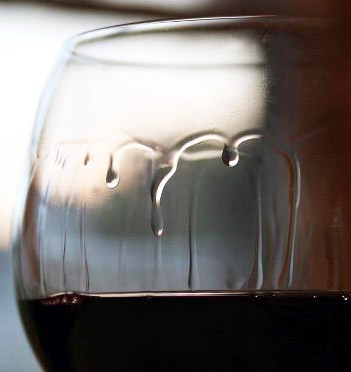
Some people pay a lot of attention to the ‘legs’ of a wine. That is to say, the ‘tears’ of alcohol that run down the inside of the glass following a swirl of the wine. They are an indication of viscosity, and related to alcohol, sugar and glycerol levels in the wine. The excellent wine tutor Michael Schuster once told me that he doesn’t worry about these – there’s far more information in the structure of the wine on the palate – and I’m inclined to agree. On the other hand, I learned from a French student of wine that these ‘legs’ are a good indication of age in sweet wines, Sauternes for instance. For me, the jury’s still out on that one – I’ll need to drink a lot more aged Sauternes to compare!


Legs or tears of wine on side of glass.


Finally we come to sediment in a wine. The only sediment you should see in a white wine is tartrate crystals. These originate from the natural tartaric acid in the wine and can solidify over time. They’re nothing to worry about, although many consumers have a perception that they are a fault. The only way to get rid of them is to chill the wine, prior to bottling, to at least -8°C for several days, and even then you may not get them all. As you can imagine, this is an expensive and energy-intensive exercise, which is one of the reasons the Riesling community in particular is trying to educate the public about the presence of these ‘wine diamonds’!


Sediment in wine.


Red wines will precipitate out tannins and colour molecules over time. The more tannic a wine is to begin with, the more potential for sediment it has. Very fine sediment, before it forms large clumps, can lead to a wine appearing slightly cloudy. These forms of sediment are nothing to worry about and can easily be dealt with by leaving a bottle upright for an hour or two to allow the sediment to collect at the bottom, or by decanting the wine before serving.

There’s a lot to an appearance of a wine, although ultimately its importance is superseded by what you smell, taste and feel about a wine. Thus for the average enthusiast, you’re more likely raring to get straight to the nose and the taste. If you are interested in puzzling over a wine’s appearance for tasting purposes, the important thing to remember is that there are few hard and fast rules. Each winemaker has a different approach to the next, which results in different wines – even if their vineyards are next door! The key is experience and observation. Make a note of what you’re drinking and use it to compare to other experiences. The huge variety of wines is what keeps blind tasting so interesting, so engaging, and is what makes it so hard!


Never miss a post
Name: 
Your email address:*
Please enter all required fields
Correct invalid entries

Geneva: Rock ‘n Roll Spanish Wine Tasting

Published by Thursday, August 9, 2012 Permalink 0

Wine Defender Geneva is sponsoring a wine tasting on August 9, 2012, from 7 p.m. to 10 p.m. at the Cave Do Bem, located at 14, boulevard James Fazy. The tasting will feature Spanish wines with tasty tapas and rock music provided by Bye Bye Chicken Head DJ, preceded by a tribute to Chavela Vargas. The cost of admission is 10 CHF.

Cave Do Bem is located just 2 minutes from the Cornavin train station. It is advisable to reserve ahead of time. Tel. 41 (0)76 273 88 27.


Never miss a post
Name: 
Your email address:*
Please enter all required fields
Correct invalid entries

The Art of Tasting Wine with James Flewellen: The Tools of the Trade

Published by Tuesday, July 31, 2012 Permalink 0

by James Flewellen

OK, so you’re interested in getting the most out of your wine. Perhaps you want to have a go at tasting some wines blind, or perhaps you want to maximize the expression of a wine to pair with your meal. What’s the first step? Well, to begin blind tasting, you need three things other than wine, a nose and taste buds: namely, an appropriate glass, a white background, and good lighting (you don’t need a blindfold – it’s hard enough as it is!).

A classic ‘tulip’ shaped glass is ideal for tasting wine as it allows the aromas to concentrate at the tapered mouth of the glass.


An ‘appropriate’ glass – what does that mean? Surely any old wine glass will do? Well, any wine glass is better than a coffee mug, say, but a long-stemmed tulip-shaped wine glass is ideal for blind tasting. The reason behind the tulip-shape is to allow the aromas of the wine to develop and concentrate inside the glass without them escaping too much. This shape also lets you tilt the glass significantly to observe it without spilling the wine everywhere. The appearance of a wine in the glass gives away great clues as to the climate the grapes were grown in, the age of the wine, elements of the wine-making process and even the grape variety itself. It should thus go without saying that the glass should be clear. While a very few tastings use black glasses to obscure the colour of the wine, I personally don’t see the point and would certainly steer clear from the hideous coloured champagne glasses I’ve seen in department stores!

Continue Reading…

Never miss a post
Name: 
Your email address:*
Please enter all required fields
Correct invalid entries

Fine Wines give Geneva a Great Evening

Published by Sunday, December 5, 2010 Permalink 0


Kickoff of Switzerland’s spring wine tastings: Berthaudin at the Beau Rivage

Massaya comes from a long line of winemakers, and has expanded the family business into a distributorship of wines of a quality that only someone “born in the vines” could put together.

His spring wine tasting Tuesday 5 May at the Geneva Beau Rivage hotel offered a well-balanced collection of hand-picked wines from all over the world, including the sought-after Lebanese wine Massaya.

Berthaudin: Geneva and Vaud wines, and it’s a family affair

Claude Berthaudin.

Continue Reading…

Never miss a post
Name: 
Your email address:*
Please enter all required fields
Correct invalid entries

UA-21892701-1