Food Art: Chocolate Popcorn, food photography by SandeeA

Published by Tuesday, August 9, 2011 Permalink 0

These photos are by SandeeA, author of the column Food Play, and who runs a site called La Receta de la Felicidad. SandeeA is never lacking ideas when it comes to playful, fun recipes. Click Scrumptious Jelly-Filled Fruits – Sandee A.’s Strawberry Bananas are a Fruity Way to Feed Friends
to find the recipe for this chocolate popcorn. It would be a great recipe to get your kids in the kitchen!

Never miss a post
Name: 
Your email address:*
Please enter all required fields
Correct invalid entries

Food Art: Soba Noodles, A Zen Perspective

Published by Monday, August 8, 2011 Permalink 0

 “Preparing food is not about yourself and others. It is about everything!”
– Shunryu Suzuki


Click here for more pictures and a recipe for “Cold Soba Noodle Salad“.

Never miss a post
Name: 
Your email address:*
Please enter all required fields
Correct invalid entries

The Rambling Epicure is looking for social media marketing interns: immediate opening

Published by Monday, August 8, 2011 Permalink 0

Would you like to be part of a highly motivated team of well-known writers and artists from around the world working to promote real food in all its aspects?

The Rambling Epicure is a daily international food chronicle, and the first online newspaper to follow global food trends and news.

Based in Switzerland, The Rambling Epicure joins the voices of food writers and artists from around the world who are interested in promoting a mindful, responsible approach to real-food shopping, cooking, and eating, as well as food politics, safety, history, art, literature and philosophy.

Although the common language of our site is English, many articles are published in Spanish, French, German and Chinese, in bilingual version, and we plan to include still more languages. This allows us to reach a truly international audience and spread the word, literally following food from seed to table and sometimes even beyond. We want to expand, and we have no borders. That is why we are looking for social media interns from now into the fall.

Take a good look at our site and our goals, and if you’d like to be part of the our mission to spread the word, please contact us by clicking the blue Contact Us button at the top right of the home page.

There are no geographic location requirements for the job. You can do it from anywhere on the globe. All you need is fluent English and a stable ADSL or broadband connection.

Never miss a post
Name: 
Your email address:*
Please enter all required fields
Correct invalid entries

Simon Says: Daily Food Quote, August 8, 2011

Published by Monday, August 8, 2011 Permalink 0

by Simon de Swaan

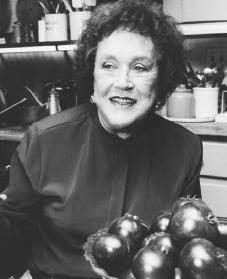
The only real stumbling block is fear of failure. In cooking you’ve got to have a what-the-hell attitude.–Julia Child

Mastering the Art of French Cooking, (1912 – 2004), American cookbook writer, TV personality and tremendous contributor to the food world, introduced Americans to the techniques of French cooking with her classic book, Mastering the Art of French Cooking, Volumes I and II.

Click here to watch her making an omelet on her famed TV show, The French Chef, one of the first cooking shows on television.

Never miss a post
Name: 
Your email address:*
Please enter all required fields
Correct invalid entries

News from David Downie: Paris, Paris on 3QD and The Little Book That Could

Published by Monday, August 8, 2011 Permalink 0

by David Downie

Writer-chef-explorer extraordinaire Elatia Harris — no relation to my wife Alison Harris — interviewed me for a great website I did not formerly know, the 3 Quarks Daily.

It’s always jarring to be on the other side of the mike — or keyboard. I’ve conducted hundreds of interviews over the last 20-odd years. I’ve given a few, too. Of them, this is outstandingly good (not because I’m such a fascinating person, but because Elatia is such a good interviewer and writer).

Here’s the opening paragraph:

In 1986, San Francisco-born David Downie, a scholar and multilingual translator, moved to Paris, into a real garret — a maid’s room, in fact — to write himself into another way of life. Fresh from Milan, his marriage to a Milanese finished, he was still young enough for years more of getting it right. A quarter century later, his authority on matters Parisian is acknowledged by Jan Morris, Diane Johnson, and Mavis Gallant, to name only a few illustrious admirers.

Happily the interview is also about Alison and includes many fine photos from Rome, Paris and elsewhere.

Photos such as this one:
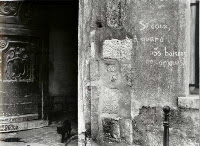
Much to my surprise and delight, The New Yorker picked up the interview. The power of new media is startling.

Speaking of which, Paris, Paris is a surprise bestseller. It was released on April 5 and in under four months has gone through four print runs… This is astonishing, given the publicity budget (budget? what budget?) and the not-dumbed-down nature of the book.

Thanks to all of you for buying so many copies, and telling your friends! Merci mille fois…

Never miss a post
Name: 
Your email address:*
Please enter all required fields
Correct invalid entries

Happy Birthday, Wendell Berry!

Published by Friday, August 5, 2011 Permalink 0

This is taken from the essay “The Pleasures of Eating” from What are People For? by Wendell Berry.

Many times, after I have finished a lecture on the decline of American farming and rural life, someone in the audience has asked, “What can city people do?”

“Eat responsibly,” I have usually answered. Of course, I have tried to explain what I mean by that, but afterwards I have invariably felt there was more to be said than I had been able to say. Now I would like to attempt a better explanation.

I begin with the proposition that eating is an agricultural act. Eating ends the annual drama of the food economy that begins with planting and birth. Most eaters, however, are no longer aware that this is true. They think of food as an agricultural product, perhaps, but they do not think of themselves as participants in agriculture. They think of themselves as “consumers.” If they think beyond that, they recognize that they are passive consumers. They buy what they want — or what they have been persuaded to want — within the limits of what they can get. They pay, mostly without protest, what they are charged. And they mostly ignore certain critical questions about the quality and the cost of what they are sold: How fresh is it? How pure or clean is it, how free of dangerous chemicals? How far was it transported, and what did transportation add to the cost? How much did manufacturing or packaging or advertising add to the cost? When the food product has been manufactured or “processed” or “precooked,” how has that affected its quality or price or nutritional value?

Continue Reading…

Never miss a post
Name: 
Your email address:*
Please enter all required fields
Correct invalid entries

French Food Quote: Daily Food Quote, August 5, 2011

Published by Friday, August 5, 2011 Permalink 0

by Anne Bragance

A woman’s movements when in her kitchen need no interpretation; they are like the musician’s movements when he is playing his instrument, like those of a painter as he sits in front of his canvas. No words are required to understand.

Les gestes d’une femme dans sa cuisine sont immédiatement intelligibles, comparables un peu à ceux du musicien qui joue d’un instrument, à ceux du peintre devant sa toile. Nul besoin de paroles alors.

—Anne Bragance, Un goût du soleil

Never miss a post
Name: 
Your email address:*
Please enter all required fields
Correct invalid entries

Switzerland: Pan-fried Sérac Cheese & Potato Salad Recipe

Published by Friday, August 5, 2011 Permalink 0

Spontaneous Cuisine, by Jonell Galloway

Swiss Sérac cheese, a fresh cow’s milk cheese made with whey

Whey cheese is produced when the curds are separated from the whey to make cheese. Ricotta is also a whey cheese, but unlike Sérac, it is often made with sheep’s milk. As a result, you can use your local cheesemonger’s Sérac in most recipes that call for ricotta.

Photo courtesy of FribourgRegion tourist office.

Photo courtesy of Fribourg Region tourist office.


Sérac is made in most regions of Switzerland, and each region has its own version. Some regions smoke it; others flavor it with herbs, spices or pepper.

Sérac cheese is soft and creamy in texture, so it is easy to spread it on bread to make a healthy sandwich or snack, but Sérac is not only a snack cheese. It can also be used to make healthy, quick meals, such as the recipe below. In the summertime, I often use it like mozzarella, with tomatoes and basil or other Italian-inspired recipes.

It is a great way of teaching your children to eat healthy snacks. Top it with fresh fruit to make a healthy, low-fat dessert, or use it for between-meal snacks on chunky whole-grain bread.

Since it is a fresh milk cheese, it does not keep, and should be eaten shortly after purchasing. Because it is made from fresh milk whey, it is also naturally low in fat. In Switzerland, it would have about a 3.8% fat content, the same as milk.

Continue Reading…

Never miss a post
Name: 
Your email address:*
Please enter all required fields
Correct invalid entries

Simon Says: Daily Food Quote, August 5, 2011

Published by Friday, August 5, 2011 Permalink 0

by Simon de Swaan

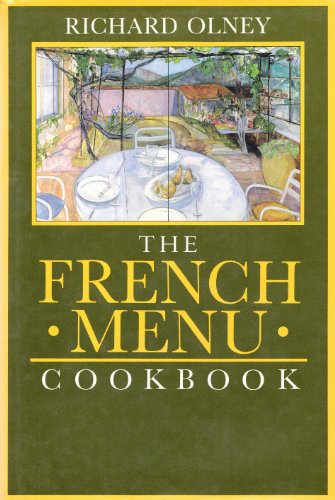
Rational habits permit of discarding nothing left over, and the use to which leftovers (and their economic allies, the wild things of nature) are put is often at the heart of a cooking’s character.–Richard Olney

Richard Olney (1835-1917) was an American cookbook author, most noted for The French Menu Cookbook, and included in The Guardian‘s “The 50 Best Cookbooks.” The Guardian said: “On a summer afternoon at his home in Provence in 1999, the American food writer Richard Olney went to lie down after a light lunch, and never woke up. He was 72, and had led an interesting and fulfilling life (his friends included the writer James Baldwin, the poet John Ashbery, and the painter John Craxton). He had also, unlike many people, been able to cook his own last meal.”


Never miss a post
Name: 
Your email address:*
Please enter all required fields
Correct invalid entries

Switzerland: Spontaneous Cuisine: Fresh fruit croûte

Published by Friday, August 5, 2011 Permalink 0

by Jonell Galloway

Cheese Croûtes, a Perfect Winter Snack

Anyone who’s every traveled or skied in Switzerland knows we love croûte. Every ski station restaurant offers a wide range of croûtes. But what exactly is a croûte, you might ask.

A classic cheese croûte from the Refuge de Chesery

Literally, the word means “crust,” but in practice the dish is usually made with day-old bread, onto which a wide array of foodstuff can be placed. The classic croûtes are layers of toasted bread in a shallow baking dish, covered with any combination of ham, bacon, egg, cheese, tomatoes, etc., but never leaving out the cheese.

For these savory dishes, the bread is cut into slices about 1 cm thick and placed in a buttered shallow baking dish. The bread is browned on both sides in the oven, and then slightly dampened with a little white wine or water. Thin slices of a fatty, hard cheese, such as Gruyère or Emmental, are then distributed evenly over the toast, pepper is added (and other ingredients if desired), and the composition is popped back into the oven until the cheese melts and turns brown.

Because of the oven and the hot cheese, winter croûtes are certainly not appropriate for getting your kids in the kitchen, so I’ve come up with this summer version.

Continue Reading…

Never miss a post
Name: 
Your email address:*
Please enter all required fields
Correct invalid entries