
What to Eat in France: Pouteille

Published by Tuesday, August 18, 2015 Permalink 0

What to Eat in France: Pouteille, or Pig’s Trotter and Beef Stew from La Canourgue

by Jonell Galloway

Gargantua, épuisé après une longue marche et tenaillé par la faim, décide de s’arrêter avant d’entrer dans le village de La Canourgue. L’immense cuvette de grès située au pied du Sabot retient son attention; il s’assied sur ce curieux rocher, en attendant que les fadarelles (les fées) l’informent de la cuisson d’une étrange préparation composée de bœuf, de pieds de cochons, de pommes de terre et de vin.--Rabelais

After a long walk, dying of hunger, Gargantua decided to go into the village of La Canourgue. His attention was immediately drawn to a large earthenware dish sitting on a stand. Curious, he sat down on a rock, waiting for the fairies to tell him about how this strange preparation of beef, pig’s trotters, potatoes and wine, was prepared. It was pouteille.

Pouteille is not commonly found outside La Canourgue, a small commune located in the Languedoc-Roussillon region in the south of France.

In the old days, every family put their pouteille stew together and took it to the village communal oven in an earthenware dish referred to as a toupi. It was eaten on special occasions and on Sundays.
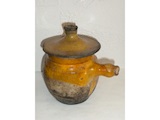
Pig’s trotters are commonly used in the cuisine of this region, and are an integral ingredient of this slow-cooked dish.

Continue Reading…

Never miss a post
Name: 
Your email address:*
Please enter all required fields
Correct invalid entries

What to Eat in France: Matafans

Published by Monday, August 17, 2015 Permalink 0

What to Eat in France: Matafans, or Thick Pancakes from the Franche-Comté

by Jonell Galloway

Matafans are a specialty of the rugged region of Franche-Comté in eastern France; the word is Franco-Provençal. They are sometimes called mata fame, meaning in Spanish “to kill hunger.” It’s not surprising that the word originally comes from Spanish, since they controlled this region in the sixteenth and seventeenth centuries.

Matafans are also found in the Savoy and Lyon under the francisized name matefaim.

They are fairly ancient, and Rabelais mentioned them in his third book in 1546.

Matafans were originally eaten by peasants for breakfast. Today, they are often eaten as a starter, accompanied by a green salad.

They are essentially very thick pancakes, and in the old days were made with leftover mashed potatoes, but can also be made with apples and eaten as a dessert. Lucy Vanel gives a recipe for the historical potato recipe on her website. Today, most people make them from wheat flour.

They are eaten at Candlemas, washed down with Génépi, an absinthe liqueur. The dessert version is accompanied by a sparkling rosé or a fortified wine.

Continue Reading…

Never miss a post
Name: 
Your email address:*
Please enter all required fields
Correct invalid entries

Quintessential France: Beach in Saint-Tropez

Published by Friday, August 14, 2015 Permalink 0

Quintessential France: Beach in Saint-Tropez, by Igor Marceau

Igor Marceau is a self-taught painter from Marseille, France. His world is an enchanting one, full of color and dreams. He describes his work as Expressionist, German Expressionist, Naive and Fauve, all in one. Some call it Neo-Naive. He works from his studio in Valbonne.


Never miss a post
Name: 
Your email address:*
Please enter all required fields
Correct invalid entries

What to Eat in France: Bourride à la Sétoise

Published by Thursday, August 13, 2015 Permalink 0

What to Eat in France: Bourride, or Provençal Fish Soup with Aioli in the Style of Sète

by Jonell Galloway

Bourride is the specialty of Sète, a town on the coast of the Languedoc in Provence. Sète is one of the largest fishing ports in the region. Native poet Paul Valéry called it l’île singulaire, the singular island, because it is nestled in between two salt water lakes and the sea.

Bourride is said to date back to the Phocaeans, the ancient inhabitants of Marseilles, then called Massilia.

In Provençal, it is called boulido, meaning “boiled.” It is not unlike bouillabaisse, a specialty of nearby Marseilles, the difference being that bourride is made with only white fish — monkfish tails in particular, and that it is accompanied by aioli instead of the traditional rouille served with bouillabaisse. Shellfish are never added.

My recipe is very traditional. There are many variants, but the aim of this series of articles “What to Eat in France” is to seek original or traditional recipes for traditional, regional dishes.

This dish is a sure pleaser for parties and is easy enough to cook ahead, doing everything but poaching the fish, which should be done before serving.

In the region, many locals drink rosé wine such as Coteaux-d’Aix-en-Provence with bourride, but one might just as easily pair it with a perfumed Languedoc white. There are a world of them to be discovered, but since they are not, for the most part. A.O.C., it’s difficult to recommend one in particular. It’s a matter of producer as much as place.

Continue Reading…

Never miss a post
Name: 
Your email address:*
Please enter all required fields
Correct invalid entries

What to Eat in France: Pâte de Coings

Published by Tuesday, August 11, 2015 Permalink 0

What to Eat in France: Cotignac ou Pâte de Coings, or Quince Cheese or Paste

by Jonell Galloway

Before having the best Cotignac sent from Orléans, because you were yearning for the tastes of  your childhood…Avant de faire venir d’Orléans le meilleur cotignac, puisque vous vouliez redevenir enfant et goûter au cotignac…—Balzac, Lettres à l’Étrangère

Quince is my husband’s favorite word. Annoying situations or people are quinces in his lexicon. But quinces can be most agreeable, as in the case of quince paste, a cherished confection in France. Although the fruit must be cooked to be digestible, rather like annoying situations have to be cogitated over to be digested, it is worth the effort. They are, after all, a member of the Rosaceae family, like apples and pears.

Quince paste, often called quince cheese or in Spanish membrillo, is not specific to France. In fact, it dates as far back as the Ancient Greeks, who made a similar preparation using honey instead of sugar.

Cotignac d’Orléans, quince cheese from the region of Orléans, has a special place in the history of France. In the Middle Ages, a pastry chef from the village of Cotignac in the region of Var in the southeast set up shop in Orléans. He made quince cheese, which came to be known as Cotignac, and which became a favorite of King François I. French kings continued the tradition, and Louis XIV and XV offered Cotignac to ambassadors and other important guests.

There are also historical references to a Cotignac from Mâcon.

How is Cotignac different from other quince cheese? It’s not, really. The name just stuck because of its place in history.

Continue Reading…

Never miss a post
Name: 
Your email address:*
Please enter all required fields
Correct invalid entries

What to Eat in France: Cou de Canard Farci

Published by Tuesday, August 11, 2015 Permalink 0

What to Eat in France: Cou de Canard Farci, or Duck Neck Stuffed with Foie Gras and Duck Breast

by Jonell Galloway

Stuffed duck neck is considered a delicacy in the Southwest of France. It is often bought conserved in duck fat in jars, sold along with cassoulet, gizzards and other specialties from the region.

Stuffed poultry neck is not particular to France, however. In German, it is called helzel; in English, magel, in Hungarian halsli, and in Yiddish falsa kishke (Encyclopedia of Jewish Food, by Gil Marks). Outside France, it is known as a dish for the poor, since it is usually stuffed with inexpensive ingredients such as bread, matzah meal, giblets and other inexpensive starches so as to stretch the meat as far as possible.

The addition of foie gras in the French version makes it out of the reach of the poor, although many farmers in the Southwest raise ducks, so they get the foie gras from their own ducks.

In France, this is eaten as a starter with green salad and/or potatoes fried in duck fat, but it could just as easily make a main course for lunch.

Continue Reading…

Never miss a post
Name: 
Your email address:*
Please enter all required fields
Correct invalid entries

Quintessential France: Dijon in Burgundy

Published by Monday, August 10, 2015 Permalink 0

by Jonell Galloway

Dijon capital of mustard, escargots/snails and fine wine, is a gastronomic capital. It was a Roman town, and a major crossroads for trade routes, including pewter, tin, amber and exotic spices. It was the capital of the Kingdom of Burgundy, and the seat of the Dukes of Burgundy, from the eleventh to the late fifteenth centuries. Their palace is today the Beaux-Arts Museum, which still houses their tombs.

These half-timbered buildings are near the covered market in the old town, which was registered as a UNESCO World Heritage site in 2015.


Never miss a post
Name: 
Your email address:*
Please enter all required fields
Correct invalid entries

Quintessential France: Rules for Dunking

Published by Saturday, August 8, 2015 Permalink 0

by Jonell Galloway

Croissants were made to be dunked into coffee, right? Doesn’t the very shape lends itself to dunking?

One of the first things I fell in love with in France was the general acceptance, albeit a bit common, of dunking my morning baguette-and-butter tartine or croissant in my café au lait. Dunking was forbidden in my mother’s house. She said it was common and thought Dunkin’ Donuts a travesty, so the French acceptance, though not formal, made me feel the reins of my upbringing had been loosened, if not removed.

Some French people, like Mme Verdurin in Proust’s Le Temps Retrouvé / Time Regained, actually suffer when they’re not allowed to dunk:

Mrs. Verdurin, suffering with migraines from no longer having a croissant to dunk in her café au lait, had gotten a prescription from Dr. Cottard allowing her to do it in certain restaurants, which we talked about. This was almost as difficult as getting the government to nominate a general. She ate her first croissant on the morning the newspapers reported the sinking of the Lusitania.

Continue Reading…

Never miss a post
Name: 
Your email address:*
Please enter all required fields
Correct invalid entries

Quintessential France: George Sand on Soup and Souper

Published by Saturday, August 8, 2015 Permalink 0

by Jonell Galloway

Well into the twentieth century, the word souper, meaning literally “to eat soup,” was (and sometimes still is) used for the evening meal. It is also the origin of the word “supper” in English. The history is complex and varies according to region, class and period in history, but the word mainly derives from the fact that French people who lived in the country ate their main meal at noon and only soup and bread in the evening. It later came to be used for meals after the theatre or a night on the town, meaning more something small to fill your belly than a full meal. In Paris, this often consisted of eating onion soup after dancing all night. In all cases, supper is lighter and less formal than dinner. Since 1300, the term “supper” was also applied to the last meal of Christ.

This is an extract from George Sand’s 1872 novel Nanon, about the evening soup:

It was Saturday. For Saturday supper and Sunday lunch we ate bread. The rest of the week, like other poor people in the Marche, we lived only on chestnuts and buckwheat gruel. I’m talking about a long time ago; I believe it was in 1787. In those days, many families lived like we did. Now, poor people are better nourished. We had ways of bartering our staple foods and we used the chestnuts to get a little wheat.

On Saturday nights, my great uncle brought back a loaf of rye bread from the market, along with a small chunk of butter. I was determined to make his soup for him all on my own and I had had someone explain exactly how Mariotte did it. I went into the garden to pull up a few vegetables and I peeled them so that they were perfectly clean, using my horrible little knife. Mariotte, seeing that I was becoming skillful, lent me hers for the first time. Before she had never wanted to let me use it because she thought I’d hurt myself.

My older cousin Jacques got back from the market before my uncle; he brought bread, butter and salt. Mariotte left us and I went to work. Jacques made fun of my determination to make the soup all by myself and claimed it would be bad. I was full of pride. Everyone found my soup good and flooded me with compliments.

From Nanon, 1872, by George Sand

Continue Reading…

Never miss a post
Name: 
Your email address:*
Please enter all required fields
Correct invalid entries

What to Eat in France: Lapin au Miel et à la Moutarde

Published by Friday, August 7, 2015 Permalink 0

What to Eat in France: Lapin au Miel et à la Moutarde, or Honey Mustard Rabbit

by Jonell Galloway

In the Orléanais and Beauce regions around where I live in Chartres, rabbit is king. They raise them and hunt them as well, eating hare during hunting season. They make distinctions depending on the age and kind of rabbit.

Historically, the French have had a preference for lièvre or hare or lapin de garenne or wild rabbit. Gastronomes like Prosper Montagné considered the flesh of domestic rabbits tasteless and in need of heavy seasoning.

In the late eighteenth century, poor Parisians consumed rabbits regularly. They fed them cabbage leaves and kept the rabbit hutches by their beds.

Domestic rabbit must be eaten young — at 3 to 3 1/2 months old — and is called lapin, while young wild rabbit is called lapereau. Domestic rabbit has white, tender flesh, while the young hares produce firmer meat of which the flavor has more character. It can, however, taste musty. It’s best to check for mustiness before cooking because it can sometimes render it inedible.

Today, the most common recipe is for Lapin à la Moutarde, or rabbit with mustard. This recipe can in fact be made with both honey and/or mustard, giving a classic honey mustard taste to the flesh.

miel_gatinais


The region has been known for its honey, Miel du Gâtinais, since the Middle Ages, and is a blend of acacia, heather, chestnut and forest honey.

Continue Reading…

Never miss a post
Name: 
Your email address:*
Please enter all required fields
Correct invalid entries