What to Eat in France: Truffle Salad

Published by Friday, August 7, 2015 Permalink 0

What to Eat in France: Salade de Truffes, or Truffle Salad

by Jonell Galloway

The Périgord is truffle country: these large black truffles that grow underground next to oak trees and sometimes hazelnut trees are highly prized. Today, three-quarters of them come from the Var, Drôme and Vaucluse. They are harvested in autumn and winter, but the best ones are found in January.

They are often eaten raw, but can just as easily be cooked.

Recipe

  1. Peel truffles.
  2. Bring white wine, salt and pepper to a low boil and simmer truffles for 10 minutes.
  3. Drain and slice.
  4. Place truffles in a salad bowl. Add walnut oil, diced shallots and a trickle of wine vinegar. Mix carefully so that truffles don’t break apart.
  5. Cook soft-boiled eggs. Peel and slice.
  6. In another salad bowl, season sliced eggs with salt, pepper, walnut oil and verjuice. Mix carefully.
  7. Pour eggs into truffles. Add a few pickled nasturtium pods and some chopped chervil.
  8. Mix carefully and serve either one its own or over toast.

Note: The eggs can be replaced with artichoke bottoms or boiled potatoes. One should avoid adding aromatic herbs and spices so as not to interfere with the deep flavor of the truffles. Capers may be substituted for the nasturtium pods. If you like your eggs runny, place them directly onto the toast and pour dressing and truffles over them.


Never miss a post
Name: 
Your email address:*
Please enter all required fields
Correct invalid entries

What to Eat in France: Fougasse aux Anchois

Published by Thursday, August 6, 2015 Permalink 0

What to Eat in France: Flat Provençal Bread Cooked in Wood Oven with Anchovy Paste and Rosemary

Fougasse is a traditional flat loaf made in Provence and cooked in woodash. It can be served plain, or with olives, bacon bits, anchovies or cheese. Some even add sugar and spices or jam.

The word fougasse, fougace or fouasse comes from Provençal, but variations have spread all over Europe, and include Italy’s focaccia and Spain’s fougassa. It originally came from the Latin panis focacius, meaning “a flat bread cooked in an oven or over the ashes of a fire.” It was originally eaten plain, but there are endless variations these days. The sweet version can be eaten for breakfast and is usually eaten cold, while the savory version is eaten hot out of the oven.

The ingredients are simple: flour, water, sometimes eggs or milk, and yeast. Even though recipes vary from village to village and region to region, some using baker’s yeast and others baking powder, it is always flat like a pancake, and shaped into the branches, giving it the shape of ears of wheat. It is the shape that makes it distinctive.

See recipe on the next page.

Continue Reading…

Never miss a post
Name: 
Your email address:*
Please enter all required fields
Correct invalid entries

What to Eat in France: Melon au Pineau

Published by Thursday, August 6, 2015 Permalink 0

What to Eat in France: Cantaloupe with Fortified Wine from the Charentes Region

There are few things that please more than a ripe melon in summer. This is a simple starter that can be made before your guests arrive.

Pineau des Charentes is a fortified wine from the Poitou-Charentes region, made from a blend of lightly fermented grape must and Cognac eau-de-vie. In France, it is drunk as an apértif.

Its history is colorful. In 1589, a wine producer in Burie stored his must in a barrel to let it ferment, as was the custom in those days. He had forgotten that the bottom of the barrel contained just a covering of alcohol, which was the local tradition. A few years later, he had a large harvest, so he needed to use all the barrels he had available. He tasted the must, sure it would have turned to vinegar and he would have to throw it out. Much to his surprise, it was exquisite. His name was Pineau, and he had discovered a new recipe, one that came to be called Pineau des Charentes.

See recipe on the next page.


Continue Reading…

Never miss a post
Name: 
Your email address:*
Please enter all required fields
Correct invalid entries

Lists of Food Writers

Published by Wednesday, August 5, 2015 Permalink 0

Lists of Food Writers

Historical Food Writers

Archestratus

Apicius

J.A. Brillat-Savarin

Grimod de La Reyniere

Carême

Artusi

Escoffier

Historians of Food and Foodways

Rachel Laudan

Lizzie Collingham

Alan Davidson

Claudia Roden

Margaret Visser

Carolin C. Young

Michael J. Twitty

Waverley Root

Continue Reading…

Never miss a post
Name: 
Your email address:*
Please enter all required fields
Correct invalid entries

What to Eat in France: Buckwheat Crêpes

Published by Sunday, August 2, 2015 Permalink 0

What to Eat in France: Galettes de Blé Noir, or Breton-style Buckwheat Pancakes

The buckwheat crêpes of Brittany are unique in the context of French cuisine. They go by many names: galettes de sarrasin, crêpe bretonne, galette de blé noir.

Crusaders brought back buckwheat from Asia in the twelfth century, but it proved to be hard to grow until they took it to Brittany, where there is always plenty of rain, yet the climate is not harsh and the soil is acidic: all the right conditions for growing blé noir, meaning literally “black wheat,” even though it’s not technically of the wheat family.

It was Anne of Brittany who had it planted it all over Brittany and made it part of the Breton diet at the beginning of the fifteenth century. It grows fast and is ready to eat in 100 days, so it helped feed Bretons for centuries, and is often referred to as “poor people’s wheat,” since wheat was only affordable for the rich in those days. It was probably used for gruel or very thick griddle cakes at the beginning.

It still took centuries before the buckwheat pancake as we know it to became popular. The original recipe, which dates from some one thousand years ago, contained only buckwheat, salt and water and was much thicker than the crêpes we know today, which also contain milk, eggs and regular wheat flour, giving a thinner crêpe.

On February 2, Catholics celebrate Candlemas by eating buckwheat crêpes together. For farmers, this date concurs with the end of winter and the beginning of the new farming year, so superstitious farmers keep the candles from this celebration lit to protect their future harvests.

Traditionally, buckwheat galettes are reserved for savory dishes, and are not used for dessert. The Bretons drink apple cider with them.

Continue Reading…

Never miss a post
Name: 
Your email address:*
Please enter all required fields
Correct invalid entries

What to Eat in France: Truffade

Published by Saturday, August 1, 2015 Permalink 0

What to Eat in France: Truffade, or Potato, Bacon and Cheese Melt

by Jonell Galloway

I don’t want to disappoint you, but truffade doesn’t contain truffles. It’s a specialty of Auvergne, and “truffade” which simply means “a potato dish” in the local dialect.

This dish was traditionally prepared by shepherds, who went into the mountains for months at a time to live in cheesemaking chalets called burons. It is traditionally made with fresh (i.e. not aged) Cantal cheese, but different cheeses are used in different villages, depending on the local cheese available.

Truffade is usually eaten with a green salad and sometimes with local country ham.

Continue Reading…

Never miss a post
Name: 
Your email address:*
Please enter all required fields
Correct invalid entries

Quintessential France: Le Touquet-Paris-Plage

Published by Friday, July 31, 2015 Permalink 0

The domain of Le Touquet was purchased by Alphonse Jean-Baptiste Daloz, a notary, in 1837. It consisted of large sand dunes at the mouth of the Canche River. He planted pines and other species of trees, making the site an ideal junction between sea and forest. The head of Le Figaro newspaper, Hypolite de Villemessant, was a friend of Daloz. It is he who gave the site the chic-sounding name Paris-Plage.

An English businessman, Sir John Whitley, jumped on the opportunity, and Le Touquet-Paris-Plage was soon developed as a seaside town complete with everything English tourists dreamed of. It is known for the diversity of its buildings, which sought to achieve a perfect harmony between the architecture and nature. Between the two World Wars, it became cosmopolitan and known worldwide.


Never miss a post
Name: 
Your email address:*
Please enter all required fields
Correct invalid entries

What to Eat in France: Ficelles Picardes

Published by Thursday, July 30, 2015 Permalink 0

French Recipe: Ficelles Picardes, or Mushroom and Ham Crêpes

by Jonell Galloway

Ficelle Picarde, meaning literally “long thin baguette from Picardy,” is not an ancient dish. Marcel Lefèvre invented it for a dinner for dignitaries of the region during an exposition in Amiens in the fifties, and Picardy soon adopted it as its own. The name most likely comes from its long, thin shape, since it’s a crêpe, not a baguette. Its importance in the region is confirmed by the fact that an entire professional fraternity devoted to it was created in 1997, Les compagnons de la ficelle picarde et les compagnes de la rabotte picarde.

In Picardy, this is eaten as a starter.

Continue Reading…

Never miss a post
Name: 
Your email address:*
Please enter all required fields
Correct invalid entries

What to Eat in France: Flamiche aux Poireaux

Published by Thursday, July 30, 2015 Permalink 0

French Recipe: Flamiche aux Poireaux, or Leek and Cheese Pie

by Jonell Galloway

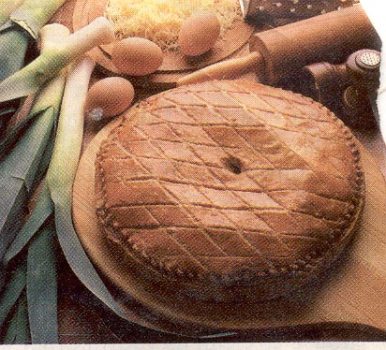
Flamiche is a tart or pie or tourte or quiche from Picardy, depending on who you’re talking to. In Picardy, it is traditionally made with leeks or onions, and sometimes with pumpkin, which is eaten as a savory dish in much of the north of France. It is one of the main traditional starters offered in the region, along with Ficelle Picarde, a crêpe stuffed with ham and mushrooms and served with a cream sauce; Tarte Au Maroillles, a cheese tart, and Rissoles Laonnoises, meat or fish fritters.

Recipe

Ingredients

These are U.S. measurements. Click here for metric and British conversions.

2 9-inch pie crusts
1 1/2 lbs leeks, white only
2 oz. butter
2 egg yolks
1/2 c. crème fraîche
Nutmeg
Salt and pepper to taste
Egg yolk for pie crust

Continue Reading…

Never miss a post
Name: 
Your email address:*
Please enter all required fields
Correct invalid entries

Quintessential France: Lunch by the River Seine

Published by Thursday, July 30, 2015 Permalink 0

The painter Gaston Balande, 1880-1971, was born in Saujon, France, and took part in numerous Beaux-Arts salons during his lifetime. This painting is in the tradition of Edouard Manet’s Le Déjeuner sur l’Herbe painted in 1862 and 1863, without the brazenness of the nude woman.

Never miss a post
Name: 
Your email address:*
Please enter all required fields
Correct invalid entries