Quintessential France: Still Life with Flowers and Fruit, by Pierre Auguste Renoir.
|
|

A Literary Culinary Journal

|
|
The only time to eat diet food is while you’re waiting for the steak to cook.
|
|

French cuisine is much more than the haute cuisine inherited from the nobility. It is also the tasty, inexpensive cuisine that French families eat every day, called cuisine bourgeoise, or “bourgeois cuisine.”
We all learned in school that “bourgeois” was a social class. Originally, it was what we now call the “middle class,” as opposed to the nobility and the poor and working classes. The bourgeoisie, or middle class, grew rapidly in France after the French Revolution.
In terms of cooking, the bourgeois weren’t rich enough to use expensive ingredients and their cooking skills were not as highly developed as those of the aristocrats’ chefs, but they had sufficient means to entertain friends and family. This cuisine came to be known as cuisine bourgeoise, which today simply means family cooking, tasty but not pretentious, as opposed to the haute cuisine of the elite.
|
|

In Loss There is Nourishment: A Southern Biscuit Story
One has to be able to work the dough intimately; it is like making love and following every move of your lover. Timing is of the utmost importance. The symphony of movements is different with every batch, and one has to be in step with every beat. A bit more flour, a bit more lard, just enough air pockets, stop, stop. It’s about perfect harmony, ending on a perfect note, at the perfect moment; it’s fast-moving and playful like a scherzo, and, like a live piano concert, once you’ve hit a wrong note, there’s no going back.
Every Southerner has a biscuit story. Biscuits are what bind us and make us Southern, whether they are slathered with sticky blackstrap molasses or sausage gravy. When we say we miss the South, we are missing a wooden swing on a front porch, beads of sweat running down our foreheads, and a welcome breeze bringing a waft of biscuits cooking; we are missing the sound of the oven door opening and of hearing the biscuits coming hot out of our mothers’ ovens, calling us to supper, calling us home.
This is the introduction to my first article for the British publication Modern Salt, published by Penny Averill.
Click here to read the rest: Biscuit Therapy.
|
|

The New Year’s Eve celebration, referred to as Saint Sylvestre in France, is of pagan origin. The celebration existed long before St. Sylvester himself and long before there was even a pope. Ancient beliefs and celebrations, both religious and pagan, are mixed with those of winter solstice.
In Ancient Rome, the New Year was celebrated after Saturnalia, which was around December 25th, and was a time for “feasting, goodwill, generosity to the poor, the exchange of gifts and the decoration of trees.” People exchanged coins and medallions in celebration of the New Year. This tradition has slipped into oblivion, although adults sometimes still give children coins on this day, but other parts of Saturnalia continue today.

Up until the time of Julius Caesar, this end-of-year celebration didn’t have to fall on a fixed date; it was simply about ten days after Saturnalia. It was Caesar who set the date of December 31, and later, in France, Charles IX set the first day of the year as January 1.
St. Sylvester was Pope from 314 to 335, at the time the Church was emerging from the catacombs. Although Emperor Constantine controlled most of what went on in the Empire, Sylvester persuaded him to convert to Christianity and close the pagan temples. The great basilicas were also built under his influence.
|
|
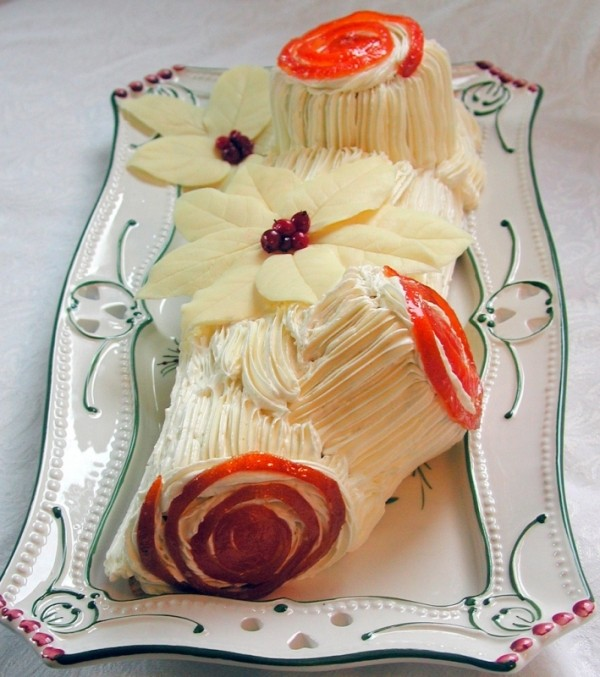
The Yule Log, or the bûche de Noël, “an elaborate creation consisting of a rolled, filled sponge cake, frosted with chocolate buttercream to look like tree bark and festooned with meringue mushrooms, marzipan holly sprigs, spun sugar cobwebs and any other sort of edible decoration,” is the traditional choice of Christmas dessert in France. It comes in many flavors and pastry chefs and home cooks alike let their creativity go wild.
distopiandreamgirl via Foter.com / CC BY-NC-ND
|
|

Etre le dindon de la farce. / To fall victim to dupery.
Une dinde. / A stupid, pretentious woman.
Anthelme Brillat-Savarin, perhaps France’s best-known gastronomic writer, said that the turkey was certainly one of the most beautiful gifts the New World had given to the Old. “…the fattest, and if not the most delicate, at least, the tastiest of all domesticated birds.” It’s not often that the New World gets such compliments from discerning French epicures.
Turkeys were originally called poules d’Inde, “Indian hens,” in France, because they were thought to have come from India, which they later learned was Mexico. The French were not the only ones to get the name wrong. In Hebrew a turkey is a tarnagol hodu, meaning literally “Indian chicken;” in Russian indiuk, Polish indyk and Yiddish indik.
There is some controversy over who brought turkeys to Europe. Columbus probably brought brought them back in the early sixteenth century, since records show that King Ferdinand had ordered that every ship to bring back ten turkeys before the Spanish explorer Cortés set out in 1519. In any case, by 1548, they were the rage in France. In 1549, Catherine de Medicis served 70 “Indian hens” and 7 “Indian roosters” at a banquet held in honor of the Bishop of Paris.
French aristocrats were accustomed to eating all sorts of feathered creatures, including chewy storks, herons, peacocks, swans, cranes and cormorants, so it wasn’t surprising that they fell in love with the less-chewy turkeys, and that in 1570, Charles IX and Elizabeth of Austria thought turkey noble enough to serve at their wedding feast.
By the seventeenth century, the French were raising turkeys as if they were their own and most cookbooks included turkey recipes. French chefs weren’t lacking in ideas: they made stews and ragouts; they larded, roasted and glazed it; they stuffed it and made it into soups and pâtés.
Marie-Antonin Carême preferred the wings, which he deboned, then stuffed with chicken and truffles. Alexander Dumas, in his Dictionary of Cuisine, included 27 recipes. Turkeys were well established in the Hexagon.
Christmas dinners usually meant lots of mouths to feed, so turkey, being the largest of the winged creatures available, eventually became the dish of choice for Christmas feasts. By the nineteenth century, it became customary to stuff the Christmas turkey with chestnuts, and the tradition continues today.
|
|

|
|

In France, the main Christmas meal is eaten on Christmas Eve. Every region in France approaches Christmas Eve meals differently, but that of Provence, known as Le Gros Souper in French and the Gros Soupa in the Provençal dialect, is perhaps the best known.
The table is set with three white tablecloths, one on top of the other, representing the Holy Trinity. Three candles light the table, representing past, present and future. The past is in memory of loved ones who are deceased; the present to express one’s loyalty to friends and family, and the future to express hope for children yet to be born. Three bowls of germinated wheat, planted on December 4th, St. Barbara’s Day, and decorated with red and yellow ribbons, are used as table decoration. Once again, the number three is symbolic of the Holy Trinity.
St. Barbara, a Middle Eastern Christian saint, was the beautiful and much sought after daughter of Dioscore, who locked her in a tower to keep her suitors away. Much to her pagan father’s chagrin, she managed to get baptized, inciting him to go after her with a sword. She managed to escape and hide under a cliff, but a shepherd saw her and informed on her. As a result, God punished him by turning his herd of sheep into grasshoppers. She was sent to prison, then forced to give up Christianity and marry a pagan. Refusing to renounce her God, she was tortured and her father finally slit her throat, so the heavens promptly sent down lightning and killed Dioscore in revenge. This miracle is recreated symbolically today by germinating and planting grains of wheat, and sometimes chickpeas.

Quand lou blad vèn bèn, tout vèn bèn ! or “when the wheat is doing well, everything is going well,” meaning that if it germinates, it will bring prosperity for the coming year. This tradition apparently dates back to the Romans. The direct connection between germination of the wheat and St. Barbara is not clear, nor how St. Barbara became a favorite saint in Provence.
|
|

Avoir la frite. / To have the French fry, meaning “to be fit.”
The French swear they invented frites, what we call French fries. The Belgians also claim to have invented them. One thing we do know is that French fries, or “chips,” as the British call them, came on the scene relatively late in the context of food history, since potatoes were incorporated into the French diet well after the discovery of the New World. It was in the late eighteenth century that Parmentier made them popular; before that, they had been the food of the poor who couldn’t afford bread and had often been used as animal feed.
But before there were French fries, there were fried potatoes, sliced, then fried in butter or lard, or sometimes breaded and fried like fritters. There is mention of this method in the eighteenth century, and recipes started appearing in French cookbooks in the nineteenth century. Already in 1807, the famous gastronomic writer Grimod de La Reynière, advised eating steak with potatoes fried in fresh butter. The following year, Stendhal wrote in his journal: “At quarter past four, I ate grilled mutton with fried potatoes and salad.”
It was only in 1838 that a Belgian by the name of Monsieur Fritz discovered the secret to making frites or French fries as we know them today. He had learned the technique in a rotisserie in the Rue Montmartre in Paris. His secret was to cut the potatoes into sticks instead of slices. This method soon took over in France and abroad.
Make a batter using potato flour and two eggs beaten with water. Add a spoon of oil, a spoon of eau de vie, salt and pepper. Beat well until there are no more lumps. Peel raw potatoes. Slice. Soak in the batter. Fry until they form a nice color.–Madame Mérigot, La Cuisinière républicaine / The Republican Cook, 1794
Peel raw potatoes. Slice them. Flour them and throw them into extraordinarily hot deep fat. When they are fried, sprinkle salt on them.–A.T. Raimbault, Le Parfait Cuisinier / The Perfect Cook, 1811.
————————————————————————————
Jonell Galloway grew up on Wendell Berry and food straight from a backyard Kentucky garden. She is a freelance writer. She attended Le Cordon Bleu and La Varenne cooking schools in Paris and the Académie du Vin, worked for the GaultMillau restaurant guide and CityGuides in France and Paris and for Gannett Company in the U.S., and collaborated on Le tour du monde en 80 pains / Around the World with 80 Breads with Jean-Philippe de Tonnac in France; André Raboud, Sculptures 2002-2009 in Switzerland; Ma Cuisine Méditerranéenne with Christophe Certain in France, At the Table: Food and Family around the World with Ken Albala, and a biography of French chef Pierre Gagnaire. She ran a cooking school in France, and owned a farm-to-table restaurant, The Three Sisters’ Café, with her two sisters in the U.S. She organizes the Taste Unlocked bespoke food and wine tasting awareness workshops with James Flewellen, is an active member of Slow Food, and runs the food writing website The Rambling Epicure. Her work has been published in numerous international publications and she has been interviewed on international public radio in France, Switzerland, and the U.S. She writes for the British publications In Search of Taste and Modern Salt, and is now working on two books, The French and What They Eat and What to Eat in Venice.
|
|
 Meet Jonell Galloway, a freelance writer and editor specialized in French cuisine.