The Concise Guide to Wine & Blind Tasting is destined to become a modern classic. Written by Neel Burton, psychiatrist and Oxford professor, and James Flewellen, biophysicist at Oxford – together founders of the Oxford Wine Academy — the book is well stocked with vital information about all aspects of wine, from soil and vine to drinking for pleasure and blind tasting.
Its clear, detailed information will appeal to serious amateurs and experienced professionals alike. The first three chapters tackle the history of wine as well as the principles of viticulture and winemaking, using an approach unique to the authors, reflecting their methodical way of thinking and scientific backgrounds. This section serves as a comprehensive, accessible introduction for less seasoned wine drinkers, giving them a firm technical basis and the curiosity to want to continue learning.
The ensuing twenty-three chapters address the world’s geographic regions, including three dedicated to notable French appellations, sparkling wine and fortified wine, respectively. Chapters are well structured, dealing with the lie of the land, climate, soil, grape varieties, appellations, and wine styles, and give thorough attention to each of these components. The authors explain how to differentiate wines based on the interplay of these factors, and address the effect of appearance, palate and nose and how these interact with one’s senses and perceptions. This section serves as a reference for even the most seasoned wine drinker.
For those interested in blind tasting, the appendices explain how to set up a blind tasting, and include crib sheets by grape and terroir — a most useful reference for those interested in honing their skills — along with international classification systems and food and wine matching.
This is both a user’s manual and a connoisseur’s guide, and its clear and fluent exposition sets it apart from other guides. You’ll keep this reference book on your shelf; its pages will yellow (and possibly purple) and show their wear and tear. You might even pass it on to your grandchildren. That’s how good it is.
A charlotte is traditionally fruit sautéed in butter which is then placed in a mold lined with bread. In our day, the bread is usually ladyfingers, but I’ve used financier, a dense almond flour cake made with beurre noisette, giving it a distinctive flavor.
Insteading of sautéing the strawberries, I’ve marinated them in rum and used the marinade to “wet” the cake, similar to the way the British make trifle.
600 g strawberries 2 T. brown sugar
1 tsp. cinnamon 4 T. rum 3/4 c. water 4 financier cakes, individual size (or other type of soft, but dense, almond cakes) 200 g thick cream 1/2 vanilla bean 2 T. brown sugar
4 parfait dishes
Top strawberries and cut in half. Place in mixing bowl.
Mix in 2 T. brown sugar and cinnamon.
Add rum and water. Mix gently.
Leave for 30 minutes, mixing gently from time to time. A natural sauce should form. If it doesn’t, add a little more water and rum.
Meanwhile, mix cream with vanilla from vanilla bean and brown sugar.
Break up 1/3 of each financier into each parfait cup. Spoon in 1/9th of strawberries into each cup, pouring some juice onto the cake to moisten it.
Cover with 1/9 of cream.
Add two more layers of financier, strawberries and cream, in the same proportions, ending with cream.
Decorate top with bits of strawberry, mint, or dark chocolate.
Chartres-style Blanquette de Veau Recipe / Apple, onion, carrot and veal stew in apple juice and white sauce recipe
This dish hails from Normandy, where cream, butter, apples and calves are abundant. Chartres is not officially in Normandy, but its cuisine is similar.
1 kilogram or 2 pounds veal shoulder, cut into 2″ x 2″ pieces 12 pearl onions, or the white of 12 small spring onions, peeled and whole 1 apple, chopped 4 carrots, cut into large chunks crosswise Apple juice Veal or chicken broth 6 small new potatoes in jacket 4-5 tablespoons flour 2-3tablespoons butter 1/2 liter or 1 quart milk Italian or flat parsley, chopped Salt Pepper
Dutch oven or similar large pan
Put the veal pieces in Dutch oven.
Add the onions, apple and carrots.
Cover with half apple juice and half veal broth. Salt and pepper.
Simmer gently for 1 hour, then add the whole potatoes.
Simmer for 30 to 45 minutes, or until the potatoes are cooked.
Drain broth from meat and reserve it to make white sauce.
Melt butter in a large, deep frying pan or saucepan. When melted, gradually whisk in 3-4 tablespoons of flour, stirring constantly until the roux starts to gently brown.
Gradually whip in the milk until sauce starts to thicken. Continue whipping until all the milk is absorbed. It should be extra thick. If not, put one more tablespoon of flour into a ladle and add white sauce to ladle. Mix well to form a smooth paste, then whip this into white sauce.
Gradually whip the broth from the stew into the white sauce. When smooth and thick, pour this back into the stew.
Gently mix, turning the meat and vegetables over in white sauce.
Simmer very gently for 5 minutes, stirring carefully so that meat and vegetables don’t fall apart.
Serve, sprinkling with chopped parsley.
Note: This is often served with rice. If you prefer rice, leave out the potatoes. Small turnips can also be added at the beginning, as well as other vegetables, according to taste.
Most writers want and need to concentrate on the words, not the computer. Computers, by definition, require technical acumen, and many of us have neither the skills nor the desire to learn. The fact is, in today’s world, we must; it will make our lives easier if we do.
Food writers and bloggers do not need extremely powerful computer hardware if they are posting mainly text files. Working with images, however, requires more powerful equipment. Each publisher will require different software and applications.
Software and Applications
If you’re preparing a book in manuscript format, you don’t need a huge desktop publishing package, though that’s what most people seem to end up using. Many authors use Microsoft Word, others swear by a variety of less-common options.
For those writing for print, if at all affordable, I suggest buying Microsoft Word Professional or its equivalent. It offers stricter spelling and grammar checkers and has more complete dictionaries and thesauri for a long list of languages, if you indeed need the language option. Even if you’re doing content writing for online publications, this version of Word will give you a maximum of tools.
If you’re using Windows or another Microsoft operating system, I’d suggest taking a class in how to maneuver it and problem-solve. Whether you’re using Microsoft or Apple, a class in Word is a time-saver in the long run, and it will save you hours of frustration. Learn to use the Format, Insert, View and Tools options, and how to create and use a style sheet. I’ll be giving a summer class in Word for Writers. Fill in the form below to sign up for the class.
Sometimes I think I’m liquefying like an old Camembert.–Gustave Flaubert
History of Camembert
The legend goes that Marie Harel invented Camembert in 1791 in the village of Vimoutiers in Normandy, a froward priest giving her the instructions, which she guarded preciously hidden away. Camembert is not taken lightly in France. In 1928, Alexandre Millerand, former president of France, inaugurated a statue in Vimoutiers in honor of Harel’s great “achievement.”
The legend lives on, despite the fact that the family name Harel has never appeared on the list of cheesemakers or business people in the Camembert region, and that the first historical recording of the cheese was in 1708, well before Harel supposedly lived.
How Camembert is Made
Camembert is made from unpasteurized whole milk, abiding by specific requirements if it is to be labeled “Camembert de Normandie.” The milk is first skimmed, then the lactobacillus bacteria is added as a starter. The milk is left at 12° C to coagulate for several hours and is then heated to around 30° C.
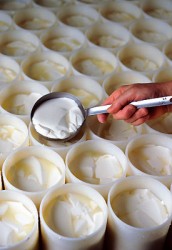
These curds are then sliced vertically and ladled into perforated cheese moulds. This manual operation is repeated four or five times over the space of 40 minutes, allowing the curds to drain off all excess water. After about 12 hours, the cheese is turned over and a stainless steel plate is placed on it, putting pressure on it so that it continues to drain overnight.
The next day, the cheese is removed from the moulds and salted. It is left for a week in a curing room with 100% humidity, where it is turned regularly. Thanks to the Pénicillium candidum in the atmosphere of the room, a natural crust is formed. (Some modern facilities spray the cheese with Pénicillium candidum to start the process.) French regulations require that it then be placed in a curing room with 50% humidity for a week.
The Camembert de Normandie A.O.C./A.O.P. is then ready for packaging. It is wrapped in plastic and then enclosed in a thin, round poplar box.
There are numerous variations on this process, depending on the manufacturer, but all makers more or less follow these steps, whether on a farm or in a larger establishment.
How to Choose a Camembert
Labeling
The first thing to look for is the origin. It will probably be Camembert de Normandie or Camembert fabriqué en Normandie. Only Camembert de Normandie is made from raw milk and and has the legal right to bear the A.O.C. or A.O.P. label. This category includes some 500 milk producers and 9 or 10 cheese makers. In any case, Camembert de Normandie is always hand-made and the dairy cattle have been let out to pasture for a minimum of 6 months. It should always be marked moulé à la louche, indicating that it is hand-made using a ladle.
This name has been protected since 1983, and only represents 4.2% of all Camembert made in France. Look for all these indications on the packaging. Labeling can often be deceptive. Study the images in this article so you’ll be able to tell whether it’s real Camembert and to get a picture of the deceptive practices used. In any case, it should bear this label:
Camembert fabriqué en Normandie simply means it’s made in Normandy. There are no regulations controlling how it is made, so it will most likely be made in a factory, but there are certainly some artisanal cheese makers who for one reason or another don’t qualify for the strict Camembert de Normandie label, but whose cheese is of a high quality.
Then there are manufacturers from other parts of the country who make what they call Camembert. This is usually made with pasteurized milk and most often in factories. We have no way of knowing whether it is made according to the rules of the trade or whether it is good except by tasting. It might even be made with milk from another country.
Appearance
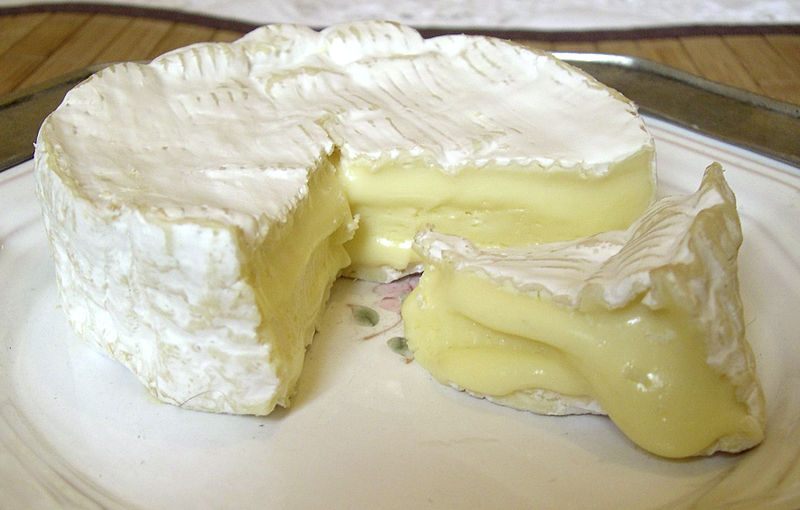
Camembert should be perfectly round and flat. The crust should be white, but slightly brownish, and should not be cracked. The brownish spotting is the result of healthy mould and ripening. The entire surface should be the smooth and even. The edges should be slightly yellow.
Smell the Camembert. Any whiff of ammonia indicates that it is too ripe. It should smell fruity and ripe like you’d like it to taste, but not overwhelming.
Touch the edges, then press the middle. It should be neither too hard nor too soft.
When you cut into the cheese, it should be light yellow in color and creamy in texture.
Note: raw milk Camembert is best in the spring and autumn.
How to Eat Camembert
The French eat their cheese after the main course, either with or after a green salad. It is eaten as is, at room temperature, with bread, and followed by dessert. Some nicer restaurants will serve dried fruit, jam or nuts with the cheese course.
Let me find what ails you, and set you to “writes”. Whether through modest adjustments or major overhauls, let’s get your prose in good health!
You are a food blogger, but your dream is to become a food writer. Writing is a craft, and like all crafts, it takes time and patience to learn. Think of it as a house. You start with a solid foundation, with a frame and a floor, but you have to finish the building so you can house your family.
Working with a writing coach is like adding a roof, insulation and siding to suit the climate you live in. The climate can be compared to the market or the type of writing you aim to do. You have to hone your writing to that market and meet the expectations of publishers and of your audience. Writing free of spelling and grammatical errors is not enough.
ESCOFFIER’S RECIPE FOR POT-AU-FEU OR PETITE MARMITE
Pot-au-feu and petite marmite in today’s vocabulary are the same thing. Until the nineteenth century, the term pot-au-feu simply referred to a family soup to which was added different ingredients every day, usually with beef and chicken added on Sunday. The regional variations were endless, depending on availability and season and depending on the cook.
In 1829, the French etymology dictionary defined pot-pourri as “the name our fathers gave to the pot-au-feu.” In the nineteenth century, the recipe started to take on its modern ingredients of beef, root vegetables and a veal bone, but it still included chicken, which many people, including my French butcher’s wife, leave out these days.
Escoffier, who codified French cuisine in the late nineteenth century and early twentieth century, set down the recipe in Le Guide Culinaire in 1902, still calling it petite marmite. The regional variations started to disappear, and the recipe has now been simplified by most home cooks to contain only beef, no chicken. Escoffier insisted on the importance of the chicken, but today, one rarely finds a pot-au-feu with mutton, veal, pork, chicken, duck or turkey. The other name, petite marmite, has pretty much gone out of usage.
“I tell you it will be more tolerable for the Fejee that salted down a lean missionary in his cellar against a coming famine; it will be more tolerable for that provident Fejee, I say, in the day of judgment, than for thee, civilized and enlightened gourmand, who nailest geese to the ground and feastest on their bloated livers in thy pate-de-foie-gras.”–Herman Melville, Moby Dick (1851)
In What to Eat in France: Foie Gras, we talked about how foie gras is made and the different legal classifications, which determine both the quality and price. Let’s move on to the fun part now. We’ve bought our high-quality foie gras and we want to eat it in the best way possible. Here are some ideas, both traditional and inventive.
Cooked Foie Gras
So you’ve bought a foie gras entier, a foie gras, or a bloc de foie gras. You’ll be eating pure or fairly pure foie gras, but how do you eat it and with what?
There is no one way to eat it. The Romans soaked it in honey and milk to fatten it still more before cooking. The first recipe on record comes from Apicius in his fourth century De re culinaria: Thinly slice the foie gras with a reed. Soak in garum. Crush some pepper, lovage and two bay leaves. Wrap in a caul. Grill and serve.
Today we eat it differently. Cold foie gras is most often eaten with something acidic to help digest the fat. This traditionally includes cold, sweet garnishes such as apple, rhubarb, fresh or dried figs, grapes, or pears, and toast, but contemporary chefs venture outside these limits, serving it with dried fruit and nuts and toasted brioche or raisin-fruit bread. More contemporary garnitures are onion jam or caramelized onions, Balsamic vinegar, port or Sauternes jelly, chutney, cassis berries, raspberries, blueberries or coarse sea salt.
Some people simply eat it with green salad, although I find that salad dressing deadens the natural depth of flavor. It’s also possible to eat it with cornichons and pickled onions. like one does with regular pâté, but once again, the vinegar is likely to overpower the delicate flavor.
Cooked foie gras should never be reheated. It should be eaten just colder than room temperature, so take it out of the refrigerator about 45 minutes before serving. Slice it with a knife while it is still cold. It is usually served with cold garnishes, most often as a starter.
The French eat 90% of the foie gras they make themselves. That’s how much they like it, but they didn’t invent it. Although the Egyptians might have force-fed their birds, we’re not sure that they ate foie gras. The Greeks probably did, since the 4th-century Greek poet Archestratus wrote about it in his Gastronomy. The liver is the soul of the goose, he said.
Foie gras is made using a process called gavage, which consists of force-feeding ducks or geese through a feeding tube to fatten them. The Romans stuffed dried figs down their throats. In Latin, the word for liver even comes from fig, ficus. Scipio Metellus, a Roman chef, had the idea of soaking still warm livers in honey and milk to swell them even more before cooking.
Apart from the region of Béarn in the southwest, this practice disappeared in medieval France, coming back to life in the southwest and Alsace during the Renaissance.
French foie gras is made by force-feeding corn to geese and ducks, and still, occasionally, figs, which swells the livers.
Goose foie gras has traditionally been the most cherished because it is fattier, but it cannot be produced year round. Duck liver is less fatty, and can be produced year round and industrially, meeting the ever-increasing demand.
The fattened liver can be made into terrine, pâté, mousse, parfait, and a host of other things, and, in more recent times, there is a trend of cutting fresh foie gras into thin slices and pan-searing it. It can be eaten fresh or preserved in glass jars, and can be seasoned with truffles, port, Armagnac or Sauternes. Southwesterners prefer a simple, less perfumed foie gras, while Alsacians like to add flavor.
When purchasing, there are legal distinctions in names that indicate the purity and therefore determine the price:
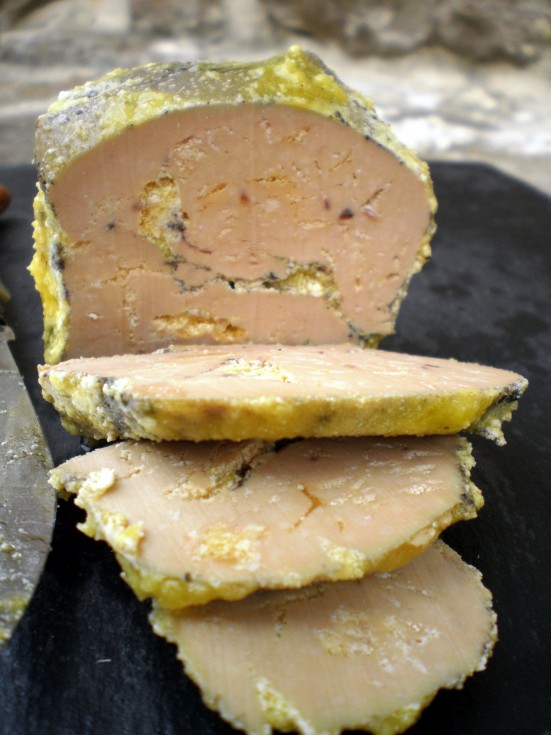
Foie gras entier means that it contains the actual lobes of the liver. The only legally allowed addition is truffles. As it’s solid, you cut it with a knife, just like you do extra-tender beef filet.
Foie gras consists of pieces of liver that are put back together and pressed.
Bloc de foie gras is reconstituted liver combined with other ingredients, but containing at least 50% foie gras for goose, and 30% for duck .
Parfaits are preparations containing 75% foie gras and made by mechanical means, to which regular, unfattened liver is added.
Médaillon or pâte de foie de canard or d’oie contains 50% duck or goose foie gras or bloc de foie gras in the middle, surrounded by forcemeat.
Galantine is a butcher’s mixture of meats and other forcemeats, with no defined percentage of foie gras.
Mousse contains 50% foie gras mixed with forcemeat, giving it the texture of foie gras.
Terrine is pure foie gras pressed into pâté shape.
Forcemeat can consist of one or several ingredients, including pork, veal or chicken fat; pork or chicken liver; scraps from deveining; poaching fat; eggs; milk; lactoproteins; flour, and starch.
Foie gras comes in a jar, plastic package or can or fresh from the butcher. When purchasing, be aware of the different cooking preparations, since the temperature at which it is cooked and the method of cooking change the flavor and shelf-life. Generally speaking, fresh is better.
It is important to make sure you are being sold what you ask for in both restaurants and shops. As a consumer, you have a legal right.
The French don’t eat foie gras every day. Traditionally, it is for special occasions and holiday meals, especially Christmas and New Year’s celebrations.
Write every day, even if it’s just for 10 minutes or to churn out 250 words, even if you have nothing to write about. Being a writer means you write, even when the inspiration is not there. A restaurant chef has to serve dinner to her guests even when she’s just had a fight with her banker. See yourself as a professional and you’re already on the way to becoming one.
Write about things you know. If you don’t know about something, but you’re inspired by it, do your research first. Knowing doesn’t always mean intellectual knowledge. It can also be unique life experiences or things you’ve learned in the school of hard knocks. It can even be about how not to follow a recipe because you’ve learned from your own failures.
Revise and revise, then revise some more. These days it’s easy to number your drafts 1, 2, and 3 or A, B, and C, so you can also recover whole paragraphs or chapters you’ve deleted if you decide you liked previous versions better. Drafts are not children you keep forever; you can play around with them like puzzles. They’re like Humpty Dumpty. You can tear them into little pieces and put them back together again. That’s part of the process. Never be afraid you’re destroying by revising. Think of it as perfecting a work of art.
Cut words, then cut some more. Excess is your worst enemy. There should not be a single word or sentence that is not absolutely necessary to the message you want to get across. Again, consider your writing as you consider your family. Every word is a child and every paragraph a parent. Every element is necessary to the big picture and the message, just as every ingredient is necessary to the success of a great recipe.
Practice great first lines that grab readers’ attention. There’s an art to it. When you read, take note of first lines that strike you. Writing is like theatre in that way. When the play is boring, you nod off to sleep. That’s the last thing you want your reader to do. A recipe by the name of Lemon Chicken isn’t half as appealing as Chicken filet au citron, even if it means the same thing.
Writing is not just words. Writers have to paint a picture in their readers’ minds. As you observe the world, in your mind, start using words to paint pictures to tell your readers about later. Flour is often called white, but it comes in many colors: bleached white, off-white, yellowish, white with brown specks, etc.
Don’t be a perfectionist. All first drafts are pretty bad and we have to accept that. We learn as we go, just like everything in life. Perfectionism can give you writer’s block. Accept your writing for what it is. Love and nurture it until it’s good. Care for it patiently, watering it like you do your flowers, until it grows tall and strong.
Practice flow. Put your hands on the keyboard and let it rip. You can polish it later. Just write and don’t let your brain get in the way. We talk about free association. Practice free writing and write quickly. That can even mean making lists of ideas or words and putting them together later. Free writing touches more on your creative self than on your left brain. When you don’t have time to shop for food, you go to the fridge and think up a meal using what you have. Writing can be the same way. You can connect the dots later if your central idea is not yet clear.
Develop a thick skin. Join a writing group and get feedback. Take writing classes and get more feedback. Be dedicated to your mission of becoming a food writer and use criticism as a tool to improve it and a way of understanding how readers will react. Take it gracefully and then think about it.If you develop recipes, share them with your friends and listen carefully to every comment they have. They are probably the kind of people who will be buying your books and reading your articles. Feedback isn’t always right either, but it makes you think about your craft. Your recipes don’t always turn out right, so don’t expect better from your writing.
Read and read a lot; read good writing, not bad. Read the kind of things you’d like to write yourself. If you want to write a recipe book, read recipe books. If you want to write a food memoir, read every one you can get your hands on. Read books about writing. What you read affects your own writing. Never forget that. Reading feeds your imagination by letting you step into other writers’ minds and observe their skills. You learn to cook better when you follow the recipes of accomplished cooks. Writing is no different.