Simple Sustenance: Roasted Cauliflower with Kalamata Olives and Lemon-Parsley Gremolata

Published by Thursday, March 29, 2012 Permalink 0

Mediterranean Flair: Roasted Cauliflower with Kalamata Olives and Lemon-Parsley Gremolata

by Renu Chhabra


Food is our common ground, a universal experience.– James Beard


Spring is in the air, a season for new growth and rejuvenation. Everywhere we look, nature is awakening from its long winter rest. With flowers blooming and landscape covered with a blanket of green, there is a sense of new life welcoming the ever-inspiring spring, signifying a fresh start. And what better way to celebrate this beautiful time than to cook up something delicious with fresh ingredients and clean flavors just like the season itself.

Growing up I was always intrigued by cauliflower, a vegetable that came in a beautiful green leafy package. Peel off the leaves, and a white head of tiny trees clustered together greeted me. It was like removing gift wrap to find a lovely present inside. And who doesn’t like presents? I guess, that is why I have always loved this vegetable — a beautifully packaged gift from Mother Nature.

Continue Reading…

Never miss a post
Name: 
Your email address:*
Please enter all required fields
Correct invalid entries

French Food Fact: What’s a Cromesquis?

Published by Thursday, March 29, 2012 Permalink 0


by Jonell Galloway

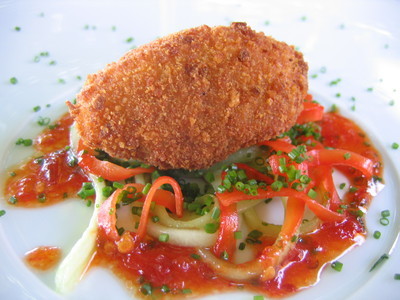
Cromesquis are back in fashion as an hors d’oeuvre. They are made with a salpicon wrapped in pig’s caul or slices of salt pork, then dipped in batter and deep-fried to make a croquette.


Photo courtesy of Patrick Chazallet.

Contemporary chefs like to make the salpicon a little runny so that when you bite into the croquette, the liquid squirts into your mouth. I first ate the contemporary version of cromesquis at Ferran Adria’s El Bulli about 12 or 13 years ago.


Note: A salpicon consists of ingredients that are diced and bound with a sauce.
Never miss a post
Name: 
Your email address:*
Please enter all required fields
Correct invalid entries

Simon Says: Daily Food Quote, March 29, 2012

Published by Thursday, March 29, 2012 Permalink 0

by Simón de Swaan

Bread always falls on its buttered side.–English proverb

Photo courtesy of http://3.bp.blogspot.com/_pwrKRcgY4w4/S9XFGRE2sDI/AAAAAAAAATo/xZyDtpawfYs/s1600/ButteredToast.jpg


Never miss a post
Name: 
Your email address:*
Please enter all required fields
Correct invalid entries

Simon Says: Daily Food Quote, March 28, 2012

Published by Wednesday, March 28, 2012 Permalink 0

by Simón de Swaan

Vodka is cursed, tea is twice cursed, coffee and tobacco are thrice cursed.–Russian proverb


Never miss a post
Name: 
Your email address:*
Please enter all required fields
Correct invalid entries

Cross-Continental Cuisine: Chicken Liver Pâté with Cava and Ginger Sangria

Published by Tuesday, March 27, 2012 Permalink 0

by SandeeA and Tricia Martin

Pate al cava / Giger sangria
I spent most of my childhood dreaming about food I’d read about in books: Enyd Blyton’s pies and ginger ale; feasting with Astérix and Obélix and those fantastic roast boars… Now, thanks to this Cross Continental Cooking project with Tricia Martin from Eating is Art, I know how to prepare my own ginger ale… who would have ever thought it? And you must take a look at her highly original ginger sangria recipe. And kudo to her for starting still another project, Studio Tricia Martin. I suggest you have a look; she is a true artist.

Pate al cava / Ginger sangria

Continue Reading…

Never miss a post
Name: 
Your email address:*
Please enter all required fields
Correct invalid entries

Simon Says: Daily Food Quote, March 27, 2011

Published by Tuesday, March 27, 2012 Permalink 0

by Simón de Swaan

Hunger is felt by a slave and hunger is felt by a king.–Ghanaian proverb


Never miss a post
Name: 
Your email address:*
Please enter all required fields
Correct invalid entries

Sauce for Thought: Sweet Flower of Dreams

Published by Monday, March 26, 2012 Permalink 0


by Alice DeLuca

A little prehistoric flower has been grown, re-created really, from 32,000 year-old seeds found in the ancient den of an artic ground squirrel. The photo of the little white flower in the New York Times [i] brought a rush of excitement and a feeling of kinship with the scientists who sought to cover those seeds with earth and add water, to cup their hands and breathe warm air over the planting, revealing the sprouts last seen by the tiny ground squirrel so long ago. I have the same feeling when reading an antique recipe that might bring back the flavors of the ancestors. Can we breathe life in to an antique delicacy and resurrect a better flavor? Why did people add rose geraniums to their jelly, infuse herring pie[ii] with grains de paradis[iii], or even stir and stir to create cornstarch pudding for that matter? Perhaps they knew a marvelous flavor-way or texture that has been lost to us, overtaken by food fads and conveniences of the present day?

Continue Reading…

Never miss a post
Name: 
Your email address:*
Please enter all required fields
Correct invalid entries

Food Art: Campari Orange Macarons, food photography by Meeta Khurana Wolff

Published by Monday, March 26, 2012 Permalink 0

See more food photo compositions at Meeta K. Wolff.

Never miss a post
Name: 
Your email address:*
Please enter all required fields
Correct invalid entries

Food Art: The Other Side of the Matterhorn: Gornergrat Rösti, food photography by Jenn Oliver

Published by Monday, March 26, 2012 Permalink 0
Never miss a post
Name: 
Your email address:*
Please enter all required fields
Correct invalid entries

Spanish Cava or Champagne: Both Bubbly, but Distinctly Different

Published by Monday, March 26, 2012 Permalink 0

by Raquel Pardo

Translated into English and adapted by Jonell Galloway

Para leer la versión en español, pinche aquí

I risk sounding like a schoolteacher (or a wine snob), but I shall continue. My hair stands on end when I hear people confuse Champagne and Spanish cava, or bubbly (I hide my annoyance, of course).

I can no longer maintain my silence, so I will hastily scribble out a few lines to remove all doubts about the difference between cava and Champagne, and you can face up to the test. You only have to worry about perhaps finding yourself at a blind tasting with people who always know how distinguish one from the other, who never get it wrong. Otherwise, you’re set to roll.

Continue Reading…

Never miss a post
Name: 
Your email address:*
Please enter all required fields
Correct invalid entries

UA-21892701-1