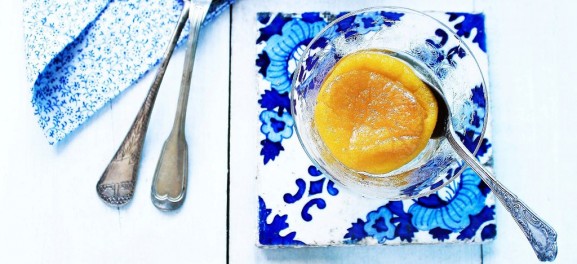
Spontaneous Cuisine: Parsnip Velouté with Aged Mimolette Cheese

Published by Thursday, December 15, 2011 Permalink 0

Itsy Bitsy History of the Parsnip

In the Middle Ages, Geneva was running over with parsnips, which they referred to as “white carrots”. It was almost always included in their “eternal pots” of soup, which consisted of seasonal vegetables that they just kept adding more vegetables to as needed, and a piece of meat once a week.

After World War II, many root vegetables went out of fashion in Europe, because people had had to survive on them and nothing else during the war, so farmers eventually stopped growing them. The same went for pumpkin. People in the north of France who had lived through the war and eaten pumpkin every day couldn’t bear the thought of eating pumpkin ever again.

In recent years, these old-fashioned vegetables, including parsnips, have again become available, and chefs are going crazy with new ideas on how to use them.

Parsnips are plentiful at the moment and there’s nothing better than soup to warm you up on a cold winter’s day. Eric Burkel, former financial analyst, entrepreneur and now president of his local food coop in Paris, got this recipe from one of the farmers who supplies vegetables to the coop.

Parsnip soup recipe

Continue Reading…

Never miss a post
Name: 
Your email address:*
Please enter all required fields
Correct invalid entries

Simon Says: Daily Food Quote, December 15, 2011

Published by Thursday, December 15, 2011 Permalink 0

by Simón de Swaan

Little Tommy Tucker
Sings for his supper;
What shall we give him?
White bread and butter.

Tommy Thumb’s Pretty Song Book, c 1744

Tommy Thumb’s Pretty Song Book is the earliest extant printed collection of English language nursery rhymes, published in London in 1744. It was a sequel to the lost Tommy Thumb’s Song Book and contains the oldest version of many well-known and popular rhymes, as well as several that have been largely forgotten.


Related articles

Never miss a post
Name: 
Your email address:*
Please enter all required fields
Correct invalid entries

USDA: new guidelines for calculating fertilizer; runoff producing over-nutrition in waterways

Published by Wednesday, December 14, 2011 Permalink 0

Around the world, environmentalists and scientists are mobilizing to fight the plague of over-nutrition due to over-fertilization

The problem with farming today — whether fertilizer be conventional or natural — is that fertilizer runoff produces over-nutrition of waterways and other natural habitats.
USDA logo


So around the world, environmentalists and scientists are mobilizing to fight the plague of over-nutrition. That’s where the new USDA document comes in. It lays out a host of steps that farmers can take — and will have to take, if they get funding from certain USDA programs — to minimize the spread of nutrients outside farm fields.

Essentially, it involves putting farmland on a sensible diet. Only feed the land as much as it really needs. And don’t apply fertilizer, including manure, when the crops don’t need it. Also, try to capture and store any excess nutrients. For instance, grow wintertime “cover crops” that can trap free nitrogen before it leaches into groundwater.

Click here to read this on NPR’s blog.

Related articles
Never miss a post
Name: 
Your email address:*
Please enter all required fields
Correct invalid entries

The Importance of Olive Oil’s Virginity

Published by Wednesday, December 14, 2011 Permalink 0

NPR’s Losing ‘Virginity’: Olive Oil’s ‘Scandalous’ Fraud gives a good overview of the importance of olive oil labeling and the tricks used to get around the rules, with Tom Mueller, author of Extra Virginity: The Sublime and Scandalous World of Olive Oil.

English: virgin oil of aceitunas (IMPERIA) Fra...
Never miss a post
Name: 
Your email address:*
Please enter all required fields
Correct invalid entries

Simon Says: Daily Food Quote, December 14, 2011

Published by Wednesday, December 14, 2011 Permalink 0

by Simón de Swaan

The proof of the pudding is in the eating.–Miguel de Cervantes, 1615

Don Quixote was a Spanish novelist, poet, and playwright. His magnum opus, here, considered the first modern novel, is a classic of Western literature, and is regarded amongst the best works of fiction ever written.

Click to read more about him.


Related articles
Never miss a post
Name: 
Your email address:*
Please enter all required fields
Correct invalid entries

Food News: Italian police seize 2,500 tons of fake organic food

Published by Tuesday, December 13, 2011 Permalink 0

This is the real-food lover’s worst nightmare. We all know that no matter how many checks and inspections are set up, there is always a risk of runoff from other farms, dishonest sellers and middlemen, and falsely labeled organic food.

The Italian police have seized 2,500 tons of grains, fruits and soy products that were falsely labled as organic in a food fraud ring that exported phony organic products across Europe, says Boston.com, including the Netherlands, Germany, Spain, France, Belgium, Hungary, Austria and Switzerland.

Click here to continue reading.

Never miss a post
Name: 
Your email address:*
Please enter all required fields
Correct invalid entries

Simon Says: Daily Food Quote, December 13, 2011

Published by Tuesday, December 13, 2011 Permalink 0

by Simón de Swaan

A warmed-up dinner was never worth anything.–Nicolas Boileau, 1667

Nicolas Boileau-Despréaux was a French poet and critic. He was born in the rue de Jérusalem, in Paris, France. He was brought up in the law, but devoted to letters, associating himself with La Fontaine, Racine, and Molière. He is the author of Satires and Epistles, L’Art poétique and Le Lutrin, in which he attacked and employed his wit against what he perceived to be the bad taste of his time.

Boileau did much to reform the prevailing form of French poetry, as Blaise Pascal did to reform the prose, and was for a long time the law-giver of Parnassus. He was greatly influenced by Horace.


Continue Reading…

Never miss a post
Name: 
Your email address:*
Please enter all required fields
Correct invalid entries

Simon Says: Daily Food Quote, December 2, 2011

Published by Saturday, December 3, 2011 Permalink 0

by Simon de Swaan

Do I dare to eat a peach?–T.S. Elliot, 1917

Thomas Stearns “T. S.” Eliot OM as a playwright, literary critic, and arguably the most important English-language poet of the 20th century. Although he was born an American, he moved to the United Kingdom in 1914 (at age 25) and was naturalized as a British subject in 1927 at age 39. He was awarded the Nobel Prize in Literature in 1948.


Never miss a post
Name: 
Your email address:*
Please enter all required fields
Correct invalid entries

Food Art: Azulejos 1, food photography by Mónica Pinto

Published by Thursday, December 1, 2011 Permalink 0

by Jonell Galloway

I recently discovered Mónica Pinto’s beautiful food photography when searching for World Food Blogs for my Food News Daily column. Of Portuguese origin, her recipes are often traditional Portuguese, but her photography is firmly rooted in the spirit of cutting-edge food photography. Mónica runs the blog Pratos y Travessas, writtten in both Portuguese and English.

Continue Reading…

Never miss a post
Name: 
Your email address:*
Please enter all required fields
Correct invalid entries

Simon Says: Daily Food Quote, December 1, 2011

Published by Thursday, December 1, 2011 Permalink 0

by Simon de Swaan

At meat cleanse not thy teeth nor pick
With knife or straw or wand or stick.

The Book of Courtesy, c 1450

Published in 1868 under the title The Babee’s Book along with the second volume Queen Elizabeth’s Academy, published a year later, give the best example of medieval life and manners in England.


Continue Reading…

Never miss a post
Name: 
Your email address:*
Please enter all required fields
Correct invalid entries

UA-21892701-1