Food News Daily: August 17, 2011

Published by Wednesday, August 17, 2011 Permalink 0

Mainstream Press

School Districts Rediscover Value of From-Scratch Meals, The New York Times
Why the Swiss Don’t Buy Swiss Cheese, Moneyland, Time
Consider chocolate, The Guardian
India Sues Monsanto Over Genetically-Modified Eggplant, Forbes
Why the Government Is Regulating Gluten-Free Foods, The Atlantic
One Man’s Blurry Quest to Cook Every Meal with Beer, BA Daily
Sex on a plate: in Paris, food and seduction are one and the same, The Telegraph

Best of the Anglo Food Blogs and Sites

Mexican Chocolate Pops Recipe, Leite’s Culinaria
{For Jennie & Mikey} Chocolate Peanut Butter Pie, Healthy-Delicious
Search – LocalHarvest, find local produce in your area by in U.S. by clicking on map
Yogurt Ice Pops with Berries Recipe, Leite’s Culinaria
Deliciously Rich Salted Caramel Ice Cream Recipe, Simply Stated

Alternative Press/Sites

2011 James Beard Foundation Leadership Awards – Sustainable Food Awards, The Daily Green
Best Farmers Markets – Big U.S. Farmers Markets, The Daily Green
The 10 (U.S.) Colleges With The Best Campus Food, Huffington Post

World

Masterchef India, playful Bollywood style
Sticky Date Pudding With Toffee Sauce, a Dubai take on a British classic, Sips and Spoonfuls
Ancient Rice Offering Is the Heart of India’s Jewish Community – Jew and the Carrot, Forward
The 7 Most Annoying Ways To Order At A Restaurant, Zagat
Flavors of Brazil: Attn Chocoholics: The World’s Largest Chocolate Fair Is Coming to Brazil, Flavors of Brazil
Keeping Food True: Embrace Pickles, Danish bread and butter pickles
The okra renaissance, the outcast vegetable is back in style, Food Bridge
Japanese Farm Food, Indigo Days
What food cravings say about your health?, IOL Lifestyle
Buttermilk ice cream with basil & Vanilla – Summer, come back!, Munich-based Delicious Days
Homemade Peanut Butter, Indian Country Today Media Network


Never miss a post
Name: 
Your email address:*
Please enter all required fields
Correct invalid entries

Simon Says: Daily Food Quote, August 17, 2011

Published by Wednesday, August 17, 2011 Permalink 0

by Simón de Swaan

On a hot day in Virginia, I know nothing more comforting than a fine spiced pickle, brought up trout-like from the sparkling depths of the aromatic jar below the stairs of Aunt Sally’s cellar.—Thomas Jefferson, 3rd President of The United States of America

At the age of 33, Thomas Jefferson (1743 to 1826) drafted the Declaration of Independence. More a writer than an orator, he was elected President in 1800, serving two terms. Monticello, his house on the hill outside Washington, D.C., is known for its beautiful views over the Potomac and the surrounding countryside.

Click here to read his official biography on the White House website.

Cropped version of Thomas Jefferson, painted b...

Image via Wikipedia


Never miss a post
Name: 
Your email address:*
Please enter all required fields
Correct invalid entries

Switzerland: Tomatoes and Swiss Chard, and it’s in Season!

Published by Tuesday, August 16, 2011 Permalink 0

by Jonell Galloway

Swiss chard, along with kale, mustard greens and collard greens, is one of several leafy green vegetables often referred to as “greens”. It is a tall leafy green vegetable with a thick, crunchy stalk that comes in white, red or yellow with wide fan-like green leaves.

The Swiss variety tends to have whitish stems not dissimilar to green celery but wider and somewhat fan-shaped, while the varieties found in North America can be red, purpose or yellow. Some say chard is second only to spinach in terms of nutrients, and it is certainly full of fiber and phytonutrients.

When choosing chard, make sure the leaves are not wilted and the stems look fresh and crisp. If it looks limp in any way, pass it up.

It is one of the few vegetables that probably shouldn’t be eaten raw, due to its high acid content.

Although it is referred to as “Swiss” chard, it isn’t actually native to Switzerland. It is a Mediterranean vegetable. Already in the fourth century B.C., Aristotle wrote about “chard”, the common name used in the Mediterranean region. It probably got its name from a vegetable that it resembles, the cardoon. It is thought that the French confused the two and ended up calling them both “charde”.

In modern times, the French call Swiss chard blettes, the Swiss call them côtes de bettes, and, funnily enough, the English-speaking world has kept the name closest to the original used in ancient times: chard.


Swiss chard (Beta vulgaris) with variously col...


Its actual homeland lies farther south, in the Mediterranean region; in fact, the Greek philosopher Aristotle wrote about chard in the fourth century B.C. This is not surprising given the fact that the ancient Greeks, and later the Romans, honored chard for its medicinal properties. Chard got its common name from another Mediterranean vegetable, cardoon, a celery-like plant with thick stalks that resemble those of chard. The French got the two confused and called them both “carde.”

Swiss chard is in season for a good deal of the year in Switzerland, but this recipe takes advantage of summer to use some of those divine tomatoes that embellish the farmers markets.

In winter, it can be mixed with potatoes to make a lovely purée or soup.

Recipe

Tomatoes and Swiss Chard

Ingredients

Click here for recipe measurement converter

1 Tbsp. cooking oil

1 kg Swiss chard

500 g ripe tomatoes

1 tsp. sea salt
Pepper to taste
  1. Heat oil to medium low in a Dutch oven.
  2. In the meantime, bring a large soup pan of water to boil.
  3. Scrape any mud or black spots off Swiss chard. Wash carefully.
  4. Cut stems into 2 cm long chunks.
  5. Add Swiss chard to warm oil.
  6. Sautée for 2 minutes, stirring all the time.
  7. Wash tomatoes.
  8. Drop tomatoes into boiling water for 30 seconds or until skin starts to crack.
  9. Remove tomatoes from boiling water, and run under cold water, carefully removing the skins with fingers.
  10. Squeeze to remove seeds or scrape out seeds with end of a knife.
  11. Chop finely.
  12. Add tomatoes to Swiss chard. Mix well.
  13. Add sea salt and pepper to taste. Continue mixing.
  14. Turn heat down to low and cover Dutch oven. Cook slowly for 20 to 40 minutes, depending on whether you prefer it crunchy or less crunchy.
  15. Serve hot.

Suggestion: For a livelier version, add garlic and garam masala.

Suggestion: To make this in to a vegetarian meal, add borlotti, cannellini beans  or garbanzo beans and sprinkle with grated cheese.

Related articles

Simon Says: Daily Food Quote, August 16, 2011

Published by Tuesday, August 16, 2011 Permalink 0

by Simón de Swaan

[Breadbaking is] one of those almost hypnotic businesses, like a dance from some ancient ceremony. It leaves you filled with one of the world’s sweetest smells…there is no chiropractic treatment, no Yoga exercise, no hour of meditation in a music-throbbing chapel that will leave you emptier of bad thoughts than this homely ceremony of making bread.-–M.F.K. Fisher, The Art of Eating

Mary Francis Kenney Fisher (July 3, 1908 – June 22, 1992). a Californian by birth, was a prolific and well-respected author of 20 books, many of which dealt with the preparation, history and culture of food. She spent the first three years of her marriage in France, where she learned how to live and eat economically and was introduced to various wines, pastries and cheeses. This was to determine the path of her life.

DSC_2145
Never miss a post
Name: 
Your email address:*
Please enter all required fields
Correct invalid entries

Food Play: How to make Homemade Butter

Published by Monday, August 15, 2011 Permalink 0

por SandeeA

Versión origínale en español

Kids in the Kitchen

Nowadays we’ve forgotten where food actually comes from. Some people find it difficult to believe olives were “born” with pits, because they’ve only eaten the pitted ones out of cans, and others have never known fresh milk or milk straight from the cow; they’ve only had milk from a U.H.T. Tetra Brik carton.

So what about pulling some magic in the kitchen and showing your kids how cream becomes butter? You will get a delicious homemade butter, full of flavour, with 65%  fat, as compared to commercial butters, which commonly have up to 80% fat and zero flavour to boot.

So switch on the music on, and let’s shake it! Who said you cannot play with food?


Mantequilla casera 4

Recipe

Homemade Butter

Click here for recipe converter

Preparation time: 4-5 min
Cooking time: 0 min
Total: 4-5 min
Yield: 40 gr butter (2 portions)

Difficulty: My 3-year-old son can do it

Ingredients

100 ml heavy cream, very cold (minimum 35% fat)
A small jar with lid

Preparation

1. Put cream in the jar and close lid.

Mantequilla casera 2

2. Turn the music on.

3. Shake it, shake it. About two minutes later, you will notice that the cream is starting to thicken. Take a rest.

Mantequilla casera 2

4. Keep shaking shaking (it will take a couple more minutes). Suddenly, the cream will start to divide into a solid part (butter) and a liquid part (buttermilk) You did it! Press butter and knead it a litte bit to eliminate exceeding buttermilk, and clean it under clean water. You can keep both buttermilk and butter in the refrigerator for a few days.

Mantequilla casera 3

Note 1: You can do the same thing using a food processor, but it won’t be as much fun! Click here to watch a video showing how to make homemade butter using a food processor.

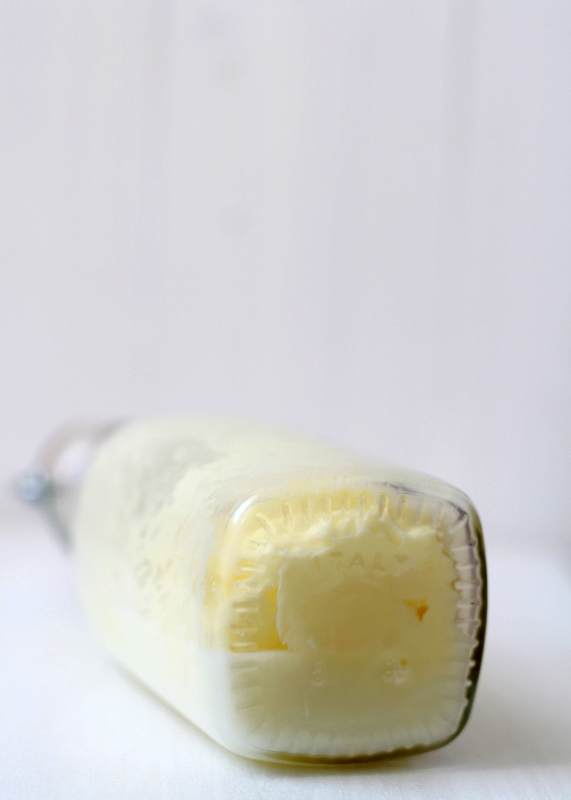
Note 2: The bottle shown in the pics is not the ideal recipient for making butter…when butter becomes solid, it is really hard to get the butter out of it.

Note 3:  The time indicated on the recipe is for an adult. Kids have less strengh and cannot mantain constant movement, so it will take them longer to actually get butter.


As seen at Cultured Butter


Related articles
Never miss a post
Name: 
Your email address:*
Please enter all required fields
Correct invalid entries

Simon Says: Daily Food Quote, August 15, 2011

Published by Monday, August 15, 2011 Permalink 0

by Simón de Swaan

Green beans, or string beans as they are usually called, must be done [boiled] till very tender — it takes nearly an hour and a half.—Sarah Josepha Hale, The Good Housekeeper (1839)

Sarah Josepha Hale was an American writer and editor who wrote the nursery rhyme “Mary Had a Little Lamb.”  She is also known for campaigning for the creation of the Thanksgiving holiday, and Hale served as editor of Ladies’ Magazine from 1827-1836 and Godey’s Lady’s Book from 1837-1877.

Click here to listen to “Mary Had a Little Lamb.”

Frontispiece from issue 41 of Godey's Lady's B...


Related articles


Never miss a post
Name: 
Your email address:*
Please enter all required fields
Correct invalid entries

Food Play: cómo hacer mantequilla en casa

Published by Monday, August 15, 2011 Permalink 0

por SandeeA
Click here to read English version

Hoy en día hemos olvidado el proceso de elaboración de los alimentos. Aunque no lo creáis, las aceitunas nacen con hueso y sin lata, y la leche no sale del tetrabrik. ¿Qué tal si nos divertimos haciendo magia en la cocina, y les enseñamos a nuestros hijos el proceso de convertir nata en mantequilla? Vamos a conseguir una mantequilla casera deliciosa, con un sabor increíble, y con un contenido de materia grasa en torno al 65%, a diferencia de las mantequillas comerciales que tienen al menos un 80%… y ningún sabor. Así que poned vuestra música favorita y a tocar las maracas! No sé quién dijo que con la comida no se juega…

Mantequilla casera 4

Receta de mantequilla casera

Tiempo de preparación: 4-5 min
Tiempo de cocción: 0 min
Total: 4-5 min
Cantidad: 40 gr de mantequilla (2 raciones, aproximadamente)

Dificultad: mi hijo de 3 años sabe hacerla

Ingredientes

100 ml de nata para montar, muy fría (mínimo 35 % MG, mejor si tiene 35,1% MG como Pascual por ejemplo)
un bote pequeño y que cierre herméticamente, por ejemplo un frasco de mermelada de 250 ml de capacidad


Preparación:

1. Introducimos 100 ml de nata en el bote y cerramos bien
Mantequilla casera 1

2. Ponemos la música.

Mantequilla casera 2

3. Agitamos de arriba a abajo. Puedes descansar un poco (pero acuérdate de apuntarte a un gimnasio) Notaremos como cada vez la mezcla se hace más ligera, llegará un momento en que parecerá que no se mueve nada dentro del bote. Hemos montado la nata (lleva unos 2 minutos)

4. Seguimos agitando el bote enérgicamente. De repente la nata se dividirá en una parte líquida y otra sólida. (tardará otros dos minutos). Ya tenemos la mantequilla por un lado, y el suero de leche (suero de mantequilla o buttermilk) por otro. Pasamos la mantequilla por agua fría, apretándola bien y amasándola para eliminar el exceso de suero, y ya está lista para consumir. El suero lo podemos usar en numerosas recetas de panes y repostería.

Mantequilla casera 3

Nota 1: Se puede hacer el mismo proceso mucho más rápido con una batidora de varillas para fabricar una cantidad mayor de mantequilla. Eso sí, será mucho menos divertido! Aquí tenéis un vídeo donde se muestra cómo hacerlo Cómo hacer mantequilla casera

Nota 2: La botella que se ve en las imágenes no es el recipiente más adecuado para fabricar la mantequilla, dado que cuando se solidifica resulta bastante complicado sacar la mantequilla. Mejor un envase de boca ancha como un bote de mermelada pequeño, tal y como comentaba anteriormente.

Nota 3: Los tiempos indicados en la receta son para un adulto. Si la elaboran niños, que tienen menos fuerza y son menos constantes en sus movimientos, les llevará más tiempo.

Visto en Ohdeedoh


Never miss a post
Name: 
Your email address:*
Please enter all required fields
Correct invalid entries

Food Art: Puff Pastry Salad, food photography by SandeeA

Published by Monday, August 15, 2011 Permalink 0

These photos are by SandeeA, author of the column Food Play, and who runs a site called . SandeeA is never lacking ideas when it comes to playful, fun recipes. Click here to find the recipe for this salad in a puff pastry. It would be a great recipe to get your kids in the kitchen!


Never miss a post
Name: 
Your email address:*
Please enter all required fields
Correct invalid entries

Food Art: Kheer, or Saffron Rice Pudding, by Meeta Khurana Wolff

Published by Saturday, August 13, 2011 Permalink 0

See more food photo compositions at Meeta K. Wolff or in our Food Art category.

Never miss a post
Name: 
Your email address:*
Please enter all required fields
Correct invalid entries

Simon Says: Daily Food Quote, August 11, 2011

Published by Thursday, August 11, 2011 Permalink 0
Cover of "The Importance of Being Earnest...

Cover via Amazon

by Simón de Swaan

You can’t possibly ask me to go without having some dinner. It’s absurd. I never go without my dinner. No one ever does, except vegetarians and people like that.–Oscar Wilde

Quote by Oscar Wilde, in “The Importance of Being Earnest” (1895).

The “ Importance of Being Earnest”, said to be “A Trivial Comedy for Serious People,” is a farcical comedy in which the protagonists maintain fictitious personae in order to escape burdensome social obligations. Working within the social conventions of late Victorian London, the play’s major themes are the triviality with which it treats institutions as serious as marriage, and the resulting satire of Victorian ways.

The official Oscar Wilde website can be viewed here.

Related articles


Never miss a post
Name: 
Your email address:*
Please enter all required fields
Correct invalid entries

UA-21892701-1