The Revolution of French Bread Baking (part 1)

Published by Sunday, April 1, 2012 Permalink 1

by Jean-Philippe de Tonnac

Cliquez ici pour la version française.

Translated and adapted by Jonell Galloway

The reinvention of French cuisine: it’s springtime for French cuisine, and it may not all be thanks to French bread bakers, but they are playing a major role

French bread bakers are in the limelight these days, and are considered as much artists as artisans. Marie-Odile Briet recently paid homage to their creativity, unbridled by the French government’s 1993 “bread decree,” defining in very precise terms what could and couldn’t be defined as “bread.” The most illustrious advocates of the art of bread making, which in essence had to be reinvented, were Gontran Cherrier (Paris), Dominique Saibron (Paris), Christophe Vasseur (Paris), Jean-Luc Poujauran (Paris), Basile Kamir (Paris), Eric Kayser (Paris) and Benoît Fradette (Aix-en-Provence).

They merit the name of bread baker, or boulanger, as well as inventors. But we mustn’t leave out the stout-hearted artisans, working quietly in their bakeries in the wee hours of the morning, with no one tooting horns for them, who are nonetheless master bakers. And where there’s smoke, there’s fire, and this is the proof of the true renaissance of the French bread making profession — a renaissance that has spread from a few Parisian arrondissements to the entire country. It is a true phenomenon that has spread its wings far and wide; it is a movement that has started a new chapter in the history of French bread making. In this new paradigm, there is no longer any plausible excuse for bad bread, for flavorless bread, for bread that is too expensive or too anything. The movement is quietly deepening its roots, backed by a history dating back thousands of years, basking in the glow of its established nutritional qualities. But that’s not all: these master bakers are now an integral part of the whole redefinition of French cuisine. Bread is no longer considered a humble food to fill your belly or to sop up your sauce. It is clearly in the public eye.

Continue Reading…

Never miss a post
Name: 
Your email address:*
Please enter all required fields
Correct invalid entries

Simon Says: Daily Food Quote, March 29, 2012

Published by Thursday, March 29, 2012 Permalink 0

by Simón de Swaan

Bread always falls on its buttered side.–English proverb

Photo courtesy of http://3.bp.blogspot.com/_pwrKRcgY4w4/S9XFGRE2sDI/AAAAAAAAATo/xZyDtpawfYs/s1600/ButteredToast.jpg


Never miss a post
Name: 
Your email address:*
Please enter all required fields
Correct invalid entries

Europain 2012 starts Tomorrow March 3 in Paris

Published by Friday, March 2, 2012 Permalink 0

The Europain bread trade show, which starts on March 3rd every second year, starts tomorrow, March 3, 2012. It runs until March 7.

Food Art: Bread Pot, by SandeeA


This year’s show includes large sections for artisanal bread making, a smaller one for industrial bread baking, a pastry making section, as well as a new SuccessFood section, dedicated to creative catering and restaurant remakes. Click here for an overview of the various sections.

Click here for a list of the various events going on throughout the show.

It is located at Paris Nord Villepinte outside Paris, France. To get there from Paris, take the RER B commuter train from the Gare du Nord in the direction of “Aéroport Charles de Gaulle,” and get off at the station “Parc des Expositions.”  From Roissy Charles-de-Gaulle airport, take the RER B, and get off at “Parc des Expositions.”

Never miss a post
Name: 
Your email address:*
Please enter all required fields
Correct invalid entries

The Dancing Bread Loaves

Published by Thursday, February 16, 2012 Permalink 0

On the UniversalBread Facebook page, Anne Le Cozannet-Renan just posted this scene of “the dancing bread loaves” from Johnny Depp‘s 1993 comedy “Benny & Joon,” including comedy scenes in the spirit of Charlie Chaplin and Buster Keaton. This scene takes place in a diner, where forks are put into two small baguette-like pieces of bread and the two baguettes are made to dance with each other.

Never miss a post
Name: 
Your email address:*
Please enter all required fields
Correct invalid entries

Is Focaccia Pizza’s Rival?

Published by Thursday, February 16, 2012 Permalink 0

by Diana Zahuranic

“It’s the most dangerous competitor of pizza,” said the president of Recco’s Consorzio near Genova. What could possibly pose a risk to the hallowed Italian dish? The risk lies in a similar bread known as focaccia, an olive-oily, salt-crunchy, inch-thick fluffy white dough often cut into squares in the piazza’s panetteria, or bakery. Tomato sauce and ciliegini cherry tomatoes, may be dropped on top, as well as anchovies, thin potato slices with rosemary sprigs, zucchini, eggplant, olives and tomato – basically any ingredient that goes on a pizza sits comfortably on its fluffy focaccia pillow, too. And like pizza, mozzarella cheese is basically a given.


If focaccia is pizza’s most serious contender, then Focaccia di Recco is the Achilles of this battle – but Recco’s focaccia has no weak spot.

I went with my class from the University of Gastronomic Sciences, a Slow Food-founded school based in Piemonte, Italy, to the 150-year old Ristorante Vitturin. The owner applied for the IGP label for his focaccia, and is now waiting for it to pass. If the bread earns this Indicazione di Geografica Protetta, or Protected Geographic Indication, that will make it the first restaurant product with that label. Naples’ pizza likely regrets not applying for one every time a new “Napoletano style” pizzeria erects its greasy walls in small suburbs and big cities. If it gains the IGP label, then that’s Point One for Focaccia di Recco.

We walked down a flight of steps into a moodier section of the restaurant and the kitchen, open with a line of windows framing the working chefs who flip paper-thin focaccia dough in the air and mix potions of ingredients to create pestos and sauces. The bustle of a restaurant kitchen was unapparent, non-existent, at 2:30 in the afternoon. The chef had time to show us how to make Focaccia di Recco.

Three long tables were set up in a U at the end of the room, set with dough, flour and long, thin rolling pins that were more like sticks. The chef was cheerful and energetic and even a bit cheeky to the very sincere Consorzio leader/ restaurant owner, who explained to us why the Focaccia di Recco deserved the IGP label.

“We use a farina di forza,” he explained. This “flour of strength” is 100% Manitoba flour, its forza derived from the high gluten content. The chef let us feel the fine, fine flour. He began to roll out soft, warm piles of dough very quickly into a thin layer on the table.

“The cheese must be this kind,” he said, showing us the Formaggio fresco latte ligurie tracciato. It was a big, white, squishy brick. The chef laid out the first layer over the tray, and then pinched off chunks with his hands of this fresh goat’s cheese from Liguria and plopped them evenly onto the pie.

“We’ve used the same recipe since 1800,” said the owner. The recipe is also written on the brochure of the restaurant (although the cheese is described as crescenza, an Italian-style Philadelphia cream cheese, because few people will ever get their hands on the crucial ligurie tracciato cheese). We were pinching off moist bits of this rich, creamy cheese and popping them into our mouths as we watched the chef toss his next piece of dough high into the air until it was so thin it was transparent.

Formaggio fresco di latte ligurie tracciato

The chef gently laid the fragile dough over the cheesy bottom layer. Some cheese chunks broke through, which would burst through in an exquisite, oily sizzle when in the oven. He drizzled it with extra virgin olive oil, cut off the excess dough in one deft motion using the rolling pin, and smashed the leftovers into another dough ball. “We don’t waste anything,” he said. In fact, we ate hand-rolled corkscrew-shaped pasta later, called trofie or trofiette, made out of that very dough ball.

The focaccia was carefully cooked on hot coals, the traditional method, especially for us. When it was ready, it was sent up to the ground level by a veritable focaccia carousel – a large wheel with level platforms where focaccia was placed, sent up, up, up and lifted off by the waiter to be served, pizza-style, at the table. The place is known as the “restaurant of the wheel.”

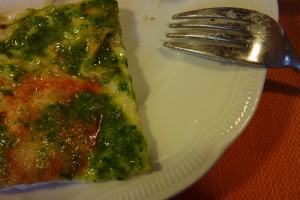
The cheesy Focaccia di Recco was crunchy in all the right places, soft and gooey where you wanted it, and underlined by the wholesome nuttiness and vegetal taste of the extra virgin olive oil. My preference was the Focaccia di Recco covered in zesty, herby, house-made pesto. Interestingly, they proudly deemed this una ricetta nuova, a new recipe. Tradition runs strong in Italy, where changes are tested slowly and considered seriously.

The pesto version of focaccia

Perhaps this answers the questionable “difference” between a focaccia and pizza. Focaccia is often thicker, and it is sometimes sold as “pizza a taglio,” “pizza by the slice,” even though everyone knows it is focaccia. In Italy, pizza is never one slice – it is a pie per person. And in Recco, the focaccia is thin and served on a round dish, one per person. These qualifications bring it dangerously close to pizza. When I asked the question, I was told that the ingredients in the dough are different than that of pizza dough.

And so it seems that pizza will remain pizza, focaccia will remain focaccia, and they will continue to be sold alongside one another for a long, long time as they always have. Don’t worry, pizza. Focaccia isn’t out to get you. Just don’t set up shop in Recco.

Related articles
Never miss a post
Name: 
Your email address:*
Please enter all required fields
Correct invalid entries

Our favorite food books of 2011

Published by Friday, December 23, 2011 Permalink 0

by Jonell Galloway

Cookbooks:

Ancient Grains for Modern Meals, by Maria Speck

My favorite cookbook of the year. Maria Speck knows how to incorporate ancient whole grains from around the world into dishes that remain rustic on the edges, but healthy, original and elegant at the same time. The technical explanations about ancient grains are excellent, as well as her explanations about general cooking techniques. The food stories she incorporates here and there about growing up in Greece and Germany add a touch of charm.

A must for any health-conscious real food lover who wants to eat interesting food combinations and dishes with a touch more sophistication that can pleasantly surprise guests, but not take them totally away from their references, because the dishes are for the most part influenced by Mediterranean cuisine.

For poetry-loving foodies:

The Poet’s Cookbook: Recipes from Germany, poems by 33 American poets with German translations

The Poet’s Cookbook: Recipes from Tuscany, poems by 28 Italian and American poets

I love the original concept of these books, pairing a food poem with a recipe. A poem by our Food Poetry Editor, Christina Daub, “Wine“, appears in the Tuscany version.

Farming: A Hand Book, by Wendell Berry

As a Kentuckian, Wendell Berry has forever been my mentor. He is, in my mind, the precursor of the Slow Food philosophy in the U.S., through the philosophy he has cultivated and spread for over 50 years now, well before Petrini and company started the Slow Food movement. Whether writing prose or poetry, he is always eloquent, and the same message of integrity, respect for others and for the land is the central message. This is one more inspiring book of poetry to add to our shelves of books to keep forever, that will comfort us in times of trouble, that we will pick up time and time again when we’re losing faith in humanity, devastated by the disrespect shown to the land, losing touch with our roots. Berry always says what he thinks in all his eloquence and with true gentillesse, but more than that, he lives the life he preaches, and that is consoling.

For food lovers, wine lovers, and culinary travelers:

Food Wine Rome, by David Downie and Alison Harris, published by The Little Bookroom, part of The Terroir Guides series

Food Wine Burgundy, by David Downie and Alison Harris, published by The Little Bookroom, part of The Terroir Guides series

Paris, Paris: Journey into the City of Light, by David Downie

David Downie writes wonderful articles for The Rambling Epicure and Alison does exquisite food photo exhibits for our Food Art section. I can never get enough of their work, because the writing is exquisite and full of literary and historical references, and the photos are truly art. Downie always shows you the insider’s view of whatever he writes about, and Alison has a great eye for catching the very essence of what they’re covering, whether it be truffle hunting or discovering little out-of-the way restaurants in isolated villages. You can never go wrong with their books.

For bread lovers:

Dictionnaire Universel du Pain, by Jean-Philippe de Tonnac

Jean-Philippe de Tonnac also writes for The Rambling Epicure, and has recently become THE bread writer all bakers want to meet. This book should in my mind be translated into English immediately. It offers a wealth of information about bread from time immemorial, covering techniques and breads from around the world, as well as spirituality, sex, gluten intolerance, bakers as poets, bakers as prophets and much more. “Encyclopedia” would be a more appropriate term than “dictionary”.

Mindful eating:

The Self-Compassion Diet: Guided Practices to Lose Weight with Loving-Kindness by Jean Fain

Jean Fain has tried every diet out there, so she can speak with authority about the subject of weight loss. She is also affiliated with Harvard Medical School as a psychotherapist, so she has the credentials to talk about the subject. Her book takes a totally different approach to weight loss than any I’ve seen. She doesn’t count calories and restrict what you eat. Her approach is instead through the mind, to become mindful of what we eat, when we eat (when stressed or lonely, for example), why we eat (out of need to nourish ourselves or out of boredom or frustration); to appreciate what we eat, and above all to be conscious of our entire relationship with food.

The book teaches you how to take control of yourself and your relationship to food so that you can change the way you think about food in general, so that eating becomes a totally different experience. Jean does this through loving-kindness, self-hypnosis, meditation and numerous other weight-loss approaches, which you follow gradually, not all in one go. She also offers a CD including guided meditations to help patients after they have stopped therapy.

Her main thrust is self-love, that we must not be too hard on ourselves, or we’ll fall back in to our old and bad habits quickly. The beauty of the book and CD combination is that you can live half way around the planet and still follow her method.

For lovers of literature: food essays and prose:

Slow Food: Collected Thoughts on Taste, Tradition, and the Honest Pleasures of Food, by Carlo Petrini and Ben Watson

This book consists of an anthology of articles by the world’s top food writers, making me remember the old days when we’d visit the family in the countryside and how I thought it odd that they grew all their vegetables themselves and knew how to can them; how they drank milk straight from the cow (one of my fondest childhood memories), and how we relished in those meals, how it built bonds between us. “Drawn from five years of the quarterly journal Slow (only recently available in America), this book includes more than 100 articles covering eclectic topics from “Falafel” to “Fat City.” From the market at Ulan Bator in Mongolia to Slow Food Down Under, this book offers an armchair tour of the exotic and bizarre. You’ll pass through Vietnam’s Snake Tavern, enjoy the Post-Industrial Pint of Beer, and learn why the lascivious villain in Indian cinema always eats Tandoori Chicken.”

For pastry makers and lovers:

Mich Turner’s  Masterclass: The Ultimate Guide to Cake Decorating Perfection, by Mich Turner, published by Jacqui Small LLP, London

Mitch Turner’s cake decorating book is worthy of a fine art book in its presentation, and of an encyclopedia in terms of the detailed explanations about cake decorating. Her pastry and cakes are truly works of art. A must for all pastry makers, whether professional or amateur.

Food art:

From Plate to Pixel: Digital Food Photography, by Hélène Dujardin

This book is special for many reasons. There are lots of people out there trying to learn food photography without a clue as to even the basic techniques required and no possibility of taking a food photography workshop. This is the book for them, because all the basics plus quite a lot more are explained in a clear, direct manner. It also verges on being an art book, because it is illustrated by Dujardin’s beautiful food photography.



Never miss a post
Name: 
Your email address:*
Please enter all required fields
Correct invalid entries

Health Challenge: 5 ways to make your child’s lunchbox healthier

Published by Tuesday, November 1, 2011 Permalink 0

by Tamar Chamlian

The alarm goes off again. Another day…you need to get yourself out of bed, get your creative juices flowing, and prepare your kids a healthy lunchbox for school.

The challenge for parents today is creating a healthy balanced lunchbox meal ensuring their children receive all the required nutrients, and at the same time giving them things that they want to eat (and WILL actually eat).


Here are five easy tips to render your child’s lunchbox “yummier” and more child-friendly, creative, and appealing:

  1. Use a variety of breads during the week. Make a tuna sandwich with whole grain toast one day, and a cream cheese bagel the next.
    Other ideas for bread: White toast, multi-grain toast, white French baguette, whole grain French baguette, plain bagel, sesame bagel, olive bagel, flour, whole wheat tortillas, pita bread, wholewheat burger bun, etc.
  2. Introduce new items that are fun and creative, such a hummus dip with carrots or cucumbers, bean dips with side crackers, or even fruit dips with plain crackers.
  3. Add items such as low fat yogurt — plain, fruity, or chocolate – as their snack or dessert.
  4. Substitute potato chips with things like almonds, nuts, sunflower seeds or dried apricots, raisins, prunes, or with fruit chips that can have a variety of sliced grilled apples, bananas, peaches, and grape tidbits.
  5. Pack a small water bottle to encourage water consumption, as well as a small fruit juice. If you have the time to make a fruit juice or smoothie yourself at home, all the better, because your children will benefit from the extra the vitamins and nutrients found in fresh, unprocessed foods.

Tamar Chamlian studied in Lebanon and the U.K. She is a food scientist and holds a Master’s degree in food marketing. She currently lives in Switzerland.

Continue Reading…

Never miss a post
Name: 
Your email address:*
Please enter all required fields
Correct invalid entries

What is Mindful Eating?

Published by Wednesday, October 5, 2011 Permalink 0

by Jonell Galloway

Mindful Eating : Get serious about what you put in your mouth!

Mindful Eating means getting serious about what you put in your mouth.

Mindful Eating is sensual — in this case visual — as well as cerebral.

You don’t have to think with your taste buds every minute of your life, like I do, but eating takes on a new importance in your life, and is no longer just an essential action required to fuel your body.

Mindful Eating starts by being mindful of every aspect of our food chain, from the very soil to the end product we put in our mouths. It is about taste and smell and nutrition, but also about respect for the land and soil that provide our nourishment.

It is about the seeds we plant, the fertilizer we spread.

It is about the human contact between a producer and a buyer and the bond that is formed when he puts the vegetables he has grown with tender loving care and the sweat of his brow into your hand. It is about leaving the land in a condition that will allow our children to live on in a healthy manner.

Mindful Eating is not only about how the steak tastes, but also about what the cow has eaten, where it comes from, how it has been treated.

It is about cooking real homemade food for our family in a spirit of love and awareness, and making sure they are getting the nutrients they need and about avoiding the toxic ingredients so many foods contain.

Photo courtesy of Odette de Crecy.

It is about reading labels in supermarkets, about trying to eat natural, if we can, or at least making the best effort we can to put quality products on the table.

Mindful Eating requires us to look at the food we eat, smell it, chew it slowly and appreciate its texture and flavor, and then pause and enjoy the aftertaste.

Mindful Eating is somewhat a way of life, although we mustn’t become obsessive about it. Almost by definition, it moves toward consumption of local products, and thus re-creation of local economies.

It is a way of communing with our environment – our family, our community, local business, producers, nature – and the satisfaction that is derived from this.

Mindful Eating gives concrete, practical results. It can improve our health and help us lose weight; it can help us lower cholesterol and consume more nutritious food.

It can give us a sense of well-being, because we have the feeling we’re doing what is right not only for ourselves and our family, but also for our community and the world.

Photo courtesy of Nikoman.

It can cut down our food budget, since seasonal products bought directly from local farmers will invariably be cheaper. They will also fresher and have more vitamins.

This is Part One of a series of articles exploring the endless possibilities incorporating this approach into our daily lives. Stay tuned for the following segments:

Part Two: Mindful Eating and Farmers
Part Three: Mindful Eating and Health
Part Four: Mindful Eating and the Local Economy
Part Five: Mindful Eating and the Land
 
___________________

Alessandro Guerani is a food and still life photographer in Bologna, Italy. He also has a food photography blog with beautiful food photos, Food-o-Grafia. The pomegranate photo is from his Baroque Food photo album.

Never miss a post
Name: 
Your email address:*
Please enter all required fields
Correct invalid entries

Switzerland: Rosa’s Musings: Butterzopf, The History Of A National Sunday Bread

Published by Saturday, October 1, 2011 Permalink 0

by Rosa Mayland

Switzerland (also known as “Confoederatio Helvetica” or “die Schweiz”, “la Suisse”, “Svizzera”, “Svizra”) is a federal republic composed of 26 cantons and 4 different linguistic and cultural areas (German, French, Italian and Romansch). It’s therefore not surprising if its cuisine reflects its rich heritage and highly diverse cultures. It is rather like an island in the middle of Europe, like a tiny kingdom.

Each region and canton has its very own traditional dishes and specialties as well as produce, and they defend and even protect it fiercely, because there are dishes, cheeses, wines, breads, and many more food items that are now protected by AOCs in Switzerland.

Even if this tiny piece of land stuck between Germany, Austria, France, Italy has its own highly diverse culinary identity, one cannot refute that each part of the Swiss Confederation has, to a certain extent, been influenced by its neighbors, and vice versa. For example, a sausage resembling the anise-flavored Geneva sausage called Longeole can also be found in Chablais (Haute-Savoie); a cheese similar to Valais raclette is made in Savoie too; the Swiss German spätzli seem to be of Swabian (German) origin. Then there is polenta or risotto which evoke the Apennine Penninsula, and are often found in Ticino, and, well, the list goes on. As it is the case with every place that is not in total isolation, the borders are quite permeable, so it is pretty understandable that ideas, information, arts and science cross back and forth across the borders.

Continue Reading…

Never miss a post
Name: 
Your email address:*
Please enter all required fields
Correct invalid entries

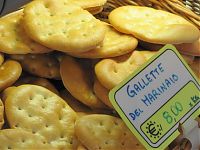
David Downie: Gallette, Italian Riviera Sea Biscuits

Published by Tuesday, September 27, 2011 Permalink 0

by David Downie

gallette del marinaio, sea biscuits, panificio maccarini

Everyone knows about the focaccia of Genoa and the Italian Riviera. But who remembers the region’s hardtack?

Sea biscuits: those hard, dry crackers that sailors would take with them on long journeys, because normal bread got moldy within days?
In Italian, sea biscuits are called “gallette.” The same word is used for the surf-worn, flattened stones you find on beaches. That’s because sea biscuits look very much like those stones, with pock marks.

There used to be hundreds of bakeries up and down the coast of Italy, and in America too, that baked sea biscuits. Now only a handful continue the tradition, most of them in Liguria, and only one makes gallette in the old-fashioned way, meaning the way they were made in the nineteenth and early twentieth centuries.

Continue Reading…

Never miss a post
Name: 
Your email address:*
Please enter all required fields
Correct invalid entries

UA-21892701-1