by Jonell Galloway

At the New York Botanical Garden, the Medicine Hunter takes a close look at the tree that can help boost your mood, heart health and brain power in the video Chocolate as Medicine.
|
|

A Literary Culinary Journal
Too Little Chocolate, Too Little Time

There’s a new bakery in Kensington, Maryland. Tiny, charming and open early. This is great news for a town which has so little to offer on the culinary front, you might think you were in North Dakota.
|
|
by Jenn Oliver
I love to make food creations as gifts for holidays, because I communicate through food (definitely better than through words). With words I find myself trying to be very precise, searching rather unsuccessfully for the most succinct way to express a thought. However, with cooking, I let loose a little more – I find the constraints and structures of recipes to actually encourage a bit of play. It’s one of the reasons why I have come to love gluten-free cooking, because the restriction in effect serves as an impetus for ingenuity; so amidst all of the rules surrounding the preparation of food, I find the freedom to express myself. Today, I tempered chocolate to tell my husband, “I love you” for Valentine’s.
Tempering chocolate is one of those techniques that is all about rules. It takes care, patience, and most of all, constant attention. A bit of a hassle if you don’t have a temperature controlled device – but, if dipping fruit or other chocolaty Valentine’s confections, there are definitely some advantages to using tempered chocolate. For one, the melting point of the chocolate is higher, so it doesn’t melt as easily, making it less messy to eat. Tempered chocolate is also prettier. It has a more glossy sheen to it, and snaps a bit when you break it apart. Besides aesthetics, tempered chocolate is less likely to bloom – the process where fat rises to the surface giving chocolate unattractive gray splotches.

|
|

With all we remember about chocolatini, her legendary eyes and films and husbands and tireless efforts on the behalf of AIDS victims, the Hollywood queen was also, by the way, an icon of the chocolate world.
In 1953, her face sold Whitman’s chocolates ads for Valentine’s that year. In 1955, she and Rock Hudson invented the Senator John Warner, a concoction of vodka, Kahlua and Hershey’s syrup after working long hours on the set of Giant in Marfa, TX. Taylor proclaimed it “the best drink I ever tasted.”
But my favorite Taylor contribution to the chocolate world was one you could order just five blocks from the White House. During her marriage to National Velvet, she frequented the show restaurant in Washington DC, Dominique’s. It may not have had the best food in town, but its patrons attracted attention like no one else and people went to see and be seen. Autographed photographs of Ted Kennedy and Tony Bennett, Robert Redford and others glammed the walls while exotic mounted animals, an alligator, a lion and several other large creatures loomed near diners craning their necks between bites.
I don’t remember what I ate for dinner at Dominique’s since already in those days, my sole focus was on dessert. And the Elizabeth Taylor Special was as extravagant as she was. I ordered it every time.

It looked heavenly, a large cloud of whipped cream, but inside this cumulus pouf hovering on the signature Dominique plate, were the real jewels: five chocolate truffles, brown diamonds every one.
Dominique’s no longer exists having been sold by its original owner in 1987, but that dessert will float on in my memory more than Cleopatra, poet or any other work Liz Taylor graced with her fierce talent and jaw-dropping beauty.
—————
On The Chocolate Trail: Christina Daub is an American The Poet’s Cookbook who has spent her life traveling around the world in search of great chocolate. She is also the editor of the Food Poetry section. Published in The Poet’s Cookbook series, she has work in the first volume, which included poems and recipes from Tuscany (in English and Italian), and the second (in German and English), published by the Goethe Institute. She teaches creative writing at George Washington University in Washington, D.C.
|
|

Food photographer Steve Homer of Sabor de Almería in the southeast of Spain is a regular contributor to our site.
|
|
 by Jonell Galloway
One of my favorite ways of creating tasty but healthy dishes is using fruit and vegetables as sauce. There are millions of ways to do this, depending mainly on the season.

Oranges are abundant at the moment, so I’ve been using a lot of orange juice to liven up dishes. It adds a burst of flavor, yet requires no cream or butter, thus making it low in calories and high in fiber.
The season is short for wild Italian asparagus, so take advantage of it in April and May.
|
|
Including a food trend prediction for 2012…
by Alice DeLuca
When first married, I received lots of advice on how to stay married, which is of course so much more complicated than “getting” married. For example, Sally told me that both a happy marriage and a career had been possible for her because she created and froze 4 quiches at a time. I immediately pictured 4 quiches in the deep-freeze, carefully labeled for rotation of the stock so as to avoid freezer-burn and waste. The quiches would keep.

|
|
by Diana Zahuranic
“Let’s make cheese!” To my friends and me, the idea sounded satisfyingly artisanal. Cheesemaking is simple enough in practice so that anyone with some background can try their hand at it. The theory is more complicated, but because my friends and I had that part down pat, actually putting it to use would be an afternoon well-spent.
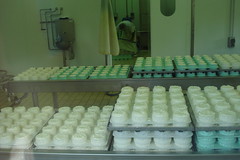
Cheesemakers in Chaource
Or so we thought. Yes, the craft of cheesemaking is simple compared to the amazing, diverse world of cheese that it produces (or rather, that Europe produces, with no laws prohibiting unpasteurized cheese aged less than 60 days – which is 100s to 1000s of varieties). But the first thing the nine of us did in my friend’s tiny Italian kitchen was say, “Doesn’t anybody know how to make cheese?”
|
|
 by Jonell Galloway
Since I live in the old town in Geneva, I walk everywhere. A few years ago, I had shoulder and wrist injuries from carrying too many heavy shopping bags, and ever since, I’ve had to do my heavy grocery and household shopping with a trolley. A couple of years ago, after regularly hearing the leshop.ch ads on WRS, I decided to try and avoid pulling my heavy trolley, filled with milk, detergents, and other heavy products, up the hill from the Coop 2000 and the Boulevard Helvétique market to the Russian Church, so I tried leshop.ch. With the ice and snow on the streets, home delivery can definitely be a godsend.
|
|
In classic French cuisine, the term “salpicon” refers to a mixture of one or more ingredients, diced, and then bound with a sauce.

The salpicon is then used to fill pastry shells, fill pastry dough, make canapés — the list is endless.
They can also be used to make cromesquis or to stuff eggs or meat.
Typical examples are diced cucumbers, green asparagus seafood bound with mayonnaise, or leftover meats bound with white or brown sauce.
Today, the term is also used in Mexican cuisine.
|
|
 Meet Jonell Galloway, a freelance writer and editor specialized in French cuisine.