 by Simón de Swaan
Appetite comes with eating; the more one has, the more one would have.–French proverb
|
|

A Literary Culinary Journal

Prerna Singh runs the award-winning food blog Indian Simmer, which was a finalist in the prestigious Saveur Best Food Blogs this year. Her photos are at the same time sophisticated and rustic, giving a natural yet polished look to the simplest of foods. She grew up in India, but now lives in the U.S. with her husband and daughter.
Prerna uses a Canon 50mm f1.4 lens and photographs in natural light, occasionally using reflectors.
|
|
by Diana Zahuranic
“It’s the most dangerous competitor of pizza,” said the president of Recco’s Consorzio near Genova. What could possibly pose a risk to the hallowed Italian dish? The risk lies in a similar bread known as focaccia, an olive-oily, salt-crunchy, inch-thick fluffy white dough often cut into squares in the piazza’s panetteria, or bakery. Tomato sauce and ciliegini cherry tomatoes, may be dropped on top, as well as anchovies, thin potato slices with rosemary sprigs, zucchini, eggplant, olives and tomato – basically any ingredient that goes on a pizza sits comfortably on its fluffy focaccia pillow, too. And like pizza, mozzarella cheese is basically a given.

If focaccia is pizza’s most serious contender, then Focaccia di Recco is the Achilles of this battle – but Recco’s focaccia has no weak spot.

I went with my class from the University of Gastronomic Sciences, a Slow Food-founded school based in Piemonte, Italy, to the 150-year old Ristorante Vitturin. The owner applied for the IGP label for his focaccia, and is now waiting for it to pass. If the bread earns this Indicazione di Geografica Protetta, or Protected Geographic Indication, that will make it the first restaurant product with that label. Naples’ pizza likely regrets not applying for one every time a new “Napoletano style” pizzeria erects its greasy walls in small suburbs and big cities. If it gains the IGP label, then that’s Point One for Focaccia di Recco.
We walked down a flight of steps into a moodier section of the restaurant and the kitchen, open with a line of windows framing the working chefs who flip paper-thin focaccia dough in the air and mix potions of ingredients to create pestos and sauces. The bustle of a restaurant kitchen was unapparent, non-existent, at 2:30 in the afternoon. The chef had time to show us how to make Focaccia di Recco.

Three long tables were set up in a U at the end of the room, set with dough, flour and long, thin rolling pins that were more like sticks. The chef was cheerful and energetic and even a bit cheeky to the very sincere Consorzio leader/ restaurant owner, who explained to us why the Focaccia di Recco deserved the IGP label.
“We use a farina di forza,” he explained. This “flour of strength” is 100% Manitoba flour, its forza derived from the high gluten content. The chef let us feel the fine, fine flour. He began to roll out soft, warm piles of dough very quickly into a thin layer on the table.
“The cheese must be this kind,” he said, showing us the Formaggio fresco latte ligurie tracciato. It was a big, white, squishy brick. The chef laid out the first layer over the tray, and then pinched off chunks with his hands of this fresh goat’s cheese from Liguria and plopped them evenly onto the pie.
“We’ve used the same recipe since 1800,” said the owner. The recipe is also written on the brochure of the restaurant (although the cheese is described as crescenza, an Italian-style Philadelphia cream cheese, because few people will ever get their hands on the crucial ligurie tracciato cheese). We were pinching off moist bits of this rich, creamy cheese and popping them into our mouths as we watched the chef toss his next piece of dough high into the air until it was so thin it was transparent.

The chef gently laid the fragile dough over the cheesy bottom layer. Some cheese chunks broke through, which would burst through in an exquisite, oily sizzle when in the oven. He drizzled it with extra virgin olive oil, cut off the excess dough in one deft motion using the rolling pin, and smashed the leftovers into another dough ball. “We don’t waste anything,” he said. In fact, we ate hand-rolled corkscrew-shaped pasta later, called trofie or trofiette, made out of that very dough ball.

The focaccia was carefully cooked on hot coals, the traditional method, especially for us. When it was ready, it was sent up to the ground level by a veritable focaccia carousel – a large wheel with level platforms where focaccia was placed, sent up, up, up and lifted off by the waiter to be served, pizza-style, at the table. The place is known as the “restaurant of the wheel.”
The cheesy Focaccia di Recco was crunchy in all the right places, soft and gooey where you wanted it, and underlined by the wholesome nuttiness and vegetal taste of the extra virgin olive oil. My preference was the Focaccia di Recco covered in zesty, herby, house-made pesto. Interestingly, they proudly deemed this una ricetta nuova, a new recipe. Tradition runs strong in Italy, where changes are tested slowly and considered seriously.
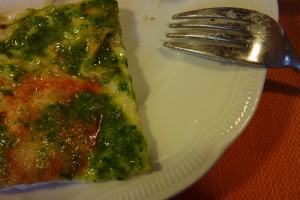
Perhaps this answers the questionable “difference” between a focaccia and pizza. Focaccia is often thicker, and it is sometimes sold as “pizza a taglio,” “pizza by the slice,” even though everyone knows it is focaccia. In Italy, pizza is never one slice – it is a pie per person. And in Recco, the focaccia is thin and served on a round dish, one per person. These qualifications bring it dangerously close to pizza. When I asked the question, I was told that the ingredients in the dough are different than that of pizza dough.
And so it seems that pizza will remain pizza, focaccia will remain focaccia, and they will continue to be sold alongside one another for a long, long time as they always have. Don’t worry, pizza. Focaccia isn’t out to get you. Just don’t set up shop in Recco.
|
|
 by Simón de Swaan
We plan, we toil, we suffer — in the hope of what? A camel-load of idol’s eyes? The title deeds to Radio City? The Empire of Asia? A trip to the moon? No, no, no, no. Simply to wake just in time to smell coffee and bacon and eggs. And, again I cry, how rarely it happens! But when it does happen — then what a moment, what a morning, what a delight?–J.B. Priestley
John Boynton Priestley, OM known as J. B. Priestley, was an English novelist, playwright and broadcaster. He published 26 novels, notably The Good Companions (1929), as well as numerous dramas, such as An Inspector Calls. His output included literary and social criticism.

|
|
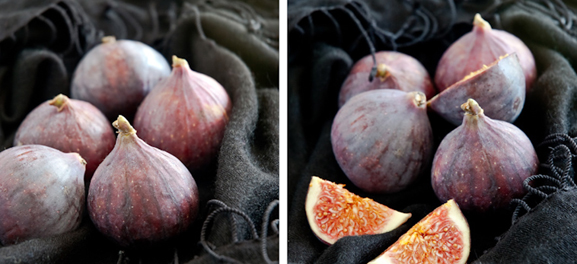
See more beautiful photo compositions at Meeta K. Wolff. She runs the popular blog What’s For Lunch Honey?
|
|
There are people who eat the earth and eat all the people on it like in the Bible with the locusts. And other people who stand around and watch them eat it.–Lillian Hellman, 1939
Lillian Florence “Lily” Hellman (June 20, 1905 – June 30, 1984) was an American playwright, linked throughout her life with many left-wing causes. She was romantically involved for 30 years with mystery and crime writer Dashiell Hammett (and was the inspiration for his character Nora Charles), and was also a long-time friend and literary executor of author Dorothy Parker.

|
|
|
|
VIII. The table is the only place where man is never bored for the first hour.–Jean Anthelme Brillat-Savarin
Jean Anthelme Brillat-Savarin was a French lawyer and politician, and gained fame as an epicure and gastronome. His famous work, Physiologie du goût (Physiology of Taste), was published in December 1825. The full title is Physiologie du Goût, ou Méditations de Gastronomie Transcendante; ouvrage théorique, historique et à l’ordre du jour, dédié aux Gastronomes parisiens, par un Professeur, membre de plusieurs sociétés littéraires et savantes. The book has never been out of print since it first appeared, two months before Brillat-Savarin’s death. Its most notable English translation was done by food writer and critic M.F.K. Fisher, who remarked, “I hold myself blessed among translators.” Her translation was first published in 1949.

|
|
It is not from the benevolence of the butcher, the brewer, or the baker that we expect our dinner, but from their regard to their own interest.–Adam Smith, 1776
Adam Smith was a Scottish social philosopher and a pioneer of political economy. One of the key figures of the Scottish Enlightenment, Smith is the author of The Theory of Moral Sentiments and An Inquiry into the Nature and Causes of the Wealth of Nations. An Inquiry into the Nature and Causes of the Wealth of Nations, generally referred to by its shortened title “The Wealth of Nations,” is the magnum opus of the Scottish economist and moral philosopher Adam Smith. First published in 1776, it is a reflection on economics at the beginning of the Industrial Revolution and argues that free market economies are more productive and beneficial to their societies. The book is a fundamental work in classical economics.

|
|
 Meet Jonell Galloway, a freelance writer and editor specialized in French cuisine.


