
What are the four mother sauces as defined by French chef Carême in the nineteenth century? Tomate, Béchamel, Velouté and Espagnole.
|
|

A Literary Culinary Journal
What are the 5 mother sauces as defined by Auguste Escoffier in the twentieth century? Béchamel, Velouté, Espagnole, Hollandaise and Tomate.
|
|
What are the four mother sauces as defined by French chef Carême in the nineteenth century? Tomate, Béchamel, Velouté and Espagnole.
|
|

Comté cheese is a jewel born of Franco-Swiss history. By today’s boundaries, it is in the Jura Mountains in France, so it is technically considered a French cheese, although it’s made in a manner similar to that of the hard “cooked” Swiss cheeses we know as “holey Swiss cheese.”
Cara De Silva waxed poetic about Comté several years ago in Saveur magazine. I can’t describe it any better:
…that semifirm Comté is born of the distinctive milk of the region’s Montbeliarde cows, whose diet includes wild orchids, daisies, dandelions, and more than 400 other plant varieties; that it’s produced in the fruitières, or cooperative dairies, that have dotted the landscape of the Franche-Comté region for centuries; that the Montbeliardes’ milk is partly skimmed and heated gently in copper-lined vats before being combined with rennet; that the resulting curds are broken into fine grains, put into molds for pressing, and set on spruce boards for a few weeks of aging before being entrusted to an affineur, who oversees the further maturing of the cheese.
The Ancient Romans were already enjoying cheeses from this Franche-Comté region, and the cheese production in the villages of Deservillers and Levier were mentioned as early as 1264-1280. In 1380, there was mention of a cheese of such a large size that it could only be produced by a cooperative. After 1678, when Franche-Comté became part of France, there was an exodus of native Helvetics. It was then that other Swiss from the Gruyère region moved to the region, bringing the method of making Gruyère cheese — the cheese we often call “Swiss cheese” — with them. It is for this reason that the original name was Gruyère de Comté, now the AOC “Comté.”
|
|

Emmanuel Ménétrier / Foter / CC BY-NC-SA
Pot-au-feu and petite marmite in today’s vocabulary are the same thing. Until the nineteenth century, the term pot-au-feu simply referred to a family soup to which was added different ingredients every day, usually with beef and chicken added on Sunday. The regional variations were endless, depending on availability and season and depending on the cook.
In 1829, the French etymology dictionary defined pot-pourri as “the name our fathers gave to the pot-au-feu.” In the nineteenth century, the recipe started to take on its modern ingredients of beef, root vegetables and a veal bone, but it still included chicken, which many people, including my French butcher’s wife, leave out these days.
Escoffier, who codified French cuisine in the late nineteenth century and early twentieth century, set down the recipe in Le Guide Culinaire in 1902, still calling it petite marmite. The regional variations started to disappear, and the recipe has now been simplified by most home cooks to contain only beef, no chicken. Escoffier insisted on the importance of the chicken, but today, one rarely finds a pot-au-feu with mutton, veal, pork, chicken, duck or turkey. The other name, petite marmite, has pretty much gone out of usage.
|
|
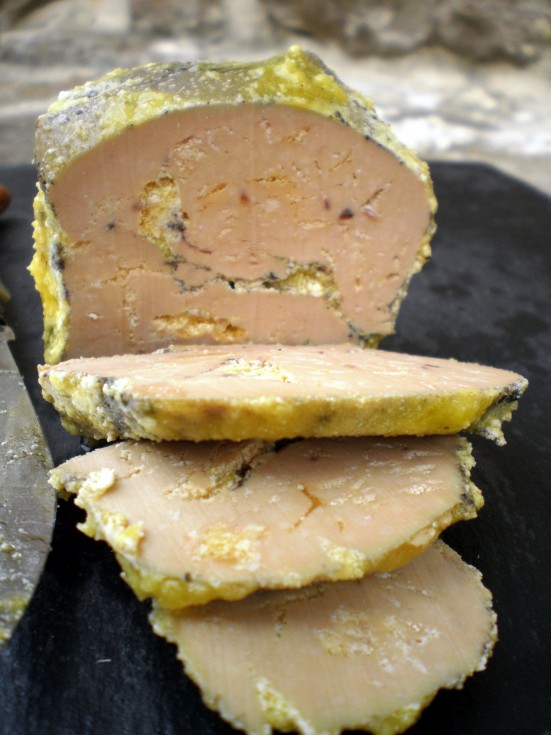
“I tell you it will be more tolerable for the Fejee that salted down a lean missionary in his cellar against a coming famine; it will be more tolerable for that provident Fejee, I say, in the day of judgment, than for thee, civilized and enlightened gourmand, who nailest geese to the ground and feastest on their bloated livers in thy pate-de-foie-gras.”–Herman Melville, Moby Dick (1851)
In What to Eat in France: Foie Gras, we talked about how foie gras is made and the different legal classifications, which determine both the quality and price. Let’s move on to the fun part now. We’ve bought our high-quality foie gras and we want to eat it in the best way possible. Here are some ideas, both traditional and inventive.
So you’ve bought a foie gras entier, a foie gras, or a bloc de foie gras. You’ll be eating pure or fairly pure foie gras, but how do you eat it and with what?
There is no one way to eat it. The Romans soaked it in honey and milk to fatten it still more before cooking. The first recipe on record comes from Apicius in his fourth century De re culinaria: Thinly slice the foie gras with a reed. Soak in garum. Crush some pepper, lovage and two bay leaves. Wrap in a caul. Grill and serve.
Today we eat it differently. Cold foie gras is most often eaten with something acidic to help digest the fat. This traditionally includes cold, sweet garnishes such as apple, rhubarb, fresh or dried figs, grapes, or pears, and toast, but contemporary chefs venture outside these limits, serving it with dried fruit and nuts and toasted brioche or raisin-fruit bread. More contemporary garnitures are onion jam or caramelized onions, Balsamic vinegar, port or Sauternes jelly, chutney, cassis berries, raspberries, blueberries or coarse sea salt.
Some people simply eat it with green salad, although I find that salad dressing deadens the natural depth of flavor. It’s also possible to eat it with cornichons and pickled onions. like one does with regular pâté, but once again, the vinegar is likely to overpower the delicate flavor.
Cooked foie gras should never be reheated. It should be eaten just colder than room temperature, so take it out of the refrigerator about 45 minutes before serving. Slice it with a knife while it is still cold. It is usually served with cold garnishes, most often as a starter.
|
|
Nouvelle cuisine was so specifically French that it was, and still is, misunderstood in the rest of the world. You have to be dominated by Escoffier before rejecting him becomes meaningful.–Mark Kurlansky, Choice Cuts (2002)
Mark Kurlansky’s Choice Cuts features more than 200 essays on what great thinkers, writers, musicians and sometimes even foodies thought about food in all its forms throughout time. It is essential to any cookbook collection and serves as an amusing read at any time of the day.

|
|
//
par Jean-Philippe de Tonnac
Click here for English
Michael Steinberger, La cuisine française, un chef d’œuvre en péril, traduit de l’américain par Simon Duran [Au Revoir To All That, Bloomsbury, New York, 2009], Fayard, 2011.

Qui aime bien châtie bien. Prenez la France. La Fraaaaaance !, comme disait le Général. Voilà le sujet urticant par excellence. Parmi ses thuriféraires et inconditionnels, obsédés par l’idée de ce qu’est la France en essence et assez peu en actes, les étrangers qui fréquentent ce pays, qui l’adorent tout en conservant leur distance, une sorte de regard critique, ces étrangers sont souvent les plus enragés. Pour eux les Français ne sont tout simplement pas à la hauteur de leur histoire qu’ils desservent et trahissent à l’envie. La cuisine française, un chef d’œuvre en péril, le livre de Michael Steinberger, œnologue de réputation faite, chroniqueur au The New Yorker ou au The New York Times Magazine, est des plus symptomatiques de cette façon de considérer que le haut héritage qui échoit à cette France en décomposition économique et spirituelle, c’est un peu la confiture aux cochons. Vous pouvez, si vous voulez, remplacer la confiture par ce « gâteau de foies blonds » qui a fait la gloire d’Alain Chapel (« une purée de foies de poulet et de moelle de bœuf servie avec une sauce au homard et à la crème », décrit par le critique gastronomique Craig Claiborne du New York Times comme « l’une des plus grandes gloires culinaires de la génération actuelle »), c’est la même chose. La charge est peut-être salutaire puisqu’il s’agit d’essayer de mettre la gastronomie française au défi de s’égaler une fois encore. Mais elle est cruelle aussi car elle ne pardonne aucun écart, veut crever les arrogances et les baudruches qui desservent, selon l’auteur, un héritage inestimable. Steinberger est une bête qui aime, et donc une bête féroce. Comme l’empereur Commodore défiant le général Maximus dans Gladiator, il convoque les traîtres dans l’arène après leur avoir planté une dague dans le dos.
|
|
 Meet Jonell Galloway, a freelance writer and editor specialized in French cuisine.


