Switzerland: Watermelon and Fennel Salad Recipe

Published by Thursday, September 8, 2011 Permalink 0

Switzerland: Watermelon and Fennel Salad Recipe

by Jenn Oliver

Until recently, I didn’t know anyone did anything with a watermelon besides just cut it up and eat it. I mean, it’s already completely sweet, juicy, the pure essence of summer. Why mess with the perfection embodied in this pink fruit? The mere sight of a ripe watermelon evokes memories of childhoods past. For me, it evokes images of weeks at girl scout camp, running around outside, carefree, swimming in the lake, making new friends, riding horses…you get the idea.

But why not play, and see just where the flavor of this fruit can go? Have you ever thought about the flavors of this king of summertime snacks and how they would meld with other foods? I certainly hadn’t until Meeta challenged us Plate to Page alumni to photograph watermelon as a fun photography assignment — two photos — one raw, and one in a dish. Yes, a dish. Who puts watermelon in things? Ha, maybe it was time to change my perspective and open my eyes to other possibilities.

Perspective is a funny thing. Sometimes our first impressions have such a profound effect on us that we forget to look for other possibilities right in front of our noses. I think that’s why I like to go for walks and hikes, because all that time away from everything gives my mind space to think and breathe. And sometimes, I even get to get lost and freak out after sitting at a train station for 30 minutes until I figure out that the train only passes through on weekdays…

Continue Reading…

Never miss a post
Name: 
Your email address:*
Please enter all required fields
Correct invalid entries

Food News Daily: September 1, 2011

Published by Thursday, September 1, 2011 Permalink 0

Mainstream Anglo Media and Press

Gordon Ramsay’s Australian Nightmare, The Wall Street Journal

‘The Art of Eating’ from Flemish painters to Ferran Adrià, Phaidon Press

The Art of Picking the Perfect Meal for Beer, The Wall Street Journal

Cargill sees cocoa demand up 1 mln tons by 2020, Market Watch

Food is the ultimate security need, new map shows, The Guardian

How Many Calories Do You Need to Eat Per Day?, The Atlantic

Think outside the box: Top cooks reveal how to perk up your children’s packed lunches, The Independent

Nine Tips for Digging Through Local Farmers Markets, Dallas Observer

Best of the Anglo Food and Travel Blogs and Sites

Praising farm wives: The spirit can exist in anyone, Culinate

A Cardiac Surgeon on the Glory of Saturated Fat, They’re Good for You, The LRC Blog

Plums – Food of the Month, Health Castle

Alternative Press/Sites

Potatoes reduce blood pressure in people with obesity and high blood pressure, Eurek Alert

A Classy Model-Egg Chicken Coop (Coupe) (shaped like a Model A),

How the Soaring Price of Bread Will Shake the World Economy, AlterNet

World

The Famous Anzac Biscuit, Honest Cooking

Red Velvet Crêpes, duhlicious

Melon au citron vert, Ma p’tite cuisine by Audrey

$1 Million Of (Mollydooker) Wine Destroyed In Forklift, Accident, Technorati

Food Photography

Coffee bean owl, Image Shack

The Evolution of Coke, Pete

Never miss a post
Name: 
Your email address:*
Please enter all required fields
Correct invalid entries

Wild Woman on Feral Acres: Backyard Poultry Skills; from chick to plate in mere weeks

Published by Wednesday, July 20, 2011 Permalink 0

by Esmaa Self

Insulted by misleading labeling U.S. laws that allow “free range” to mean the chickens had limited outdoor access, while “natural” meat can include a percentage of injected saline, for after all, salt is natural, and “fresh” chicken can be sold as such even if it has been kept at 30 degrees, we decided it was time to take matters related to the quality of the meat we consumed into our own hands.

Which is a wordy introduction to the following fact: this year we raised and butchered our own meat chickens.

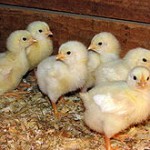
Cornish chicks. Photo courtesy Wiki Commons.

Our goal was not to simply eat cheaply. If price per serving was the only consideration, we’d shop Sam’s Club and save the trouble of raising our own food. No, as always, our goal is to grow excellent food while reducing overall costs (shipping, packaging, additives, bacterial contamination, supporting factory farming). We hoped to produce this higher caliber meat for less than we could buy a locally produced ‘natural’ chicken. And we did. In 11 weeks we raised a baker’s dozen of Cornish roasters, realized 77 pounds (about 35 kilograms) of meat at an amazingly low $1.43 cost per pound. This figure includes butcher paper and freezer bags, feed and lighting, and, of course, the animals. Excluded from the weight are necks, giblets, wing tips, etcetera, reserved for making nutrient rich stock.

Keep in mind that what we produced is not organic meat, for we used a non-medicated, locally produced non-organic feed, however neither is local favorite Red Bird brand organic, and their skinless, boneless chicken breasts sell for $2.99. What we produced is an incredibly tasty, tender and truly farm fresh chicken meat without the factory, the trucking or the non-recyclable packaging.

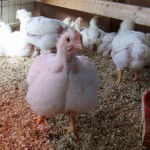
Our Cornish roasters at 4 weeks

And zero labeling lies.

Continue Reading…

Never miss a post
Name: 
Your email address:*
Please enter all required fields
Correct invalid entries

Wendell Berry: Daily Food Quote, June 30, 2011

Published by Thursday, June 30, 2011 Permalink 0

“A person who undertakes to grow a garden at home, by practices that will preserve rather than exploit the economy of the soil, has his mind precisely against what is wrong with us… What I am saying is that if we apply our minds directly and competently to the needs of the earth, then we will have begun to make fundamental and necessary changes in our minds. We will begin to understand and to mistrust and to change our wasteful economy, which markets not just the produce of earth, but also the earth’s ability to produce.” — Wendell Berry

Wendell Berry was born in Kentucky in 1934. He has always promoted a responsible kind of agriculture that is fully integrated into one’s everyday life. Because he promoted this vision of food and agriculture long before the Slow Food movement started, he is considered by many to have laid the foundation for the American Slow Food movement and the move toward a more sustainable and ethical agriculture.

The American Poetry Foundation says of Berry: Critics and scholars have acknowledged Wendell Berry as a master of many literary genres, but whether he is writing poetry, fiction, or essays, his message is essentially the same: humans must learn to live in harmony with the natural rhythms of the earth or perish. The Unsettling of America: Culture and Agriculture, which analyzes the many failures of modern, mechanized life, is one of the key texts of the environmental movement, but Berry, a political maverick, has criticized environmentalists as well as those involved with big businesses and land development. Berry strongly believes that small-scale farming is essential to healthy local economies, and that strong local economies are essential to the survival of the species and the well-being of the planet.

You can view his books and biography on the official Wendell Berry site.

Click here to listen to the 2-part series “Building a Slow Food Nation,” including an interview with Wendell Berry.

Never miss a post
Name: 
Your email address:*
Please enter all required fields
Correct invalid entries

Simon Says: Daily Food Quote, June 8, 2011

Published by Wednesday, June 8, 2011 Permalink 0

by Jonell Galloway

I am not bound for any public place, but for ground of my own where I have planted vines and orchard trees, and in the heat of the day climbed up into the healing shadow of the woods.–Wendell Berry (1954-)

Wendell Berry is a Kentucky poet, novelist, essayist, philosopher and farmer. He has always remained close to the land, continuing to farm on his family farm, and this is reflected in much of his work. His most well known book, The Unsettling of America, provides a classic critique of industrial agriculture which is foundational to today’s agrarianism and a precursor of the Slow Food movement and the current food revolution taking place in the U.S.


Never miss a post
Name: 
Your email address:*
Please enter all required fields
Correct invalid entries

Wild Woman on Feral Acres: Falling Far From the Tree

Published by Saturday, May 14, 2011 Permalink 0

by Esmaa Self

We have a 35-year-old Jonathan apple tree that produces marvelous, sweet apples. This tree is supposed to be dead by now, for Jonathans have a life expectancy of about 25 years. While tending the special needs of this fire blight affected tree, I got to thinking about the saw that apples don’t fall far from the tree. It has long been my intention to do just that.

My appetite for a simple, healthy, self sufficient life was teased by failure: the sins of my father, the sometimes health food nut. He introduced me to organic gardening, raw milk and farm eggs; insisted that I eat a hot breakfast; refused to buy white bread, candy or soda pop and preached that from-a-box cooking was no way to live a healthy life.

photo: Wellerco

Continue Reading…

Never miss a post
Name: 
Your email address:*
Please enter all required fields
Correct invalid entries

Back to the Land: From City Living to Farming, the Young Farmers Movement

Published by Tuesday, April 26, 2011 Permalink 0

by Cozette Russell

Brookford Almanac:  A Documentary Film about a Year in the Life of First-Generation Farmers in the U.S.

I’m a filmmaker interested in the relationship between people and landscape, so in 2008 when I read an article in The New York Times about the trend of young people moving out of the city to farm, I knew this was a story I wanted to film. I wanted to find out why highly educated people would walk away from specific career paths to choose a life of farming. Why would they embrace the risks of a life of hard work that offers such little security?

My film, Brookford Almanac, a cinema verité documentary currently in production, tells the story of Luke and Catarina Mahoney and their lively farm apprentices who run Brookford Farm in Rollinsford, New Hampshire.

Luke and Catarina are first-generation farmers. They came to farming through their desire for a connection to the land, not from their family’s expectations. The Mahoneys have embraced the rewards and frustrations of a life centered on the small-scale production of local food. But without inherited land, a major obstacle for first-generation farmers, they must lease their farm with little security for the future.

I discovered the Mahoneys through my father, John Carroll, a professor at the University of New Hampshire who has written several books about New England farming. I decided to spend a year documenting the Mahoneys lives at Brookford Farm because they are not only new to farming but also run a biologically diverse farm and organic dairy. Before long I found myself filming at the breakfast table, riding in the tractor, slogging through cow pastures, attending business meetings and farmer’s markets, and hanging out in the pasture with the cows well before dawn. I learned the dedication it takes to farm and how the rigorous labor of each day is always interrupted by an inevitable drama such as animals breaking out or tractors dying or storms approaching. For a filmmaker the tensions of life on a farm are exciting and unexpected.

Every documentary filmmaker starts out with one idea for their film and watches that idea ebb and flow as life unfolds in front of the camera. When I began, I envisioned Brookford Almanac as a celebratory portrait of a year in the life of a farm family. At that time, I could not have predicted the changes that would take place both on the farm and in my film. Luke and Catarina have expanded their operation considerably. With this expansion has come problems with their landlord, a strong-willed, retired farmer who holds different opinions as to how things should be done. Sadly, because of these divergent philosophies, the landlord has decided not to renew the Mahoneys’ lease.

The issue of land access – something almost all first-generation farmers struggle with – is now no longer just a looming issue for Luke and Catarina; it is a harsh reality in their lives and it has come front and center in my film. The making of Brookford Almanac continues as I film life at Brookford Farm for a second farming season.

To continue this second year of production I am raising money through Kickstarter, a popular online crowd-funding tool. To learn more about the film and to join the production, please visit my Kickstarter page by clicking here below by April 30th.

_________________

Cozette Russell is a documentary filmmaker. She is currently a fellow at Harvard University’s Film Study Center, and she lives with her husband and creative partner Julian Russell in Lee, New Hampshire.

Never miss a post
Name: 
Your email address:*
Please enter all required fields
Correct invalid entries

Book Review: Jean-Philippe de Tonnac’s “Dictionnaire Universel du Pain” or Universal Dictionary of Bread

Published by Wednesday, April 13, 2011 Permalink 0

by Jonell Galloway

Jean-Philippe de Tonnac, contributor to The Rambling Epicure, has written more than 20 books on subjects as varied as Umberto Eco, anorexia and, in October 2010, his masterpiece, the Dictionnaire Universel du Pain, or “Universal Dictionary of  Bread,” a veritable encyclopedia about every facet of  bread from all corners of the earth. The dictionary — not yet translated into English — covers the history of bread, as well as anthropological, symbolic, emotional, sexual, agricultural, botanical aspects . . . well, absolutely everything you might want to know about bread, literally from crop to crust (to borrow Dan Lepard‘s term), with every technical step in the process of bread baking covered in minute detail.

Continue Reading…

Never miss a post
Name: 
Your email address:*
Please enter all required fields
Correct invalid entries

A Thought for Food: One Woman’s Journey into the World of Slow Food

Published by Tuesday, April 5, 2011 Permalink 0

by Meeta Khurana Wolff

A Thought for Food – Slow Food

Eating poorly or inadequately in our fast food culture is easy. Overworked and stressed, we rush out to find a quick bite and often find solace in a burger or a hot dog. The temptation of sugar, salt and fat feel good while we are eating it, but it really does little to satisfy us. It is convenient at the time and stills our hunger. Dinner might be a quick microwave meal, frozen pizza ready in minutes in the oven, or even take out. Looking at the long-term effects, it will make our family and us fat, lazy and sick!

Continue Reading…

Never miss a post
Name: 
Your email address:*
Please enter all required fields
Correct invalid entries

Switzerland: How About a Biodynamic Dinner for Valentine’s Day?

Published by Wednesday, February 9, 2011 Permalink 0

by Jonell Galloway

The Philosophy of Fine Dining, Rudolf Steiner style, in Crissier

The Austrian philosopher Rudolf Steiner was the inventor of the spiritual movement anthroposophy, a kind of intuitive ethics which has thrived in Switzerland, chiefly through the Waldorf schools and through foundations and communities inspired by his teachings. This seventeenth-century castle, Le Castel, was bought by the Lausanne branch of the Rudolf Steiner Foundation in 1989.

The current community living on the grounds of Le Castel practices biodynamic farming, quite in line with Steiner’s view of humans’ relationship to the world. These products are used in the restaurant.

Continue Reading…

Never miss a post
Name: 
Your email address:*
Please enter all required fields
Correct invalid entries

UA-21892701-1