An Ode to Thanksgiving: A Poem by Mark Manning

Published by Wednesday, November 21, 2012 Permalink 0

by Jonell Galloway

While there is an abundance of Christmas songs, both religious and simply festive, there aren’t many Thanksgiving songs to remember, so Mark Manning decided to take a stab at one. It’s a jolly effort!

Randolph the Red-beaked Turkey

by Mark Manning

Randolph the red-beaked turkey
Had a very shiny beak.
And if you ever saw it,
It would be Thanksgiving week.
None of the other turkeys
Ever laughed or called him names.
(That’s just because they’re turkeys —
Turkeys all have tiny brains.)
Then one bright Thanksgiving eve
Th’ farmer came to say,
“Randolph with your beak so bright,
You’ll be on the plate tonight.”
Then all the diners loved him,
And they shouted out with glee,
“Randolph the red-beaked turkey,
You taste great with mom’s gravy!”


Never miss a post
Name: 
Your email address:*
Please enter all required fields
Correct invalid entries

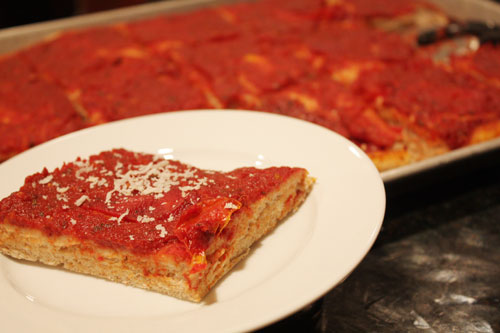
Food Poetry: Tomato Pies, 25 cents

Published by Tuesday, August 21, 2012 Permalink 0

by Grace Cavalieri


Tomato pies are what we called them, those days,
before Pizza came in,
at my Grandmother’s restaurant,
in Trenton New Jersey.
My grandfather is rolling meatballs
in the back. He studied to be a priest in Sicily but
saved his sister Maggie from marrying a bad guy
by coming to America.
Uncle Joey is rolling dough and spooning sauce.
Uncle Joey, is always scrubbed clean,
sobered up, in a white starched shirt, after
cops delivered him home just hours before.
The waitresses are helping
themselves to handfuls of cash out of the drawer,
playing the numbers with Moon Mullin
and Shad, sent in from Broad Street. 1942,
tomato pies with cheese, 25 cents.
With anchovies, large, 50 cents.
A whole dinner is 60 cents (before 6pm.)
How the soldiers, bussed in from Fort Dix,
would stand outside all the way down Warren Street,
waiting for this new taste treat,
young guys in uniform,
lined up and laughing, learning Italian,
before being shipped out to fight the last great war.

Continue Reading…

Never miss a post
Name: 
Your email address:*
Please enter all required fields
Correct invalid entries

Food Poetry: 张错: 茶的情诗 / Love Lyrics of Tea

Published by Tuesday, April 3, 2012 Permalink 0

by Dominic Cheung

Translated into English by Karl Zhang

张错: 茶的情诗 Love Lyrics of Tea

1

如果我是开水 If I were boiling water
你是茶叶 And you were tea leaves,
那么你的香郁 Then all your fragrance would depend
必须倚赖我的无味 Upon my lack of taste.

2

让你的干枯柔柔的 As your shriveling
在我里面展开,舒散;Loosened within me and unfolded;
让我的浸润 My moisture and lubrication
舒展你的容颜。Would smooth the wrinkles from your face.

3

我们必须热,甚至沸 We would need to be hot, even boiling
彼此才能相溶。To dissolve inside each other.

4

我们必须隐藏 We would need to hide
在水里相觑,相缠 Face to face under water, twisting and twining,
盏茶功夫 In a moment of tea
我俩才决定成一种颜色。Before we decided, which color to become.

5

无论你怎样浮沉 No matter how long you might float and swirl
把持不定 Unstable
你终将缓缓的 Eventually you would
(噢,轻轻的) (Oh, gently)
落下,攒聚  Sink down
在我最深处。To assemble in my depths.

6

那时候  In that moment
你最苦的一滴泪 Your bitterest teardrop
将是我最甘美的 Would become my sweetest
口茶。 Mouthful of tea.

Continue Reading…

Never miss a post
Name: 
Your email address:*
Please enter all required fields
Correct invalid entries

Simon Says: Daily Food Quote, February 8, 2012

Published by Wednesday, February 8, 2012 Permalink 0

by Simón de Swaan

Food Haiku

A man that eats
his meals amidst morning glories—
that’s what I am!

–Matsuo Bashō

Matsuo Bashō was the most famous poet of the Edo period in Japan. During his lifetime, Bashō was recognized for his works in the collaborative haikai no renga form; today, after centuries of commentary, he is recognized as a master of brief, clear haiku.

Continue Reading…

Never miss a post
Name: 
Your email address:*
Please enter all required fields
Correct invalid entries

Our favorite food books of 2011

Published by Friday, December 23, 2011 Permalink 0

by Jonell Galloway

Cookbooks:

Ancient Grains for Modern Meals, by Maria Speck

My favorite cookbook of the year. Maria Speck knows how to incorporate ancient whole grains from around the world into dishes that remain rustic on the edges, but healthy, original and elegant at the same time. The technical explanations about ancient grains are excellent, as well as her explanations about general cooking techniques. The food stories she incorporates here and there about growing up in Greece and Germany add a touch of charm.

A must for any health-conscious real food lover who wants to eat interesting food combinations and dishes with a touch more sophistication that can pleasantly surprise guests, but not take them totally away from their references, because the dishes are for the most part influenced by Mediterranean cuisine.

For poetry-loving foodies:

The Poet’s Cookbook: Recipes from Germany, poems by 33 American poets with German translations

The Poet’s Cookbook: Recipes from Tuscany, poems by 28 Italian and American poets

I love the original concept of these books, pairing a food poem with a recipe. A poem by our Food Poetry Editor, Christina Daub, “Wine“, appears in the Tuscany version.

Farming: A Hand Book, by Wendell Berry

As a Kentuckian, Wendell Berry has forever been my mentor. He is, in my mind, the precursor of the Slow Food philosophy in the U.S., through the philosophy he has cultivated and spread for over 50 years now, well before Petrini and company started the Slow Food movement. Whether writing prose or poetry, he is always eloquent, and the same message of integrity, respect for others and for the land is the central message. This is one more inspiring book of poetry to add to our shelves of books to keep forever, that will comfort us in times of trouble, that we will pick up time and time again when we’re losing faith in humanity, devastated by the disrespect shown to the land, losing touch with our roots. Berry always says what he thinks in all his eloquence and with true gentillesse, but more than that, he lives the life he preaches, and that is consoling.

For food lovers, wine lovers, and culinary travelers:

Food Wine Rome, by David Downie and Alison Harris, published by The Little Bookroom, part of The Terroir Guides series

Food Wine Burgundy, by David Downie and Alison Harris, published by The Little Bookroom, part of The Terroir Guides series

Paris, Paris: Journey into the City of Light, by David Downie

David Downie writes wonderful articles for The Rambling Epicure and Alison does exquisite food photo exhibits for our Food Art section. I can never get enough of their work, because the writing is exquisite and full of literary and historical references, and the photos are truly art. Downie always shows you the insider’s view of whatever he writes about, and Alison has a great eye for catching the very essence of what they’re covering, whether it be truffle hunting or discovering little out-of-the way restaurants in isolated villages. You can never go wrong with their books.

For bread lovers:

Dictionnaire Universel du Pain, by Jean-Philippe de Tonnac

Jean-Philippe de Tonnac also writes for The Rambling Epicure, and has recently become THE bread writer all bakers want to meet. This book should in my mind be translated into English immediately. It offers a wealth of information about bread from time immemorial, covering techniques and breads from around the world, as well as spirituality, sex, gluten intolerance, bakers as poets, bakers as prophets and much more. “Encyclopedia” would be a more appropriate term than “dictionary”.

Mindful eating:

The Self-Compassion Diet: Guided Practices to Lose Weight with Loving-Kindness by Jean Fain

Jean Fain has tried every diet out there, so she can speak with authority about the subject of weight loss. She is also affiliated with Harvard Medical School as a psychotherapist, so she has the credentials to talk about the subject. Her book takes a totally different approach to weight loss than any I’ve seen. She doesn’t count calories and restrict what you eat. Her approach is instead through the mind, to become mindful of what we eat, when we eat (when stressed or lonely, for example), why we eat (out of need to nourish ourselves or out of boredom or frustration); to appreciate what we eat, and above all to be conscious of our entire relationship with food.

The book teaches you how to take control of yourself and your relationship to food so that you can change the way you think about food in general, so that eating becomes a totally different experience. Jean does this through loving-kindness, self-hypnosis, meditation and numerous other weight-loss approaches, which you follow gradually, not all in one go. She also offers a CD including guided meditations to help patients after they have stopped therapy.

Her main thrust is self-love, that we must not be too hard on ourselves, or we’ll fall back in to our old and bad habits quickly. The beauty of the book and CD combination is that you can live half way around the planet and still follow her method.

For lovers of literature: food essays and prose:

Slow Food: Collected Thoughts on Taste, Tradition, and the Honest Pleasures of Food, by Carlo Petrini and Ben Watson

This book consists of an anthology of articles by the world’s top food writers, making me remember the old days when we’d visit the family in the countryside and how I thought it odd that they grew all their vegetables themselves and knew how to can them; how they drank milk straight from the cow (one of my fondest childhood memories), and how we relished in those meals, how it built bonds between us. “Drawn from five years of the quarterly journal Slow (only recently available in America), this book includes more than 100 articles covering eclectic topics from “Falafel” to “Fat City.” From the market at Ulan Bator in Mongolia to Slow Food Down Under, this book offers an armchair tour of the exotic and bizarre. You’ll pass through Vietnam’s Snake Tavern, enjoy the Post-Industrial Pint of Beer, and learn why the lascivious villain in Indian cinema always eats Tandoori Chicken.”

For pastry makers and lovers:

Mich Turner’s  Masterclass: The Ultimate Guide to Cake Decorating Perfection, by Mich Turner, published by Jacqui Small LLP, London

Mitch Turner’s cake decorating book is worthy of a fine art book in its presentation, and of an encyclopedia in terms of the detailed explanations about cake decorating. Her pastry and cakes are truly works of art. A must for all pastry makers, whether professional or amateur.

Food art:

From Plate to Pixel: Digital Food Photography, by Hélène Dujardin

This book is special for many reasons. There are lots of people out there trying to learn food photography without a clue as to even the basic techniques required and no possibility of taking a food photography workshop. This is the book for them, because all the basics plus quite a lot more are explained in a clear, direct manner. It also verges on being an art book, because it is illustrated by Dujardin’s beautiful food photography.



Never miss a post
Name: 
Your email address:*
Please enter all required fields
Correct invalid entries

Simon Says: Daily Food Quote, December 15, 2011

Published by Thursday, December 15, 2011 Permalink 0

by Simón de Swaan

Little Tommy Tucker
Sings for his supper;
What shall we give him?
White bread and butter.

Tommy Thumb’s Pretty Song Book, c 1744

Tommy Thumb’s Pretty Song Book is the earliest extant printed collection of English language nursery rhymes, published in London in 1744. It was a sequel to the lost Tommy Thumb’s Song Book and contains the oldest version of many well-known and popular rhymes, as well as several that have been largely forgotten.


Related articles

Never miss a post
Name: 
Your email address:*
Please enter all required fields
Correct invalid entries

Simon Says: Daily Food Quote, December 2, 2011

Published by Saturday, December 3, 2011 Permalink 0

by Simon de Swaan

Do I dare to eat a peach?–T.S. Elliot, 1917

Thomas Stearns “T. S.” Eliot OM as a playwright, literary critic, and arguably the most important English-language poet of the 20th century. Although he was born an American, he moved to the United Kingdom in 1914 (at age 25) and was naturalized as a British subject in 1927 at age 39. He was awarded the Nobel Prize in Literature in 1948.


Never miss a post
Name: 
Your email address:*
Please enter all required fields
Correct invalid entries

Thankful Moments — Honey-Ginger and Pomegranate Salad

Published by Tuesday, November 29, 2011 Permalink 0

by Renu Chhabra

“For each new morning with its light,
For rest and shelter of the night,
For health and food, for love and friends,
For everything Thy goodness sends.”
– Ralph Waldo Emerson


Last Sunday, I went for a walk with my daughter in our neighborhood. It was a lovely autumn afternoon, and sunshine was gracing the landscape with its golden rays. Everywhere we looked, the view was stunning with trees dressed in red, green and golden tones. “Look at that red tree – it looks so majestic. Let’s take a picture of it,” I said. “And what about that wall covered with golden leaves? That’s very charming too,” she pointed out with excitement. Enjoying these simple moments was worth treasuring. We clicked several pictures of this beautiful scenery.

Continue Reading…

Never miss a post
Name: 
Your email address:*
Please enter all required fields
Correct invalid entries

Simon Says: Daily Food Quote, November 3, 2011

Published by Thursday, November 3, 2011 Permalink 0

by Simón de Swaan

If you don’t eat yer meat, you can’t have any pudding. How can you have any pudding if you don’t eat yer meat?–Pink Floyd, “Another Brick in the Wall,” Part II (1979)

Pink Floyd were an English rock band that achieved worldwide success with their progressive and psychedelic rock music. Their work is marked by the use of philosophical lyrics, sonic experimentation, innovative album art, and elaborate live shows. Pink Floyd are one of the most commercially successful and influential rock music groups of all time.

Click here to listen to a video of the song.

Pink Floyd in 1968 (from left to right): Nick ...


Never miss a post
Name: 
Your email address:*
Please enter all required fields
Correct invalid entries

Simon Says: Daily Food Quote, October 13, 2011

Published by Thursday, October 13, 2011 Permalink 0

by Simón de Swaan

What is food to one is to others bitter poison.–Lucretius, 50 BC

Titus Lucretius Carus (ca. 99 BCE – ca. 55 BCE) was a Roman poet and philosopher. His only known work is an epic philosophical poem laying the foundations of Epicureanism, De Rerum Natura, translated into English as On the Nature of Things or sometimes On the Nature of the Universe.

Click here to read “The Answer Man,” a critique by Stephen Greenblatt in The New Yorker.

On the Nature of Things

No single thing abides; but all things flow.
Fragment to fragment clings-the things thus grow
Until we know and name them. By degrees
They melt, and are no more the things we know.

Globed from the atoms falling slow or swift
I see the suns, I see the systems lift
Their forms; and even the systems and the suns
Shall go back slowly to the eternal drift.

Continue Reading…

Never miss a post
Name: 
Your email address:*
Please enter all required fields
Correct invalid entries

UA-21892701-1