Simon Says: Daily Food Quotes, February 11, 2011

Published by Friday, February 11, 2011 Permalink 0

by Jonell Galloway

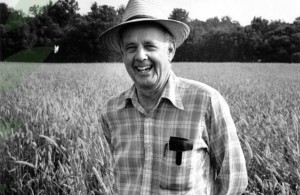
Eating with the fullest pleasure – pleasure, that is, that does not depend on ignorance – is perhaps the profoundest enactment of our connection with the world. In this pleasure we experience our dependence and our gratitude, for we are living in a mystery, from creatures we did not make and powers we cannot comprehend.–Wendell Berry

Never miss a post
Name: 
Your email address:*
Please enter all required fields
Correct invalid entries

Simon Says: Daily Food Quotes, February 10, 2011

Published by Thursday, February 10, 2011 Permalink 0

by Simon de Swaan and Jonell Galloway

If we apply our minds directly and competently to the needs of the earth, then we will have begun to make fundamental and necessary changes in our minds. We will begin to understand and to mistrust and to change our wasteful economy, which markets not just the produce of the earth, but also the earth’s ability to produce. We will see that beauty and utility are alike dependent upon the health of the world. But we will also see through the fads and the fashions of protest. We will see that war and oppression and pollution are not separate issues, but are aspects of the same issue. Amid the outcries for the liberation of this group or that, we will know that no person is free except in the freedom of other persons, and that man’s only real freedom is to know and faithfully occupy his place – a much humbler place than we have been taught to think – in the order of creation.–Wendell Berry (page 89, “Think Little”)” (The Art of the Commonplace: The Agrarian Essays of Wendell Berry)

Photo courtesy of Festival of Faiths.

Never miss a post
Name: 
Your email address:*
Please enter all required fields
Correct invalid entries

Simon Says: Daily Food Quote, February 7, 2011

Published by Monday, February 7, 2011 Permalink 0

by Simon de Swaan and Jonell Galloway

All happiness depends on a leisurely breakfast.–John Gunther

John Gunther is best known for his 500-page tome Inside Europe about pre-war and wartime Europe, and went on to write “inside” books about several continents. They were translated into 90 languages and sold by the millions around the world. As he traveled around the world, he wined and dined in the highest places.

His description of Hitler in Inside Europe is unforgettable:

He reads almost nothing. He dislikes intellectuals. He has never been outside Germany since his youth in Austria and speaks no foreign language, except a few words of French. He is nearly oblivious of ordinary personal contacts. A colleague of mine traveled with him, in the same airplane, day after day, for two months during the 1932 electoral campaigns. Hitler never talked to a soul, not even to his secretaries, in the long hours in the air; never stirred; never smiled.

Photo courtesy of NNDB.

Never miss a post
Name: 
Your email address:*
Please enter all required fields
Correct invalid entries

Simon Says: Daily Food Quote, February 5, 2011

Published by Saturday, February 5, 2011 Permalink 0

by Simon de Swaan and Jonell Galloway

One cannot think well, love well, sleep well, if one has not dined well.–Virginia Woolf

Click here to hear the recorded voice of Virginia Woolf.

Photo courtesy of NickNich4.

Never miss a post
Name: 
Your email address:*
Please enter all required fields
Correct invalid entries

Simon Says: Daily Food Quote, February 4, 2011

Published by Friday, February 4, 2011 Permalink 0

by Benjamin Franklin

A house is not a home unless it contains food and fire for the mind as well as the body.–Benjamin Franklin

Never miss a post
Name: 
Your email address:*
Please enter all required fields
Correct invalid entries

Simon Says: February 3, 2011

Published by Thursday, February 3, 2011 Permalink 0

by Simon de Swaan and Argentine Cookery

Half of all Argentine desserts would disappear if dulce de leche [caramel spread] did not exist.  When abroad, Argentine people who have no dulce de leche, suffer the syndrome of abstinence and all those who go abroad, take dulce de leche in their luggage. Dulce de leche is the national obsession.–Argentine Cookery, Monica Hoss de le Comte, 2000

Never miss a post
Name: 
Your email address:*
Please enter all required fields
Correct invalid entries

Simon Says: February 2, 2011

Published by Wednesday, February 2, 2011 Permalink 0

by Simon de Swaan and Jonell Galloway

To gulp a mouthful of soft, warm red wine, and then to lean forward and slice a fragrant chip of meat from the brown, bubbling carcass in front of you, dunk it in the fierce sauce of vinegar, garlic, and red pepper, and then stuff it, nut-sweet and juicy, into your mouth, seemed one of the most satisfying actions of my life.–Gerald Durrell, The Whispering Land, 1961

Gerald Durrell, brother of the noted author Lawrence Durrell, was foremost a zoologist interested in protecting wildlife. His brother Lawrence once suggested that he write books in order to earn money to support his numerous wildlife causes, which motivated him to write The Overloaded Ark, followed by The Bafut Beagles and Three Singles to Adventure. All were successful enough to allow him to continue writing up until his death in 1995, all for the sole means of supporting his animal protection causes, chiefly through the Durrell Wildlife Conservation Trust.

Continue Reading…

Never miss a post
Name: 
Your email address:*
Please enter all required fields
Correct invalid entries

Simon Says: Daily Food Quote, February 1, 2011

Published by Tuesday, February 1, 2011 Permalink 0

by Jonell Galloway and Simon de Swaan

There is no love sincerer than the love of food.–George Bernard Shaw

George Bernard Shaw was born in Dublin, Ireland, on July 26, 1856, and died on November 2, 1950. Although of the landed Irish gentry, his father failed at both being a civil servant and working as a grain merchant. The family lived in genteel poverty, and Shaw’s education was irregular, also due to his dislike of any organized training, and ended at the age of 16. Shaw did however develop a broad knowledge of music, art, and literature, thanks to his mother’s strong cultural influence and many visits to the National Gallery of Ireland.

Continue Reading…

Never miss a post
Name: 
Your email address:*
Please enter all required fields
Correct invalid entries

Simon Says: January 30, 2011. Eating is a Multi-sensory Experience

Published by Sunday, January 30, 2011 Permalink 0

by Jonell Galloway

Eating is a Multi-sensory Experience

from “Word of Mouth Blog,” The Guardian

We eat with all our senses and we are shorting ourselves if we’re not aware of the multi-sensory aspect of the eating experience. If something “looks” good, we have a tendency to think it “is” good. Of course we all know that can be true, or it can lead to disappointment if quality ingredients and craftsmanship have not gone into the final product. Just like with people, looks are not all that counts. What’s inside really does count.

This article from The Guardian of London explores this.

“We know that our enjoyment of food is about more than how it tastes…On the contrary, much research suggests that it is in fact our eyes leading the way, our tongues merely follow. ‘People’s perception is typically dominated by what their eyes see,’ writes Charles Spence, Oxford professor of experimental psychology.”

Continue Reading…

Never miss a post
Name: 
Your email address:*
Please enter all required fields
Correct invalid entries

Simon Says: Daily Food Quote, January 29, 2011

Published by Saturday, January 29, 2011 Permalink 0

by Simon de Swaan

The mountain sheep are sweeter
But the valley sheep are fatter.
We therefore deemed it meeter
To carry off the latter.

Thomas Love Peacock (1786-1866), excerpt from The War Song of Dinas Vawr (1823)

Thomas Love Peacock was born in Dorset, England in 1785 or 1786, depending on the source. He was a novelist, poet and playwright and mixed with the Romantic poets, although most of his work was satirical. He also worked for the British East India Company. He was also influenced by Percy Bisshye Shelley, who he met early in life. Peacock died in his library at Halliford-on-Thames in 1866, after refusing to leave his precious books to burn.

Photo inspired by Thomas Love Peacock’s poem “Ocean Gateway,” taken by the Wandering Angel.

Never miss a post
Name: 
Your email address:*
Please enter all required fields
Correct invalid entries

UA-21892701-1