There are thousands of reasons to start a blog. For authors, they serve as a complement to their main activity of writing. For recipe developers, they can be a way of sharing their recipes and of forming a community with people, and eventually leading to a book or career change. A food blogger is merely someone with a food blog, no matter the motivation.
Making money should not be a main priority, as direct revenue is rarely a viable strategy given the millions of blogs and websites out there. We shouldn’t have any illusions about that. But blogs can lead to other activities that will make you money. Your blog also allows you to establish yourself in your field of expertise. You may get consulting work, offers to write for websites, or book deals. You may be asked to develop or test recipes, or get invited to talk at conferences or workshops about your specialty or about writing.
Blogging is a format to communicate your expertise, or your story (and often a blend of both). It can start from purely a hobbyist intention, or from a professional one.
No one is a pure type. But, as writers, we all correspond loosely or tightly to certain types. You are not alone, or utterly unlike all others, or without the ability to contrast and compare yourself to writers whom you resemble — if only slightly. The deepest and best reason to do this is to grow in self-knowledge, and in the ability to tell your own tent from the tents of others.
As a writer, do you know your type?
No type below will be 100% you, but one will be much closer than all the others. You will glimpse key aspects of yourself in two or three. You will feel a strong disaffinity for one or two.
Type 1 – The Literary Writer
Love of language gets this writer to her desk. No pleasure she can experience rivals using language to its fullest – whether to break your heart, deliver you the subtlest of foods for thought, shake the dust off you, or simply to knock you down. Not that she needs an audience – she writes to be writing. When she writes about food, it’s not about food, but about the language that conjures the food. Maybe the world knows her, maybe it doesn’t, but you’ve sized her up: She’s an artist, deep and true.
Is this you?
If yes, then your greatest strength is the quality of your gift. Obstacles you may meet include perfectionism, isolation, making deadlines, debilitating bouts of writer’s block, crises of doubt, and being too thin-skinned for the marketplace.
The first of a series of articles for an upcoming book on writing about food
Getting Started
Pretend for a moment that this is you.
Over lunch, you and a friend discuss an important event. “I’ll have to go shopping,” you tell her. “My only outfit that’s perfect for the occasion has been seen too many times.” Your friend’s eyes sparkle as she replies, “Be sure to find something that expresses your personality and taste, and that sends the right vibe at a glance.” She’s kidding, of course – she knows that’s the only kind of shopping you ever do.
Is branding yourself as a writer this easy? Let’s anatomize the process.
Everyone is unerring about something — the can’t-fail baked pasta dish, the elevator pitch that always lands a meeting, the only words in the world that will comfort a desolate child. If you look closely at areas of your life where high competence and pure instinct lead you again and again to distinctiveness and success, then you will come face to face with your personal brand – nothing more or less than the way other people know you to be in the world, the keynote behavior they have come to expect of you.
Your personal brand does not deny the breadth or depth of your individuality. Rather, it introduces you to others in a way you can control – until you decide when and how to let them know you even better.
Good branding as a writer leads to your being enough of a known quantity that editors and publishers think of you when they have a certain type of assignment to hand out, and to your being counted on by a readership to deliver a certain kind of experience it craves. Your sense of your brand increases your writing efficiency, too, by making it faster and easier for you to know the difference between projects that are right for you and projects that are merely interesting to you. The difference between being appreciated as a versatile writer and being dismissed as “all over the map” is often a matter of branding, and this is a crucial consideration when you first set out to create a coherent body of work.
It’s never too soon to establish your brand as a writer. Here are 7 high-yield prompts to tighten your focus on branding, even before you begin to organize your writing life or choose the topic of your first piece.
Would you rather tell a story, or convey information in a non-narrative way?
Are you writing from expertise or as a generalist who can do the research?
Do you write for a specific readership, and know exactly what you offer it?
Which of these word counts is the most “you” – up to 750, 1000 to 1500, or 1500+?
Is your voice intimate and conversational, or do you favor a professional distance?
What’s unusual or even unique about you that will come through in your writing?
Once readers begin to know you a bit, which three words should come to their minds when they see your name?
Remember, a brand is not a label. Rather, it’s powerful knowledge that you have about yourself as a writer, and that you want others to recognize you by. They shouldn’t have to hunt for a label to do that. And the best thing about branding yourself as a writer is that it prevents others from labeling you first.
Expanding Your Brand
The time will come when you want to expand your brand. Life will deliver you a compelling new interest that becomes intrinsic to the writer you are. Or, after some time, your readers will know you well enough to welcome what they don’t necessarily expect from you, as you selectively introduce it to them. Journalists who know the secrets of telling a great story may turn to fiction, for instance, without losing readers. Food writers may move to another country, where food culture is different from what their readers usually seek information about, yet this new focus is an addition to their portfolio, not a departure from it. The key to expanding your brand is to do it mindfully and not all at once – just as you might include one unfamiliar dish, not five, in a party menu that already works beautifully.
Rebranding
If you are a writer shifting your focus to food and travel writing, but that’s not how people think of you yet, well – first, congratulations on already having readers who think of you a certain way. The chances are that you have written about food and travel before, even if tangentially, so this change is not coming out of left field. To be true to themselves, many artists and writers have had to redefine their mission, and do a lot of letting go in order to move faster in their new direction. This is risky and it takes courage, because a readership is a priceless asset, and no writer wants it to melt away.
Unlike brand expansion, rebranding is official business that a writer needs to take charge of unambiguously, if not with fanfare. You might start with the story of an experience you found irresistible, that led you straight to a new commitment as a writer. You are the same, only different – can you share the excitement about that? You have new vistas for your readers – you want nothing more than to pull back the curtain. If you suspect or know that your readers are not – particularly — gastronomes, then start with the story of how you came to develop this interest, one they can follow with pleasure even if they are not yet there. Readers may not care as much as you do about food, but they may be led to care tremendously about the cultures and the communities that food writing can open to them.
Owing to your new subject matter, you are hardly a different person as a writer – you are a writer whom readers already know, throwing open a new window onto the world for them. Aim, if you are rebranding, for the kind of continuity that underlies all shifts in subject matter – the continuity found in voice, tone and in the mission to connect.
To sum up —
If you are consistent over time, then you already have a personal brand that is very real to others. Do you know what it is?
Your brand as a writer enables readers to choose to read you, and editors to choose you for assignments. Now – what is it?
A sure sense of your brand will save you time as a writer by quickly steering you away from subjects that are “not you.” Now — can you see that body of work that is you in sharper focus yet?
Developing a strong brand as a writer will make it harder for others to either label you themselves or draw a blank when they see your name. Is there an image management problem for you to solve here?
Tread carefully and strategically when you expand your brand, or rebrand. If this is what’s next for you, have you crafted a plan?
Elatia Harris is a writer and consulting editor in Cambridge, Mass. She is most often at work on books and articles about food, wine and travel. Contact her at elatiaharrisATgmailDOTcom or via text at 617-599-7159.
Make a place to sit down.
Sit down. Be quiet.
You must depend upon
affection, reading, knowledge,
skill—more of each
than you have—inspiration,
work, growing older, patience,
for patience joins time
to eternity. Any readers
who like your work,
doubt their judgment.
ii
Breathe with unconditional breath
the unconditioned air.
Shun electric wire.
Communicate slowly. Live
a three-dimensioned life;
stay away from screens.
Stay away from anything
that obscures the place it is in.
There are no unsacred places;
there are only sacred places
and desecrated places.
iii
Accept what comes from silence.
Make the best you can of it.
Of the little words that come
out of the silence, like prayers
prayed back to the one who prays,
make a poem that does not disturb
the silence from which it came.
Jonell Galloway grew up on Wendell Berry and food straight from a backyard Kentucky garden. She is a freelance writer. She attended Le Cordon Bleu and La Varenne cooking schools in Paris and the Académie du Vin, worked for the GaultMillau restaurant guide and CityGuides in France and Paris and for Gannett Company in the U.S., and collaborated on Le tour du monde en 80 pains / Around the World with 80 Breads with Jean-Philippe de Tonnac in France; André Raboud, Sculptures 2002-2009 in Switzerland; Ma Cuisine Méditerranéenne with Christophe Certain in France, At the Table: Food and Family around the World with Ken Albala, and a biography of French chef Pierre Gagnaire. She ran a cooking school in France, and owned a farm-to-table restaurant, The Three Sisters’ Café, with her two sisters in the U.S. She organizes the Taste Unlocked bespoke food and wine tasting awareness workshops with James Flewellen, is an active member of Slow Food, and runs the food writing website The Rambling Epicure. Her work has been published in numerous international publications and she has been interviewed on international public radio in France, Switzerland, and the U.S. She has just signed on at In Search of Taste, a British print publication, and is now working on a book, What to Eat in Venice
6 egg yolks 4 egg whites 1 cups brown sugar 1 cup melted butter 1/3 cup old-fashioned oats Juice of one lemon 1 tsp. cinnamon 2 cups peeled, cored, sliced cooking apples 2 egg whites, beaten until they form hard peaks
Why do farmers farm, given their economic adversities on top of the many frustrations and difficulties normal to farming? And always the answer is: “Love. They must do it for love.” Farmers farm for the love of farming. They love to watch and nurture the growth of plants. They love to live in the presence of animals. They love to work outdoors. They love the weather, maybe even when it is making them miserable. They love to live where they work and to work where they live. If the scale of their farming is small enough, they like to work in the company of their children and with the help of their children. They love the measure of independence that farm life can still provide. I have an idea that a lot of farmers have gone to a lot of trouble merely to be self-employed to live at least a part of their lives without a boss.― Wendell Berry, Bringing it to the Table: Writings on Farming and Food
Food writing is not confined to food writers. After all, food concerns us all and we all have something to say about it. Some use it as metaphor, others as porn. Here are a few examples from classic literature.
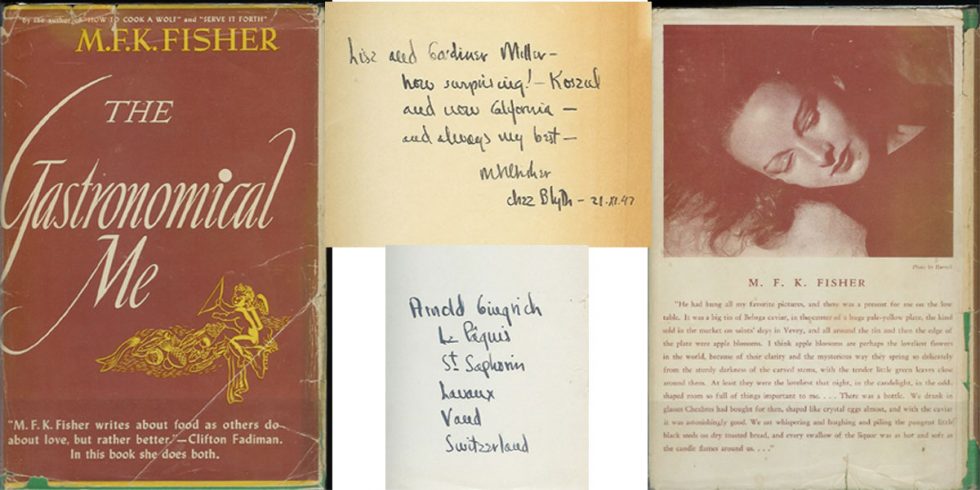
Food as the Essence of Being Human: M.F.K. Fisher
Fisher went straight to the point. Food was intertwined in almost all she wrote and used as a metaphor for the need for love in life. It was inescapable connected with its opposite, hunger.
“It seems to me that our three basic needs, for food and security and love, are so mixed and mingled and entwined that we cannot straightly think of one without the others. So it happens that when I write of hunger, I am really writing about love and the hunger for it, and warmth and the love of it and the hunger for it… and then the warmth and richness and fine reality of hunger satisfied… and it is all one.”
“Tortolita, let me tell you a story,” Estevan said. “This is a South American, wild Indian story about heaven and hell.” Mrs. Parsons made a prudish face, and Estevan went on. “If you go visit hell, you will see a room like this kitchen. There is a pot of delicious stew on the table, with the most delicate aroma you can imagine. All around, people sit, like us. Only they are dying of starvation. They are jibbering and jabbering,” he looked extra hard at Mrs. Parsons, “but they cannot get a bit of this wonderful stew God has made for them. Now, why is that?”
“Because they’re choking? For all eternity?” Lou Ann asked. Hell, for Lou Ann, would naturally be a place filled with sharp objects and small round foods.
Everyone is interested in Kate Middleton’s diet(s), especially now that she is pregnant with her second child
by Jonell Galloway
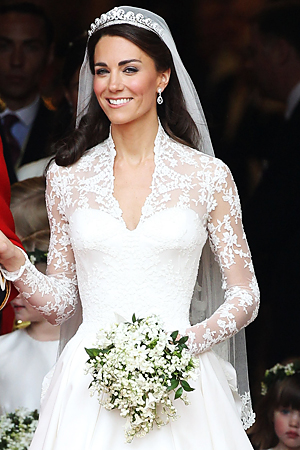
Everyone is interested in Kate Middleton’s diet, but is there really anything we can rightly called The Kate Middleton Diet?
There is more conjecture than anything, and it makes for lots of print in the British tabloids.
Most tabloids claim that Kate Middleton, now Duchess of Cambridge, followed the Dukan Diet to lose weight for her wedding. Pierre Dukan, founder of the protein-based, low-carb diet, told the New York Daily News that Middleton lost far too much weight before her wedding, but stated that it is still safe for her to continue it during her second pregnancy, despite her severe case of hyperemesis gravidarum, characterized by severe nausea, vomiting, weight loss, and electrolyte disturbance during pregnancy.
But word has it that this is just one of the diets Kate has done. Apparently, another diet secret which she followed it during her first pregnancy, and now follows two days a week, is an all-juice diet.
To lose weight after her first pregnancy, The Daily Mailreported that Kate went on a raw diet, munching on only ceviche, goji berries, gazpacho, watermelon salad, almond milk and tabbouleh.
The Dukan Diet is a classic diet French women use to control their weight. The French site Baby Book agrees with Dr. Dukan that it is safe to continue the diet during pregnancy, and that the days of women eating for two are behind us. Of course, Dukan was banned from practicing medicine in his native France in 2013. Both his U.K. and American sites have been removed. The French domain name, dukandiet.fr, is reportedly for sale.
Since graduating from college, the Duchess of Cambridge is said to have gone from a size 10 or 12 to a size 6.
Controversy surround Kate’s seemingly favorite diet or weight control secrets and will undoubtedly continue to be followed closely both by the press and readers for years to come.
Below you will find a spectrum of behaviors that are food writer markers in early life, as well as some behaviors that do not strongly associate to food writing. Say yes to all that apply. Attach a zero to behaviors that do not resonate with you. Each entry below, a. through e., is is worth points in ascending order — a. is 1, b. is 2, c. is 3, d. is 4, and e. is 5. So, the most you could accumulate for each division — (1,), (2.) and (3.) — is 15 points, for a total score of 45. My research and experience tell me that scoring higher than 40 makes you, hopelessly, a food writer. See that you think!
(1.) In childhood under 10, you
(a.) Ate what you were given, mainly, but thought over the texture pretty hard.
(b.) Wondered about the food in foreign countries. Was it better? Could you cook it just fine without going there?
(c.) Read carefully, rather than skipped over, the bits about food in your usual reading matter.
(d.) Sniffed from spice jars.
(e.) Were asked not to complain about the food, ever, even though you weren’t complaining, exactly. You were trying to help.
(2.) In early adolescence, you
(a.) Read and wrote well ahead of your grade level, regardless of other academic aptitudes.
(b.) Cooked with adults, for lack of interested peers. Cooked to get adults out of the kitchen.
(c.) Started feeling passionate about certain writers: they were writing for YOU.
(d.) Put out at least two issues of a newsletter about the food at school and at hangouts.
(e.) Sniffed wine, tried to taste it, daydreamed a lot, wanted to be older — at least 16.
(3.) Mid-adolescence through age 21, you
(a.) Worked to expand your food vocabulary because there were food sensations you experienced but had no words for.
(b.) Considered “year abroad” programs based on the food that might be involved.
(c.) Used more of your available funds to eat well than other students did, cut back elsewhere to afford it.
(d.) Sniffed fragrances, liked satin, drank wine.
(e.) Made lists of destination restaurants, and other things to experience for the sake of writing about them.
Elatia Harris is a writer and consulting editor in Cambridge, Mass. She is most often at work on books and articles about food, wine and travel. Contact her at elatiaharrisATgmailDOTcom or via text at 617-599-7159.