
Quintessential France: Still Life with Flowers and Fruit, by Pierre Auguste Renoir.
|
|

A Literary Culinary Journal
|
|

French cuisine is much more than the haute cuisine inherited from the nobility. It is also the tasty, inexpensive cuisine that French families eat every day, called cuisine bourgeoise, or “bourgeois cuisine.”
We all learned in school that “bourgeois” was a social class. Originally, it was what we now call the “middle class,” as opposed to the nobility and the poor and working classes. The bourgeoisie, or middle class, grew rapidly in France after the French Revolution.
In terms of cooking, the bourgeois weren’t rich enough to use expensive ingredients and their cooking skills were not as highly developed as those of the aristocrats’ chefs, but they had sufficient means to entertain friends and family. This cuisine came to be known as cuisine bourgeoise, which today simply means family cooking, tasty but not pretentious, as opposed to the haute cuisine of the elite.
|
|

Etre le dindon de la farce. / To fall victim to dupery.
Une dinde. / A stupid, pretentious woman.
Anthelme Brillat-Savarin, perhaps France’s best-known gastronomic writer, said that the turkey was certainly one of the most beautiful gifts the New World had given to the Old. “…the fattest, and if not the most delicate, at least, the tastiest of all domesticated birds.” It’s not often that the New World gets such compliments from discerning French epicures.
Turkeys were originally called poules d’Inde, “Indian hens,” in France, because they were thought to have come from India, which they later learned was Mexico. The French were not the only ones to get the name wrong. In Hebrew a turkey is a tarnagol hodu, meaning literally “Indian chicken;” in Russian indiuk, Polish indyk and Yiddish indik.
There is some controversy over who brought turkeys to Europe. Columbus probably brought brought them back in the early sixteenth century, since records show that King Ferdinand had ordered that every ship to bring back ten turkeys before the Spanish explorer Cortés set out in 1519. In any case, by 1548, they were the rage in France. In 1549, Catherine de Medicis served 70 “Indian hens” and 7 “Indian roosters” at a banquet held in honor of the Bishop of Paris.
French aristocrats were accustomed to eating all sorts of feathered creatures, including chewy storks, herons, peacocks, swans, cranes and cormorants, so it wasn’t surprising that they fell in love with the less-chewy turkeys, and that in 1570, Charles IX and Elizabeth of Austria thought turkey noble enough to serve at their wedding feast.
By the seventeenth century, the French were raising turkeys as if they were their own and most cookbooks included turkey recipes. French chefs weren’t lacking in ideas: they made stews and ragouts; they larded, roasted and glazed it; they stuffed it and made it into soups and pâtés.
Marie-Antonin Carême preferred the wings, which he deboned, then stuffed with chicken and truffles. Alexander Dumas, in his Dictionary of Cuisine, included 27 recipes. Turkeys were well established in the Hexagon.
Christmas dinners usually meant lots of mouths to feed, so turkey, being the largest of the winged creatures available, eventually became the dish of choice for Christmas feasts. By the nineteenth century, it became customary to stuff the Christmas turkey with chestnuts, and the tradition continues today.
|
|

There are many kinds of French cuisine. It is not limited to the haute cuisine accessible only to the rich.
What many of us think of as “French cuisine” is actually haute cuisine, the cuisine that evolved from the aristocratic cuisine of the royalty. This cuisine was centered mainly in Paris and Versailles. Regional cuisine as we know it today did not even exist at the time, since regions didn’t exist until after the Revolution. Until the Revolution, there were provinces and feudal “kingdoms,” abolished afterward. Cuisine bourgeoise, the cooking of the upper middle classes and later middle classes, developed after the Revolution, and gradually filtered down to the broader population.
Regions didn’t formally exist by name until 1890, so there was little meaning attached to the word “region”. One cooked and ate what was available, what one grew and raised and that varied widely. Even the gruel was made with different grains in different regions. Regions only formed an identity after this. Knowledge of regional cuisines increased as travel became easier and accessible to all, especially after the generalization of cars.
French cuisine has always consisted of two tiers: haute cuisine and regional cuisine. Elements of haute cuisine — the cuisine that we inherited from the courts and later the affluent bourgeoisie, the cuisine that elevated sauce-making to an art form — have over the centuries infiltrated the cuisine of the regions, and regional cuisine is the lifeline and wherein lies the future.
|
|
What are the 5 mother sauces as defined by Auguste Escoffier in the twentieth century? Béchamel, Velouté, Espagnole, Hollandaise and Tomate.
|
|

What are the four mother sauces as defined by French chef Carême in the nineteenth century? Tomate, Béchamel, Velouté and Espagnole.
|
|
From Southern biscuits to French baguette. You might wonder how a country girl from Kentucky who grew up on fried chicken, creamed corn, biscuits, cornbread, and church supper fruit pies could be qualified to tell others about boeuf bourguignon, cassoulet, choucroute or coq au vin. Yes, I’m writing a book we’ll call The French and What They Eat, since the title hasn’t yet been finalized. I’ll tell you the story in the book — from a general store/cream station/feedstore in a spot in the road in Kentucky, where the loafers discussed whether it was better to put a bag of peanuts into a Coke or an RC, to the City of Light and the Cordon Bleu Cooking School, eventually cooking, eating and drinking my way around France.
“What to Eat in France,” a series of regional French recipes with a story and a bit of history, is laying the groundwork for this book. If you’d like to follow the series on a regular basis, sign up for the newsletter in the right-hand column.
|
|

Before having the best Cotignac sent from Orléans, because you were yearning for the tastes of your childhood…Avant de faire venir d’Orléans le meilleur cotignac, puisque vous vouliez redevenir enfant et goûter au cotignac…—Balzac, Lettres à l’Étrangère
Quince is my husband’s favorite word. Annoying situations or people are quinces in his lexicon. But quinces can be most agreeable, as in the case of quince paste, a cherished confection in France. Although the fruit must be cooked to be digestible, rather like annoying situations have to be cogitated over to be digested, it is worth the effort. They are, after all, a member of the Rosaceae family, like apples and pears.
Quince paste, often called quince cheese or in Spanish membrillo, is not specific to France. In fact, it dates as far back as the Ancient Greeks, who made a similar preparation using honey instead of sugar.
Cotignac d’Orléans, quince cheese from the region of Orléans, has a special place in the history of France. In the Middle Ages, a pastry chef from the village of Cotignac in the region of Var in the southeast set up shop in Orléans. He made quince cheese, which came to be known as Cotignac, and which became a favorite of King François I. French kings continued the tradition, and Louis XIV and XV offered Cotignac to ambassadors and other important guests.
There are also historical references to a Cotignac from Mâcon.
How is Cotignac different from other quince cheese? It’s not, really. The name just stuck because of its place in history.
|
|

Award-winning wine writer James Flewellen and Cordon Bleu-educated cook and food journalist Jonell Galloway present food and wine tasting masterclasses in the historic French city of Chartres. Comprising dedicated wine tastings, sumptuous meals made from local ingredients paired with regional Loire Valley wines and a unique, “sense-awakening” taste experience, our food and wine holiday courses will help unlock your taste buds and introduce the richness of aromas, flavours and textures present in food and wine. A music festival, with live music in the streets, restaurants, theatres, churches and bars, is held to celebrate the Autumn Equinox and to mark the end of the Festival of Lights. To sign up, please click here or fill in the contact form below.
|
|
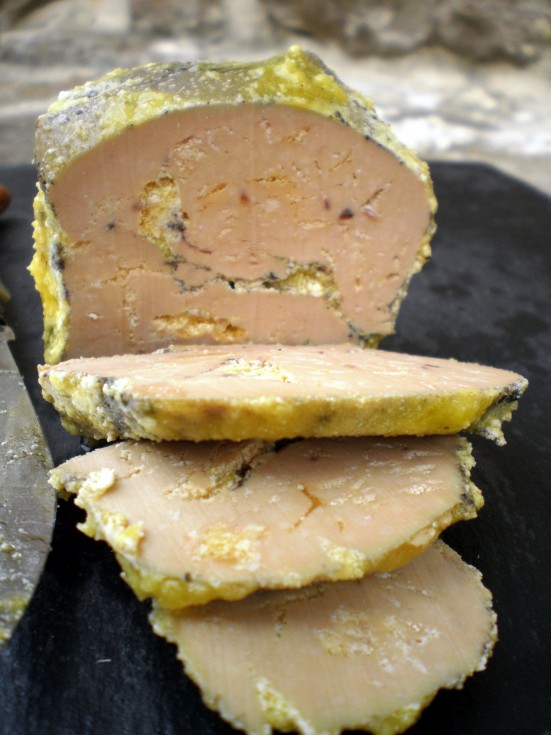
The French eat 90% of the foie gras they make themselves. That’s how much they like it, but they didn’t invent it. Although the Egyptians might have force-fed their birds, we’re not sure that they ate foie gras. The Greeks probably did, since the 4th-century Greek poet Archestratus wrote about it in his Gastronomy. The liver is the soul of the goose, he said.
Foie gras is made using a process called gavage, which consists of force-feeding ducks or geese through a feeding tube to fatten them. The Romans stuffed dried figs down their throats. In Latin, the word for liver even comes from fig, ficus. Scipio Metellus, a Roman chef, had the idea of soaking still warm livers in honey and milk to swell them even more before cooking.
Apart from the region of Béarn in the southwest, this practice disappeared in medieval France, coming back to life in the southwest and Alsace during the Renaissance.
French foie gras is made by force-feeding corn to geese and ducks, and still, occasionally, figs, which swells the livers.
Goose foie gras has traditionally been the most cherished because it is fattier, but it cannot be produced year round. Duck liver is less fatty, and can be produced year round and industrially, meeting the ever-increasing demand.
The fattened liver can be made into terrine, pâté, mousse, parfait, and a host of other things, and, in more recent times, there is a trend of cutting fresh foie gras into thin slices and pan-searing it. It can be eaten fresh or preserved in glass jars, and can be seasoned with truffles, port, Armagnac or Sauternes. Southwesterners prefer a simple, less perfumed foie gras, while Alsacians like to add flavor.
When purchasing, there are legal distinctions in names that indicate the purity and therefore determine the price:
Terrine is pure foie gras pressed into pâté shape.
Forcemeat can consist of one or several ingredients, including pork, veal or chicken fat; pork or chicken liver; scraps from deveining; poaching fat; eggs; milk; lactoproteins; flour, and starch.
Foie gras comes in a jar, plastic package or can or fresh from the butcher. When purchasing, be aware of the different cooking preparations, since the temperature at which it is cooked and the method of cooking change the flavor and shelf-life. Generally speaking, fresh is better.
It is important to make sure you are being sold what you ask for in both restaurants and shops. As a consumer, you have a legal right.
The French don’t eat foie gras every day. Traditionally, it is for special occasions and holiday meals, especially Christmas and New Year’s celebrations.
Coming soon: What to Eat with Foie Gras
|
|
 Meet Jonell Galloway, a freelance writer and editor specialized in French cuisine.


