French cuisine is much more than the haute cuisine inherited from the nobility. It is also the tasty, inexpensive cuisine that French families eat every day, called cuisine bourgeoise, or “bourgeois cuisine.”
We all learned in school that “bourgeois” was a social class. Originally, it was what we now call the “middle class,” as opposed to the nobility and the poor and working classes. The bourgeoisie, or middle class, grew rapidly in France after the French Revolution.
In terms of cooking, the bourgeois weren’t rich enough to use expensive ingredients and their cooking skills were not as highly developed as those of the aristocrats’ chefs, but they had sufficient means to entertain friends and family. This cuisine came to be known as cuisine bourgeoise, which today simply means family cooking, tasty but not pretentious, as opposed to the haute cuisine of the elite.
The New Year’s Eve celebration, referred to as Saint Sylvestre in France, is of pagan origin. The celebration existed long before St. Sylvester himself and long before there was even a pope. Ancient beliefs and celebrations, both religious and pagan, are mixed with those of winter solstice.
In Ancient Rome, the New Year was celebrated after Saturnalia, which was around December 25th, and was a time for “feasting, goodwill, generosity to the poor, the exchange of gifts and the decoration of trees.” People exchanged coins and medallions in celebration of the New Year. This tradition has slipped into oblivion, although adults sometimes still give children coins on this day, but other parts of Saturnalia continue today.
Up until the time of Julius Caesar, this end-of-year celebration didn’t have to fall on a fixed date; it was simply about ten days after Saturnalia. It was Caesar who set the date of December 31, and later, in France, Charles IX set the first day of the year as January 1.
St. Sylvester was Pope from 314 to 335, at the time the Church was emerging from the catacombs. Although Emperor Constantine controlled most of what went on in the Empire, Sylvester persuaded him to convert to Christianity and close the pagan temples. The great basilicas were also built under his influence.
Etre le dindon de la farce. / To fall victim to dupery.
Une dinde. / A stupid, pretentious woman.
Anthelme Brillat-Savarin, perhaps France’s best-known gastronomic writer, said that the turkey was certainly one of the most beautiful gifts the New World had given to the Old. “…the fattest, and if not the most delicate, at least, the tastiest of all domesticated birds.” It’s not often that the New World gets such compliments from discerning French epicures.
Turkeys were originally called poules d’Inde, “Indian hens,” in France, because they were thought to have come from India, which they later learned was Mexico. The French were not the only ones to get the name wrong. In Hebrew a turkey is a tarnagol hodu, meaning literally “Indian chicken;” in Russian indiuk, Polish indyk and Yiddish indik.
There is some controversy over who brought turkeys to Europe. Columbus probably brought brought them back in the early sixteenth century, since records show that King Ferdinand had ordered that every ship to bring back ten turkeys before the Spanish explorer Cortés set out in 1519. In any case, by 1548, they were the rage in France. In 1549, Catherine de Medicis served 70 “Indian hens” and 7 “Indian roosters” at a banquet held in honor of the Bishop of Paris.
French aristocrats were accustomed to eating all sorts of feathered creatures, including chewy storks, herons, peacocks, swans, cranes and cormorants, so it wasn’t surprising that they fell in love with the less-chewy turkeys, and that in 1570, Charles IX and Elizabeth of Austria thought turkey noble enough to serve at their wedding feast.
By the seventeenth century, the French were raising turkeys as if they were their own and most cookbooks included turkey recipes. French chefs weren’t lacking in ideas: they made stews and ragouts; they larded, roasted and glazed it; they stuffed it and made it into soups and pâtés.
Marie-Antonin Carême preferred the wings, which he deboned, then stuffed with chicken and truffles. Alexander Dumas, in his Dictionary of Cuisine, included 27 recipes. Turkeys were well established in the Hexagon.
Christmas dinners usually meant lots of mouths to feed, so turkey, being the largest of the winged creatures available, eventually became the dish of choice for Christmas feasts. By the nineteenth century, it became customary to stuff the Christmas turkey with chestnuts, and the tradition continues today.
Gratin dauphinois, which consists of thinly sliced potatoes cooked slowly with cream and garlic, seems a simple enough dish. Purists and traditionalists say there’s no cheese and no egg, despite the fact that Escoffier himself used them, and that’s what makes it difficult to achieve.
Michelin star chef Michel Rostang, who was born and raised in the region, doesn’t use them and claims that’s the only authentic way to make it. In fact, if you add cheese and nutmeg, it becomes a gratin savoyard. The real secret is in the choice of ingredients and the patience it takes to make it. A good gratin should melt in the mouth, yet the top should be crunchy.
The Dauphiné was an ancient province of France, located in the southeast, corresponding roughly to the départements of Isère, Drôme, and Hautes-Alpes plus a bit of the Rhône and the Italian Alps.
Vonnas in the east of France is the home of the legendary Michelin-star chef Georges Blanc. He is best known for his Bresse chicken with cream and mushrooms. Traditionally, this chicken is eaten with potato pancakes. This recipe is inspired by Blanc’s mother, La Mère Blanc, who ran his restaurant before him. He learned to cook at her apron strings.
Vonnas is in the Rhône-Alpes region of France, known for poulet de Bresse chickens and poultry, frogs, Reblochon and Beaufort cheese, as well as gratin dauphinois, made with raw potatoes, thick cream and garlic, and pork products, plentiful in the bouchons, small restaurants found in Lyon.
Quand les poules auront des dents. / Literally, “when chickens have teeth,” meaning that will never happen.
Bresse chicken or poulet de Bresse has had an A.O.C. since 1957, which defines the way in which they are raised as well as the geographic zone in which they can be raised.
It is a French breed known as Bresse-Gauloise. The feathers are generally white, and they have a red, crenelated comb. They have blue feet and a white beard. About a million chickens are sent to market every year.
Poulet de Bresse and other poultry from Bresse — including guinea fowl, capon, hen and even turkey — is raised under strictly defined conditions, but it is not organic. They are free range and have a grass-based diet, but also eat worms and mollusks. Final fattening is with cereals and milk products in wooden cages. Bresse poultry cannot be slaughtered under 5 months of age if they are to bear the A.O.C.
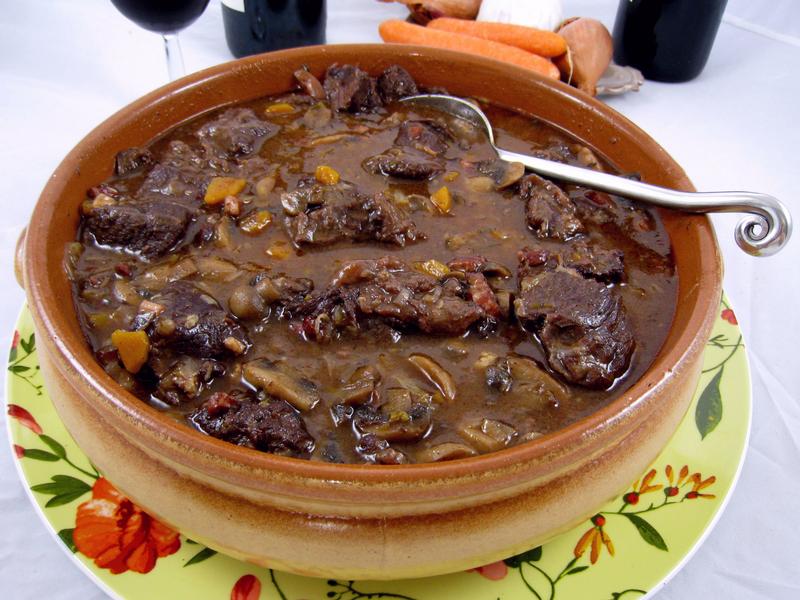
Boeuf à la bourguignonne, also referred to as beef or boeuf bourguignon, is a French classic from the Burgundy wine region of France. It is made with red Burgundy wine, and simmered for hours. It makes up part of what the French refer to as “plats cuisinés“, or slow-cooked dishes.
This recipe is quite easy to make, and should serve about 8 people. Plan to make it well in advance, since it is best when it is left to marinate for 24 hours and cook slowly several hours on the day of serving. It is the perfect dish for dinner parties or potlucks, and is one of the best leftovers around.
Boeuf Bourguignon Recipe
Click here for metric-Imperial-U.S. recipe converter