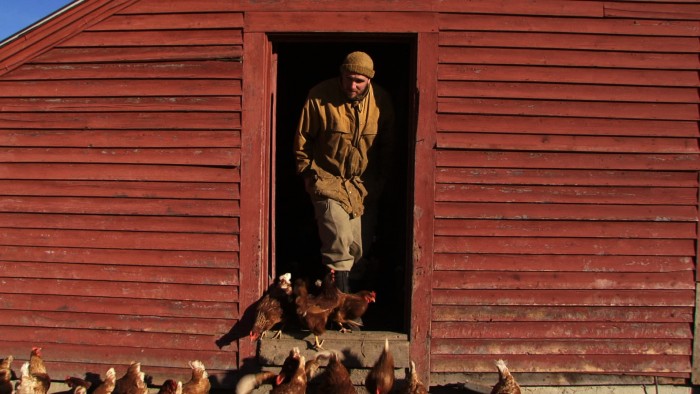
Wendell Berry: Daily Food Quote, June 30, 2011

Published by Thursday, June 30, 2011 Permalink 0

“A person who undertakes to grow a garden at home, by practices that will preserve rather than exploit the economy of the soil, has his mind precisely against what is wrong with us… What I am saying is that if we apply our minds directly and competently to the needs of the earth, then we will have begun to make fundamental and necessary changes in our minds. We will begin to understand and to mistrust and to change our wasteful economy, which markets not just the produce of earth, but also the earth’s ability to produce.” — Wendell Berry

Wendell Berry was born in Kentucky in 1934. He has always promoted a responsible kind of agriculture that is fully integrated into one’s everyday life. Because he promoted this vision of food and agriculture long before the Slow Food movement started, he is considered by many to have laid the foundation for the American Slow Food movement and the move toward a more sustainable and ethical agriculture.

The American Poetry Foundation says of Berry: Critics and scholars have acknowledged Wendell Berry as a master of many literary genres, but whether he is writing poetry, fiction, or essays, his message is essentially the same: humans must learn to live in harmony with the natural rhythms of the earth or perish. The Unsettling of America: Culture and Agriculture, which analyzes the many failures of modern, mechanized life, is one of the key texts of the environmental movement, but Berry, a political maverick, has criticized environmentalists as well as those involved with big businesses and land development. Berry strongly believes that small-scale farming is essential to healthy local economies, and that strong local economies are essential to the survival of the species and the well-being of the planet.

You can view his books and biography on the official Wendell Berry site.

Click here to listen to the 2-part series “Building a Slow Food Nation,” including an interview with Wendell Berry.

Never miss a post
Name: 
Your email address:*
Please enter all required fields
Correct invalid entries

Market Analysis: Organic Food from Supermarket vs. Straight from the Producer

Published by Thursday, April 28, 2011 Permalink 0

by Eric Burkel

Don’t allow the wool to be pulled over your eyes by supermarket organic food!

While discussing the issue of sustainable agriculture and the virtuous model of direct-channel (straight from the producer) with a friend the other day, she told me proudly that she usually buys organic food at her supermarket.

It made me think that most of us do the same and therefore we are content in the knowledge that we have most duly earned some sacrosanct “organic” brownie points!

However, it is a pact with the devil for dupes, when you boil it down. In a direct-channel model, whereby middlemen are cut out, the producer/breeder/grower gets decent compensation for his or her efforts. In a supermarket chain, the same “squeeze-the-supplier-till-he-squeals (or dies!)” modus operandi applies. How else can you explain that the major chains in France are offering organic deals at 1 € a day, for instance?

Organic growing is inherently risky and mechanically more expensive than intensively grown food. Weeds? They have to be pulled out by hand, not sprayed with the latest and greatest herbicide. Bugs? You can’t just spray the nasty freeloaders with a new-fangled pesticide.

When I asked our favourite organic Bordeaux wine-grower if he had sold out of his 2007 production (there was none to be found on his price list), he responded matter-of-factly: “We had a fungus that year and lost our whole crop.” You can imagine that it would have been soooooo much easier to spray some fungicide and make it all go away.

After factoring in such vagaries of organic farm life (without forgetting that yields are invariably lower on organic farms), someone needs to explain how in an ideal world you can have the cut-price organic prices we see in commercials all the time. Unless of course, someone is still getting shrift in the loop, as is often par for the course in our zero-sum world.

Some supermarket chains have understood the nuance and are trumpeting their programs to promote “local” procurement. This is a step in the right direction, no doubt.

So great, the chains have brought organic food to forefront our collective conscious and that must be goodness. But we must keep them on their toes to ensure that they are not just surfing the latest fad and using it their sole advantage, to sucker us once again.

Or better yet, go out of our way and support the direct-channel by joining a CSA (Community-Supported Agriculture) or buying directly from local producers.

Never miss a post
Name: 
Your email address:*
Please enter all required fields
Correct invalid entries

Help us support the cause! The Young Farmers Movement in the U.S.

Published by Wednesday, April 27, 2011 Permalink 0

by Jonell Galloway

Countdown: 66 Hours to Go!

Cozette Russell’s documentary film-in-progress, Brookford Almanac, about a year in the life of first-generation farmers in the U.S. needs funding before April 30, 2011.

Take a peak at our article Back to the Land: From City Living to Farming, the Young Farmers Movement and if you support the cause, why not donate a few dollars, euros, pounds or other.

Another way to help is to tweet this post and ask your friends to retweet it.

We’ll keep you posted about the project!

Never miss a post
Name: 
Your email address:*
Please enter all required fields
Correct invalid entries

Back to the Land: From City Living to Farming, the Young Farmers Movement

Published by Tuesday, April 26, 2011 Permalink 0

by Cozette Russell

Brookford Almanac:  A Documentary Film about a Year in the Life of First-Generation Farmers in the U.S.

I’m a filmmaker interested in the relationship between people and landscape, so in 2008 when I read an article in The New York Times about the trend of young people moving out of the city to farm, I knew this was a story I wanted to film. I wanted to find out why highly educated people would walk away from specific career paths to choose a life of farming. Why would they embrace the risks of a life of hard work that offers such little security?

My film, Brookford Almanac, a cinema verité documentary currently in production, tells the story of Luke and Catarina Mahoney and their lively farm apprentices who run Brookford Farm in Rollinsford, New Hampshire.

Luke and Catarina are first-generation farmers. They came to farming through their desire for a connection to the land, not from their family’s expectations. The Mahoneys have embraced the rewards and frustrations of a life centered on the small-scale production of local food. But without inherited land, a major obstacle for first-generation farmers, they must lease their farm with little security for the future.

I discovered the Mahoneys through my father, John Carroll, a professor at the University of New Hampshire who has written several books about New England farming. I decided to spend a year documenting the Mahoneys lives at Brookford Farm because they are not only new to farming but also run a biologically diverse farm and organic dairy. Before long I found myself filming at the breakfast table, riding in the tractor, slogging through cow pastures, attending business meetings and farmer’s markets, and hanging out in the pasture with the cows well before dawn. I learned the dedication it takes to farm and how the rigorous labor of each day is always interrupted by an inevitable drama such as animals breaking out or tractors dying or storms approaching. For a filmmaker the tensions of life on a farm are exciting and unexpected.

Every documentary filmmaker starts out with one idea for their film and watches that idea ebb and flow as life unfolds in front of the camera. When I began, I envisioned Brookford Almanac as a celebratory portrait of a year in the life of a farm family. At that time, I could not have predicted the changes that would take place both on the farm and in my film. Luke and Catarina have expanded their operation considerably. With this expansion has come problems with their landlord, a strong-willed, retired farmer who holds different opinions as to how things should be done. Sadly, because of these divergent philosophies, the landlord has decided not to renew the Mahoneys’ lease.

The issue of land access – something almost all first-generation farmers struggle with – is now no longer just a looming issue for Luke and Catarina; it is a harsh reality in their lives and it has come front and center in my film. The making of Brookford Almanac continues as I film life at Brookford Farm for a second farming season.

To continue this second year of production I am raising money through Kickstarter, a popular online crowd-funding tool. To learn more about the film and to join the production, please visit my Kickstarter page by clicking here below by April 30th.

_________________

Cozette Russell is a documentary filmmaker. She is currently a fellow at Harvard University’s Film Study Center, and she lives with her husband and creative partner Julian Russell in Lee, New Hampshire.

Never miss a post
Name: 
Your email address:*
Please enter all required fields
Correct invalid entries

National Sustainable Development Week in France, Paris AMAPs in Full Swing

Published by Friday, April 8, 2011 Permalink 0

by Eric Burkel

Without actually achieving that holiest of grails, sustainable development, and without going doing the path of ascertaining whether Mother Earth really needs more development, sustainable or otherwise, a world-leading auditing firm outside Paris opened its doors yesterday at lunchtime to host an event to offer up a few solutions that might help its employees reduce their environmental footprint.

Continue Reading…

Never miss a post
Name: 
Your email address:*
Please enter all required fields
Correct invalid entries

A Thought for Food: One Woman’s Journey into the World of Slow Food

Published by Tuesday, April 5, 2011 Permalink 0

by Meeta Khurana Wolff

A Thought for Food – Slow Food

Eating poorly or inadequately in our fast food culture is easy. Overworked and stressed, we rush out to find a quick bite and often find solace in a burger or a hot dog. The temptation of sugar, salt and fat feel good while we are eating it, but it really does little to satisfy us. It is convenient at the time and stills our hunger. Dinner might be a quick microwave meal, frozen pizza ready in minutes in the oven, or even take out. Looking at the long-term effects, it will make our family and us fat, lazy and sick!

Continue Reading…

Never miss a post
Name: 
Your email address:*
Please enter all required fields
Correct invalid entries

Wild Woman on Feral Acres: How to Keep Eggs 4 Months Without Refrigeration

Published by Friday, February 18, 2011 Permalink 0

by Esmaa Self

Backyard hens are an integral part of our sustainability efforts here at Middleground Farm. I feed ‘the girls’ wild greens, table scraps and essential nutrient-rich gruel; in return they give us incredibly healthy eggs. Our free-range flock reduces the property’s bug population and we protect them from chicken predators. It’s a beautiful relationship, and one that blesses us all.

Select fresh, clean, unblemished eggs

Perhaps you’ve heard that happy hens lay eggs. While flock contentment is relatively easy to attain (simply provide food, water, shade, soil to scratch, safe spaces in which to lay eggs, roost and roam), I am here to tell you that there is a poultry discontent beyond human control.

Some hens are better layers than others and will vigorously produce eggs come what may. Others find it too taxing to lay when the mercury rises above 92° F or falls below 32° F. A few breeds lay through the molt and when days are short, but many do not. Nearly every mature hen will lay eggs in abundance during spring, so productive are they then your refrigerator may become overrun by eggs.

Continue Reading…

Never miss a post
Name: 
Your email address:*
Please enter all required fields
Correct invalid entries

The Rambling Epicure Voices

Published by Monday, February 7, 2011 Permalink 0

Food writer, Culinary Chemistry, The Rambling EpicureJenn Oliver writes our column Culinary Chemistry. She has a Ph.D. in science, where she explains the scientific aspects of what really goes on when you cook (the next Harold McGee?). She’s been running a gluten-free blog, Jenn Cuisine, since 2008 and her kitchen is more like a laboratory than a kitchen. She’s focuses her chemical calculations and experiments on figuring out how to make traditionally glutinous food gluten-free.

Esmaa Self writes the Wild Woman on Feral Acres column. She lives on a small farm in Colorado where she employs organic and sustainable methods to grow fruits, vegetables and herbs, raise chickens, bees and fish and where she routinely turns out imaginative, healthy, guilt-free meals from scratch. One of her numerous blogs recounts her farming adventures: Backyard Eggs. She also writes novels and contributes to numerous organic farming and green publications, and runs a sustainable living site, Homeostasis.

Simon de Swaan is Food and Beverage Director at the Four Seasons hotel in New York City. He studied at the Culinary Institute of America and has an incredible collection of antique cookbooks and books about food and eating, from which he often posts interesting and unusual quotes. In his column Simon Says, he gives us daily food quotes from his tomes.

Jean-Philippe de Tonnac is an essayist, editor and journalist. He directed the special editions of the Nouvel Observateur for almost ten years and and has published twenty books. As preparation for publication of his Universal Dictionary of Bread (Dictionnaire universel du pain, Bouquins Laffont, 2010), he obtained a baker’s certificate (CAP) at the Ecole de Boulangerie et Pâtisserie de Paris in 2007, and traveled worldwide to countries where bread held a particular cultural significance.

Continue Reading…

Never miss a post
Name: 
Your email address:*
Please enter all required fields
Correct invalid entries

Simon Says: January 31, 2011

Published by Monday, January 31, 2011 Permalink 0

The aroma of food can be responsible for as much as 90 percent of its flavor. Scientists now believe that human beings acquired the sense of taste as a way to avoid being poisoned.–Eric Schlosser, Fast Food Nation

Continue Reading…

Never miss a post
Name: 
Your email address:*
Please enter all required fields
Correct invalid entries

UA-21892701-1