Health Challenge: Healthy Snacking when Couch Potatoing in front of the TV

Published by Monday, September 10, 2012 Permalink 0

by Tamar Chamlian

As the winter kicks in and we are gradually easing in to cold weather, we naturally seek activities that are warmer and right in the comfort of our own homes.

In our house, we do a TV night once in a while, keeping warm, and maybe inviting a few friends over. While snacking on popcorn and chips seems to be a common and popular ritual as well as the easy solution, I suggest you try the three healthier alternatives I have listed below so you can ditch that caramel popcorn or those nachos and cheese.

  1. Mozzarella and cherry tomato skewers. Place one mozzarella ball followed by a cherry tomato on a skewer, drizzle with a tiny bit of olive oil and dried (or fresh) basil leaves.
  2. Fruit skewers. Pick any combination of two or three fruits, place them on skewers and drizzle the fruit and juice of a passion fruit for some extra kick and flavor.
  3. Make “healthy” homemade chips. Slice apples, pears, peaches, and sweet potatoes very thinly. Drizzle a very small amount of olive oil and dried mint. Grill them in a pan, and serve in a bowl as a healthy alternative to fried potato chips.

Enjoy the movie!

Never miss a post
Name: 
Your email address:*
Please enter all required fields
Correct invalid entries

Simple Sustenance: In Season and Healthy — Peach and Spinach Salad

Published by Tuesday, September 4, 2012 Permalink 0

by Renu Chhabra

One should eat to live, not live to eat” –Benjamin Franklin

Peaches are synonymous with summer.

California being the largest peach-producing state, we are blessed with an abundance of them. Farmers markets are flooded with these fuzzy yellow beauties. So many of them. Different varieties with vibrant colors. Juicy, sweet, and simply delicious.

Farm-fresh peaches have flavor that can’t be found in supermarket ones. I have tasted a few California varieties that need no explanation. Instead, just close my eyes and bless the soil and the farmers who nurtured them. It’s nature’s bounty at its best.

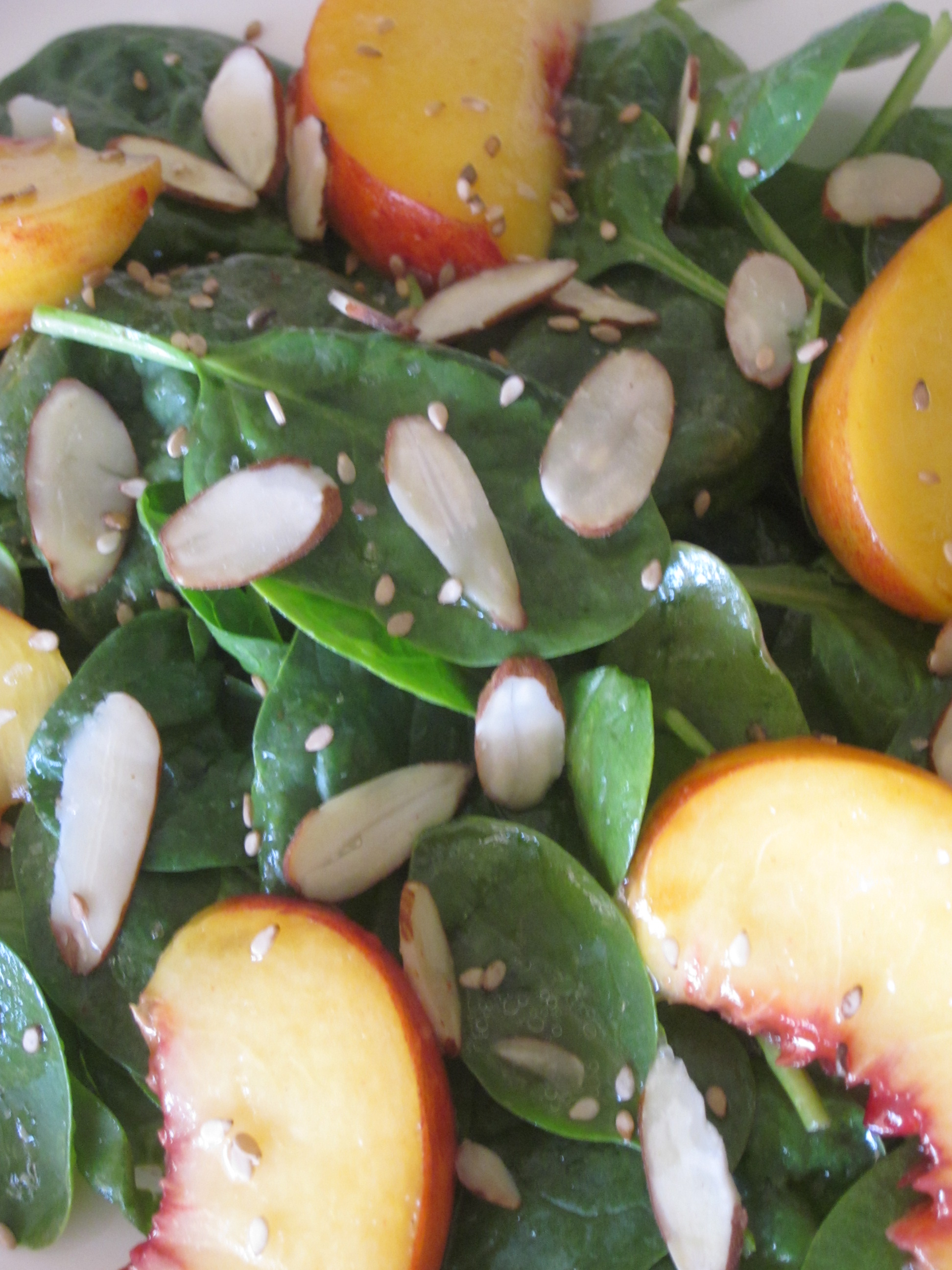
These peaches are in season from May through September. Baking, grilling, roasting, and poaching are definitely a few ways to enjoy them. But nothing beats the joy of savoring them in their natural form. So, I made a salad with this seasonal fruit and paired it with baby spinach.

Another ingredient that gives this salad a little zing is the peach balsamic vinegar. My culinary find that is absolutely delicious. Drizzle a little on salads, grilled vegetables, toasted baguette, or ciabatta, with or without olive oil. It stands out on its own. Its peachy flavor is the star that shines through.

A few other ingredients that complete this salad are ginger, honey, almonds, raw sesame seeds, and roasted sunflower seeds. Ginger and honey, a classic combination goes well with peaches. Raw sesame seeds and roasted sunflower seeds add earthiness and texture. Finishing with a grind of good sea salt (I used pink salt) and pinch of red pepper flakes complements the sweet peaches and honey. All together it makes it a sweet, salty, and spicy experience.

Recipe

Dressing
 
2 tablespoons peach balsamic or white balsamic
2 tablespoons olive oil
1 teaspoon juice of ginger
1 teaspoon honey or agave
Sea salt to taste
Red pepper flakes to taste (optional)
Salad
2 medium yellow peaches, sliced or diced, your choice
2 handfuls of baby spinach

Garnish

Sliced raw almonds
Raw sesame seeds
Roasted sunflower seeds

  1. Mix all the ingredients for the dressing in a mason jar. Set aside.
  2. In a bowl, gently toss spinach with light dressing.
  3. Place spinach on a serving dish.
  4. Drizzle some dressing on peaches and mix. Serve spinach carefully.
  5. To finish the salad, drizzle a little more dressing and sprinkle sea salt and pepper flakes on top, if needed. Garnish with almonds, sesame seeds, and sunflower seeds.
  6. Serve immediately.

Note: Use dressing to your taste, but be careful not to drench the spinach with too much of it.

    1. Mix all the ingredients for the dressing in a mason jar. Set aside.
    2. In a bowl, gently toss spinach with light dressing.
    3. Place spinach on a serving dish.
    4. Drizzle some dressing on peaches and mix. Serve spinach carefully.
    5. To finish the salad, drizzle a little more dressing and sprinkle sea salt and pepper flakes on top, if needed. Garnish with almonds, sesame seeds, and sunflower seeds.
    6. Serve immediately.

    Note: Use dressing to your taste, but be careful not to drench the spinach with too much of it.

    • Simple Sustenance: Summer in a Bowl – Honey-Ginger Papaya Salad

      1. Mix all the ingredients for the dressing in a mason jar. Set aside.
      2. In a bowl, gently toss spinach with light dressing.
      3. Place spinach on a serving dish.
      4. Drizzle some dressing on peaches and mix. Serve spinach carefully.
      5. To finish the salad, drizzle a little more dressing and sprinkle sea salt and pepper flakes on top, if needed. Garnish with almonds, sesame seeds, and sunflower seeds.
      6. Serve immediately.

      Note: Use dressing to your taste, but be careful not to drench the spinach with too much of it.

      Never miss a post
      Name: 
      Your email address:*
      Please enter all required fields
      Correct invalid entries

Part 6 on Fermentation: Sauerkraut Success

Published by Friday, August 31, 2012 Permalink 0

Part 6 on Fermentation: Sauerkraut Success

by Diana Zahuranec

I filled two scalloped blue bowls with homemade sauerkraut and kimchi, sat down, and taste-tested.

I was hesitant, but I was encouraged by the lack of mold.

Kimchi wanna-be and sauerkraut

After two weeks of pushing down the bottles that weighed on my sauerkraut and “kimchi” (which was not actually kimchi, but will be referred to as such because that’s what I wanted it to be), I balanced the heavy, full bowls of vegetables on a flimsy, plastic tray and carried them to the kitchen counter.

I removed the bottles filled with water, the plates, and then the bags (why all this? Here’s why in Step-by-step Fermentation). I began to pour the mix into large containers of what once held 1 kg of yogurt, but I stopped when I lost too much liquid.

I assumed that the liquid of fermented vegetables contains all the healthy nutrients  that can be found in the vegetables themselves. I didn’t want to lose that, although I remain baffled as to what I could do with it, and haven’t found great sources backing up my Water-From-Fermented-Vegetables-Is-Healthy Theory (yet).

So I stuck my hand in and scooped it all out, pouring the liquid over top at the end. The liquids also help to preserve the vegetables when you store them in the refrigerator, and many say that the flavor improves as the fermentation slowly continues. And another reason to save the water: use a bit mixed in with the brine the next time you ferment vegetables, helping to jump-start the fermentation process.

According to Nourishing Days, ferments with 1-2% salt content will store for 4 to 9 months.

I filled two of those yogurt containers and some glass jars, or about roughly 13 cups of sauerkraut and kimchi from almost the same amount of vegetables. I had read that the vegetables will shrink as they lose their water, but the before:after ratio was nearly the same.

Success! They were both delicious. There was not a hint of rot. In fact, although many sources claim that it’s highly probable that you’ll lose some of your batch – especially a small one, like mine – due to air or uneven fermentation, I lost no more than a few shreds of cabbage.

Both were crunchy and flavorful. The pure cabbage had a more delicate flavor, and a bit of lactic acid tang. When I made the brine, I also added a teaspoon or two of yogurt whey to help . Sauerkraut naturally has a  lactic acid flavor, so I’m curious to see if fermented vegetables without added whey would give off that taste as strongly. Fermentation Project Number 2?

The kimchi was spicy from the chili pepper flakes and chopped hot peppers I added, and the mix of vegetable textures was delightful. The tastes all ran together – a carrot didn’t taste much different from a chard stem. And the chard stems were tougher than I wanted; but on second thought, it’s great that everything retained its crunchy structure. Mushy vegetables can be the result of not adding enough salt; I also read on Nourishing Days that tannins keep the structure of the vegetables intact, so you may be able to add grape leaves, for example, to retain crunch.

And now I’ll admit that I tentatively drank the fermented water, out of curiosity and refusal to waste something healthy. Its flavor wasn’t offensive, just mostly salty. I decided it might be healthier to forgo the salt than to absorb the other nutrients in there. And drinking fermented water just doesn’t sound very appetizing.

Never miss a post
Name: 
Your email address:*
Please enter all required fields
Correct invalid entries

Simple Sustenance: Kale Power — Kale and Sunflower Seed Pesto

Published by Tuesday, August 7, 2012 Permalink 0

by Renu Chhabra


“Eat food. Not too much. Mostly plants.” Michael Pollan

This one is for kale lovers. I know. I am one of them. Until not too long ago, I did not have the slightest idea of its existence; or let’s just say, it did not visit my produce bag. But once I tasted it, I was hooked on the amazing wonders of kale like most health enthusiasts.

Kale is known by several flattering names — Queen of Greens, Powerhouse of Nutrients, King of Greens. These days kale is one of the most talked about super foods. From soups and stews to salads and stir fries, it has found its way in every possible form of cooking. Kale juice anyone? How about kale chips for a healthy snack? And if that’s not enough, just puree these hearty leaves to transform them into pesto. Now that opens up several more ways to enjoy its versatility.  Stir it in pasta, spread it on breads and crackers, or thin it a little to make dressings. If none of those options are appealing to you, a few spoonfuls as is works for me.

Speaking of pesto, I made this recipe with sunflower seeds instead of nuts. Sunflower seeds provide fair share of good fats, and they also give it a rustic texture. I left cheese out making thus making it an option for vegans. But if you prefer a cheesy flavor, add some pecorino or parmigiano. Good olive oil, lemon, and garlic with a few grinds of sea salt make it absolutely delicious. Store in refrigerator and enjoy.

Recipe

1 medium bunch kale, stems removed
1 large clove of garlic
½ cup unsalted roasted sunflower seeds
Juice of one large lemon
Sea salt to taste
Freshly ground pepper (optional)
½ cup olive oil

Instructions

Put kale leaves in boiling water for 30 seconds. Drain in a colander, and run cold water over to stop the cooking process. Squeeze kale to remove water completely.

In a food processor, pulse garlic a couple times. Add sunflower seeds and pulse again 2-3 times. Add kale, lemon juice, salt, pepper and puree.  Drizzle oil while the machine is running. Puree it to desired consistency.

Adjust lemon and salt to taste. If the pesto is too thick for your taste, add a little water.


  • In a food processor, pulse garlic a couple times. Add sunflower seeds and pulse again 2-3 times. Add kale, lemon juice, salt, pepper and puree.  Drizzle oil while the machine is running. Puree it to desired consistency.

    Adjust lemon and salt to taste. If the pesto is too thick for your taste, add a little water.


    Never miss a post
    Name: 
    Your email address:*
    Please enter all required fields
    Correct invalid entries

Simple Sustenance: Summer in a Bowl — Honey-Ginger Papaya Salad

Published by Thursday, August 2, 2012 Permalink 0

by Renu Chhabra

One cannot think well, love well, sleep well, if one has not dined well. —Virginia Woolf

Sunshine and outdoors! Summer is in full swing. We have been experiencing beautiful warm days — some warmer than others. But that’s the beauty of this season.

Farmers markets are exploding with seasonal produce and an abundance of flower power. And local honey farms are showcasing their products with great pride. In fact, I recently attended a lecture about bee pollination at our local Whole Foods Market. It is amazing how these tiny bees create something so rewarding, one bit at a time. It definitely makes me respect every drop of honey I use. Especially at a time when there is quite a buzz about honey among health-conscious people like me who try to avoid refined sugars, and want to preserve this precious commodity. So I say, love our honey bees and respect their hard work.

Continue Reading…

Never miss a post
Name: 
Your email address:*
Please enter all required fields
Correct invalid entries

Part 3: What is Fermentation?

Published by Monday, July 30, 2012 Permalink 0

“Fermentation is one of the oldest and simplest means of preserving foods. It requires no particular kind of climate, no cooking, and so no expenditure of fuel: just a container, which can be a mere hole in the ground, and perhaps some salt or seawater,” quoted from the ever-insightful Harold McGee, author of On Food and Cooking: The Science and Lore of the Kitchen.

On Food and Cooking

Harold McGee’s “On Food and Cooking: The Science and Lore of the Kitchen”

vegetable


The third article in this mini-series is going to be scientific and a little bit nerdy. Get ready to learn the nitty-gritty behind fermentation.

Fermentation begins in the vegetable or fruit. The naturally-occurring microbes in the food proliferate under the right conditions – namely, under the lack of air. At the same time, these beneficial microbes suppress the growth of harmful microbes that rot the fruit or vegetable. The good microbes metabolize the plant’s sugars and carbohydrates before the bad microbes get a chance. In a way, fermentation is a “controlled-rotting” process: the difference between sauerkraut and rotting cabbage is which microbes are allowed to grow.

When protected from air, these microbes get to work producing lactic acid, alcohol, carbon dioxide, and other compounds and nutrients.

Ferments can be made by crushing the vegetables or fruit until enough liquid is let out, ensuring that the vegetables are covered and protected from the air. Usually, though, the vegetables need a little bit of help: salt draws out the liquids, sugars, and other nutrients, and so ferments are often dry-salted or submerged in a salt-and-water brine before being stored in a covered container.

Crushing: wine is also a form of fermentation

As the plants ferment, much of the material remains intact, hence crunchy kimchi and sauerkraut as opposed to being mushy or slimy (two problems which usually signify contact with air; check out a great troubleshooting link). As the vegetables ferment, not only do they retain their vitamins, but additional nutrients are formed in the process: namely Vitamin B, folate, and the production of enzymes. New flavors and aromas begin to develop, and continue to age and change for as long as you ferment your food.

The salt concentration of the brine and the temperature during fermentation are the two main components that determine which beneficial plant microbes flourish and, consequently, the flavors and aromas that result. Vegetables with a low-salt brine and fermentation under low temperatures will produce mild but complex flavors with Leuconostoc mesenteroides. Fermentation done in high temperatures will produce almost exclusively lactic acid bacteria, from the Lactobacillus plantarum microbe. Also, fermentations undergo a dual process: they produce the first microbe, Leuconostoc mesenteroides, which is then taken over by Lactobacillus plantarum during the second stage of fermentation.

Never miss a post
Name: 
Your email address:*
Please enter all required fields
Correct invalid entries

ROSA’S MUSINGS: SPICE UP YOUR DISHES WITH HOMEMADE FLAVORED SALTS

Published by Tuesday, July 24, 2012 Permalink 0

Salt is the policeman of taste: it keeps the various flavors of a dish in order and restrains the stronger from tyrannizing over the weaker.--Margaret Visser

Salt plays an important role in our daily life. Not only is it a vital substance for all living creatures, as it regulates the water content of our body, but it is also makes food taste better. Nobody can survive or cook without sodium chloride.

Continue Reading…

Never miss a post
Name: 
Your email address:*
Please enter all required fields
Correct invalid entries

Dietitian Ariane Grumbach’s 10 rules for eating the French way and staying skinny

Published by Friday, July 20, 2012 Permalink 0

translated and adapted by Jonell Galloway

10 rules that could be called Slow Food rules?

I discovered Ariane Grumbach on one of my favorite food sites, Larousse Cuisine. I’ve translated Grumbach’s 10 rules for eating à la française, adapting them slightly for a wider audience.

  1. Continue Reading…

Never miss a post
Name: 
Your email address:*
Please enter all required fields
Correct invalid entries

Yummy Umami: The 6th Basic Taste?

Published by Thursday, April 26, 2012 Permalink 0

Yummy Umami: The 6th Basic Taste?

by Diana Zahuranec

Quick, name the 5 basic tastes: sweet, sour, bitter, salty…and the fifth one is umami. Umami is the word that describes the savory taste of food, or perhaps “meatiness” of a food. It is the taste of the amino acid L-glutamate. The Japanese singled out this flavor in the early 1900s thanks to a chemistry professor from the Imperial University of Tokyo, Kikunae Ikeda, who isolated the glutamic acid compound C5H9NO4. Glutamic acid is found in both free and bound forms. The free form, which is formed when the protein molecule breaks down and releases glutamic acid, is the one we taste. “Umami” means in Japanese, literally, deliciousness.

Kikunae Ikeda, the Chemist who singled out MSG

A few years ago, I remember there was some hype that spread virally through America’s highly-informed (and often misinformed) consumer culture about MSG.

What is this lethal-sounding additive in the foods we eat, so cleverly covered up by only using three letters to trick us when we know better? It was soon known that MSG, or monosodium glutamate, is an ingredient added to most processed foods in order to enhance their flavors. In the media, MSG was linked to many ills, including migraines, nausea, and cancer, among others.

Wariness and fear of MSG actually began in the 1970s, after Dr. Ho Man Kwok wrote in the New England Journal of Medicine that he was experiencing all sorts of uncomfortable after-effects from a Chinese dinner, including numbness, weakness, and palpitations. He did not specifically link his symptoms to MSG, but a year later a study was done on baby mice by injecting high dosages of MSG (up to 4 grams per kilogram of body weight) and observing the brain lesions the mice suffered afterwards. Thus was born Chinese Restaurant Syndrome (CRS). Studies, anecdotes, and reports were quick to follow suit afterwards, claiming that MSG was linked to all sorts of ills. Some prominent nutritionists today are convinced that added MSG is harmful, especially for children.

Continue Reading…

Never miss a post
Name: 
Your email address:*
Please enter all required fields
Correct invalid entries

Barbie’s Secret to Weight Loss: Don’t Eat

Published by Monday, April 2, 2012 Permalink 0

by Jonell Galloway

Reprint of our most popular article

Barbie’s secret to weight loss was “don’t eat”: Is that your teen’s philosophy?

The 1965 Slumber Party Barbie came with her very own How to Lose Weight book. The main message was “don’t eat.” Along with this book came a bathroom scale always set at 110 pounds/49.9 kilograms, says Teen Beauty Tips. According to Malisa Morsman, “Barbie is the plastic equivalent of a 5-foot, 9-inch (1.75 m) woman with a 36-inch (91.5 cm) bust, 33-inch (83.8 cm) hips, and an impossibly small 18-inch waist (45.7 cm).”

Photo courtesy of Mental Floss.

Continue Reading…

Never miss a post
Name: 
Your email address:*
Please enter all required fields
Correct invalid entries

UA-21892701-1