Book Review: Ingredienti, by Marcella Hazan and Victor Hazan

Published by Thursday, July 14, 2016 Permalink 0

Book Review: Ingredienti, by Marcella Hazan and Victor Hazan

by Jonell Galloway

This guide is the testament of a woman who based her cooking life on the truth of every dish she cooked and taught, the vigorous truth of clear, uncluttered taste, taste that arises neither from obeisance to dogma, nor from a craving for attention, but evolves inspired by, and respectful of, the ingredients that nourish it.–Victor Hazan in the introduction to Ingredienti

Marcella Hazan, the “godmother of Italian cooking” and the woman many credit with bringing Italian cuisine to the U.S., died in 2013, leaving behind two years’ worth of handwritten notes in Italian in preparation for Ingredienti. Her lifetime collaborator, Victor Hazan, translated and edited these notes, resulting in what is undoubtedly a classic before its time.

With Marcella Hazan’s cookbooks in my suitcase, I was already “tasting Italy” on my way back from London to my home in France. I had a plan: to use her books to learn how to cook Italian food.

That was nearly twenty years ago. It didn’t take me long to realize that the precious ingredients required were simply not available in provincial France. French supermarkets sold pasta made in France with French flour, not Italian pasta made from grano duro. French tomatoes were watery-tasting, even the canned ones. Mozzarella and Parmigiano-Reggiano were rarities found only in a few exclusive shops in Paris. The French were just starting to get interested in olive oil, although in the Southeast it had long been the fat of choice thanks to its Greek and Roman history.

Disappointment quickly set in. Marcella’s Italian recipes weren’t going to taste of Italy using French ingredients. It is no wonder that she wanted to write Ingredienti. She knew this was a problem when living outside Italy and felt the need to enlighten her readers about how to choose and treat ingredients.

It was only later when I moved to Switzerland, where good-quality Italian ingredients of all kinds — tomatoes, pasta, cheese, fruit — were readily available that I returned to Marcella. From Geneva, it was also easy to travel to Turin to the Slow Food gatherings. During the Terra Madre conference, I’d arrive every morning with a roller suitcase and, over the course of the day, fill it with food to take back to Switzerland.

Later, in my Italian food journey — even when living in Italy — Marcella, and later Victor, became for me household words, their books like a treatise, a bible, that I refer to in times of doubt, for example, when I make “red” spaghettini alle vongole, which I must have made a hundred times using Marcella’s recipe.

As important as this book is, Marcella Hazan’s recipes are not only about ingredients. The true secret to her success is the lucid precision of the explanations. A scientist by training with two doctorates, her instructions are methodical, almost mathematical. She counts in minutes and half minutes, and you can count on what she says. Though her cookbooks were not written as culinary classes per se, once you’ve followed her risotto instructions a couple of times, you are struck by the rigorousness of the recipe, of how each step is in its proper place, and each time given is exact, and it becomes like a work of art or a perfect mathematical equation, with no excess and no frill.

Ingredienti is indeed a testament to Marcella Hazan’s undying commitment not only to Italian cooking, but also to the importance of choosing products and the actual process of shopping, on which we put too little emphasis. Marcella had an intimate relationship with products, knowing them inside and out as if they were the baby she’d raised. “Choose a pepper by its size, shape, and heft. It should be large, heavy, shiny, firm, and cubical in form. The long tapered ones are not as solidly meaty.” Now you have a clear image in your mind of what to look for next time you buy a pepper. The entire book is like this, leaving you with the impression that you’d been going to a market class with Marcella for a week and held the artichokes or peppers or onions in your hands.

Speaking of extra-virgin olive oil, she says, “if olive oil were a drug, it would have a place of honour among miracle drugs,” saying that “it well might be the most significant contribution to my survival.” Although she embraces the use of lard and butter, used in her native Emilia-Romagna, olive oil was the superstar in her kitchen.

On the important subject of pasta: one can’t say fresh pasta is always better than dried pasta. Fresh pasta, made with eggs and flour, longs for butter and cream, which seep into the crevices of its rough surface; dried pasta, made with water and flour, is a perfect marriage for olive-oil and tomato-based sauces, which slide gracefully around it. You’ll never look at pasta the same way once you’ve “consumed” this chapter; in fact, you’ll want to read it over and over, making sure not to miss a single point.

She tells you everything you need to know about Parmigiano-Reggiano, not to be confused with generic parmesan cheese. Its goodness depends on the origin of the milk, the breed of cow, the age, the season, and, of course, the method used to make it. Though this is not a recipe book, Marcella throws in the prize of Victor’s grandmother’s recipe for Parmigiano crostini, not to be missed.

The book is broken down by category of ingredient, including “Produce,” “The Essential Pantry,” and “Salumi,” with individual chapters devoted to classic Italian ingredients such as artichoke, eggplant, and tomatoes; pasta, risotto rice, olive oil, Parmigiano-Reggiano, and red wine vinegar; prosciutto, pancetta, and lardo, and a whole host of other products.

For those who live in locations in the U.S. where Italian ingredients are not available in the same way, just as I did in France, the book includes a fairly exhaustive list of online suppliers of good-quality ingredients with precise indications of what to order from whom.

Count on reading the book from front to cover in one or two sittings, and then keeping it on your kitchen shelf for easy, repeated reference, as you might do with a prayer book. As with all of Marcella and Victor Hazan’s collaborations, there is never an extraneous word, sentence, or idea, so you’ll want to read the important passages numerous times.

Like a yogi, Marcella repeated the same “postures” over and over, meditating upon the ingredients, seeking the truth in them with a focused faith and methodical effort. As a result, Ingredienti reads much like a text written by a spiritual master in old age. It is concrete proof of her dedication; it is the wisdom of years lived in perfect harmony with food, based on her immeasurable knowledge and intimate relationship with ingredients, but also on an almost spiritual reverence for their integrity. It is, indeed, a testament of Marcella and the truth she sought by going to the essence of every foodstuff she touched, and of the truth she attained in her reasoned, scientific manner.


Never miss a post
Name: 
Your email address:*
Please enter all required fields
Correct invalid entries

Venetian Hours: How Not to Visit Venice

Published by Tuesday, March 29, 2016 Permalink 0

Venetian Hours: How Not to Visit Venice

by Jonell Galloway

There are many ways to visit Venice, but if you want a real Venetian experience without disappointments, here are some tips.

  1. Don’t stay near Rialto or San Marco. There’s nothing at all wrong with the neighborhoods, but they are more expensive and more touristy.
  2. Don’t eat in restaurants with colored photos of all the dishes on a plastic sign outside. They tend to be touristy and unauthentic.Santi Maria e Donato basilica/church, Murano, Venice, Italy, travel
  3. Don’t take the vaporetto everywhere. The vaporetto is good for seeing the palaces on the Grand Canal on a sunny day or at night when they’re lighted, but walking lets you fall by chance on hidden palaces, churches, bridges, canals and cafés. These are the great joys of Venice.
    vaporetto water bus rialto bridge venice
  4. Don’t take Alilaguna if you’re coming from the airport. You can’t see a thing through the windows, and the trip takes about twice as long as the No. 5 airport express bus to Piazzale Roma (20′), which leaves from directly in front of the main airport exit.
  5. Don’t walk the streets looking for a restaurant. Choose restaurants in advance instead of walking in spontaneously when you’re hungry. Venice has its full share of tourist traps, especially around San Marco and the Rialto. Note: there are good restaurants in these neighborhoods, but do your research and reserve ahead of time and you’ll have a happier experience.View from Campo San Vio, looking down Grand Canal into San Marco Basin or Bacino, at Santa Maria della Salute church and Punta della Dogana art museum
  6. Don’t go to just any shop or restaurant. Try to frequent places run by Venetians and Italians. This is not racist or chauvinistic; it simply means you’re more likely to have an authentic experience and support the economy in Venice.canal venice san polo
  7. Don’t set out on your day’s sightseeing without studying where the major landmarks in Venice are located. Know where San Marco, Rialto, Accademia, Ferrovia and Piazzale Roma are in terms of north, south, east and west and your day will go much more smoothly. It’s also good to memorize the vicinity of major landmarks and the names of the sestieri or six city districts: Castello, Cannaregio, San Marco, Dorsoduro, Santa Croce and San Polo.sestieri or districts of venice map courtesty of http://www.italyguides.it/en/veneto/venice/interactive-map-of-venice#!/catid=36
  8. Don’t think you can get everywhere like you do in a city with a grid layout. Maps are not always the best way to get around. Let yourself get lost. When you’re really lost, look for the arrows near the street names marked San Marco, Rialto, Accademia, Ferrovia and Piazzale Roma.
  9. Don’t buy tickets each time you get on the vaporetto. Buy a Venezia Unica Citypass for one, two, three or seven days. Yes, it’s expensive, but so are individual tickets at 7.50 Euros a shot.
    Ponte di Chiodo, only bridge without parapet/side rails in Venice Venezia
  10. Don’t go to Venice uninformed. Do your homework before arriving. No matter what, you’ll spend a lot of wonderful hours getting lost, but you’ll make better use of the restricted opening hours.
  11. Don’t sleep in. Museums and churches tend to close early and some even close for lunch.
  12. Don’t rely on your guide books for opening and closing hours. They’re invariably out of date and times tend to change according to the season and the budget. Web sites are not always up-to-date either, but they’re more reliable. City museum opening times can be checked on the MUVE site. Otherwise, look at websites for individual museums.

Interactive map of Venice.


Never miss a post
Name: 
Your email address:*
Please enter all required fields
Correct invalid entries

Nonna Violante and Taste Unlocked

Published by Monday, September 14, 2015 Permalink 0

I’ve spent the last week with a wonderful group of journalists and chefs in Bellaria Igea Marina on the Adriatic Coast of Italy on a press trip called #LovingRomagna, learning the cuisine of Romagna with Nonna Violante at the Hotel Eliseo. I’ll be posting soon about the incredible hospitality, wonderful food, and history of this region.

In the meantime, James Flewellen and I are busy preparing our Taste Unlocked food and wine tasting workshop, which starts on Thursday. Bon appétit et bonne semaine!

Never miss a post
Name: 
Your email address:*
Please enter all required fields
Correct invalid entries

ITALIAN-STYLE CINNAMON & RAISIN BISCOTTI

Published by Wednesday, April 15, 2015 Permalink 0

Biscotti Picnik collage 1 bis

by Rosa Jeanne Mayland

“Biscotti” (pronounced “bee-scoat-tee”) are relatively new to me. Actually, a few years ago (about 6 years ago) I had no clue what they were. That is quite understandable if you consider the fact that I’ve lived all my life in Switzerland and never travelled to Italy (I passed through that country when going to Greece, but I doubt that this can qualify for holidays) nor to America where this speciality is widespread…

I was introduced to these Italian cookies when I received James McNair and Andrew Moore’s “Afternoon Delights” for my birthday in 2003. It was love at first sight. The very second I lay my eyes on the picture that illustrated their “Almond Biscotti” recipe I knew that I had to bake them immediately in order to satisfy my curiosity. Since then I have not seized being a big fan of this crispy treat.

Before I moved away from home and started cooking for myself, I had never really tasted any Italian pastry apart from “Amaretti Macaroons” and knew absolutely nothing about “Biscotti”. Here in Switzerland, the only biscuits that can be compared to them are oven-dried brioche slices called “Zwiebacks”. Although they taste more like sweet bread than cookies and are far from being as sweet or having an identical shape, I always enjoyed eating those delicious rusks.

Continue Reading…

Never miss a post
Name: 
Your email address:*
Please enter all required fields
Correct invalid entries

WEEKENDS AWAY: TRASTEVERE, ROME, AND SANTA MARIA

Published by Saturday, February 15, 2014 Permalink 0

Jonell Galloway, The Rambling Epicure, Mindful Eating, Spontaneous Cuisine, Editor of The Rambling Epicure.WEEKENDS AWAY: TRASTEVERE, ROME, AND SANTA MARIA

by Jonell Galloway

A weekend in the Trastevere neighborhood of Rome lets you live and feast like a real Roman, if only for a short time. It is rich in history and culture, and plenty of fun and good food to boot. A little hotel we’ve found near Piazza Santa Maria will let you melt into this hidden corner of Rome.

A Little History about Trastevere

This side of the Tiber was Etruscan, until the Romans claimed it around the 6th century B.C. It was incorporated into the city of Rome’s 14 quarters by the Emperor Augustus with the “Trans Tiberim.” Thus the name, which means “across the Tevere,” the Roman name for the Tiber.

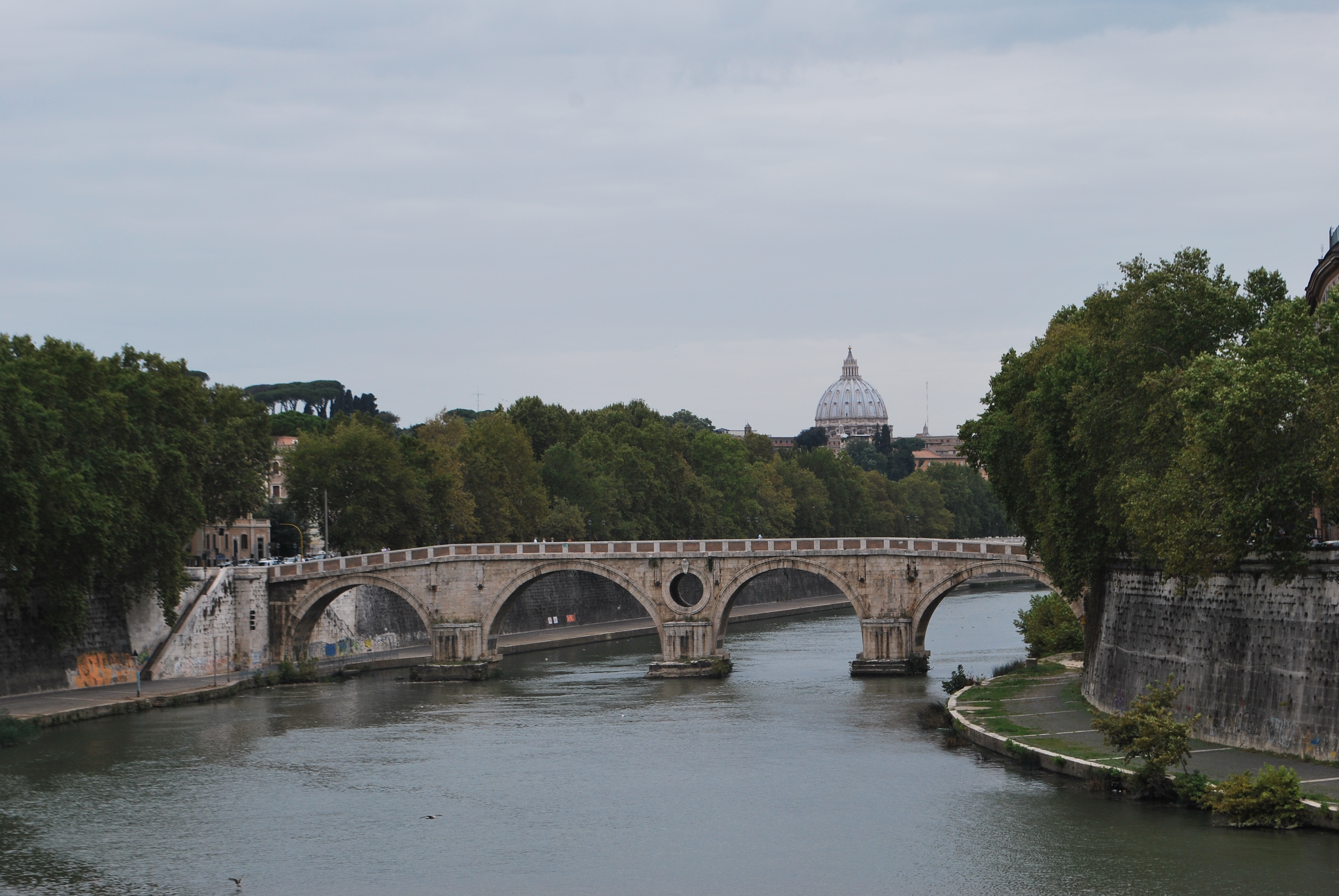
Bridge and River in Trastevere in Rome


It was a plebian quarter, where the servants and laborers and the free citizens of Rome’s as well as sailors, fishermen, Phoenicians and Jews lived. It would be the principal Jewish quarter of Rome until the end of the Middle Ages, when the Ghetto, across the river from Trastevere, became the residential area to which Jews were henceforth restricted.Rome Rione di Trastevere Logoastevere_logo


Renaissance Romans began building more noble villas around the edges of the ancient quarter, but the Trastevere of today retains its medieval, labyrinthine layout, full of narrow, winding alleys. It remains a working class neighborhood, with children playing soccer in the street, old people sitting on their stoops, and families gathering around a table in the street to visit. Trastevere lies between the western banks of the river Tiber and the Janiculum hill, one of Rome’s storied seven hills, that looms above it. It’s but a short 15-minute walk across the Tiber to the ruins of ancient Rome, the “salon” of Rome with its extravagant fountains, and only a little bit further by foot to St. Peter’s Square and the Vatican. One of the liveliest gathering places is the square in front of the church of Santa-Maria-in-Trastevere, construction of which began early in the 3rd century with the church completed in the mid-4th century, and ultimately completed in Romanesque style in the 12th century, then converted in several other centuries, giving it an unusual combination of Ancient Roman details and varied architectural features from later periods. The octagonal fountain in the piazza is an ancient Roman fountain restored and enlargened in the 17th century by Carlo Fontana.

Santa Maria Trastevere Roma Italy Carlo Fontana

Santa Maria with church, with ancient Roman foundation in center. The piazza is full of life at night.


What to See and Do in Trastevere

The Church of Santa Maria in Trastevere

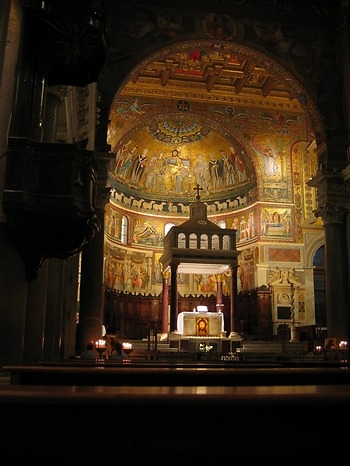
Santa Maria in Trastevere is undoubtedly the oldest church in Rome, and deserves several visits if you want to appreciate its full architectural and historical depth. Most of the mosaics date from the 12th century. They are illuminated at night, and the golden light of the façade fills the piazza with a warm glow.

12th-century gold mosaics in Santa Maria in Trastevere, http://www.aztec-history.com/traditional-mexican-food.html

12th-century gold mosaics in Santa Maria in Trastevere


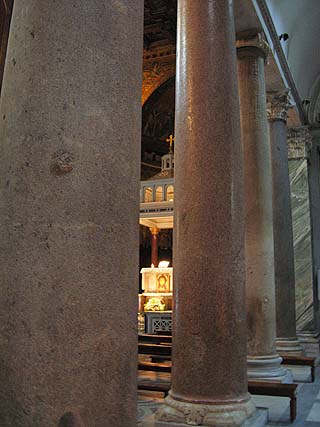
The 22 granite columns lining the nave are said to have come from the ruins of the Baths of Caracalla; the capitals are adorned with the heads of female pagan deities.

Granite columns in Santa Maria in Trastevere, from Baths of Caracalia

Numerous Roman funeral inscriptions can also be found in the church.

Ancient Roman etched gravestone in Santa Maria in Trastevere

Eating and Nightlife

There is no shortage of reasonably priced osterie, trattorie and restaurants that serve authentic Roman food in a no-frills setting. The neighborhood is timeless, with its mix of historical architectural periods and lively local residents; it remains quintessentially Roman. If you want to pretend you’re Roman for a weekend, this is the place to do it.


Old cellars and stables have been converted into bars, discos and cafés, providing a lively nightlife scene, with customers spreading out into the streets when the weather is fine.

DSC_0802


Signs like this demonstrate the colorful character of the locals, and offer contrast to our notion of contemporary, ultra-chic Italy.

Trastevere, Rugantino Trattoria Osteria Restaurant, Rome, Italy, photo by Jonell Galloway all rights reserved Jonell Galloway (R)


Sidewalk cafés and restaurants preserve the romantic character of Old Italy, spilling out onto the streets. My favorite source of restaurants in Rome is David Downie’s Food Wine Rome. David is half Roman, and sees food through the eyes of a Roman. His recommendations are all about the authentic and the unpretentious, and you’ll seldom find tourists in the places he recommends.

Hotel

While the Hotel Santa Maria is located in the very heart of the vibrant Santa Maria neighborhood just steps from the piazza, within the walls of this converted 16th-century convent, it’s so quiet and peaceful that you may think you’re staying in a remote Tuscan country house. The renovation is simple, but tasteful, with classic Roman terracotta floors and well-fitted bathrooms. Bedroom furnishings are tasteful, solid-wood reproductions. Almost all rooms are on the ground floor and give onto the courtyard. The few that do have a room above them (near the rooftop terrace) are not so quiet due to the tile floors. Otherwise, the clientele is quiet and respectful. Double Room Santa Maria Travestere, Rome, Italy


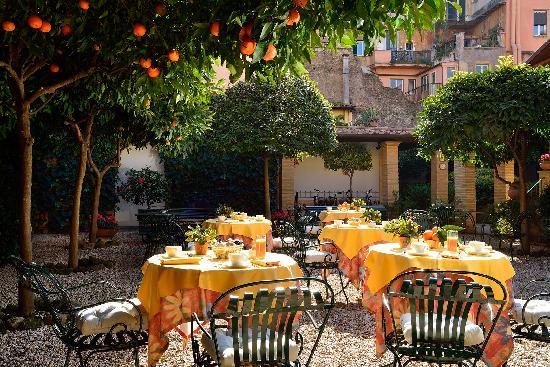
hotel-santa-maria Orange courtyard

Courtyard with orange trees where you can eat breakfast or have a drink

One enters the hotel courtyard through a large, locked iron gate, so security is good. The L-shaped convent-cum-hotel with an inner courtyard enclosing a small orange grove boasts wrought-iron tables and chairs for leisurely sitting in the sun or eating breakfast when weather permits. The breakfast room is in a converted cellar, with breakfast consisting of an international and Italian buffet with something to suit everyone, offering freshly squeezed orange juice and coffee from a professional espresso machine.

The small rooftop terrace is furnished with chic wooden lounge chairs and armchairs. It’s a great place to have a drink before dinner, read in the early evening, or sunbathe during the day. The view of the surrounding rooftops and balconies of Trastevere is a photographer’s dream. All rooms have satellite television and air conditioning, as well as Wi-Fi, which can sometimes be unstable. Bikes are available for rental at the reception.

How to Get There

If you’re flying, take the train from the Fiumicino Leonoardo da Vinci airport station to the Trastevere station, about a 30-minute train ride, then take a cab, which should take about 10 minutes. This should cost around 15 Euros all-inclusive, versus approximately 50 Euros with tip for a cab direct from the airport. A cab ride from the Termini train station to the hotel should cost around 15 Euros. The hotel is lost in a winding street and difficult to access by car. Even taxi drivers get confused with all the one-way and dead-end streets. Study your map and know the names of the surrounding streets and squares, because the driver may be forced to let you off in another street around the corner from the hotel.

Practical Info

Reservations: http://www.htlsantamaria.com Address Vicolo del Piede 2 – 00153 Rome – Italy Tel. (39) 06 5894626 – Fax: (39) 06 5894815 Click here for map: Map to Hotel Santa Maria


Jonell Galloway grew up on Wendell Berry and food straight from a backyard Kentucky garden. She is a freelance writer. She attended Le Cordon Bleu and La Varenne cooking schools in Paris and the Académie du Vin, worked for the GaultMillau restaurant guide and CityGuides in France and Paris and for Gannett Company in the U.S., and collaborated on Le tour du monde en 80 pains / Around the World with 80 Breads with Jean-Philippe de Tonnac in France; André Raboud, Sculptures 2002-2009 in Switzerland; Ma Cuisine Méditerranéenne with Christophe Certain in France, At the Table: Food and Family around the World with Ken Albala, and a biography of French chef Pierre Gagnaire. She ran a cooking school in France, and owned a farm-to-table restaurant, The Three Sisters’ Café, with her two sisters in the U.S. She organizes the Taste Unlocked bespoke food and wine tasting awareness workshops with James Flewellen, is an active member of Slow Food, and runs the food writing website The Rambling Epicure. Her work has been published in numerous international publications and she has been interviewed on international public radio in France, Switzerland, and the U.S. She has just signed on at In Search of Taste, a British print publication, and is now working on two books, What to Eat in France and What to Eat in Venice.

Related articles

Never miss a post
Name: 
Your email address:*
Please enter all required fields
Correct invalid entries

Balsamico, Balsamico: How to Choose a Good (and Authentic) Balsamic Vinegar

Published by Thursday, July 11, 2013 Permalink 0


//

Gareth Jones, food and travel writerBalsamico, Balsamico: How to Choose a Good (and authentic) Balsamic Vinegar

by Gareth Jones

“When we think that 100 kgs of grapes converts into just 2 litres of Balsamico after 25 years ageing, we appreciate what’s quite so special.”


Balsamio brusco 1985, aged Balsamic vinegar, photo by Gareth Jones

1985 aged Balsamic vinegar

Imagine a magical elixir which has a history charted back to 1785 – and probably earlier — that takes skills passed down through the generations of families, and is years in the making. Made traditionally, this elixir has the power to transport one to Heaven on a spoon, and just one word on the bottle tells us the real from the manufactured.

IMG_0894 (188x250)

That word is Tradizionale’ and to a cynic it could read like a word from the marketeer’s limited lexicon. This one word, however, divides the Heavenly stunning from the just special and Earthly – and sometimes not special at all for its added caramel and sugar. Time to become acquainted with the genuine Aceto Balsamico Tradizionale di Modena DOP.

Continue Reading…

Never miss a post
Name: 
Your email address:*
Please enter all required fields
Correct invalid entries

Food Art: Cinghiale alla liquirizia / Wild boar and licorice, food photography by Alessandro Boscolo Agostini

Published by Thursday, May 30, 2013 Permalink 0


A wildly inventive take on a well-loved Italian dish: wild boar and licorice: food photography by Alessandro Boscolo Agostini.


Bio of Alessandro Boscolo Agostini

Bilingual English/Italiano

My first love for photography started with a little theft: as a little boy I stole my father’s Vöiglander and I started taking pictures on my own, just using my instinct. At that time my father’s camera seemed to me the best camera possible in the whole world, until I reached junior high school and I gave it up for a Bencini all my own. But my little theft came all back to me; my girlfriend to whom I had lent my camera never gave it back to me: that can be considered petty theft, no?

Growing up, I robbed again: in high school I stole time I might have devoted to photography and dedicated myself to my other passion, music. I studied drums and played jazz music. But it was just an infatuation, because I went back to my first love and never left it again. And as a pledge of love, I gave up my history studies in college, causing great distress to many people, but not to myself.

Today, I rob with no qualms, and I confess it with no shame. My spoils are my sensations, emotions, lines, colours, compositions: I catch everything that stops in front of my camera, I catch it with a click to close it in a graphic cage. It doesn’t matter if its a catalogue or a magazine. What I’m really interested in is the look, my view of the world. In the millions of images that pass in front of my eyes every day, that go on around me, that chase me in my silence. For this reason I  photograph subjects of any kind and still do it every day without specializing in anything in particular. From a luxury hotel suite, to the sexy transparencies of Murano glass. From art exhibitions to a ballet. From a golf course to actors on a stage. The list can go on and on, while this bio must finish here. I hope that I haven’t once more been a thief, that I haven’t taken up to much of your time. If this was the case, please don’t report me to the police, because I will give myself immediately up: I’m Alessandro Boscolo Agostini!

Continue Reading…

Never miss a post
Name: 
Your email address:*
Please enter all required fields
Correct invalid entries

Food Art: Italian Food Rambling, a food photography exhibition by Alessandro Boscolo Agostini

Published by Monday, May 27, 2013 Permalink 0


Bio of Alessandro Boscolo Agostini

Bilingual English/Italiano

My first love for photography started with a little theft: as a little boy I stole my father’s Vöiglander and I started taking pictures on my own, just using my instinct. At that time my father’s camera seemed to me the best camera possible in the whole world, until I reached junior high school and I gave it up for a Bencini all my own. But my little theft came all back to me; my girlfriend to whom I had lent my camera never gave it back to me: that can be considered petty theft, no?

Growing up, I robbed again: in high school I stole time I might have devoted to photography and dedicated myself to my other passion, music. I studied drums and played jazz music. But it was just an infatuation, because I went back to my first love and never left it again. And as a pledge of love, I gave up my history studies in college, causing great distress to many people, but not to myself.

Continue Reading…

Never miss a post
Name: 
Your email address:*
Please enter all required fields
Correct invalid entries

Salone del Gusto versus Good, Clean, and Fair: Part 2

Published by Monday, November 26, 2012 Permalink 0

by Diana Zahuranec

In Salone del Gusto versus Good, Clean, and Fair: Part 1, I’ve already mentioned some healthy skepticism about the presence of two big Italian names at Salone del Gusto: Lavazza Italian coffee, and the supermarket Coop.

Lavazza takes on the responsibility of Fair Trade coffee, but wearing a label doesn’t necessarily prove honest actions behind it. There are loopholes to be jumped in any policy. Without venturing beyond the comfort of online research to the plantations in South America, however, I couldn’t say with utter certainty how good, clean, and fair they are. My main conclusions? Don’t check off the Good Deed Done for the Day box just by buying Fair Trade, without knowing all the facts behind it.

It just doesn’t look Slow Food-y

As for Coop, I was very surprised to see this popular Italian supermarket in a haven of small-time producers at the Salone. Coop is no WalMart nor, on this side of the Atlantic, EuroSpin; shopping in my local Coop store, I’ve noticed very high quality, Alpine mountain cheeses, for example, alongside the added-preservatives-colors-skim-milk-binder, generic salumi; and I suppose I notice more organic produce overall. As far as the realm of supermarkets is concerned, my limited observations earn Coop a dull gold star. But a place at Salone del Gusto? Hardly, I thought.

Asking fellow Slow Food members what they thought, a Swiss friend informed me that it was in large part thanks to Coop, a charter member of Slow Food, that Slow Food Switzerland was initiated and is running strong today. Polish that gold star!

In fact, Slow Food and Coop have a partnership, with Coop supporting and promoting Slow Food values through selling local products as well as over 100 Presidia products (a Presidia labeled food being the equivalent of a protected or endangered animal in the food world).

Coop’s powerful, positive presence in the world of local producers and Presidia was brought home when I sat in for a tasting of some products during Salone del Gusto. Not that I wanted to taste anything. By the end of one of Salone’s last days, I had done as much tasting as my belly and buds could bear. But my legs were tired, and Coop had set up a booth lined with dangling Prosciutto legs, plastic chairs in rows, and a tasting of jam and juice. I didn’t resist.

The tasting was introduced by a Coop Quality Control employee and a representative of a Bosnian company based in Bratunac called Frutti di Pace, or “Peace Fruits.” Together, they told a story of how the Coop employee traveled to Bosnia for this product, met with the Bosnian woman, and formed an instant friendship that was strengthened, as in all cultures, over an abundant welcoming meal.

The employee found that the hardworking spirit and community of the women of Frutti di Pace were as charming as the incredible, all-natural flavors of their products were delicious.

Frutti di Pace was established after the Bosnia and Herzegovina War in 1992-1995. The members of this cooperative, mostly widowed women or women with husbands injured from the war, wanted to spur growth: of the local economy, of a long-held tradition ground to a halt from the war (raspberry production), and of a sense of community and confidence.

The first product we tasted was a thick raspberry juice. No colors, sugars, or conservatives were added – just water and red raspberry. It was exactly like plucking a handful of raspberries from a bush, squishing them all into your mouth, and squeezing out the juices with your tongue. The jams were next, and equally impressive in their bright, strong raspberry flavors. It lacked seeds, but that’s a personal preference of mine for raspberry jams.

Frutti di Pace spent ten years trying to get into the European market. The speaker was overwhelmed almost to tears when she recalled how happy they had been when Coop began selling their products. “’To hope’ is still difficult after everything we’ve been through,” she said.

My knee-jerk reaction to “supermarket” is “too much fluorescent light!” and then, “against all things Slow Food.” But this is not true (well, the second one). Today’s food market is pulled in two directions: one towards a global system made of imports, exports, and oil, the other towards local, small production, trends, and being organic. It’s important to consider the possibility that, between these two polar opposites, not everything is black and white. The grey areas will be necessary to marry two things that won’t go away for better or for worse: supermarkets in many parts of the world, and the importance of strong, local economies and good, clean, and fair food in all parts of the world.

Selling local food (or organic, or from a small producer, etc.) through a medium that everyone uses and will continue to use as long as it exists is ethically responsible and also quite genius.

The question remains: Does Coop Italia earn the good, clean, and fair award? It is still a supermarket that sells items ranging from low to high quality, from all parts of the world, and at prices too low to actually be profitable for the producer. But the answer is nevertheless yes – just, in a rather grey way.

Never miss a post
Name: 
Your email address:*
Please enter all required fields
Correct invalid entries

Sicilian Orange and Fennel Salad

Published by Thursday, November 15, 2012 Permalink 0


//

Sicilian Orange and Fennel Salad Recipe

by Diana Zahuranec

As fall slips into winter, the open air markets in Turin, Italy push nature’s seasonal fruits and vegetables to make early appearances in the crates and boxes stacked inside each bancarella, or stand. Oranges, grapefruits, and clementines from Calabria and Sicily showed their waxy globes in the middle of October; bitter turnip tops called cime di rapa were available by the end of September; spiky artichokes, still not technically in season, have been around for weeks.

The sweet, crispy finocchio, or fennel, one of my newly-discovered favorites, entered the scene two weeks ago at the beginning of November. Last year’s discovery that I’ve waited impatiently for since the end of September is the sweet, soft kaki vaniglia, the persimmon, which has a designated corner in my refrigerator. These bombs of juicy, fruity sugar are an after dinner treat that could almost replace autumn pies. Almost.

According to the illustrated and finely detailed wheel of seasonal fruits and vegetables that I bought at Eataly, citrus fruits have just begun their yearly cycle in November. I pat myself on the back, since I resisted buying these until a few days ago. There was one mysterious exception in the form of yellow-green skinned citrus fruits, easy to peel and sour-sweet inside. They came from Calabria, and the hulking, big man that sold them ensured me they were sweet and ripe, never mind their greenness. The man who sold them seemed to have been plucked from another time and place, where people can and still do pick oranges in the fields all day for decent wages, the weakening winter sun warm on their backs. His nails were dirty and his accent thick (presumably Calabrian).

Once at a food photographer’s studio in Emilia-Romagna, the chefs and food stylists there prepared a tangy, salty, sweet salad from the South. It had been inspired by the chef’s Sicilian roots. It’s now one of my favorite meals, and I have to wait for these seasonal fruits and vegetables before I can enjoy it. It evokes flavors from a land where the sun shines across fields with rows and rows of citrus trees, bright orbs decorating the branches in a warm Christmastime.

The traditional olives to pair with this are black ones, but I had green, which I might actually prefer. Being the salt queen that I am, a shot of capers hits the spot, but I don’t know how “traditional” that is. Also, blood oranges knock the pretty factor up a notch for this already aesthetically-pleasing plate.

Recipe

Sicilian Orange and Fennel Salad

For 2-4 people (depending on if using as a light lunch or as a side dish)


Ingredients

1 large fennel
1 medium orange
¼ red onion, sliced finely (or less)
¼ cup black or green olives, pitted and sliced thinly
Salt and pepper to taste
Extra virgin olive oil
Optional: 1-2 Tbsp capers, hot pepper
  1. Slice the fennel in half, and then core each half by cutting out the tough triangular sections at the bottom.
  2. Trim the ends, reserving green fennel leaves for garnish. Trim any bruised parts. Slice finely and set aside. Note: I also slice the very end green stems, because they’re strong in flavor and very crunchy. They may be too astringent for some tastes.
  3. Peel the orange. Setting it on its side, slice it very thinly so that each piece is divided into segments. Keep them as full round slices, or break them into halves or double segments.
  4. Layer the fennel, orange, and onion, then scatter the sliced olives over the top. Sprinkle with salt and pepper, drizzle with olive oil, and garnish with the fennel leaves. Add a dash of hot pepper and a sprinkling of capers if you so choose.
Never miss a post
Name: 
Your email address:*
Please enter all required fields
Correct invalid entries

UA-21892701-1