Switzerland: Best Source of Tomatoes in Lake Geneva/France Region

Published by Monday, August 13, 2012 Permalink 0

by Jonell Galloway

Sandrine and Olivier Chapuis
1037 route des Mermes
74140 Veigy-Foncenex
Tel. +33 (0)4 50 94 84 09

Sandrine and Olivier Chapuis in Veigy-Foncenex in France are the great specialists of juicy, full-flavored tomatoes in the Geneva area. They grow between 20 and 30 different varieties every year. There are yellow, orange, green, tiger stripe, red: a cornucopia of color and as sweet as fruit (of course they are fruit, technically speaking).


The market is flowing with oodles of summer vegetables.


The Chapuis also have the widest range of wild greens and mescluns I’ve seen in Geneva.


You can also buy directly from them in Veigy-Foncenex, but Sandrine prefers that you call beforehand because she is not always there. After all farmers have to work in the fields sometimes!

They produce all the produce they sell in the farmers market, so you can be sure that is both fresh and local. Sandrine, or “Sabi,” as she is nicknamed, has lots of great recipes in her head for every product she sells.

Since their fields are scattered out in various places, she prefers customers to tell her what they want, and she will have it ready for them when they come to pick it up. The best time is Tuesday or Friday between 4 and 8, or any other evening on appointment. The Chapuis are trying to set up a system for opening every evening, but are awaiting authorization from city authorities regarding parking, since they are right off the route nationale.


Never miss a post
Name: 
Your email address:*
Please enter all required fields
Correct invalid entries

The Art of Tasting Wine with James Flewellen: What are we looking for (in a wine)?

Published by Thursday, August 9, 2012 Permalink 0

by James Flewellen

Before we get to tasting or even smelling it, the first of our senses to be engaged by a wine is our sight. Observing a wine is the first thing a wine judge or blind taster will do when assessing a new wine, but what exactly can the appearance of a wine tell us and what are we looking for?

Colour, ‘brightness’ or intensity, spritz, sediment, the difference between the core and the rim of the wine all give away subtle clues to the wine-making process, the possible age of the wine, and the grape variety.

Spritz is the term given to small bubbles of gas that may appear just under the surface of a wine immediately after pouring. They are usually carbon dioxide, which is a natural by-product of the fermentation process. Most of it is coaxed out of the wine during the winemaking through the racking process prior to bottling. However, in some wines — especially white wines fermented in airtight stainless steel tanks — some dissolved CO2 remains. In the vast majority of cases, spritz is absolutely fine and will dissipate after giving the wine a good swirl.

A glass of sparkling wine from the Limoux regi...

A glass of sparkling wine from the Limoux region of France.


Champagne and other sparkling wines, of course, make use of this by-product to obtain their characteristic sparkle. The appearance of bubbles in a sparkling wine actually has a lot more to do with the glass in which the wine is served than any inherent quality of the wine. Bubbles of CO2 nucleate at imperfections on the glass surface — deliberate or accidental scratches or microscopic bits of dirt or left-over detergent. A sparkling wine’s mousse — the French term for the fizz — is best assessed on the palate for quality purposes. That said, semi-sparkling wines will have a different character to the bubbles than a full-blown traditional method sparkling wine.

White Burgundy in the glass.


The colour of a wine is certainly the most obvious characteristic of a wine’s appearance. White wines have a colour spectrum from almost watery-white, through green, to straw, lemon, golden, and finally to coppery-orange for some dessert wines, although the vast majority fall under ‘lemon’ or ‘straw’ for me! Reds can be various shades of red (you’ll frequently hear the more poetic ‘ruby’) or purple, and rosé can go from a quite deep magenta through to a pale salmon-pink.

Both white and red wines converge to orange, or ‘brick’, as they age. This is due to the slow oxidation of the colour components in the wine. The best way to assess potential age of a wine is to tilt the wine in the glass over a white background and to look for any difference in colour between the ‘core’  of the wine (the greater body of liquid) and the ‘rim’ (the edge). This is a lot more obvious in aged red wines, where you’ll see a deeper ruby core progressing to a brick-orange at the rim. A wine that is thoroughly oxidised will be brown in colour — not necessarily a fault as some wines, Madeira for instance, are made in a deliberately oxidative style.

Wines of the same hue can vary in the depth, or opacity, of this colour. Thicker-skinned grapes imbue more colour to a wine than those with thinner skins — think of Malbec or Syrah versus Pinot Noir. Grapes tend to develop thicker skins in hotter and sunnier climates too, thus a Chilean Cabernet Sauvignon will typically be deeper in colour than one from Bordeaux. The winemaker also has a role to play, with different winemaking techniques allowing greater or lesser extraction of these colour compounds into the final wine during the maceration process. Winemaking explains most of the differences in depth of colour in rosé wines.

Thick skin wine grapes.


This idea is not limited to red wines, with Pinot Gris and Gewurztraminer two examples of relatively thick-skinned grapes that can yield a deeper-coloured white wine.

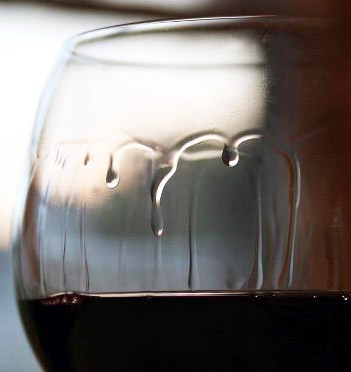
Some people pay a lot of attention to the ‘legs’ of a wine. That is to say, the ‘tears’ of alcohol that run down the inside of the glass following a swirl of the wine. They are an indication of viscosity, and related to alcohol, sugar and glycerol levels in the wine. The excellent wine tutor Michael Schuster once told me that he doesn’t worry about these – there’s far more information in the structure of the wine on the palate – and I’m inclined to agree. On the other hand, I learned from a French student of wine that these ‘legs’ are a good indication of age in sweet wines, Sauternes for instance. For me, the jury’s still out on that one – I’ll need to drink a lot more aged Sauternes to compare!


Legs or tears of wine on side of glass.


Finally we come to sediment in a wine. The only sediment you should see in a white wine is tartrate crystals. These originate from the natural tartaric acid in the wine and can solidify over time. They’re nothing to worry about, although many consumers have a perception that they are a fault. The only way to get rid of them is to chill the wine, prior to bottling, to at least -8°C for several days, and even then you may not get them all. As you can imagine, this is an expensive and energy-intensive exercise, which is one of the reasons the Riesling community in particular is trying to educate the public about the presence of these ‘wine diamonds’!


Sediment in wine.


Red wines will precipitate out tannins and colour molecules over time. The more tannic a wine is to begin with, the more potential for sediment it has. Very fine sediment, before it forms large clumps, can lead to a wine appearing slightly cloudy. These forms of sediment are nothing to worry about and can easily be dealt with by leaving a bottle upright for an hour or two to allow the sediment to collect at the bottom, or by decanting the wine before serving.

There’s a lot to an appearance of a wine, although ultimately its importance is superseded by what you smell, taste and feel about a wine. Thus for the average enthusiast, you’re more likely raring to get straight to the nose and the taste. If you are interested in puzzling over a wine’s appearance for tasting purposes, the important thing to remember is that there are few hard and fast rules. Each winemaker has a different approach to the next, which results in different wines – even if their vineyards are next door! The key is experience and observation. Make a note of what you’re drinking and use it to compare to other experiences. The huge variety of wines is what keeps blind tasting so interesting, so engaging, and is what makes it so hard!



Never miss a post
Name: 
Your email address:*
Please enter all required fields
Correct invalid entries

Food Art: Tomatoes Fresh off the Vine, a food photography exhibit by Renu Chhabra

Published by Thursday, August 9, 2012 Permalink 0

“It’s difficult to think anything but pleasant thoughts while eating a homegrown tomato.”–Lewis Grizzard


How would you like to eat them? Any ideas for dinner tonight?

Never miss a post
Name: 
Your email address:*
Please enter all required fields
Correct invalid entries

Part 5: Kimchi vs. Sauerkraut – Fermenting Vegetables

Published by Wednesday, August 8, 2012 Permalink 3
cafemama / Foter / CC BY-NC-SA

Part 5 on Fermentation: Kimchi vs. Sauerkraut – Fermenting Vegetables

by Diana Zahuranec

Once again, Harold McGee’s The Science and Lore of the Kitchen comes to the rescue.

In fermented vegetables, remember that the two components that determine aroma and flavor are the salt concentration and temperature of fermentation. Those are the two main differences between kimchi and sauerkraut.

Bowl of kraut, by Diana Zahuranec for The Rambling Epicure, editor Jonell Galloway.

Bowl of kraut.


Sauerkraut, besides being cut more finely, has no other ingredients besides cabbage and brine. It ferments at 64-76 °F/18-24°C for 1 to 6 weeks. Its final salt content is 1-2%, and its final acidity level is 1-1.5%. That higher temperature for sauerkraut results in more lactic acid bacteria, giving it a tangier flavor.

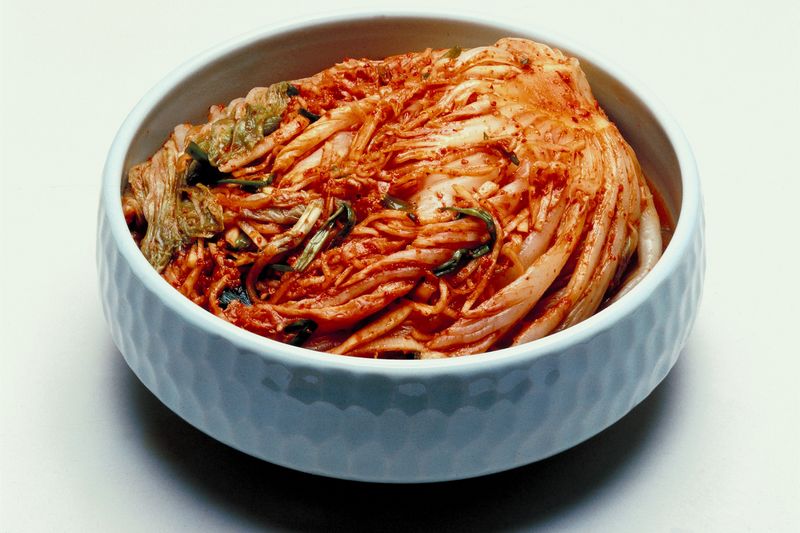
Kimchi is cut into larger chunks and includes plant leaves and stems, too; and hot Korean chili pepper, garlic, and fish sauce are added for flavor. It’s fermented at a lower temperature than sauerkraut at 41-57°F/5-14°C for 1-3 weeks, with a higher salt content in the end (3%) and lower acidity (0.4-0.8%).

Bowl of kimchi, Part 5 on Fermentation: Kimchi vs. Sauerkraut - Fermenting Vegetables, by Diana Zahuranec for The Rambling Epicure, editor, Jonell Galloway.

Bowl of kimchi.


Never miss a post
Name:

Your email address:*

Please enter all required fields
Correct invalid entries

Never miss a post
Name: 
Your email address:*
Please enter all required fields
Correct invalid entries

Simon Says: Daily Food Quote, August 8, 2012

Published by Wednesday, August 8, 2012 Permalink 0

by Simón de Swaan

All the gifts are nothing. Money gets used up. Clothes you rip up. Toys get broken up. But a good meal, that stays in your memory. From there it doesn’t get lost like other gifts. The body it leaves fast, but the memory slow.–Meir Shalev, Four Meals

Israeli journalist and television host Meir Shalev is also one of Israel’s most celebrated novelists. His other books include The Blue Mountain and A Pigeon and a Boy, for which he won the Brenner Prize, Israel’s highest literary recognition.


Never miss a post
Name: 
Your email address:*
Please enter all required fields
Correct invalid entries

Simon Says: Daily Food Quote, August 7, 2012

Published by Tuesday, August 7, 2012 Permalink 0


by Simón de Swaan

The ultimate aim of civility and good manners is to please: to please one’s guest or to please one’s host. To this end one uses the rules laid down by tradition: of welcome, generosity, affability, cheerfulness and consideration for others. People entertain warmly and joyously. To persuade a friend to stay for lunch is a triumph and a precious honour. To entertain many together is to honour them all mutually. It is equally an honour to be a guest.Claudia Roden, A Book of Middle Eastern Food, 1968

Claudia Roden is a cookbook writer and cultural anthropologist based in the United Kingdom. She was born in 1936 in Cairo, Egypt. A Book on Middle Eastern Food is a classic in the world of cookbooks, and James Beard referred to it as “a landmark in the field of cookery.”


Never miss a post
Name: 
Your email address:*
Please enter all required fields
Correct invalid entries

Simple Sustenance: Kale Power — Kale and Sunflower Seed Pesto

Published by Tuesday, August 7, 2012 Permalink 0

by Renu Chhabra


“Eat food. Not too much. Mostly plants.” Michael Pollan

This one is for kale lovers. I know. I am one of them. Until not too long ago, I did not have the slightest idea of its existence; or let’s just say, it did not visit my produce bag. But once I tasted it, I was hooked on the amazing wonders of kale like most health enthusiasts.

Kale is known by several flattering names — Queen of Greens, Powerhouse of Nutrients, King of Greens. These days kale is one of the most talked about super foods. From soups and stews to salads and stir fries, it has found its way in every possible form of cooking. Kale juice anyone? How about kale chips for a healthy snack? And if that’s not enough, just puree these hearty leaves to transform them into pesto. Now that opens up several more ways to enjoy its versatility.  Stir it in pasta, spread it on breads and crackers, or thin it a little to make dressings. If none of those options are appealing to you, a few spoonfuls as is works for me.

Speaking of pesto, I made this recipe with sunflower seeds instead of nuts. Sunflower seeds provide fair share of good fats, and they also give it a rustic texture. I left cheese out making thus making it an option for vegans. But if you prefer a cheesy flavor, add some pecorino or parmigiano. Good olive oil, lemon, and garlic with a few grinds of sea salt make it absolutely delicious. Store in refrigerator and enjoy.

Recipe

1 medium bunch kale, stems removed
1 large clove of garlic
½ cup unsalted roasted sunflower seeds
Juice of one large lemon
Sea salt to taste
Freshly ground pepper (optional)
½ cup olive oil

Instructions

Put kale leaves in boiling water for 30 seconds. Drain in a colander, and run cold water over to stop the cooking process. Squeeze kale to remove water completely.

In a food processor, pulse garlic a couple times. Add sunflower seeds and pulse again 2-3 times. Add kale, lemon juice, salt, pepper and puree.  Drizzle oil while the machine is running. Puree it to desired consistency.

Adjust lemon and salt to taste. If the pesto is too thick for your taste, add a little water.


  • In a food processor, pulse garlic a couple times. Add sunflower seeds and pulse again 2-3 times. Add kale, lemon juice, salt, pepper and puree.  Drizzle oil while the machine is running. Puree it to desired consistency.

    Adjust lemon and salt to taste. If the pesto is too thick for your taste, add a little water.


    Never miss a post
    Name: 
    Your email address:*
    Please enter all required fields
    Correct invalid entries

Food Art: Voluptuous Veal Meatballs, by Meeta Khurana Wolff

Published by Tuesday, August 7, 2012 Permalink 0

Meeta Khurana Wolffis a freelance food photographer, stylist and writer, currently living in the culturally rich city of Weimar in Germany with her German husband and their 8-year-old son, where she enjoys preparing multicultural, home-cooked meals using fresh organic ingredients. When she is not styling, photographing or writing about food, Meeta loves to travel the world, exploring new cultures and capturing it all on camera. The unique mood that Meeta creates in her food photography is also found in her travel, still life and landscape photography.

Born in India, Meeta was brought up in and went on to train in some of the world’s finest hotels, where food was always an important part of her life. Her love for food photography stems from her passion for food itself, and she combines her two greatest enthusiasms on her multifaceted, award-winning blog, What’s For Lunch, Honey? The recipes she develops and creates are documented by her powerful, yet refreshing, food photography and styling.

See more food photo compositions at Meeta K. Wolff.

Never miss a post
Name: 
Your email address:*
Please enter all required fields
Correct invalid entries

Simon Says: Daily Food Quote, August 3, 2012

Published by Friday, August 3, 2012 Permalink 0

by Simón de Swaan

One should never refuse an invitation to lunch or dinner, for one never knows what one may have to eat the next day.–Édouard de Pomiane, Cooking with Pomiane, 1962

Édouard Alexandre de Pomiane (1875-1964) was a French scientist, radio broadcaster, and food writer. His best-known works to have been translated into English are and Cooking with Pomiane. His recipes often take pains to demystify cooking by explaining the chemical processes at work.


Never miss a post
Name: 
Your email address:*
Please enter all required fields
Correct invalid entries

How Smart is a Sheep? The Churra da Terra Quente

Published by Friday, August 3, 2012 Permalink 0

by Diana Zahuranec

As I stood in the crisp air and bright sun of a Portuguese farm with the other Slow Food University of Gastronomic Sciences students, a single question popped into my mind. We were learning about the Churra da Terra Quente sheep breed, an indigenous and endangered animal with tangled wool and long, dirty tails. They were a rough-looking lot, but watched us curiously and weren’t as shy as other sheep I’ve unwittingly terrified just by standing by them. Some scratched their dirty wool on dry tree trunks, and others flopped down onto the dry soil that was bereft of rain for 4 ½ months, unconsciously dirtying themselves even more. They had curly horns like trofiette pasta. I got the impression that they were happy, or content, to be out in the sun watching us watching them.

Churra da Terra Quente sheep in the dry Douro


In an indigenous flock – or group, or pack, or what-have-you – the purity of the breed is kept by inbreeding. In dogs, I know this leads to some odd character traits: Dalmations, for example, can be suddenly temperamental; my family’s Vizsla at times suffered anxiety and, strangely for a dog, psychological problems – and was also, of course, the most intelligent dog on earth.

Continue Reading…

Never miss a post
Name: 
Your email address:*
Please enter all required fields
Correct invalid entries

UA-21892701-1