Spontaneous Cuisine: Parsnip Velouté with Aged Mimolette Cheese

Published by Thursday, December 15, 2011 Permalink 0

Itsy Bitsy History of the Parsnip

In the Middle Ages, Geneva was running over with parsnips, which they referred to as “white carrots”. It was almost always included in their “eternal pots” of soup, which consisted of seasonal vegetables that they just kept adding more vegetables to as needed, and a piece of meat once a week.

After World War II, many root vegetables went out of fashion in Europe, because people had had to survive on them and nothing else during the war, so farmers eventually stopped growing them. The same went for pumpkin. People in the north of France who had lived through the war and eaten pumpkin every day couldn’t bear the thought of eating pumpkin ever again.

In recent years, these old-fashioned vegetables, including parsnips, have again become available, and chefs are going crazy with new ideas on how to use them.

Parsnips are plentiful at the moment and there’s nothing better than soup to warm you up on a cold winter’s day. Eric Burkel, former financial analyst, entrepreneur and now president of his local food coop in Paris, got this recipe from one of the farmers who supplies vegetables to the coop.

Parsnip soup recipe

Continue Reading…

Never miss a post
Name: 
Your email address:*
Please enter all required fields
Correct invalid entries

USDA: new guidelines for calculating fertilizer; runoff producing over-nutrition in waterways

Published by Wednesday, December 14, 2011 Permalink 0

Around the world, environmentalists and scientists are mobilizing to fight the plague of over-nutrition due to over-fertilization

The problem with farming today — whether fertilizer be conventional or natural — is that fertilizer runoff produces over-nutrition of waterways and other natural habitats.
USDA logo


So around the world, environmentalists and scientists are mobilizing to fight the plague of over-nutrition. That’s where the new USDA document comes in. It lays out a host of steps that farmers can take — and will have to take, if they get funding from certain USDA programs — to minimize the spread of nutrients outside farm fields.

Essentially, it involves putting farmland on a sensible diet. Only feed the land as much as it really needs. And don’t apply fertilizer, including manure, when the crops don’t need it. Also, try to capture and store any excess nutrients. For instance, grow wintertime “cover crops” that can trap free nitrogen before it leaches into groundwater.

Click here to read this on NPR’s blog.

Related articles
Never miss a post
Name: 
Your email address:*
Please enter all required fields
Correct invalid entries

Food News Daily: Latest food news and trends from around the world, December 14, 2011

Published by Wednesday, December 14, 2011 Permalink 0

How Caffeine Can Galvanize Your Workout, Sweet Potato Soup With Ginger, Leek and Apple, Take a Tea Break – Whole Living Daily: Whole Living, First Write the Blog, then Write the Cookbook, Espresso Kahlúa Brownies,
Homemade Corn Tortilla and A Delightful Mixed Vegetable Cheesy Quesadilla, David Downie: Delving into the Heart of Genoa and its Food Shops and Cafés, and much more.

Click here to read more.

Salvadoran woman making tortillas with a tradi...


Continue Reading…

Never miss a post
Name: 
Your email address:*
Please enter all required fields
Correct invalid entries

Simon Says: Daily Food Quote, December 14, 2011

Published by Wednesday, December 14, 2011 Permalink 0

by Simón de Swaan

The proof of the pudding is in the eating.–Miguel de Cervantes, 1615

Don Quixote was a Spanish novelist, poet, and playwright. His magnum opus, here, considered the first modern novel, is a classic of Western literature, and is regarded amongst the best works of fiction ever written.

Click to read more about him.


Related articles
Never miss a post
Name: 
Your email address:*
Please enter all required fields
Correct invalid entries

Food News Daily: Latest food news and trends from around the world, December 13, 2011

Published by Tuesday, December 13, 2011 Permalink 0


Sustainable fish ‘undermined by confusing supermarket labelling,’ Moroccan “Chili” Recipe, toasted buckwheat and beetroot salad, spicy Asian brittle, food claims | 10 Food Label Lies, and much more. Click here to continue.

Never miss a post
Name: 
Your email address:*
Please enter all required fields
Correct invalid entries

Food News: Italian police seize 2,500 tons of fake organic food

Published by Tuesday, December 13, 2011 Permalink 0

This is the real-food lover’s worst nightmare. We all know that no matter how many checks and inspections are set up, there is always a risk of runoff from other farms, dishonest sellers and middlemen, and falsely labeled organic food.

The Italian police have seized 2,500 tons of grains, fruits and soy products that were falsely labled as organic in a food fraud ring that exported phony organic products across Europe, says Boston.com, including the Netherlands, Germany, Spain, France, Belgium, Hungary, Austria and Switzerland.

Click here to continue reading.

Never miss a post
Name: 
Your email address:*
Please enter all required fields
Correct invalid entries

David Downie: Delving into the Heart of Genoa and its Food Shops and Cafés

Published by Tuesday, December 13, 2011 Permalink 0

by David Downie

genoa, genova, shrine, madonna, old town, medieval alleys

A Favorite, Fabulous Specialty Food Shop and Historic Café in Genoa

North of Genoa’s historic harbor — the celebrated Porto Antico — spreads the recently pedestrianized Piazza Caricamento. It’s most imposing and significant building is Sottoripa cafes in Genoa, for centuries the HQ of the Banco di San Giorgio — the bank that gave “banking” its name, and helped make Genoa one of the world’s richest cities. The frescoed palace — part medieval fortress, part baroque mansion — now houses Genoa’s port authority. Few visitors think to visit the interior, which is open to the public and worth a peak. Frescoes, high ceilings, antique furniture and plenty of salty atmosphere are to be found.
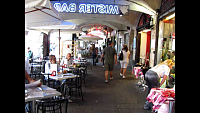
Sottoripa cafes in Genoa

Armanino

The square is backed by Sottoripa and Via Turati, two shopping arcades lined by mom-and-pop stores of all kinds: fry shops, cafes and bars.

One of my favorite shops along Sottoripa is Armanino, a specialty foods boutique founded in 1905. The Armanino family still runs this narrow, deep cavern. Celebrated for its wide variety of candied fruit, handmade by a candy-maker in Savona, Armanino also offers scores of highest-quality Ligurian specialty foods. You’ll find Santa Rita brand dry pasta, unfiltered extra virgin olive oil from the Frantoio di Borgomaro and many other small producers, Savona anchovies bottled in olive oil, authentic artisan-made bottled pesto and flours derived from chickpeas or chestnuts, perfect for traditional Ligurian recipes (and naturally gluten-free to boot).

Even older than Armanino (though a relative newcomer to the city’s medieval neighborhood) is nearby Klainguti, one of my favorite cafés in Genoa. Klainguti opened for business in 1826, the brainchild of a pair of Swiss brothers — which explains the utterly un-Genoese name. The Klainguti brothers were pastry makers. They had planned to sail to America from Genoa to make their fortune. But they literally missed their boat, opened a shop here instead, and the rest is history.

Klainguti’s is a tale of sweet success, from the archetypal Swiss butter cookies and rich cakes (including the caloric but irresistible “torta Zena” made with rum-flavored zabaglione cream, sponge cake and almond paste) on up. Another centuries’ old classic is the “torta Engadina” (a variety of German dark chocolate cake, filled with heavy cream and assembled from layers of light sponge cake made from almond flour).

Just over a decade ago two new, affable owners—also brothers—named Sauro and Fabrizio Ubaldi, plus Fabrizio’s son Luca, took over Klainguti. They trimmed the proverbial sails of this flagship café and got it flying along the Mediterranean circuit again after decades of doldrums.

Klainguti

Everything at Klainguti is made in house. The gobeletti are goblet-shaped apricot-jam cookies and they are very good. But there are also chocolate-dusted meringues made to look like miniature porcini mushrooms. The Falstaff is a croissant stuffed with hazelnut paste. Local legends claim it was one of composer Giuseppe Verdi’s favorites. Verdi was a regular at Klainguti whenever he was in Genoa, which was often.

The larger-than-life Verdi was a jumbo-sized individual and reportedly had no trouble dispatching giant portions of whatever he ordered. Those who can’t even imagine gobbling an entire torta Zena can get a fair idea of its excellent flavor by ordering a patatina rosa instead. These pink, baby potato-shaped confections explode with rummy zabaglione.

Klainguti’s outdoor tables are set up in the pocket-sized Piazza di Soziglia, a charming spot in the bull’s eye of the center of Genoa’s medieval alleyways. This is the perfect place from which to watch the multi-cultural, multi-racial Mediterranean world walk by. In case you’re hungry for the savory side before hitting the desserts, Klainguti also serves light lunches and many snacks. Don’t miss the cozy, handsome little backroom decorated with antique crystal chandeliers and colorful stone floors. It’s a good place to get out of the weather, whether hot or cold.

For addresses and opening hours, and much more on Genoa, its history, culture, food, wine, hiking trails, treks, guided tours, restaurants, food shops, best coffee, best focaccia and more, keep reading WanderingLiguria and pick up our books, Food Wine Italian Riviera & Genoa and Enchanted Liguria: A Celebration of the Culture, Lifestyle and Food of the Italian Riviera.

Never miss a post
Name: 
Your email address:*
Please enter all required fields
Correct invalid entries

Simon Says: Daily Food Quote, December 13, 2011

Published by Tuesday, December 13, 2011 Permalink 0

by Simón de Swaan

A warmed-up dinner was never worth anything.–Nicolas Boileau, 1667

Nicolas Boileau-Despréaux was a French poet and critic. He was born in the rue de Jérusalem, in Paris, France. He was brought up in the law, but devoted to letters, associating himself with La Fontaine, Racine, and Molière. He is the author of Satires and Epistles, L’Art poétique and Le Lutrin, in which he attacked and employed his wit against what he perceived to be the bad taste of his time.

Boileau did much to reform the prevailing form of French poetry, as Blaise Pascal did to reform the prose, and was for a long time the law-giver of Parnassus. He was greatly influenced by Horace.


Continue Reading…

Never miss a post
Name: 
Your email address:*
Please enter all required fields
Correct invalid entries

Simon Says: Daily Food Quote, December 2, 2011

Published by Saturday, December 3, 2011 Permalink 0

by Simon de Swaan

Do I dare to eat a peach?–T.S. Elliot, 1917

Thomas Stearns “T. S.” Eliot OM as a playwright, literary critic, and arguably the most important English-language poet of the 20th century. Although he was born an American, he moved to the United Kingdom in 1914 (at age 25) and was naturalized as a British subject in 1927 at age 39. He was awarded the Nobel Prize in Literature in 1948.


Never miss a post
Name: 
Your email address:*
Please enter all required fields
Correct invalid entries

Simon Says: Daily Food Quote, December 1, 2011

Published by Thursday, December 1, 2011 Permalink 0

by Simon de Swaan

At meat cleanse not thy teeth nor pick
With knife or straw or wand or stick.

The Book of Courtesy, c 1450

Published in 1868 under the title The Babee’s Book along with the second volume Queen Elizabeth’s Academy, published a year later, give the best example of medieval life and manners in England.


Continue Reading…

Never miss a post
Name: 
Your email address:*
Please enter all required fields
Correct invalid entries

UA-21892701-1