From Tokyo: Quirk of Fate after the Quake

Published by Wednesday, November 14, 2012 Permalink 0

by Nancy Singleton Hachisu

From the archives, in celebration of Nancy Singleton Hachisu’s new book Japanese Farm Food, already on its way to becoming a classic

My Surreal Dinner at Les Créations de Narisawa Restaurant after the Quake in Tokyo

Just moments before the Great East Japan Earthquake began to shake I was thinking about food.

While making my way towards Tokyo Station to catch the bullet train back to my local area 100 kilometers northwest of Tokyo, I was toying with dropping by my regular sushi shop near Tokyo Station for a palate cleanser (to chase away a disappointing sushi lunch earlier). Though really, I was wishing I could stay in town for dinner. Alas, I knew this would not sit well with my husband as I had just gotten back a couple days earlier from a quick trip to the U.S. And I had been gone way too much this last year.

Nonetheless, the idea took hold.

That morning I had sat in on a brain storming session exploring logistics of bringing the next edition of Cook It Raw to Japan. As the talk flowed around me, my nascent desire to “experience” Yoshihiro Narisawa’s provocative Japanese-influenced French “food” swelled into an obsessive urge to eat at his Minami Aoyama restaurant, Les Créations de Narisawa that night. Impractical, crazy, costly…impossible. Or so I thought.

When the ground of the massive station building where I stood stopped rippling and the initial terror had passed, the other passengers and I all waited quietly with backs leaning against the station walls. All eyes were fixed on our cell phones in hand, trying unsuccessfully to get a signal. No one said a word.

I emailed my 14-year-old son, home sick from school that day, and got a return email immediately. The house and family were fine.

At that point I still thought the trains would be running again, because the JR announcements were telling us there had been a “big earthquake,” and to wait as they checked the train lines. I dutifully waited for 45 minutes before realizing it was pointless. And so I made my way through underground walkways to Tokyo Station and began to realize the enormity of what had just happened.

Student groups trapped on their way through Tokyo for the annual School Trip were seated on the floor as teachers gave instructions. The bullet train would not be running that day (or the next).

My first thought was getting a hotel (and that I could stay for dinner). I had already squandered a crucial hour waiting for the trains to run, so the streets had swollen with commuters by the time I surfaced outside of Tokyo Station. I only knew of a few hotels and was not sure which side of the station they were located. Tokyo Station is a massive behemoth spanning multiple city blocks. When I finally got my bearings, it was getting on towards 5pm, already 2 hours after the earthquake. The hotels were full, so I lined up for the payphone to call Les Créations de Narisawa. My iPhone battery was dying, I was getting cold, and I knew I needed to get to a safe haven to recoup my energy before the night ahead of me. I needed food and I needed good food.

It was now about 6pm. I glanced over at the hoards waiting for taxis and optimistically told the restaurant I would try to get there by 7:30, but gave them my email for contact.

I now had a destination and nothing would deter me from getting there. Nothing.

The line for taxis looked insanely long and seemed to feed in from different directions. I dithered. I stood in line for a while, still unable to commit: wait it out or find another way. I tried to gauge how long it would take by talking to others around me in line—I’m not sure what we were thinking. We somehow believed that if we stood there long enough, the taxi would take us where we wanted to go. But what exactly was, “long enough?” One hour…five?

The alternative was unthinkable. Walk.

But I didn’t have all night to passively wait. I had less than 2 hours to get to my asylum away from the massive surge of humanity that had filled the sidewalks and streets. I knew I could handle a night on the floor of Tokyo Station, but desperately needed something to ground me in the chaos. And the only thing that does that for me is a quiet room and thoughtful food.

So I set off walking. Power walking, that is.

Thanks to a fellow “traveler” met early on in my trek, I got to Minami Aoyama in about an hour and a half. We stopped one time on a pedestrian bridge over Aoyama Dori (a main thoroughfare). The vast sea of lights before us was from the cars that barely inched forward. No taxis were getting through that night. Walking had been a good decision.

A flute of champagne in hand, my iPhone charging, I heaved a huge sigh of relief. I was “home.”

For the next two hours, a surreal dinner like I had never had before unfolded. It almost seems obscene in retrospect: tree bark, tree sap…bread baked before my eyes in a small stone capsule. Unusual and whimsical morsels from land and sea played together on the equally fanciful “plates.” I was the only customer that night. Perhaps I was the only one crazy enough to take refuge in such a place. Shut off from the outside world, none of us in that hushed room of Les Créations de Narisawa really knew or understood the gravity of the earthquake and all the horror and devastation it had brought. Nor had any of us imagined the unthinkable happening as it has happened at Fukushima Daiichi.

That night at Les Créations de Narisawa, I was caught in a soft little bubble, coddled by the staff. All of us unaware of what awaited us when the bubble burst.

At 10 o’clock, I stepped back out into the brisk night and started my return voyage. Long (useless) waits for trains, a night spent shivering on the marble floor of Tokyo Station, and more endless lines later, I finally got home late the following day. And for now we are safe, though 215 kilometers does not seem far enough from Fukushima Daiichi. But hundreds of thousands of Japanese are still in shelters and many will not be able to go home for many years to come.

And in the aftermath, we try to pick up our lives. I am planting seeds for the summer and looking towards the future. I am trying to organize food for a shelter in our prefecture and to offer a family the vacant teacher apartment at our school, but the wheels grind slowly here and accepting help from outside sources means someone has to manage that. There seems to be an absence of organization to deal with donations and the shelter contacts prefer money or instant ramen over real food like a big pot of stew from farm chickens and local (non-irradiated) vegetables. But that’s Japan, it’s all about the face-to-face meeting, not phone arrangements. I suppose a road trip is in order.


Never miss a post
Name: 
Your email address:*
Please enter all required fields
Correct invalid entries

Pumpkin “Museum”, Salone del Gusto 2012, Slow Food Italia

Published by Tuesday, November 13, 2012 Permalink 0

All the Pumpkins Varieties in the World: A Photo Essay

by Jonell Galloway

Pumpkin varieties of the world, Salone del Gusto 2012

Image 1 of 6


Never miss a post
Name: 
Your email address:*
Please enter all required fields
Correct invalid entries

Beef Brisket Recipe: Bookmark This

Published by Tuesday, November 6, 2012 Permalink 0

Beef Brisket Lover Recipe: Bookmark This

Chicago Tribune‘s Bill Daley interviews Daniel Rose in Paris about how the French make beef brisket. Rose, who runs , formerly in Chicago and now in Paris, shares his beef brisket recipe.


Never miss a post
Name: 
Your email address:*
Please enter all required fields
Correct invalid entries

Slow Food’s Salone del Gusto 2012, Turin, Italy, photo essay 1

Published by Saturday, November 3, 2012 Permalink 0

by Jonell Galloway

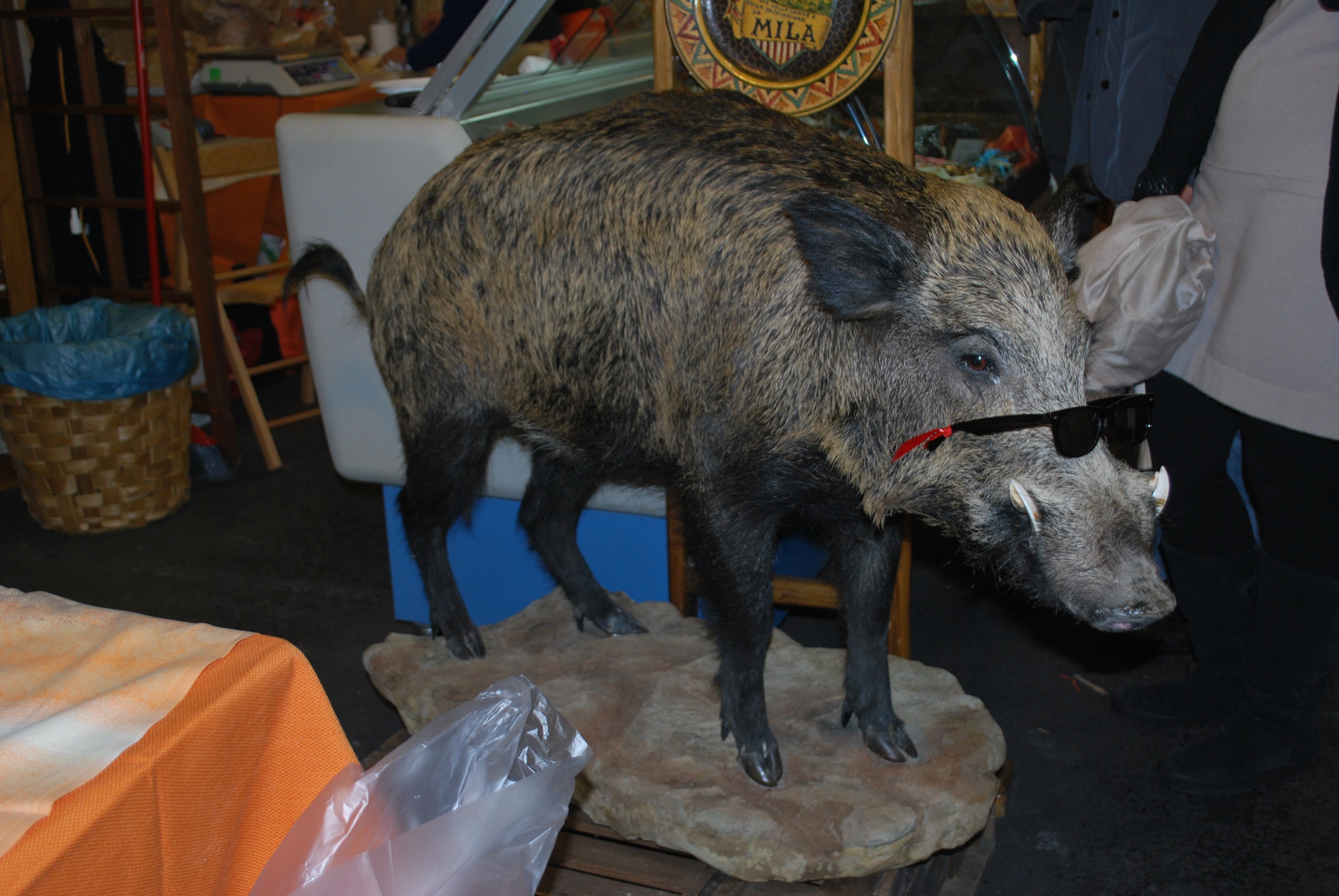
I went camera-crazy at the Slow Food Salone del Gusto 2012 in Turin, Italy. Here are my unedited photos, part 1, documenting the incredible products available. The signs tell you where the product came from and give a full description in English and Italian. Watch the slideshow!

Wild boar with sunglasses, Piemonte,Slow Food Salone del Gusto 2012, Turin, Italy

Image 1 of 28

Never miss a post
Name: 
Your email address:*
Please enter all required fields
Correct invalid entries

Handmade Italian cheese from Tuscany at the Salone del Gusto 2012 in Turin, Italy

Published by Friday, November 2, 2012 Permalink 0


Related articles


Never miss a post
Name: 
Your email address:*
Please enter all required fields
Correct invalid entries

Beef Production in Feedlots – How we do it in Australia

Published by Friday, November 2, 2012 Permalink 0

by Amanda McInerney

I have no illusions. The majority of people do not think too hard about where their food comes from. There are lots of reasons for that – life can be a pretty distracting business for many and they just don’t need another thing on their plate (pardon my pun) to cause anxiety and emotional or financial stress. What concerns me, though, is that those who find their way to my site and others like it and actively choose to consider their food options do so from a well-informed foundation. To that end I always endeavor to make sure I am as well informed as possible about a subject before I start “blowing off “about it.


I’m a carnivore and a (very) small-scale Angus beef producer, so have a direct interest in how beef is produced in this country. My cattle live a very pleasant life indeed and their end is relatively quick and clean, but for some time now I’ve been curious about what happens to other cattle. While it would be nice if all livestock could avoid the industrial food system, this is unlikely to happen any time soon and I wanted to try to understand how the general beef production model works. These days we hear much that is negative in relation to U.S. feedlots, so I’ve been interested in learning about the conditions on Australian feedlots and comparing our system with the the US model. Recently, I have had several requests for information regarding the perceived difficulties of sourcing grass-fed beef and a query regarding the Australian commitment to corn crops and government subsidies of them, so clearly I’m not the only one who needs to become a little more well-informed on this subject.

There are quite a lot of clean, comfortable and slightly detached ways to go about researching a topic these days, but never let it be said that your trusty correspondent was reluctant to face up to the cold hard facts of life – which is how I found myself at one of Australia’s largest feedlots and processing plants just outside of Toowoomba in Queensland last week. I was pleased to be able to accept an offer from Meat & Livestock Australia to see, absolutely first-hand, exactly how feedlotting is operated here and, while it is a little tricky to use the word “enjoy” in this context, I certainly found the experience enlightening and even bracing.

Housing cattle in feedlots is an intensive animal feeding technique designed to fatten livestock and encourage the deposit of more fat in the beast’s muscles – known as marbling. There are approximately 600 accredited beef cattle feedlots in Australia, with over 95% family-owned and -operated. In the U.S. the feedlots are much, much bigger than any here in Australia, often holding 150,000 to 200,000 head of cattle. Beef City, the lot I visited, has a 25,000-head capacity and we have only one other which is larger than that in this country.

The fact is most Australian beef is grass-fed and even feedlot cattle spend 80-90% of their lives on grass, only being sent to feedlots for “finishing”.  Cattle are generally sent to feedlots when poor pasture quality during poor seasons or during the dryer winter months, and in southern Australia during the dryer summer months, can result in low weight gain and the need for feedlot finishing.  In comparison, U.S. beef cattle are introduced to a grain diet very early – indeed, some are weaned on to it – and generally spend a much larger percentage of their life confined in small feedlot yards.

As I’m sure many are aware, U.S. grain-feeding is heavily dependent upon a ration of GM corn by-products (obtained from ethanol production), with the addition of antibiotics to prevent the infections that will arise as a result of the stress placed on the beasts. Once again, this is not at all the case here.  Australian feedlots use a much more varied combination of wheat, barley and sorghum – all grains which cattle prefer to grass – and follow strict transitional protocols over a period of weeks to ensure that the beasts have no rumen problems from a sudden change in diet. Antibiotics are NOT used as preventatives here in Australia and are only ever introduced on direct evidence of infection.

Australian feedlots are regulated through the industry’s quality assurance program, the National Feedlot Accreditation Scheme which, in 1995, was the first agricultural quality assurance scheme introduced in Australia and means that every lot in the country is individually audited every year. Environmental aspects are of significant importance here in Australia, too, and all feedlots have to provide monitoring data on soil quality and water tables annually.

My own impressions of Beef City in no way contradicted any of these facts. I was one of a group who were visiting the lot as part of their training and we were taken through every single part of the operation. Nothing was hidden from us, no question went unanswered, and the only thing we were requested not to photograph was the actual kill in the abattoir – not an unreasonable request, I thought.

The cattle in the yards (which were ALL shaded) were content, relaxed, but alert and very curious about the visitors – just as my own cattle in the paddocks are. They are very inquisitive beasts and like to know what is going on. Another thing which is worth knowing about cattle is that they are highly “vocal” and leave you in no doubt if they are unhappy or distressed about something. There was not a murmur out of this lot – apart from the odd contented conversational lowing – and certainly not the calling I hear from mine if one or two of them become separated, or the anxious bellowing of the cows when the calves are separated from the herd.  If they were uncomfortable or distressed, they sure weren’t talking about it.

I’m not aiming to convert anyone with the above thoughts, nor am I posing as any sort of a mouthpiece for industrial agriculture – this is simply an issue which is of personal interest to me. As it turns out,  the facts are a good deal less confronting than I expected and I’m nowhere near as horrified as I thought I’d be.   Large-scale meat production not going to go away and, if we are going to eat it, there is no point in being squeamish about how it gets on our plates. As meat-eaters we have a responsibility to the beast that dies for our dinner and that responsibility includes treating it respectfully while it is alive. Of course, that will not happen in every case, but the standards which are in place are helping us get there. I believe that, as far as Australian beef production is concerned, we are on the right track.


Never miss a post
Name: 
Your email address:*
Please enter all required fields
Correct invalid entries

Switzerland: Raphael of Fribourg making Fribourg-style Swiss fondue using cheese he makes

Published by Friday, November 2, 2012 Permalink 0

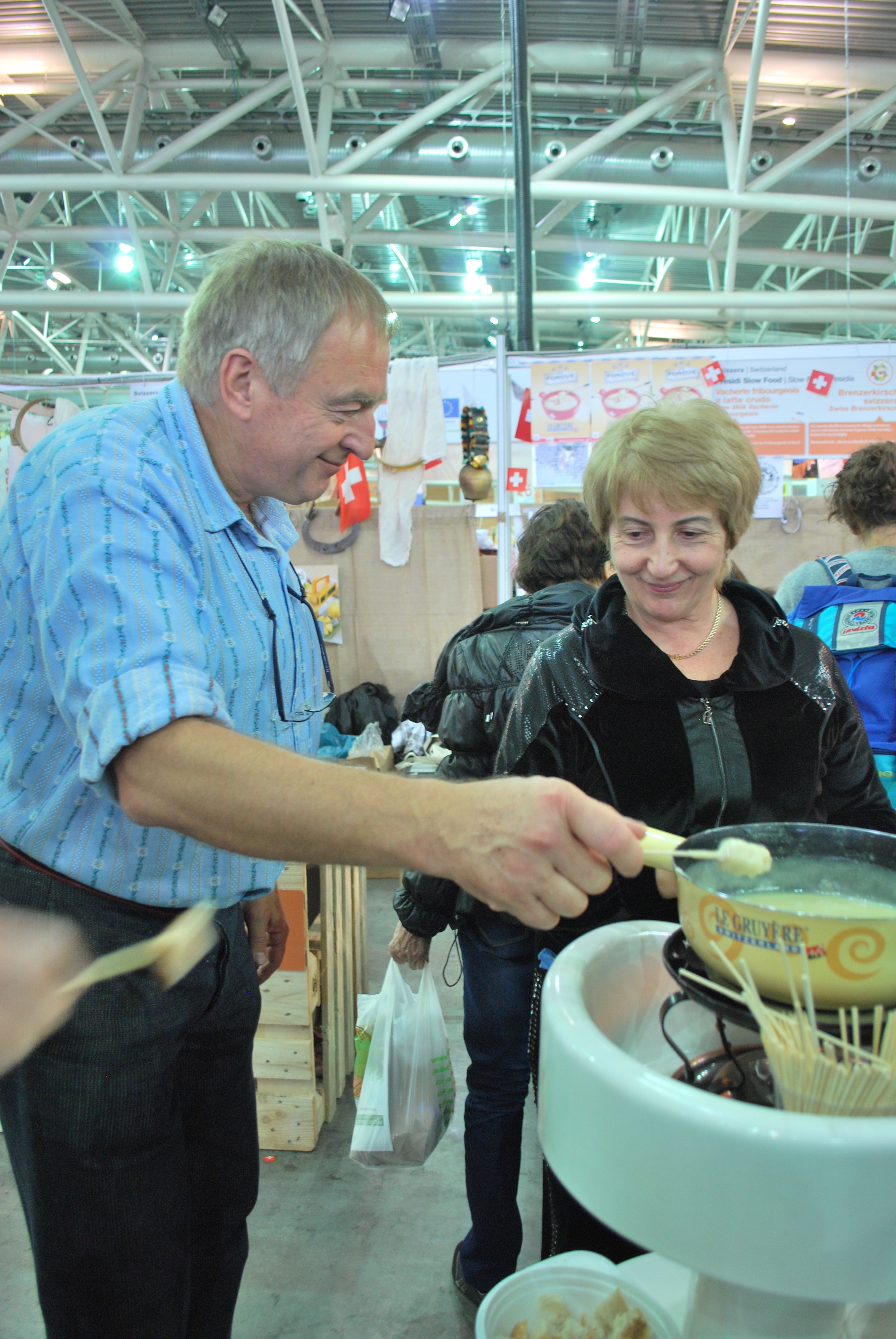
Fribourg-style Swiss fondue is referred to as moitié-moitié. Unlike fondues from other regions, it is made with a hard, cooked cheese native to Fribourg, known as Vacherin Fribourgeois (not to be confused with Vacherin or Mont d’Or). The recipe calls for half Vacherin Fribourgeois and half Swiss Gruyère.

In this photo, Raphael is making fondue using the handmade cheeses he makes himself, at the Slow Food Switzerland stand at the Salone del Gusto in Turin, Italy last week. The visitors ran to his stand every time he put a new pot of fondue out. Obviously, it was very good!


Never miss a post
Name: 
Your email address:*
Please enter all required fields
Correct invalid entries

What we’re reading: food sculptures, hugging carrots, revolting cakes, Salone del Gusto 2012, 100 best American cakes

Published by Thursday, November 1, 2012 Permalink 0

by Jonell Galloway

Click here to keep up with the latest in world food and wine news.


Never miss a post
Name: 
Your email address:*
Please enter all required fields
Correct invalid entries

Opening of Salon du Chocolat 2012 chocolate show in Paris

Published by Thursday, November 1, 2012 Permalink 0

by Jonell Galloway

Take a look at this lovely chocolate dress fashion parade to celebrating the opening of the show.


Click here to see entire show. Which dress is your favorite?

Never miss a post
Name: 
Your email address:*
Please enter all required fields
Correct invalid entries

Recipe: Kids in the Kitchen: Making Homemade Halloween Treats with your Children

Published by Sunday, October 28, 2012 Permalink 0

by Jonell Galloway

American Jack-o’-lanterns. Photo courtesy of Nosajanimus.

Have you ever thought of making homemade Halloween treats, and getting your kids into the kitchen to help out?

Sharon Bowers’ book Ghoulish Goodies: Creature Feature Cupcakes, Monster Eyeballs, Bat Wings, Funny Bones, Witches’ Knuckles, and Much More! (Frightful Cookbook) arose out of her lifelong love affair with Halloween. Epicurious has featured some of her recipes and ideas in its weekly newsletter.

Continue Reading…

Never miss a post
Name: 
Your email address:*
Please enter all required fields
Correct invalid entries

UA-21892701-1