I wish I were on this beach in Normandy today, walking on the Trouville promenade, the French flag flying high and proud, the sea breeze in my locks. I might fling off that long, thick dress with its petticoat, however, and walk shoeless into the sea and stick my toes in the chilly water, before going up for coffee and a Madeleine in that little tower in the half-timber house looking out to sea. That’s me in the blue dress, of course; I always wear a color that matches the sky.
****
This painting is from the current exhibit at the Jacquemart-André Museum in Paris. By Claude Monet, The Boardwalk on the Beach at Trouville, 1870.
No one loves cream or creaminess more than the French. They love it so much that they call all sorts of things other than cream “crème“: cream soups, pudding, sauces, custard filling, pastry cream, coffee with hot milk, puréed chestnuts, almond cream, cream horns, and even certain liqueurs. Just about anything creamy is likely to be called cream in French.
Cream has existed ever since milk existed. Despite our association with French cuisine, in general, cream is more a specialty of the north of France where it’s cooler, of the land of butter, than of the south, the land of olive oil and duck fat.
Normandy might well be called the cream capital of the world, or at least of France. The Vikings brought what we now call Normande cows to Normandy a thousand years ago. They, along with Jersey cows, are known for the quality of their fatty, high-protein milk, which makes excellent cream, butter and cheese. Half of all French milk and cream now comes from Normandy.
Apples and cream are a quintessentially Norman flavor combination. This is a festive dish made on Sundays and holidays.
In Normandy, they would traditionally drink it with dry cider or Pommeau, but a fruity white wine such as a Riesling goes well, or even dry white Burgundies. If you prefer red, try a light one, such as Saint-Nicolas-de-Bourgueil or another Loire red.
These fruit trees in blossom with the cow in the verdant fields of Lower Normandy and the church steeple in the background could almost be a Pissarro painting. The Impressionists made this sort of village scene familiar to us all. It’s almost like going home.
Sometimes I think I’m liquefying like an old Camembert.–Gustave Flaubert
History of Camembert
The legend goes that Marie Harel invented Camembert in 1791 in the village of Vimoutiers in Normandy, a froward priest giving her the instructions, which she guarded preciously hidden away. Camembert is not taken lightly in France. In 1928, Alexandre Millerand, former president of France, inaugurated a statue in Vimoutiers in honor of Harel’s great “achievement.”
The legend lives on, despite the fact that the family name Harel has never appeared on the list of cheesemakers or business people in the Camembert region, and that the first historical recording of the cheese was in 1708, well before Harel supposedly lived.
How Camembert is Made
Camembert is made from unpasteurized whole milk, abiding by specific requirements if it is to be labeled “Camembert de Normandie.” The milk is first skimmed, then the lactobacillus bacteria is added as a starter. The milk is left at 12° C to coagulate for several hours and is then heated to around 30° C.
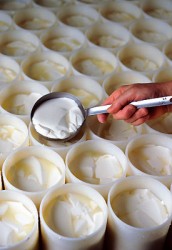
These curds are then sliced vertically and ladled into perforated cheese moulds. This manual operation is repeated four or five times over the space of 40 minutes, allowing the curds to drain off all excess water. After about 12 hours, the cheese is turned over and a stainless steel plate is placed on it, putting pressure on it so that it continues to drain overnight.
The next day, the cheese is removed from the moulds and salted. It is left for a week in a curing room with 100% humidity, where it is turned regularly. Thanks to the Pénicillium candidum in the atmosphere of the room, a natural crust is formed. (Some modern facilities spray the cheese with Pénicillium candidum to start the process.) French regulations require that it then be placed in a curing room with 50% humidity for a week.
The Camembert de Normandie A.O.C./A.O.P. is then ready for packaging. It is wrapped in plastic and then enclosed in a thin, round poplar box.
There are numerous variations on this process, depending on the manufacturer, but all makers more or less follow these steps, whether on a farm or in a larger establishment.
How to Choose a Camembert
Labeling
The first thing to look for is the origin. It will probably be Camembert de Normandie or Camembert fabriqué en Normandie. Only Camembert de Normandie is made from raw milk and and has the legal right to bear the A.O.C. or A.O.P. label. This category includes some 500 milk producers and 9 or 10 cheese makers. In any case, Camembert de Normandie is always hand-made and the dairy cattle have been let out to pasture for a minimum of 6 months. It should always be marked moulé à la louche, indicating that it is hand-made using a ladle.
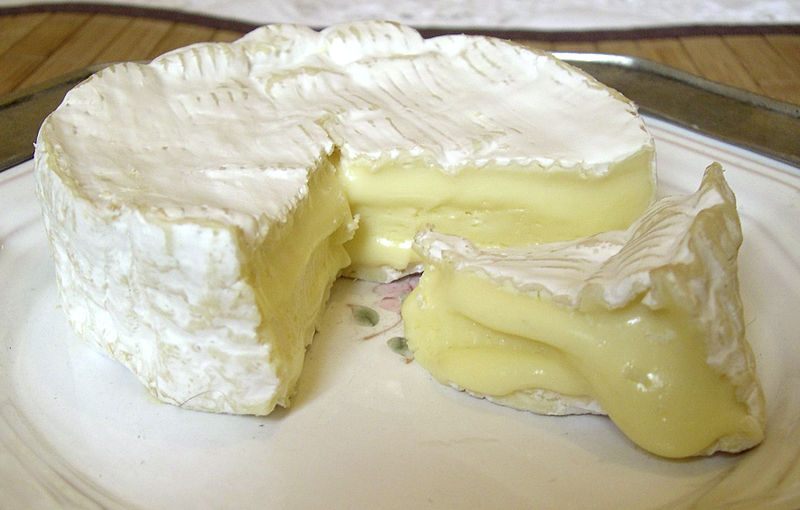
This name has been protected since 1983, and only represents 4.2% of all Camembert made in France. Look for all these indications on the packaging. Labeling can often be deceptive. Study the images in this article so you’ll be able to tell whether it’s real Camembert and to get a picture of the deceptive practices used. In any case, it should bear this label:
Camembert fabriqué en Normandie simply means it’s made in Normandy. There are no regulations controlling how it is made, so it will most likely be made in a factory, but there are certainly some artisanal cheese makers who for one reason or another don’t qualify for the strict Camembert de Normandie label, but whose cheese is of a high quality.
Then there are manufacturers from other parts of the country who make what they call Camembert. This is usually made with pasteurized milk and most often in factories. We have no way of knowing whether it is made according to the rules of the trade or whether it is good except by tasting. It might even be made with milk from another country.
Appearance
Camembert should be perfectly round and flat. The crust should be white, but slightly brownish, and should not be cracked. The brownish spotting is the result of healthy mould and ripening. The entire surface should be the smooth and even. The edges should be slightly yellow.
Smell the Camembert. Any whiff of ammonia indicates that it is too ripe. It should smell fruity and ripe like you’d like it to taste, but not overwhelming.
Touch the edges, then press the middle. It should be neither too hard nor too soft.
When you cut into the cheese, it should be light yellow in color and creamy in texture.
Note: raw milk Camembert is best in the spring and autumn.
How to Eat Camembert
The French eat their cheese after the main course, either with or after a green salad. It is eaten as is, at room temperature, with bread, and followed by dessert. Some nicer restaurants will serve dried fruit, jam or nuts with the cheese course.
And indeed she proved to be right. It is only now, 60 years later, that cooking has established itself as gastronomy, and only when referring to a few great American chefs.
This is Foodista’s list of their favorite Julia recipes.
Vichyssoise is actually the base of almost all French soups. This simple base — made of potatoes, leeks, and salt — is elaborated on in countless ways to make an endless variety of soup. When served cold in summer and cream is added, it is referred to as Vichyssoise.
Ratatouille brings all the flavors of the Southern sun together: red ripe tomatoes, eggplant, zucchini, bell peppers, garlic, onions and Provençal herbs. Today there are many other versions, many of them even in the oven, but this is the classic recipe.
The problem with duck is always the same: the fat spews all over the place and it is difficult to digest. The acid of the orange in this classic French dish helps digest the fat, and makes it tasty too. This is a favorite Julia Child recipe.
Boeuf Bourguignon is a fancy version of our classic beef stew. What makes it different is that it is cooked in red wine, and pearl onions and mushroom caps are added to it.
Not all French pies are made with custard, but you often find this version in Normandy, the land of cream and butter. It can be served either cold or warm.
Clafoutis can be made with many different fruits, but plus and cherries are all-time French favorites. This tart has a custard-like consistency, but also contains ground almonds, giving it a salty edge.
Sabayon is a a cousin of the light, egg-based Italian dessert zabaglione. It is light and custard-like, and a standard in French as well as British cuisine.