Slow Life in Chartres, the Breadbasket of France

Published by Sunday, February 14, 2016 Permalink 0

Eating and Drinking in Chartres, the Breadbasket of France

by Jonell Galloway

Kentucky is far from Chartres, but not so far as one might think. Biscuits and cornbread were the bond that held us together in Kentucky; wheatfields and bread do the same in Chartres. We like white gravy; the Chartrains, as they’re called, like sauce. Isn’t white gravy a sauce, after all?

Growing up in Kentucky, I embraced the Slow Food concepts without ever knowing it. Wendell Berry was my breakfast, lunch and supper, after all. The French have never fully embraced the official Slow Food concept of Good, Clean and Fair, since they consider that French cuisine and agriculture already embrace these values and do not need an organization – especially an Italian association with an English name – to teach them about their own time-honored traditions. One might say that the French are arrogant and chauvinist, which I would never totally deny, but it is this very pride that has maintained a high level of quality in the world of artisanal food and agriculture.

I have lived in the Beauce region, the bread basket of France, for over 15 years. The hill of Chartres is surrounded by wheat and grain fields and when you go to the bakers, they actually mark the name of the millers who provided the grain for particular breads. It’s all rather magical for those who have a holistic view of the world. The Beauce is all about farming, in particular, wheat, grain and sugar beets, but also goat cheese, pork products, rabbits, beer, apples and apple cider products, pears, chickens, rapeseed, etc. My goal has been to find all the best producers and growers and support them in every way possible.

Continue Reading…

Never miss a post
Name: 
Your email address:*
Please enter all required fields
Correct invalid entries

What to Eat in France: Turkey Stuffed with Chestnuts

Published by Friday, December 18, 2015 Permalink 0

What to Eat in France: Dinde Farcie aux Marrons, Turkey Stuffed with Chestnuts

by Jonell Galloway

Etre le dindon de la farce. / To fall victim to dupery.

Une dinde. / A stupid, pretentious woman.

Anthelme Brillat-Savarin, perhaps France’s best-known gastronomic writer, said that the turkey was certainly one of the most beautiful gifts the New World had given to the Old. “…the fattest, and if not the most delicate, at least, the tastiest of all domesticated birds.” It’s not often that the New World gets such compliments from discerning French epicures.

Turkeys were originally called poules d’Inde, “Indian hens,” in France, because they were thought to have come from India, which they later learned was Mexico. The French were not the only ones to get the name wrong. In Hebrew a turkey is a tarnagol hodu, meaning literally  “Indian chicken;”  in Russian indiuk, Polish indyk and Yiddish indik.

There is some controversy over who brought turkeys to Europe. Columbus probably brought  brought them back in the early sixteenth century, since records show that King Ferdinand had ordered that every ship to bring back ten turkeys before the Spanish explorer Cortés set out in 1519. In any case, by 1548, they were the rage in France. In 1549, Catherine de Medicis served 70 “Indian hens” and 7 “Indian roosters” at a banquet held in honor of the Bishop of Paris.

French aristocrats were accustomed to eating all sorts of feathered creatures, including chewy storks, herons, peacocks, swans, cranes and cormorants, so it wasn’t surprising that they fell in love with the less-chewy turkeys, and that in 1570, Charles IX and Elizabeth of Austria thought turkey noble enough to serve at their wedding feast.

By the seventeenth century, the French were raising turkeys as if they were their own and most cookbooks included turkey recipes. French chefs weren’t lacking in ideas: they made stews and ragouts; they larded, roasted and glazed it; they stuffed it and made it into soups and pâtés.

Marie-Antonin Carême preferred the wings, which he deboned, then stuffed with chicken and truffles. Alexander Dumas, in his Dictionary of Cuisine, included 27 recipes. Turkeys were well established in the Hexagon.

Christmas dinners usually meant lots of mouths to feed, so turkey, being the largest of the winged creatures available, eventually became the dish of choice for Christmas feasts. By the nineteenth century, it became customary to stuff the Christmas turkey with chestnuts, and the tradition continues today.

Continue Reading…

Never miss a post
Name: 
Your email address:*
Please enter all required fields
Correct invalid entries

A Sausage Walks in to a Bar…..

Published by Monday, July 16, 2012 Permalink 0

by Alice DeLuca

A story for carnivores

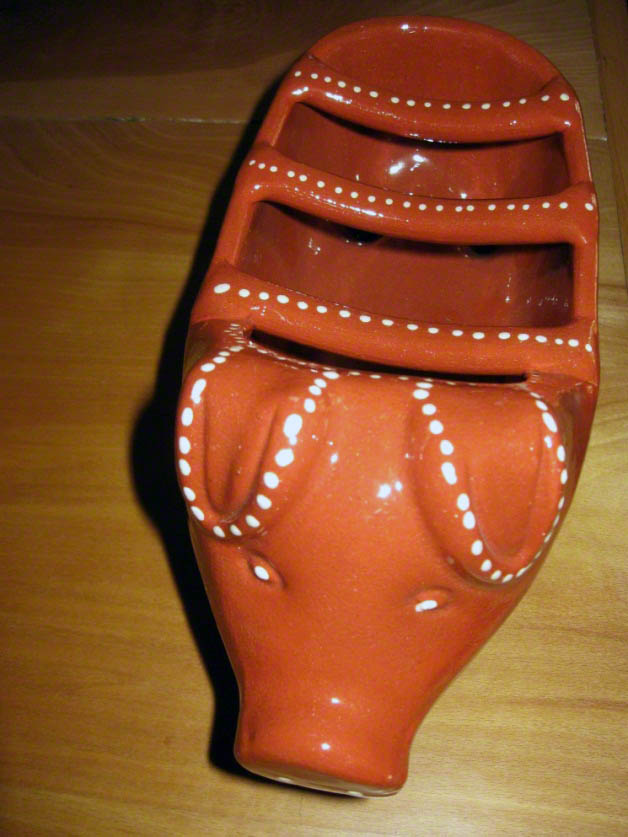
Assador - Alice DeLuca 2012 (C) digimarc

Assador


This whole adventure started with a search for the perfect sausage to use in a recipe for pork with clams, which led to a little ceramic pig, and ended up with a truly excellent party. This cute little piece of specialty cookware, which looks like footwear for some impossible outer-space monster, is in fact designed for brazing sausages over flaming, hi-octane Portuguese liquor. As we learned the purpose and the method for using this device, we became completely distracted from our original mission and found ourselves planning a sausage-roast.

Linguica roasting - Alice DeLuca 2012 digimarc

Sausages roasting over flaming Aguardente

First, we had to obtain the little pig dishes from Portugal – that was easy and took only a few weeks. As soon as the dishes arrived we set about making home-smoked sausages and invited some guests to come over and roast them with us – RSVPs were instantaneous and none declined the invitation.

Continue Reading…

Never miss a post
Name: 
Your email address:*
Please enter all required fields
Correct invalid entries

‘Nduja: The Spicy and Spreadable Calabrian Treat

Published by Tuesday, March 13, 2012 Permalink 0

by Diana Zahuranec

‘Nduja (n-due-yah) is a spreadable, spicy, red pork meat that can be found everywhere in Calabria. Calabria is the southern Italian region that is the “toe” of the boot, so to speak. Nduja Nduja is used for sauces, bruschetta, or on anything that spreadable meat – spalmabile – would be tasty, including a spoon.

‘Nduja is produced from the throat of a pig, called the guanciale meat, and also the guanciale – stomach meat – and the back lardo, or fat. The lardo, when mixed with salt and added to the meat, takes on another name that has no exact English translation, called sugna. This meat and fat mix is ground with salt, local peperoncino (the Italian chili pepper), and absolutely nothing else. Not even nitrates, a common preservative added to most sausages and cured meats (linked to a higher risk in cancer), adulterate this all-natural ‘nduja. Salt, the extended maturation, and the fact that 30% of ‘nduja is peperoncino, which acts as a natural preservative, defy the need for synthetic additives.


Luigi Caccamo, left

Continue Reading…

Never miss a post
Name: 
Your email address:*
Please enter all required fields
Correct invalid entries

UA-21892701-1