
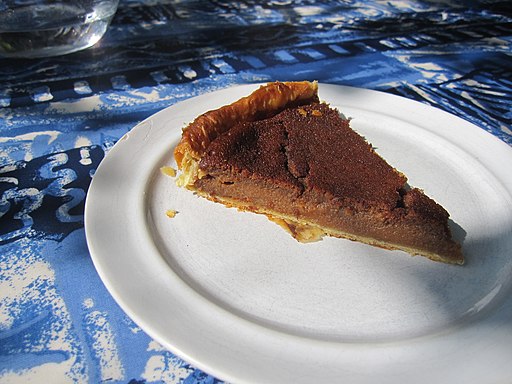
Swiss Food: Tarte à la Raisinée – Apple & Pear Syrup Pie

Published by Sunday, March 30, 2014 Permalink 0

Swiss Food: Tarte à la Raisinée – Apple and Pear Molasses Pie

What is Swiss Raisinée?

The French-Vaudois word raisinée refers to a syrup or molasses made of the must of apples and pears. It was originally cooked in grape juice, thus the name — raisin means grape in French. Often called vin cuit, or “cooked wine,” it is in the form of a dark brown, viscous liquid. In still other parts of Switzerland, another concoction similar in consistency to jam and using the same ingredients is called cougnarde and probably dates back to at least the Middle Ages. Raisinée was used as a sweetener in many regions in Europe, and the tradition has lingered in Switzerland, especially in the cantons of Vaud, Fribourg and Neuchâtel. Today, it is mainly used for cakes and pies, and is not fermented, so it not technically a wine.

The tart itself has numerous names — raisinée, vin cuit (literally cooked wine), cougnarde and Biresaassa, depending on the location.

Recipe: Tarte à la Raisinée – Apple and Pear Syrup Pie

This recipe is inspired by Concert des Casseroles and translated with their authorization

Use a pie ring or pie tin 24 cm in diameter
Sweet Pie Crust
  • 200 g of flour
  • 100 g butter
  • 3 g of fine salt
  • 15 g walnut or hazelnut nillon* (here a mixture in equal parts)
  • 1 small egg (less than 60 g)
  • 60 g white sugar
Filling
  • 3 eggs
  • 2 egg yolks
  • 200 g double cream
  • 150 g pear raisinée (click on link to see our recipe for making raisinée)
  1. Dough: Combine the butter and sugar. Add the beaten egg and walnut/hazelnut nillon, then flour, mix and form into a ball, then roll out or pat down to flatten. Wrap in plastic and chill for 30 minutes.
  2. Spread the dough on a sheet of baking paper and place it along with the sheet in a pie ring or pie pan. Shape the edges by pinching the dough between your thumb and forefinger. Prick the bottom and edges with a fork. Cool for 30 minutes to firm up and avoid sagging when cooking.
  3. Preheat oven to 180° C. Place baking paper and beans or ceramic beads on the dough to prevent it from swelling. Bake for 20 minutes: the dough should barely brown.
  4. Meanwhile, prepare the filling by mixing the eggs and yolks, the double cream and the raisinée.
  5. Remove dough from oven. Remove weights and parchment paper. Lower thermostat to 150°C.
  6. Pour the filling into the dough and cook for about 30 to 40 minutes. The filling must be taken when it is not too firm and must have a slightly caramelized smell. It will probably still appear liquid when it comes out of the oven, but do not prolong the cooking, as it gets much firmer while it is cooling.

*Nillon: Nillon (or nion), is a local product used in French-speaking Switzerland. It is the residue from pressing of nuts. It is found in sheets, grated or powdered form. There are walnut and hazelnut nillons packaged in small 160-gram bags. In the canton of Vaud (Switzerland), nillon is used to make a walnut cake and apple pie. In France, it is known as walnut flour or walnut meal.


Never miss a post
Name: 
Your email address:*
Please enter all required fields
Correct invalid entries

Swiss Food: How to Make Raisinée

Published by Thursday, January 16, 2014 Permalink 0

Swiss Food: Raisinée: The History and the Recipe

by Jonell Galloway

The French Vaudois word raisinée refers to a syrup made of the must of apples and pears. It was originally cooked in grape juice, thus the name — raisin means grape in French. Often called vin cuit, or “cooked wine”, it is in the form of a dark brown, viscous liquid. In still other parts of Switzerland, another concoction similar in consistency to jam and using the same ingredients is called cougnarde and probably dates back to at least the Middle Ages. Raisinée was used as a sweetener in many regions in Europe, and the tradition has lingered in Switzerland, especially in the cantons of Vaud, Fribourg and Neuchâtel. Today, it is mainly used for cakes and pies, and is not fermented, so it not technically a wine.

History

In the 17th century, raisinée meant a thick fruit jam, generally made of apples and pears, and slow-cooked in concentrated grape juice. According to the Encyclopédie d’Yverdon, published in the 1770s, raisinée was made from the must of very ripe green grapes cooked until reduced by two thirds, then kept in barrels. Drinking it was said to give energy to people of a frail nature.

Raisinée is no longer drunk as a cooked or fortified wine, although in the 18th century one finds recipes for fruit must syrup made from apples and pears (dropping the use of grape juice) and used to replace sugar. Like today, the apple and pear juice was cooked until thick, until a drop on a plate didn’t run anymore. During periods of scarcity and hardship — for example, during and after World War II when sugar was low or not available — it was and still is used as a sweetener.

Cantons like Fribourg and the Vaud have kept up the tradition more than elsewhere, partially because they have a history of orchards. Recipes had been maintained and they were brought back to life in the 1980s.

Traditions similar to this were to be found in Mesopotamia and Ancient Rome.

Recipe

Use apples and pears not suitable for eating. The fruit shouldn’t be overly ripe. You should be able to crush it and press it, but it mustn’t turn into a purée. The juice is filtered to get rid of hard bits. It is then decanted overnight (no more).

Unlike industrial fruit concentrates, the juice is not clarified. It is simply brought to a boil in a large copper kettle over a wood fire. Try to use up any bits of wood not suitable for a regular fire. A coil-type steam burner can be used to prevent risk of overheating, especially when making large quantities.


Never miss a post
Name: 
Your email address:*
Please enter all required fields
Correct invalid entries

UA-21892701-1