What to Eat in France: Bourride à la Sétoise

Published by Thursday, August 13, 2015 Permalink 0

What to Eat in France: Bourride, or Provençal Fish Soup with Aioli in the Style of Sète

by Jonell Galloway

Bourride is the specialty of Sète, a town on the coast of the Languedoc in Provence. Sète is one of the largest fishing ports in the region. Native poet Paul Valéry called it l’île singulaire, the singular island, because it is nestled in between two salt water lakes and the sea.

Bourride is said to date back to the Phocaeans, the ancient inhabitants of Marseilles, then called Massilia.

In Provençal, it is called boulido, meaning “boiled.” It is not unlike bouillabaisse, a specialty of nearby Marseilles, the difference being that bourride is made with only white fish — monkfish tails in particular, and that it is accompanied by aioli instead of the traditional rouille served with bouillabaisse. Shellfish are never added.

My recipe is very traditional. There are many variants, but the aim of this series of articles “What to Eat in France” is to seek original or traditional recipes for traditional, regional dishes.

This dish is a sure pleaser for parties and is easy enough to cook ahead, doing everything but poaching the fish, which should be done before serving.

In the region, many locals drink rosé wine such as Coteaux-d’Aix-en-Provence with bourride, but one might just as easily pair it with a perfumed Languedoc white. There are a world of them to be discovered, but since they are not, for the most part. A.O.C., it’s difficult to recommend one in particular. It’s a matter of producer as much as place.

Continue Reading…

Never miss a post
Name: 
Your email address:*
Please enter all required fields
Correct invalid entries

WHAT TO EAT IN FRANCE: STRAWBERRY-FINANCIER CHARLOTTE

Published by Wednesday, June 3, 2015 Permalink 0

French Recipe: Strawberry, Rum, Almond and Cream Trifle

by Jonell Galloway

A charlotte is traditionally fruit sautéed in butter which is then placed in a mold lined with bread. In our day, the bread is usually ladyfingers, but I’ve used financier, a dense almond flour cake made with beurre noisette, giving it a distinctive flavor.

Insteading of sautéing the strawberries, I’ve marinated them in rum and used the marinade to “wet” the cake, similar to the way the British make trifle.


600 g strawberries
2 T. brown sugar
1 tsp. cinnamon

4 T. rum
3/4 c. water
4 financier cakes, individual size (or other type of soft, but dense, almond cakes)
200 g thick cream
1/2 vanilla bean
2 T. brown sugar

4 parfait dishes

  1. Top strawberries and cut in half. Place in mixing bowl.
  2. Mix in 2 T. brown sugar and cinnamon.
  3. Add rum and water. Mix gently.
  4. Leave for 30 minutes, mixing gently from time to time. A natural sauce should form. If it doesn’t, add a little more water and rum.
  5. Meanwhile, mix cream with vanilla from vanilla bean and brown sugar.
  6. Break up 1/3 of each financier into each parfait cup. Spoon in 1/9th of strawberries into each cup, pouring some juice onto the cake to moisten it.
  7. Cover with 1/9 of cream.
  8. Add two more layers of financier, strawberries and cream, in the same proportions, ending with cream.
  9. Decorate top with bits of strawberry, mint, or dark chocolate.
  10. Refrigerate for 2 hours before serving.


Never miss a post
Name: 
Your email address:*
Please enter all required fields
Correct invalid entries

WHAT TO EAT IN FRANCE: BLANQUETTE DE VEAU

Published by Tuesday, June 2, 2015 Permalink 0

Chartres-style Blanquette de Veau Recipe / Apple, onion, carrot and veal stew in apple juice and white sauce recipe

This dish hails from Normandy, where cream, butter, apples and calves are abundant. Chartres is not officially in Normandy, but its cuisine is similar.

by Jonell Galloway

1 kilogram or 2 pounds veal shoulder, cut into 2″ x 2″ pieces
12 pearl onions, or the white of 12 small spring onions, peeled and whole
1 apple, chopped
4 carrots, cut into large chunks crosswise
Apple juice
Veal or chicken broth
6 small new potatoes in jacket
4-5 tablespoons flour
2-3tablespoons butter
1/2 liter or 1 quart milk
Italian or flat parsley, chopped
Salt
Pepper
Dutch oven or similar large pan

  1. Put the veal pieces in Dutch oven.
  2. Add the onions, apple and carrots.
  3. Cover with half apple juice and half veal broth. Salt and pepper.
  4. Simmer gently for 1 hour, then add the whole potatoes.
  5. Simmer for 30 to 45 minutes, or until the potatoes are cooked.
  6. Drain broth from meat and reserve it to make white sauce.
  7. Melt butter in a large, deep frying pan or saucepan. When melted, gradually whisk in 3-4 tablespoons of flour, stirring constantly until the roux starts to gently brown.
  8. Gradually whip in the milk until sauce starts to thicken. Continue whipping until all the milk is absorbed. It should be extra thick. If not, put one more tablespoon of flour into a ladle and add white sauce to ladle. Mix well to form a smooth paste, then whip this into white sauce.
  9. Gradually whip the broth from the stew into the white sauce. When smooth and thick, pour this back into the stew.
  10. Gently mix, turning the meat and vegetables over in white sauce.
  11. Simmer very gently for 5 minutes, stirring carefully so that meat and vegetables don’t fall apart.
  12. Serve, sprinkling with chopped parsley.

Note: This is often served with rice. If you prefer rice, leave out the potatoes. Small turnips can also be added at the beginning, as well as other vegetables, according to taste.


Never miss a post
Name: 
Your email address:*
Please enter all required fields
Correct invalid entries

FRENCH RECIPES: POT-AU-FEU OR PETITE MARMITE

Published by Saturday, May 23, 2015 Permalink 1

Emmanuel Ménétrier / Foter / CC BY-NC-SA

ESCOFFIER’S RECIPE FOR POT-AU-FEU OR PETITE MARMITE

Pot-au-feu and petite marmite in today’s vocabulary are the same thing. Until the nineteenth century, the term pot-au-feu simply referred to a family soup to which was added different ingredients every day, usually with beef and chicken added on Sunday. The regional variations were endless, depending on availability and season and depending on the cook.

In 1829, the French etymology dictionary defined  pot-pourri  as “the name our fathers gave to the pot-au-feu.” In the nineteenth century, the recipe started to take on its modern ingredients of beef, root vegetables and a veal bone, but it still included chicken, which many people, including my French butcher’s wife, leave out these days.

Escoffier, who codified French cuisine in the late nineteenth century and early twentieth century, set down the recipe in Le Guide Culinaire in 1902, still calling it petite marmite. The regional variations started to disappear, and the recipe has now been simplified by most home cooks to contain only beef, no chicken. Escoffier insisted on the importance of the chicken, but today, one rarely finds a pot-au-feu with mutton, veal, pork, chicken, duck or turkey. The other name, petite marmite, has pretty much gone out of usage.

Continue Reading…

Never miss a post
Name: 
Your email address:*
Please enter all required fields
Correct invalid entries

What to do with the last apricots of the season: jam, coulis, baked, purée

Published by Friday, August 9, 2013 Permalink 0

Jonell Galloway, Spontaneous Cuisine, Mindful Eating, Slow Food, Editor of The Rambling EpicureWhat to do with the last apricots of the season: jam, coulis, baked, purée

by Jonell Galloway

From the archives

How to Choose Apricots

apricots_valais_tree_switzerland_suisse_geneva

Photo courtesy of Ellen Wallace.


The first and most important thing is to buy tree-ripened apricots. By definition, this means local ones, since ripe apricots are soft to the touch and do not travel well.

If you plan to eat them fresh, they should be soft, but not blemished or bruised. The riper they are, the more flavorful they are.

If you are using them for cooking, the riper the better, and you can even get by with blemishes as long as they are not rotten-looking. As a general rule, the softer the sweeter.

You will often see crates of extra-ripe apricots discounted in farmers markets. Look them over, and if there are not too many black or rotting ones, they are actually the best for cooking purposes, especially for jams, cakes and sauces.

Recipe Ideas for Apricots

Note: With all apricot recipes, the amount of sugar used depends on the acidity of the apricots. The acidity depends on the ripeness, origin and variety. With so many factors coming into play, taste tests are indispensable and the quantity of sugar should be determined by taste, using the quantities given here as a guideline.

Apricot Jam Recipe

The basic formula is 900 grams/2 lbs of sugar for every 2 kilograms/4 1/2 lbs of fruit used. This holds true for apricots, apples, cherries, nectarines and plums. If you like your jam really sweet, you can put equal weights of fruit and sugar.

Use cane sugar for more taste. I often halve the quantity of sugar in dessert recipes, but with jams this can be tricky, since sugar is what makes the jam set. It also serves as a preservative. If your fruit is extra-sweet, you might try cutting the quantity of sugar a tad.

apricot_raspberry_jam_valais-switzerland_suisse_recipe_geneva
Photo courtesy of Ellen Wallace.


Wash and rub apricots until perfectly clean. Remove any rotten spots with a paring knife. Dry well. Cut in half and remove stones. Save about half of the stones for later use.

Place apricots in a copper confiturier or a large stock pot. Add sugar. Let it sit overnight.

If the apricots are not ripe enough, they will not render any natural juices. If there are no juices, add 500 ml/1 pint of water to the pan.

Slowly bring to a boil on low heat, stirring constantly with a wooden spoon. This can take anywhere from 1 hour to 2 1/2 hours, depending on the water content of the apricots and the type of pan and stove or cooker you are using. Scrape the sides of the pan from time to time so that the mixture doesn’t crystallize.

The jam is set when you can dip a wooden spoon in it and it completely coats the spoon. Let jam settle for about 15 minutes before putting it into jars.

Pour jam into sterilized glass jars. Leave to cool. If you see the jam hasn’t set properly, you can put it back into the pan and boil it again, adding a little lemon juice.

Add two stones to each jar. Cool. Seal jars.

Apricot Purée or Coulis

Once again, the amount of sugar you use depends on whether you want it to have a tart flavor or a sweet flavor. If you’re going to pour it onto a very sweet cake or pie, opt for a more acidic taste. If you’re eating with something that is itself a little acidic, you might want to make your sauce sweeter. And once again, the sweetness will always depend on the ripeness of your apricots, so you’ll have to do a taste test in any case.

Wash apricots. Remove stones.

Put 300 grams/10 ounces of cane sugar (labeled sucre de canne roux or cassonade in Swiss and French supermarkets) and a vanilla bean (cut open in the lengthwise direction) into a saucepan. Slowly bring to a boil over medium heat until it begins to thicken and sugar has completely dissolved, i.e. until it forms a syrup.

Put 500 grams/18 ounces of apricots into a food processor, or run them through a food mill or chinois. Add apricots to the liquid sugar mixture and mix with a wooden spoon. Heat mixture until it is thick enough to completely coat a wooden spoon.

This apricot sauce can be eaten warm or cold, depending on what you are using it with. It keeps for several days in the refrigerator.

Apricot coulis is a perfect accompaniment to a dark chocolate cake, but can be used to make ice cream sundaes or parfaits just as easily.

It can also be used in savory dishes, for example with cold chicken breasts or cold pork roast. In this case, you would of course considerably reduce the amount of sugar.

Roasted Apricots

Preheat oven to 250° C or French mark 8. Wash apricots. Cut in half. Remove stone.

Lay apricot halves out on a roasting tin or broiler pan, or in a large casserole dish. Sprinkle lightly with brown cane sugar and just a tad of butter, distributed evenly in small bits, so that it will form a natural sauce.  (This can also be done on a barbecue grill, but you’d lose the juices.) Put in oven, and immediately turn temperature down to 220° C or French mark 7. Turn when top side is browned. If butter starts to burn, add a few drops of water.

When soft and slightly browned and caramelized, remove from oven or grill.

Distribute on individual plates. Serve with a scoop of salt caramel, coffee or walnut ice cream. Lightly sprinkle with vanilla powder (labeled poudre vanille or vanille en poudre in supermarket; easy to find in France, but difficult to find in Switzerland), cinnamon and a high-quality chocolate or cocoa powder. Drizzle a little maple syrup over it. It is now ready to serve.

Sugar-free Apricot Purée or Coulis

The great French chef Michel Guérard, who started the Cuisine Minceur movement in 1974, has a recipe for a sugar-free version of a coulis. This is adapted from the 1976 edition of Michel Guérard’s Cuisine Minceur, now out of print:

Wash, halve and pit 12 ripe fresh apricots. In a saucepan, add apricots, 1/2 cup of water, 1 vanilla bean (cut open in the lengthwise direction, down the middle) and artificial sweetener to taste, the equivalent of about 3 tablespoons of granulated sugar. Simmer for 10 or 15 minutes, until mixture is reduced by about one third.

Remove vanilla bean. Put mixture in a food processor to make a purée.

This sugar-free sauce can be served in the same manner as the traditional apricot purée or coulis recipe above.

 

Related articles

This article was originally published on GenevaLunch.

Never miss a post
Name: 
Your email address:*
Please enter all required fields
Correct invalid entries

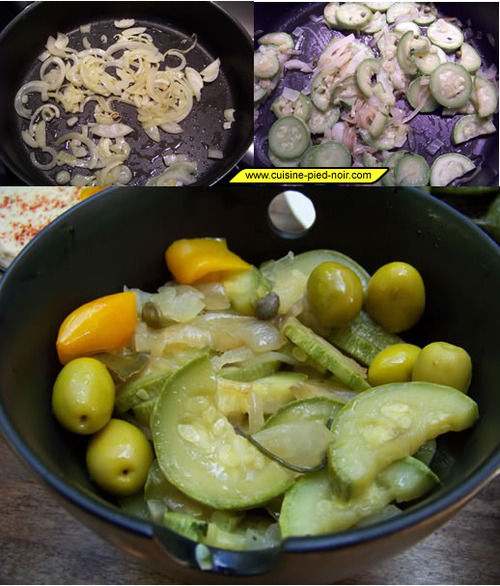
Mediterranean Food Connection: Zucchini and preserved lemon salad, a recipe by Christophe Certain

Published by Tuesday, July 9, 2013 Permalink 0


Mediterranean Food Connection: Zucchini and preserved lemon salad, a recipe by Christophe Certain

Recipe translated from the French and adapted by Jonell Galloway

This recipe is perfect for Ramadan.

Recipe

Ingredients

2 onions, chopped
4 zucchini / courgettes
1 tablespoon of capers in vinegar
1 preserved lemon (see note I posted here a month or so ago about how to make them), chopped into 3 mm / 1/8” cubes
Salt
Pepper
Olive oil or butter

Equipment

Large, deep frying pan

Instructions

  1. Heat olive oil or butter. Sautée onions.
  2. While onions are cooking, wash zucchini / courgettes. Start by cutting off ends, then cut then slice them into medium-thick slices, leaving the skin on.
  3. When onion is translucent, add zucchini / courgettes. Mix well, but gently.
  4. Let this mixture cook over low heat for about 15 minutes, until the water from zucchini / courgette has evaporated. They should remain crunchy, but if you prefer them soft, just cook them a little longer.
  5. Add capers and chopped lemon.
  6. Leave on burner for a few minutes, gently stirring, so that the zucchini / courgette will absorb the lemon flavor.
  7. This dish can be eaten warm with chicken or fish, for example, or cold, as a salad.

You can view the original recipe in French on Christophe’s website Cuisine Pied Noir.


Never miss a post
Name: 
Your email address:*
Please enter all required fields
Correct invalid entries

Switzerland: Swiss Food: Rhubarb Cream Recipe

Published by Monday, May 27, 2013 Permalink 0

by Jonell Galloway

Cherry-Rhubarb Fool

When you talk about rhubarb cream in Switzerland, you mean rhubarb cream, not pudding or custard. This naughty dessert is one of the easiest rhubarb desserts around, and is so thoroughly Swiss.

Recipe for Rhubarb Cream

Ingredients

Photo courtesy of Robin Stewart


1 lb. / 500 g rhubarb
3/4 cup / 200 g cane sugar
 2 egg yolks
 Cinnamon or lemon juice, according to which taste you prefer
3/4 cup / 0.2 l whipping cream

Directions

  1. Scrape or cut off any hard outer surface of rhubarb.
  2. Dice rhubarb and put into saucepan. Add sugar. Cover with water. Cook until tender but firm, 5 to 10 minutes.
  3. While rhubarb is cooking, beat the yolks until smooth.
  4. Run cooked rhubarb through food processor or chinois to purée.
  5. Add hot rhubarb purée to beaten egg yolks. Beat until thoroughly blended and eggs start to cool.
  6. Mix in cinnamon or lemon juice. Set aside to cool.
  7. Beat whipping cream. When it starts to form hard peaks, fold in cooled rhubarb and egg mixture.
  8. Cool in refrigerator, either in individual serving dishes or in a large bowl.
  9. Serve cool.


Never miss a post
Name: 
Your email address:*
Please enter all required fields
Correct invalid entries

What to Eat in Switzerland: A Geneva Christmas: White Wine Potatoes

Published by Friday, December 21, 2012 Permalink 0

A Geneva Christmas: White Wine Potatoes Recipe

by Jonell Galloway

From the archives

English: Jet d'Eau, Geneva

In A Geneva Christmas: Longeole sausage, I think I got your mouth watering talking about longeole, or fennel seed sausage. But did you see the potatoes in the photo? That’s THE essential side dish: potatoes cooked in broth and white wine.

I translated and adapted this recipe from A la mode de chez nous, Plaisirs de la table romande, a book on cooking in French-speaking Switzerland, by M. Vidoudez and J. Grangier.

Recipe

A Geneva Christmas-white wine potatoes-Longeole-recipe-Switzerland-the rambling epicure-jonell galloway-genevalunch-traditional dish

Longeole sausage served with
potatoes cooked in white wine and broth

Ingredients

1 kg / 2.2 lbs type 2 all-purpose potatoes
Olive oil, just enough to lightly coat potatoes
1 tablespoon spelt flour (farine d’épeautre), or otherwise whole wheat
240 ml / 1 cup chicken broth
1 onion, diced
1 laurel leaf
3 whole cloves
300 ml / 1 1/4 cup dry white wine
1 bouquet garni
Fresh parsley, chopped
Salt and pepper to taste

Instructions

Fennel-flavored Longeole sausages for Christmas, made by Jacky Bula butcher in Geneva


  1. Scrub potatoes. If you really don’t like potato peels, or your potatoes have lots of black spots on them, peel them. Just remember: all the fiber and vitamins are in the peel.
  2. Chop potatoes into large cubes. Put potatoes in a large saucepan. Coat lightly with olive oil and mix well.
  3. Sautée for 2 or 3 minutes, stirring constantly.
  4. Heat broth. Pour hot broth over potatoes. Add chopped onion, laurel, cloves, salt, pepper and bouquet garni. Bring to a boil. Cover, then lower heat and let it boil gently.
  5. Cook until potatoes are soft, about 15 or 20 minutes, depending on the kind of potato and the kind of pan.
  6. While the potatoes are cooking, mix flour and olive oil in a small utility bowl, until it becomes a smooth paste. Add a couple tablespoons of the hot broth from the potatoes to paste, and beat with wire whip until smooth.
  7. Add paste to potatoes, and beat gently with a wire whip. When smooth, add white wine.
  8. Continue cooking, stirring often so that it doesn’t stick, and gently boiling until the sauce starts to thicken.
  9. Taste. Add salt and pepper if required.
  10. Sprinkle with chopped parsley when serving. Traditionally, in Geneva this is served with longeole sausage at Christmas, but it goes well with many dishes, for example a smoked cooking sausage from the canton of Vaud.

Cooking notes:  I use a Kuhn Rikon Durotherm to maintain the vitamins and decrease cooking time. This also allows you to use less liquid, which gives a more intense flavor. In this case, you would use just enough broth to cover the potatoes.

Continue Reading…

Never miss a post
Name: 
Your email address:*
Please enter all required fields
Correct invalid entries

Switzerland: Cucumber and Tarragon Salad Recipe

Published by Monday, July 16, 2012 Permalink 0

Jonell Galloway, Editor, The Rambling EpicureSwitzerland: Cucumber and Tarragon Salad Recipe

by Jonell Galloway

Spontaneous Cuisine: A Swiss Recipe

When the days are hot and sultry, few things can be as refreshing as a cold cucumber salad, especially this classic cucumber and tarragon salad. In Switzerland, we make it with sour cream and tarragon, while in France they cook the cucumbers slightly and then add crème fraîche and chives.

This salad goes perfectly with a grilled chicken breast or any white fish. It also goes perfectly with smoked or natural salmon, in which case you might want to replace the tarragon with fresh dill or dill seeds.


Continue Reading…

Never miss a post
Name: 
Your email address:*
Please enter all required fields
Correct invalid entries

Spontaneous Cuisine: Lacquered Pork Tenderloin, Roast Potatoes, Ramp/Ramson Recipe

Published by Tuesday, April 17, 2012 Permalink 0

From the archives

Lacquered Pork Tenderloin, Roast Potatoes & Ramson Recipe

by Jonell Galloway

Ramson and wild garlic leaves, as we call them in Switzerland, are in season, so now is the perfect time to make this recipe. The season doesn’t last long, so don’t tarry. If you don’t have ramson, or Allium ursinum,  in your area, try ramps or Allium tricoccum, which will produce a similar taste.

The sweetness of the lacquer and the tart acidity of the ramps give this recipe a lovely balance of opposing flavors. The roast potatoes serve as a neutral taste that makes the contrasts less shocking.


Spontaneous Cuisine: Lacquered Pork Tenderloin, Roast potatoes & Ramps Recipe

Continue Reading…

Never miss a post
Name: 
Your email address:*
Please enter all required fields
Correct invalid entries

UA-21892701-1