What to Eat in France: Boeuf Bourguignon

Published by Saturday, November 14, 2015 Permalink 0

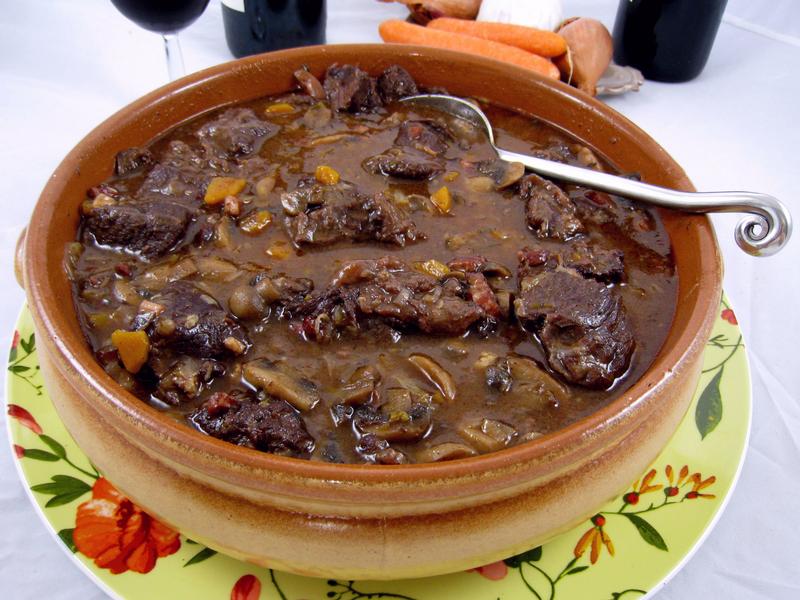
What to Eat in France: Boeuf Bourguignon, or Burgundy-style beef stew in red wine, inspired by French chef Bernard Loiseau

by Jonell Galloway

Boeuf à la bourguignonne, also referred to as beef or boeuf bourguignon, is a French classic from the Burgundy wine region of France. It is made with red Burgundy wine, and simmered for hours. It makes up part of what the French refer to as “plats cuisinés“, or slow-cooked dishes.

This recipe is quite easy to make, and should serve about 8 people. Plan to make it well in advance, since it is best when it is left to marinate for 24 hours and cook slowly several hours on the day of serving. It is the perfect dish for dinner parties or potlucks, and is one of the best leftovers around.

Boeuf Bourguignon Recipe

Click here for metric-Imperial-U.S. recipe converter

Serves 8

Preparation time: 45 min

Cooking time: 2 1/2 to 3 hrs
Marinating: 24 hrs
Never miss a post
Name: 
Your email address:*
Please enter all required fields
Correct invalid entries

What to Eat in France: Soupe de Légumes

Published by Thursday, September 24, 2015 Permalink 0

What to Eat in France: Soupe de Légumes, or French Vegetable Soup

French children hate soup because most of the soup they get looks like the one below. You’ll not find any tiny pasta alphabets swimming around in French soup. It looks like mush or worse, children say. And it does. It’s anything but the bright, primary colors that would attract a child.

soupe de légumes lyonnaise


Adults see it differently. In fall and winter, soup often replaces salad as a starter. It has a high vegetable content, therefore providing all the vegetables one needs for a day, and it always uses seasonal, mainly root, vegetables. Every region has their own version, as does every cook, and any day’s version depends on what is available at the market and in the larder.

Most French soup uses a classic potato and leek purée as a base, the same one used to make vichyssoise, no matter what the region.

In the country, there is a longstanding tradition of pouring a little red wine into the last few spoonfuls of soup, and drinking it straight from the bowl. This is referred to as “faire chabrot” (or “faire chabrol” or “fà chabroù” in other regions). All these variations come from the Latin capreolus. It means literally “to drink like a goat.” The tradition exists mainly south of the Loire. Today, it is mainly older people in the country who still practice it.

faire chabrot


This recipe is from the Lyon region, where they add a bit of cabbage to the otherwise classic base.

Recipe

Ingredients

1 leek
1 carrot
1 turnip
1 stick of celery
2 onions
2 potatoes
Chunk of cabbage
4 1/2 cups veal or chicken broth, hot
1 T. butter
Salt and pepper to taste

Slices of country bread
Parsley, chopped
Glass of red wine for each diner

Directions

  1. Chop vegetables into small cubes and place in saucepan or soup pot. (I leave on the skin for added fibre.)
  2. Cover with hot broth.
  3. Bring to a boil over medium-high heat, then cook over medium-low heat for about 1 1/2 hours.
  4. Toast bread.
  5. Purée in a food processor or with a potato masher.
  6. Add butter and mix well. Add salt and pepper to taste.
  7. Lay slices of toast in soup bowls.
  8. Pour soup over toast.
  9. Sprinkle with parsley.
  10. Serve immediately.
  11. When there are just a few spoonfuls of soup left in the bowl, add a little red wine and drink the rest of your soup straight from the bowl (if you dare).


Never miss a post
Name: 
Your email address:*
Please enter all required fields
Correct invalid entries

What to Eat in France: Pouteille

Published by Tuesday, August 18, 2015 Permalink 0

What to Eat in France: Pouteille, or Pig’s Trotter and Beef Stew from La Canourgue

by Jonell Galloway

Gargantua, épuisé après une longue marche et tenaillé par la faim, décide de s’arrêter avant d’entrer dans le village de La Canourgue. L’immense cuvette de grès située au pied du Sabot retient son attention; il s’assied sur ce curieux rocher, en attendant que les fadarelles (les fées) l’informent de la cuisson d’une étrange préparation composée de bœuf, de pieds de cochons, de pommes de terre et de vin.--Rabelais

After a long walk, dying of hunger, Gargantua decided to go into the village of La Canourgue. His attention was immediately drawn to a large earthenware dish sitting on a stand. Curious, he sat down on a rock, waiting for the fairies to tell him about how this strange preparation of beef, pig’s trotters, potatoes and wine, was prepared. It was pouteille.

Pouteille is not commonly found outside La Canourgue, a small commune located in the Languedoc-Roussillon region in the south of France.

In the old days, every family put their pouteille stew together and took it to the village communal oven in an earthenware dish referred to as a toupi. It was eaten on special occasions and on Sundays.

Pig’s trotters are commonly used in the cuisine of this region, and are an integral ingredient of this slow-cooked dish.

Continue Reading…

Never miss a post
Name: 
Your email address:*
Please enter all required fields
Correct invalid entries

The Art of Tasting Wine with James Flewellen: Using your nose: Aromas in red wines

Published by Friday, August 31, 2012 Permalink 0

by James Flewellen

Like white wines, the aromas of reds can similarly be broken up into ‘fruity’ and ‘non-fruity’ categories. Rather than a fruit ‘spectrum’, however, I tend to think of red wines in terms of red fruit and black fruit. Some of the lighter, more ethereal red wines have notes of redcurrant, cranberry, raspberry and strawberry, while in fuller-bodied wines you’ll often find luscious blackcurrant, blackberry and damson. Some wines, notably Pinot Noir can straddle the red fruit-black fruit divide, while I often find cherry and red plum notes specifically in Italian varietals.

I mentioned that with white wines, the position of the wine’s aroma profile along a ‘spectrum’ can indicate the ripeness of the fruit, and thus the climate in which the vine has grown. There is an analogue with red wines, where wine from cooler climes may smell (and taste) more of tart, fresher fruit while wine from wamer places will have notes of ripe, jammy or even baked fruit. Think of the subtle notes of fresh raspberries versus the heady aroma of a pot of homemade raspberry jam on the boil. Grapes from very hot places can have yield wines with dried fruit notes such as raisin, prune or date.

Some fruit aromas found in red wine

It’s perhaps worth mentioning here, that other than flavouring added by maturation in oak barrels, the flavours and aromas in wine come entirely from the fermentation of grapes. Grapes are not so far removed from other fruits on the evolutionary tree that it should come as no surprise that we might find some of the same chemicals in grapes as we do in apples, cherries or blackberries. Over millennia humans have domesticated the vine and carried out a series of genetic selections to bring forward different characteristics in what we now term different ‘varieties’ of the vine.

On the whole, red wines are more suited to oak ageing than whites. Thus we’ll often get the characteristic vanilla or coconut notes from wines that have seen, respectively, new French or American oak. More red wines will be aged in what is termed ‘old oak’ or ‘second use’ barrels. These are barrels that have already been used for one vintage and have thus imparted most of their bright, toast and vanilla aromas to a previous wine. Their effect on a subsequent wine is thus more subtle, and in such wines you’ll often find aromas of nuts — hazelnuts and walnuts are the two I find more commonly — and also coffee, mocha and chocolate.

Image Copyright James Flewellen. All Rights Reserved.

French oak barrels used for maturing red wine in Bordeaux.

Red wines too have a broad spectrum of non-fruit aromas. Wine writers and critics have come up with all sorts of interesting descriptors to attempt to communicate these sensations to their readers, and although they may sound rather rude, they are in fact (usually) complimentary. Some that spring to mind are farmyard, wet wool, horse manure, charcoal, ash and earth.

Spices too are a rich vein to tap for red wine aroma descriptions. Licorice, anise, Chinese five-star, pepper – both white and freshly ground black, juniper, cloves, nutmeg to name a few.

Some red wines have a herbaceous aspect to their aroma profile. Cabernet Sauvignon from a relatively cool climate famously has a note of ‘green bell pepper’. Cabernet Franc can smell grassy and leafy while Pinot Noir can bring forth hints of mushroom or autumnal leaves. Others still have floral aromas.

The most interesting wines will smell of many things; the aroma will swirl, morph and change over time in the glass; with bottle age, even more aromas come to the fore while other recede into the background. And of course different people will notice different things in the same glass of wine. Smell is a very powerful  trigger for memory — which perhaps explains some of the more poetic descriptions for wine aromas. The great thing is that there are no wrong answers — nobody else has your olfactory sense nor your memories top draw upon. What can be frustrating to begin with is not to have the right vocabulary for describing what you smell. The best way to solve this is to buy some fruit, or some flowers, or some spices and just smell them! It might seem a bit mad but surely, not to notice what your wine smells like is to miss out on at least half the fun!

__________________

James Flewellen is The Rambling Epicure wine columnist. James is a biophysicist at the University of Oxford. Originally from New Zealand, the huge range of wine James discovered in Europe spurred his interest in all things vinous. He became involved in the University’s Blind Wine Tasting Society and has recently completed a two-year term as its President. During this time he represented the University in a number of domestic and international wine tasting competitions, winning several awards. He is currently completing the WSET Diploma in Wine and Spirits. James has a passion for wine communication and education and runs the Oxford Wine Blog and the Oxford Wine Academy.

Never miss a post
Name: 
Your email address:*
Please enter all required fields
Correct invalid entries

UA-21892701-1