Daily Food Quotes: Farm Philosophy from Wendell Berry

Published by Sunday, March 24, 2013 Permalink 0

by Jonell Galloway

For 50 or 60 years, we have let ourselves believe that as long as we have money we will have food. This is a mistake. If we continue our offenses against the land and the labor by which we are fed, the food supply will decline, and we will have a problem far more complex than the failure of our paper economy. The government will bring forth no food by providing hundreds of billions of dollars to the agribusiness corporations.

Wendell Berry, “in the op-ed piece he published with his old friend and collaborator Wes Jackson, shortly after the economy crashed in the fall of 2008.” (Michael Pollan, in introduction to Wendell Berry’s Bringing it to the Table: On Farming and Food).


Wendell Berry speaking in Frankfort, Indiana

Wendell Berry speaking in Frankfort, Indiana

Never miss a post
Name:

Your email address:*

Please enter all required fields
Correct invalid entries

Related articles

Never miss a post
Name: 
Your email address:*
Please enter all required fields
Correct invalid entries

Best Fondue Restaurants in French Savoie as per Michelin Restaurant Guide

Published by Tuesday, March 19, 2013 Permalink 0


 Best Fondue Restaurants in French Savoie as per Michelin Restaurant Guide

by Jonell Galloway

For reference: here is a list of the Michelin guide’s favorite fondue restaurants in the Geneva/French Savoie area.

A magnificent collection

A magnificent collection of the Michelin “red guides”


Never miss a post
Name: 
Your email address:*
Please enter all required fields
Correct invalid entries

What to Eat in Switzerland: A Geneva Christmas: Cardoon Gratin Recipe

Published by Wednesday, December 19, 2012 Permalink 0

by Jonell Galloway

From the archives


Cardoon gratin is a classic Geneva Christmas dish, but only brave souls should try to prepare them because they are prickly, and the preparation can be long and tedious. Many farmers markets in Switzerland now sell them prepared sous vide, in plastic vacuum-packed packages, which is probably the best option for those who don’t get a thrill out of getting a few pricks. In any case, it is important to schedule it carefully into your meal preparations, because it is time-consuming any way you go about it.

Cardoon Gratin Recipe

Preparation of Cardoons for Gratin

  1. Throw out any hard stems and any that are wilted.
  2. Peel the cardoons by removing leaves, spines and stringy parts. The exterior will then be covered with a fuzzy layer. Use a cloth to rub stalks gently to remove fuzz.
  3. Cut stems into 8 cm (3 cm) slices. Rub with lemon, or if you intend to use them later, put slices into lemon water so they won’t turn dark.
  4. You now have two choices: you can either cook them in a white vegetable broth you’ve made ahead of time, or you can cook them in the lemon water you soaked them in.
  5. Bring to a boil and boil until tender. It should take about 30 minutes for them to become tender, but if they are larger in diameter it can take up to 2 hours, so allow plenty of time.

Recipe


All these steps can be carried out while the cardoons are cooking. There are actually several ways of doing this. You can either make a Béchamel (white) sauce and sprinkle cheese on the cardoons before you put them in the oven, or you can make a Mornay (cheese) sauce and pour it on the cooked cardoons before putting in the oven to brown. I think it’s tastier to make a Mornay sauce, and then sprinkle a bit of cheese on the top before putting it in the oven. Here’s my recipe.

Ingredients

Click here for British/American/metric recipe converter

Approximately 1 kg of cardoons
30 g of butter
1 tablespoon of flour
2.5 dl of whole milk
1 dl of cream
50 g of cheese, type Gruyère or Swiss (see photo below), grated
Lemon juice, freshly squeezed
Salt and pepper to taste
 

Emmentaler (also known as Swiss Cheese), while...


DIRECTIONS

  1. Make a Béchamel sauce, using the proportions of ingredients above.
  2. When finished and seasoned, add cream and cheese, setting aside a tablespoon of cheese. Set aside.
  3. Preheat oven to 250° C.
  4. Once cardoons are tender, drain, making sure all water is drained off.
  5. In a large bowl, mix cooked cardoons and Mornay sauce.
  6. Pour into a baking dish of the appropriate size, so that there is a layer of about 3 cm high.
  7. Sprinkle evenly with remaining grated cheese and a few knobs of butter.
  8. Put in hot oven for 15 to 20 minutes, or until golden brown.

Notes: It is important to use a hard, Swiss-type cheese. Cheddar cheese would have too strong of a taste. If you can’t find cardoons, the same recipe can be made with Swiss chard, thus eliminating the long, meticulous preparation. Simply cut them as for the cardoons and cook in chicken broth until tender, then follow the other steps in the recipe for making the gratin. Its texture is quite similar to that of cardoons.

Related articles


Never miss a post
Name: 
Your email address:*
Please enter all required fields
Correct invalid entries

My Favorite Hanukkah Foods: Grandma’s Latke Recipe

Published by Saturday, December 8, 2012 Permalink 0

by Warren Bobrow

From the archives

Hanukkah recipes are passed down from generation to generation. There are hundreds of recipes floating around on the Internet, but I thought it best to consult a friend with trained taste buds. Here is what Warren Bobrow has to say.–Jonell Galloway, Editor

My Favorite Hanukkah Foods

Of all the holiday foods I look forward to, there are two dishes that clearly connect my stomach to the past. The first is a rousing bowl of matzo ball soup. The other, specifically a Hanukkah dish, is a plate of crispy potato latkes, cooked in a heavy cast iron pan.

Ur-Bubby’s Latkes

I forewarn you. This is a Jewish story, so it is repetitive and sometimes fahklumpt (a confused story, for those who are not in the know), told by a kvetch (a complainer) who secretly loves life and food and words and work, and tells a story full of fond memories.

My great-grandmother Yetta made excellent latkes. During these eight days of Hanukkah (eight chances to get it right . . . to be exact), we celebrate the past by reliving these flavors and the stories that go with them each time we bite into a steaming morsel of grated potato, egg, onion and a bit of vegetable oil, made straight from her recipe.

Generations of cooks have grated potatoes for latkes in celebration of Hanukkah. You will not be the first or the last. And every family has their own special recipe, their own special stories.

Bubby Yetta was particularly interested in not scraping her knuckles. Even so, she used to say that if you don’t catch your knuckle on the potato grater, the latkes couldn’t possibly taste good. Something about the physical act of grating potatoes already connects me to the old days when Bubby made the latkes every evening during Hanukkah.

Onions also resonate in my memory:  the tears that ran down her cheeks as she grated the onions were not tears of joy. We heard the same kvetching every year, and carry on as we make our own history.

Every day of Hanukkah, Ur-Bubby Yetta would scrape and grate until the job was done. Much hushed conversation would follow. Were the latkes going to be good?  If not, what would we do, there was no place in those days to buy frozen latkes in the supermarket!

And with each potato and onion grated, each tear fallen, each latke fried, another memory was made. Years of latke conversation would follow . . . How about the ones we made twenty years ago? Did potatoes taste differently then, or was it a specific taste that stuck in our memories?

So careful with the grater, and accept that you’ll invariably catch your knuckle at least once, and that you may well have the battle scars to prove that you made them from scratch. And stories to tell.

Recipe

Continue Reading…

Never miss a post
Name: 
Your email address:*
Please enter all required fields
Correct invalid entries

What we’re reading: Persian chicken stew, Yam’Tcha Chinese fusion in Paris, anti-inflammatory recipes, Slow Down Diet

Published by Tuesday, November 27, 2012 Permalink 0

by Jonell Galloway

Click here to keep up with the latest in world food and wine news.


Never miss a post
Name: 
Your email address:*
Please enter all required fields
Correct invalid entries

Salone del Gusto versus Good, Clean, and Fair: Part 2

Published by Monday, November 26, 2012 Permalink 0

by Diana Zahuranec

In Salone del Gusto versus Good, Clean, and Fair: Part 1, I’ve already mentioned some healthy skepticism about the presence of two big Italian names at Salone del Gusto: Lavazza Italian coffee, and the supermarket Coop.

Lavazza takes on the responsibility of Fair Trade coffee, but wearing a label doesn’t necessarily prove honest actions behind it. There are loopholes to be jumped in any policy. Without venturing beyond the comfort of online research to the plantations in South America, however, I couldn’t say with utter certainty how good, clean, and fair they are. My main conclusions? Don’t check off the Good Deed Done for the Day box just by buying Fair Trade, without knowing all the facts behind it.

It just doesn’t look Slow Food-y

As for Coop, I was very surprised to see this popular Italian supermarket in a haven of small-time producers at the Salone. Coop is no WalMart nor, on this side of the Atlantic, EuroSpin; shopping in my local Coop store, I’ve noticed very high quality, Alpine mountain cheeses, for example, alongside the added-preservatives-colors-skim-milk-binder, generic salumi; and I suppose I notice more organic produce overall. As far as the realm of supermarkets is concerned, my limited observations earn Coop a dull gold star. But a place at Salone del Gusto? Hardly, I thought.

Asking fellow Slow Food members what they thought, a Swiss friend informed me that it was in large part thanks to Coop, a charter member of Slow Food, that Slow Food Switzerland was initiated and is running strong today. Polish that gold star!

In fact, Slow Food and Coop have a partnership, with Coop supporting and promoting Slow Food values through selling local products as well as over 100 Presidia products (a Presidia labeled food being the equivalent of a protected or endangered animal in the food world).

Coop’s powerful, positive presence in the world of local producers and Presidia was brought home when I sat in for a tasting of some products during Salone del Gusto. Not that I wanted to taste anything. By the end of one of Salone’s last days, I had done as much tasting as my belly and buds could bear. But my legs were tired, and Coop had set up a booth lined with dangling Prosciutto legs, plastic chairs in rows, and a tasting of jam and juice. I didn’t resist.

The tasting was introduced by a Coop Quality Control employee and a representative of a Bosnian company based in Bratunac called Frutti di Pace, or “Peace Fruits.” Together, they told a story of how the Coop employee traveled to Bosnia for this product, met with the Bosnian woman, and formed an instant friendship that was strengthened, as in all cultures, over an abundant welcoming meal.

The employee found that the hardworking spirit and community of the women of Frutti di Pace were as charming as the incredible, all-natural flavors of their products were delicious.

Frutti di Pace was established after the Bosnia and Herzegovina War in 1992-1995. The members of this cooperative, mostly widowed women or women with husbands injured from the war, wanted to spur growth: of the local economy, of a long-held tradition ground to a halt from the war (raspberry production), and of a sense of community and confidence.

The first product we tasted was a thick raspberry juice. No colors, sugars, or conservatives were added – just water and red raspberry. It was exactly like plucking a handful of raspberries from a bush, squishing them all into your mouth, and squeezing out the juices with your tongue. The jams were next, and equally impressive in their bright, strong raspberry flavors. It lacked seeds, but that’s a personal preference of mine for raspberry jams.

Frutti di Pace spent ten years trying to get into the European market. The speaker was overwhelmed almost to tears when she recalled how happy they had been when Coop began selling their products. “’To hope’ is still difficult after everything we’ve been through,” she said.

My knee-jerk reaction to “supermarket” is “too much fluorescent light!” and then, “against all things Slow Food.” But this is not true (well, the second one). Today’s food market is pulled in two directions: one towards a global system made of imports, exports, and oil, the other towards local, small production, trends, and being organic. It’s important to consider the possibility that, between these two polar opposites, not everything is black and white. The grey areas will be necessary to marry two things that won’t go away for better or for worse: supermarkets in many parts of the world, and the importance of strong, local economies and good, clean, and fair food in all parts of the world.

Selling local food (or organic, or from a small producer, etc.) through a medium that everyone uses and will continue to use as long as it exists is ethically responsible and also quite genius.

The question remains: Does Coop Italia earn the good, clean, and fair award? It is still a supermarket that sells items ranging from low to high quality, from all parts of the world, and at prices too low to actually be profitable for the producer. But the answer is nevertheless yes – just, in a rather grey way.

Never miss a post
Name: 
Your email address:*
Please enter all required fields
Correct invalid entries

In Europe, sometimes it has to be sweet potato pie instead of pumpkin for Thanksgiving

Published by Wednesday, November 21, 2012 Permalink 0

Tom and Maggie’s Thanksgiving Sweet Potato Pie

We’ve been making Thanksgiving dinner together for oh so many years — ever since we were in college in Paris. Since the pumpkin in France is always too watery, no matter what method of cooking we used and what type of pumpkin, we had difficulty getting it to set, so we decided to use sweet potatoes, which give a much more predictable and reliable result, which is absolutely necessary when preparing a Thanksgiving feast for a crowd of 20 or 30 convives. In addition, we’ve grown to like it better (perhaps because we know it will always set, unlike pumpkin?).

Continue Reading…

Never miss a post
Name: 
Your email address:*
Please enter all required fields
Correct invalid entries

Thanksgiving Turkey News: Tips on Choosing, Buying and Cooking

Published by Tuesday, November 20, 2012 Permalink 0

by Jonell Galloway

How to Choose, Buy and Bake a Turkey in the U.S. and Europe

The USDA gives useful facts about about turkey hygiene and cooking, all based on the assumption that you’re cooking frozen turkey. If you live in the U.S., you’ll most likely be cooking a frozen turkey, so this information is spot-on.

Julia Child’s The Way to Cook still rates top on my list for detailed, illustrated explanations of how to prepare and cook a turkey and lots of other tips.

If you live in Western Europe, there are plenty of free-range, grain-fed turkeys. I order mine months ahead from a farmer near me, since in Europe they only eat turkey at Christmas and they won’t be fattened otherwise.

In Paris, in the 7th and 16th arrondissements in particular, many butchers have fattened turkeys for Thanksgiving, and they are often free range and natural. One of the most prized origins in France is dinde de Bresse, which of course comes from Bresse and is free range. In Geneva, you can buy these, stuffed or unstuffed, at La Boucherie Molard across from the Globus during the Thanksgiving period.

If you live in other cities in Western Europe, you may not have a lot of choice. I’ve had a number of bad experiences ordering turkeys through the butchers in the provinces. They are never sure whether they’ll actually receive a fattened turkey or a scrawny thing which was intended to be fat for Christmas. If you live in the country, however, try and find a turkey farmer near you. They will invariably be cheaper and often better.

Free-range, organic turkeys will never weigh as much as the supermarket variety, but the ratio of meat to bone is greater. It’s amazing how much meat there is on a 9 or 10 lb. turkey.

I have never tasted Mary’s Turkey in California, but they sound appetizing. Mary certainly takes her poultry seriously. They are free-range, vegetarian-fed, gluten-free, and free of all antibiotics, preservatives and hormones. They are also USDA-certified organic. You can order them online, or find a store near you that sells them.

Click here to watch an entertaining but helpful video about the dangers of frying turkeys.

Chowhound has a great discussion board about whether free-range, heritage turkeys are worth the price. I would always vote for free-range and natural. They have more meat and less bone, probably due to the fact that they’ve not been gorged with antibiotics, steroids and we probably don’t want to know what else. In addition, they don’t taste like meal.

The wild turkey population is growing in much of the U.S., so I’m sure many are tempted to shoot a big one for Thanksgiving. That’s all fine, but keep in mind: cooking a wild turkey is an entirely different bag of worms. If they are large, they risk tasting gamy. Here is some good common-sense advice for preparing and cooking them.

Truth About Turkey” gives an excellent layman’s explanation about how the various kinds of turkey in the U.S. are raised.

Have a Slow Food Thanksgiving” gives a list and directories of where to buy heritage, organic and free-range turkeys in the U.S.

Whenever possible, buy directly from a local farmer. When buying fresh turkey, always ask about the “use by” date. It will depend on packaging as well as when the turkey has been slaughtered. If bought fresh and unpackaged, The New York Times and Seattle Times suggest you can keep it one or two days maximum in the refrigerator, so plan your pick-up time carefully.


Related articles
Never miss a post
Name: 
Your email address:*
Please enter all required fields
Correct invalid entries

A Look at Slow Food’s Salone del Gusto, October 2012, in Turin, Italy

Published by Saturday, November 3, 2012 Permalink 0

by Diana Zahuranec

Salone del Gusto ended on Monday 29, but I can’t stop thinking about it.

Salone del Gusto, held in Turin, Italy, is a Slow Food biannual food fair and conference. To sum it up in these few words undermines everything else it is, too, and its importance as an event that brings together producers from all over the world. These are producers that grow ancient varieties of grain to save genetic biodiversity, that make Slow Food Presidia cheeses or salumi, that pipe their cannoli full of the freshest organic ricotta you’ve ever tasted, and whose principles and values align with your own and, it goes without saying, Slow Food’s – good, clean, and fair food for all.

The Slow Food mascot

For all things Slow Food, here are some links courtesy of Scoop.it and Slow Food. To understand a few of those words in the paragraph above, just look at the end of the article.

This year, Salone del Gusto was a marriage of the original Salone del Gusto, first held in 2006, and Terra Madre, first held in 2004. While both events had food artisans and producers from all over the world, different activities were held at each and were not all accessible to the public. Salone del Gusto focused more on the exposition and sale of high quality foods and products, while Terra Madre was a gathering of a network of food producers from around the world. Having never been to either of these before, I can’t offer judgment on the differences of before and after. What I would love to do is share my first-time impressions of this year’s.

To say Salone is a food fair means that, like your down-home county fair, the place is jumping with activity – with a few notable differences. The funnel cakes are replaced with French butter cookies in 20 different flavors, the groundhog whacking game is replaced with the foodie’s (divisive word, I know) form of fun, that is vertical Barolo wine tastings, and that feeling of riding the Zipper right after you eat your funnel cake is replaced by the feeling of pressing up against crowds right after you drink your Barolo wines.

Continue Reading…

Never miss a post
Name: 
Your email address:*
Please enter all required fields
Correct invalid entries

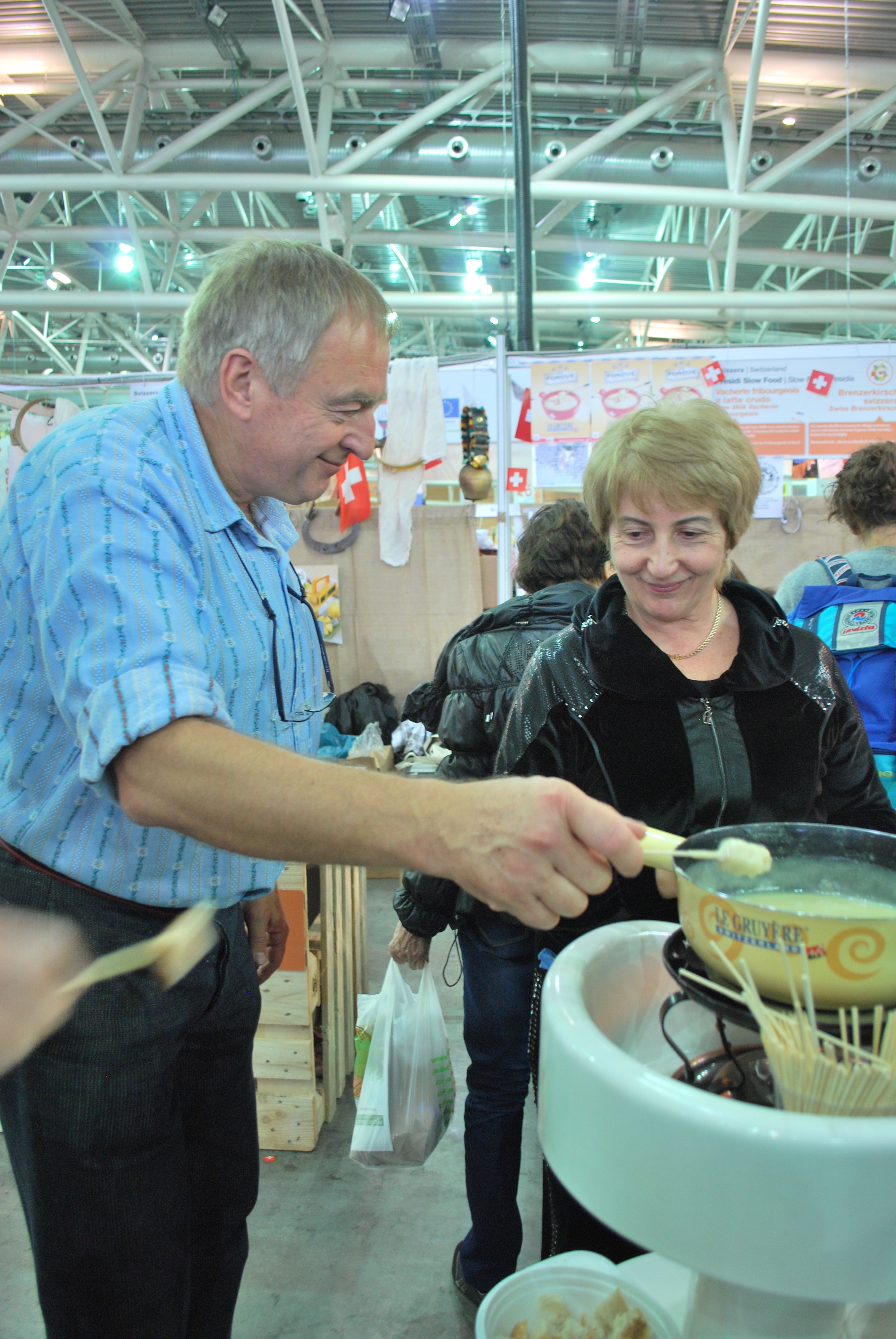
Switzerland: Raphael of Fribourg making Fribourg-style Swiss fondue using cheese he makes

Published by Friday, November 2, 2012 Permalink 0

Fribourg-style Swiss fondue is referred to as moitié-moitié. Unlike fondues from other regions, it is made with a hard, cooked cheese native to Fribourg, known as Vacherin Fribourgeois (not to be confused with Vacherin or Mont d’Or). The recipe calls for half Vacherin Fribourgeois and half Swiss Gruyère.

In this photo, Raphael is making fondue using the handmade cheeses he makes himself, at the Slow Food Switzerland stand at the Salone del Gusto in Turin, Italy last week. The visitors ran to his stand every time he put a new pot of fondue out. Obviously, it was very good!


Never miss a post
Name: 
Your email address:*
Please enter all required fields
Correct invalid entries

UA-21892701-1