A Brief History of Confit and Food Preservation in France
Uneingénuitéconfitedevieillefille. / The preserved naivité of a spinster.–Colette, LaNaissancedu Jour / Break of Day
I like my man to be a bit confit.Confit is my favorite French word. It can mean many things, but the meaning always implies intensity to the point of being almost sweet, and sometimes sickly sweet.
The word comes from the Latin, conficiere, meaning “to do” or “to make,” and is the root of other familiar words like confiture and confection,” says Kate McDonough. “It can equally describe flavoring and preserving foods in other substances, as fruit in sugar, olives in oil, pickles in vinegar, or capers in salt.”
In the food world, there are two main meanings, although the term basically means “preserved;” there are, of course, many ways of preserving food. The first refers to something candied or crystallized, such as the fruits confits so popular in France, especially at Christmas and during other holiday periods. The second refers to a savory food either cooked in its own juices or preserved.
The French confit we know best is canard confit, or duck confit, which is traditionally cooked in a copper pot over a fire for up to 24 hours so that its fat oozes out and envelops it. It is then stored in its own fat and conserved in a jar for up to a year.
Pickles and salted capers also count as confits. Another common one is tomates confites, or confit tomatoes, which are slow-cooked like duck in a low-temperature oven until they become almost sweet like candy. Intense, yes.
Sauces were once the domain of French haute cuisine, aristocratic food. This started changing after the Revolution, first in the bourgeoisie, who copied the ways of the former royalty, and eventually in restaurants.
In France, there have always been sauces. Even the Franks and the Gauls moistened their food with a “flavored liquid.”
French cuisine, influenced by Roman cuisine, saw the first sauce recipes using meat jus in the fifth and sixth centuries, and were then called saulce. To the jus was added vinegar, wine, acidic fruits and spices. The Romans had already used ginger and cloves, but in the eleventh century, the Crusaders brought back others from the Levant, including cinnamon, the most commonly used, galangal (or ginger), coriander seeds, cumin, nutmeg, cardamom, saffron, grains of paradise and pepper. The acidic quality was often given to sauces through the addition of verjus, made from green grapes, which are not yet sweet in flavor and remain acidic, or with other acidic fruit such as apple, lemon or plums. Verjus is still used in French sauces.
Guillaume Tirel, known as Taillevent (after whom a Paris palace of gastronomy is named), wrote the first known cookbook, Le Viandier, around 1375. Stews and other slow-cooked dishes didn’t yet exist; most meat was boiled or cooked over a spit, i.e. quite plain, so sauces were a way to liven them up. About thirty sauces have been recorded during the medieval period. They of course featured in the cuisine of the well-to-do; most common people were still eating gruel, as they always had.
During the Renaissance, spices dropped out of French cuisine. It was the halcyon days for sauces, which proliferated. Slow-cooked sauces were invented using fonds, mirepoix, butter and flour for thickening. Simple jus and coulis became common. Recipes for green sauces from Italy using new ingredients and herbs were also popular and easy to make since herbs were plentiful and grew wild in even the coldest parts of France.
It was La Varenne in the seveneenth century who started precisely defining sauces and how they’re made and documented roux, which then consisted of a paste of flour and lard for thickening:
Thickening of flowre
Melt some lard, take out the mammocks; put your flowre into your melted lard, seeth it well, but have a care it stick not to the pan, mix some onion with it proportionably. When it is enough, put all with good broth, mushrums and a drop of vinegar. Then after it hath boiled with its seasoning, pass all through the strainer and put it in a pot. When you will use it, you shall set it upon warm embers for to thicken or allay your sauces.—The French Cook, Francois Pierre La Varenne
To the “low-fat” sauces of the Middle Ages were added bread, eggs and cream, making them much heavier, and herbs replaced spices from the Orient. Roux was the thickener of choice. Beurre blanc and hollandaise sauce accompanied pike, a popular dish.
In the eighteenth century, Carême perfected the art of sauce making and was the first to classify the mother sauces: béchamel, espagnole, velouté, and allemande. Auguste Escoffier later refined this list to the contemporary five mother sauces by dropping allemande as a daughter sauce of velouté, adding hollandaise and sauce tomate, in his classic Le Guide Culinaire, published in 1903.
Today, French people of all social and economic classes eat sauce. It is not restricted to the wealthy or the aristocrats. Just about anyone can whip up mayonnaise without a recipe.
—————————-
Jonell Galloway grew up on Wendell Berry and food straight from a backyard Kentucky garden. She is a freelance writer. She attended Le Cordon Bleu and La Varenne cooking schools in Paris and the Académie du Vin, worked for the GaultMillau restaurant guide and CityGuides in France and Paris and for Gannett Company in the U.S., and collaborated on Le tour du monde en 80 pains / Around the World with 80 Breads with Jean-Philippe de Tonnac in France; André Raboud, Sculptures 2002-2009 in Switzerland; Ma Cuisine Méditerranéenne with Christophe Certain in France, At the Table: Food and Family around the World with Ken Albala, and a biography of French chef Pierre Gagnaire. She ran a cooking school in France, and owned a farm-to-table restaurant, The Three Sisters’ Café, with her two sisters in the U.S. She organizes the Taste Unlocked bespoke food and wine tasting awareness workshops with James Flewellen, is an active member of Slow Food, and runs the food writing website The Rambling Epicure. Her work has been published in numerous international publications and she has been interviewed on international public radio in France, Switzerland, and the U.S. She has just signed on at In Search of Taste, a British print publication, and is now working on two books, The French and What They Eat and What to Eat in Venice.
Comté cheese is a jewel born of Franco-Swiss history. By today’s boundaries, it is in the Jura Mountains in France, so it is technically considered a French cheese, although it’s made in a manner similar to that of the hard “cooked” Swiss cheeses we know as “holey Swiss cheese.”
Cara De Silva waxed poetic about Comté several years ago in Saveur magazine. I can’t describe it any better:
…that semifirm Comté is born of the distinctive milk of the region’s Montbeliarde cows, whose diet includes wild orchids, daisies, dandelions, and more than 400 other plant varieties; that it’s produced in the fruitières, or cooperative dairies, that have dotted the landscape of the Franche-Comté region for centuries; that the Montbeliardes’ milk is partly skimmed and heated gently in copper-lined vats before being combined with rennet; that the resulting curds are broken into fine grains, put into molds for pressing, and set on spruce boards for a few weeks of aging before being entrusted to an affineur, who oversees the further maturing of the cheese.
The Ancient Romans were already enjoying cheeses from this Franche-Comté region, and the cheese production in the villages of Deservillers and Levier were mentioned as early as 1264-1280. In 1380, there was mention of a cheese of such a large size that it could only be produced by a cooperative. After 1678, when Franche-Comté became part of France, there was an exodus of native Helvetics. It was then that other Swiss from the Gruyère region moved to the region, bringing the method of making Gruyère cheese — the cheese we often call “Swiss cheese” — with them. It is for this reason that the original name was Gruyère de Comté, now the AOC “Comté.”
“I tell you it will be more tolerable for the Fejee that salted down a lean missionary in his cellar against a coming famine; it will be more tolerable for that provident Fejee, I say, in the day of judgment, than for thee, civilized and enlightened gourmand, who nailest geese to the ground and feastest on their bloated livers in thy pate-de-foie-gras.”–Herman Melville, Moby Dick (1851)
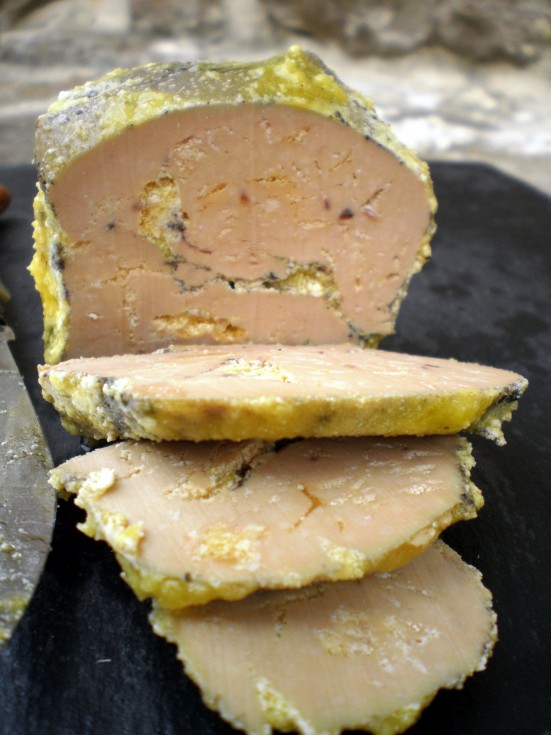
In What to Eat in France: Foie Gras, we talked about how foie gras is made and the different legal classifications, which determine both the quality and price. Let’s move on to the fun part now. We’ve bought our high-quality foie gras and we want to eat it in the best way possible. Here are some ideas, both traditional and inventive.
Cooked Foie Gras
So you’ve bought a foie gras entier, a foie gras, or a bloc de foie gras. You’ll be eating pure or fairly pure foie gras, but how do you eat it and with what?
There is no one way to eat it. The Romans soaked it in honey and milk to fatten it still more before cooking. The first recipe on record comes from Apicius in his fourth century De re culinaria: Thinly slice the foie gras with a reed. Soak in garum. Crush some pepper, lovage and two bay leaves. Wrap in a caul. Grill and serve.
Today we eat it differently. Cold foie gras is most often eaten with something acidic to help digest the fat. This traditionally includes cold, sweet garnishes such as apple, rhubarb, fresh or dried figs, grapes, or pears, and toast, but contemporary chefs venture outside these limits, serving it with dried fruit and nuts and toasted brioche or raisin-fruit bread. More contemporary garnitures are onion jam or caramelized onions, Balsamic vinegar, port or Sauternes jelly, chutney, cassis berries, raspberries, blueberries or coarse sea salt.
Some people simply eat it with green salad, although I find that salad dressing deadens the natural depth of flavor. It’s also possible to eat it with cornichons and pickled onions. like one does with regular pâté, but once again, the vinegar is likely to overpower the delicate flavor.
Cooked foie gras should never be reheated. It should be eaten just colder than room temperature, so take it out of the refrigerator about 45 minutes before serving. Slice it with a knife while it is still cold. It is usually served with cold garnishes, most often as a starter.
Swiss chard, along with kale, mustard greens and collard greens, is one of several leafy green vegetables often referred to as “greens”. It is a tall leafy green vegetable with a thick, crunchy stalk that comes in white, red or yellow with wide fan-like green leaves.
The Swiss variety tends to have whitish stems not dissimilar to green celery but wider and somewhat fan-shaped, while the varieties found in North America can be red, purpose or yellow. Some say chard is second only to spinach in terms of nutrients, and it is certainly full of fiber and phytonutrients.
When choosing chard, make sure the leaves are not wilted and the stems look fresh and crisp. If it looks limp in any way, pass it up.
It is one of the few vegetables that probably shouldn’t be eaten raw, due to its high acid content.
Although it is referred to as “Swiss” chard, it isn’t actually native to Switzerland. It is a Mediterranean vegetable. Already in the fourth century B.C., Aristotle wrote about “chard”, the common name used in the Mediterranean region. It probably got its name from a vegetable that it resembles, the cardoon. It is thought that the French confused the two and ended up calling them both “charde”.
In modern times, the French call Swiss chard blettes, the Swiss call them côtes de bettes, and, funnily enough, the English-speaking world has kept the name closest to the original used in ancient times: chard.
Its actual homeland lies farther south, in the Mediterranean region; in fact, the Greek philosopher Aristotle wrote about chard in the fourth century B.C. This is not surprising given the fact that the ancient Greeks, and later the Romans, honored chard for its medicinal properties. Chard got its common name from another Mediterranean vegetable, cardoon, a celery-like plant with thick stalks that resemble those of chard. The French got the two confused and called them both “carde.”
Swiss chard is in season for a good deal of the year in Switzerland, but this recipe takes advantage of summer to use some of those divine tomatoes that embellish the farmers markets.
In winter, it can be mixed with potatoes to make a lovely purée or soup.