A Brief History of Confit

Published by Wednesday, February 10, 2016 Permalink 0

by Jonell Galloway

A Brief History of Confit and Food Preservation in France

Une ingénuité confite de vieille fille. / The preserved naivité of a spinster.–Colette, La Naissance du Jour / Break of Day

I like my man to be a bit confit. Confit is my favorite French word. It can mean many things, but the meaning always implies intensity to the point of being almost sweet, and sometimes sickly sweet.

The word comes from the Latin, conficiere, meaning “to do” or “to make,” and is the root of other familiar words like confiture and confection,” says Kate McDonough. “It can equally describe flavoring and preserving foods in other substances, as fruit in sugar, olives in oil, pickles in vinegar, or capers in salt.”

Confit de canard - duck confit from Gascony, France

In the food world, there are two main meanings, although the term basically means “preserved;” there are, of course, many ways of preserving food. The first refers to something candied or crystallized, such as the fruits confits so popular in France, especially at Christmas and during other holiday periods. The second refers to a savory food either cooked in its own juices or preserved.

The French confit we know best is canard confit, or duck confit, which is traditionally cooked in a copper pot over a fire for up to 24 hours so that its fat oozes out and envelops it. It is then stored in its own fat and conserved in a jar for up to a year.

Pickles and salted capers also count as confits. Another common one is tomates confites, or confit tomatoes, which are slow-cooked like duck in a low-temperature oven until they become almost sweet like candy. Intense, yes.

Continue Reading…

Never miss a post
Name: 
Your email address:*
Please enter all required fields
Correct invalid entries

How to Become a Chef in France

Published by Saturday, January 9, 2016 Permalink 3

How to Become a Chef in France

by Jonell Galloway

Schooling Required

Becoming a chef in France requires a long commitment, both in terms of schooling and on-the-job training. The program is similar to that of a vocational school, but requires many years of on-the-job experience before one can be called “chef.”

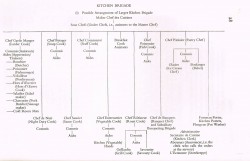
A typical French kitchen brigade looks like the diagram below. To become a chef, you basically have to work your way up from the bottom. Each level in the hierarchy may take a few years to master. It all looks rather daunting, but the French start young, around the age of 14, with chefs following what is referred to as a vocational track rather than a general high school.

Typical kitchen brigade in France

After Troisième or 8th/9th Grade

Continue Reading…

Never miss a post
Name: 
Your email address:*
Please enter all required fields
Correct invalid entries

Still Life with Flowers and Fruit, by Pierre Auguste Renoir

Published by Monday, January 4, 2016 Permalink 0

Quintessential France: Still Life with Flowers and Fruit, by Pierre Auguste Renoir.

Never miss a post
Name: 
Your email address:*
Please enter all required fields
Correct invalid entries

The only time to eat diet food is while you’re waiting for the steak to cook.

Never miss a post
Name: 
Your email address:*
Please enter all required fields
Correct invalid entries
— Julia Child

New Year’s Eve Dinner in France

Published by Saturday, December 26, 2015 Permalink 0

New Year’s Eve Dinner n France: Le Réveillon de St-Sylvestre

by Jonell Galloway

The New Year’s Eve celebration, referred to as Saint Sylvestre in France, is of pagan origin. The celebration existed long before St. Sylvester himself and long before there was even a pope. Ancient beliefs and celebrations, both religious and pagan, are mixed with those of winter solstice.

In Ancient Rome, the New Year was celebrated after Saturnalia, which was around December 25th, and was a time for “feasting, goodwill, generosity to the poor, the exchange of gifts and the decoration of trees.” People exchanged coins and medallions in celebration of the New Year. This tradition has slipped into oblivion, although adults sometimes still give children coins on this day, but other parts of Saturnalia continue today.

Saturnalia, an ancient Roman feast, St. Sylvester's, New Year's Eve


Up until the time of Julius Caesar, this end-of-year celebration didn’t have to fall on a fixed date; it was simply about ten days after Saturnalia. It was Caesar who set the date of December 31, and later, in France, Charles IX set the first day of the year as January 1.

St. Sylvester was Pope from 314 to 335, at the time the Church was emerging from the catacombs. Although Emperor Constantine controlled most of what went on in the Empire, Sylvester persuaded him to convert to Christianity and close the pagan temples. The great basilicas were also built under his influence.

Continue Reading…

Never miss a post
Name: 
Your email address:*
Please enter all required fields
Correct invalid entries

What to Eat in France: Turkey Stuffed with Chestnuts

Published by Friday, December 18, 2015 Permalink 0

What to Eat in France: Dinde Farcie aux Marrons, Turkey Stuffed with Chestnuts

by Jonell Galloway

Etre le dindon de la farce. / To fall victim to dupery.

Une dinde. / A stupid, pretentious woman.

Anthelme Brillat-Savarin, perhaps France’s best-known gastronomic writer, said that the turkey was certainly one of the most beautiful gifts the New World had given to the Old. “…the fattest, and if not the most delicate, at least, the tastiest of all domesticated birds.” It’s not often that the New World gets such compliments from discerning French epicures.

Turkeys were originally called poules d’Inde, “Indian hens,” in France, because they were thought to have come from India, which they later learned was Mexico. The French were not the only ones to get the name wrong. In Hebrew a turkey is a tarnagol hodu, meaning literally  “Indian chicken;”  in Russian indiuk, Polish indyk and Yiddish indik.

There is some controversy over who brought turkeys to Europe. Columbus probably brought  brought them back in the early sixteenth century, since records show that King Ferdinand had ordered that every ship to bring back ten turkeys before the Spanish explorer Cortés set out in 1519. In any case, by 1548, they were the rage in France. In 1549, Catherine de Medicis served 70 “Indian hens” and 7 “Indian roosters” at a banquet held in honor of the Bishop of Paris.

French aristocrats were accustomed to eating all sorts of feathered creatures, including chewy storks, herons, peacocks, swans, cranes and cormorants, so it wasn’t surprising that they fell in love with the less-chewy turkeys, and that in 1570, Charles IX and Elizabeth of Austria thought turkey noble enough to serve at their wedding feast.

By the seventeenth century, the French were raising turkeys as if they were their own and most cookbooks included turkey recipes. French chefs weren’t lacking in ideas: they made stews and ragouts; they larded, roasted and glazed it; they stuffed it and made it into soups and pâtés.

Marie-Antonin Carême preferred the wings, which he deboned, then stuffed with chicken and truffles. Alexander Dumas, in his Dictionary of Cuisine, included 27 recipes. Turkeys were well established in the Hexagon.

Christmas dinners usually meant lots of mouths to feed, so turkey, being the largest of the winged creatures available, eventually became the dish of choice for Christmas feasts. By the nineteenth century, it became customary to stuff the Christmas turkey with chestnuts, and the tradition continues today.

Continue Reading…

Never miss a post
Name: 
Your email address:*
Please enter all required fields
Correct invalid entries

What to Eat in France: Souper de Noël

Published by Tuesday, December 15, 2015 Permalink 0

What to Eat in France: Le Gros Souper de Noël, the Great Christmas Supper in Provence

by Jonell Galloway

In France, the main Christmas meal is eaten on Christmas Eve. Every region in France approaches Christmas Eve meals differently, but that of Provence, known as Le Gros Souper in French and the Gros Soupa in the Provençal dialect, is perhaps the best known.

The table is set with three white tablecloths, one on top of the other, representing the Holy Trinity. Three candles light the table, representing past, present and future. The past is in memory of loved ones who are deceased; the present to express one’s loyalty to friends and family, and the future to express hope for children yet to be born. Three bowls of germinated wheat, planted on December 4th, St. Barbara’s Day, and decorated with red and yellow ribbons, are used as table decoration. Once again, the number three is symbolic of the Holy Trinity.

St. Barbara, a Middle Eastern Christian saint, was the beautiful and much sought after daughter of Dioscore, who locked her in a tower to keep her suitors away. Much to her pagan father’s chagrin, she managed to get baptized, inciting him to go after her with a sword. She managed to escape and hide under a cliff, but a shepherd saw her and informed on her. As a result, God punished him by turning his herd of sheep into grasshoppers. She was sent to prison, then forced to give up Christianity and marry a pagan. Refusing to renounce her God, she was tortured and her father finally slit her throat, so the heavens promptly sent down lightning and killed Dioscore in revenge. This miracle is recreated symbolically today by germinating and planting grains of wheat, and sometimes chickpeas.

St. Barbara of Provence


Quand lou blad vèn bèn, tout vèn bèn ! or “when the wheat is doing well, everything is going well,” meaning that if it germinates, it will bring prosperity for the coming year. This tradition apparently dates back to the Romans. The direct connection between germination of the wheat and St. Barbara is not clear, nor how St. Barbara became a favorite saint in Provence.

Continue Reading…

Never miss a post
Name: 
Your email address:*
Please enter all required fields
Correct invalid entries

What to Eat in France: Gratin Dauphinois

Published by Thursday, November 19, 2015 Permalink 0

What to Eat in France: Authentic Gratin Dauphinois, or Real Gratin Potatoes with Cream and Garlic

by Jonell Galloway

Gratin dauphinois, which consists of thinly sliced potatoes cooked slowly with cream and garlic, seems a simple enough dish. Purists and traditionalists say there’s no cheese and no egg, despite the fact that Escoffier himself used them, and that’s what makes it difficult to achieve.

Michelin star chef Michel Rostang, who was born and raised in the region, doesn’t use them and claims that’s the only authentic way to make it. In fact, if you add cheese and nutmeg, it becomes a gratin savoyard. The real secret is in the choice of ingredients and the patience it takes to make it. A good gratin should melt in the mouth, yet the top should be crunchy.

The Dauphiné was an ancient province of France, located in the southeast, corresponding roughly to the départements of Isère, Drôme, and Hautes-Alpes plus a bit of the Rhône and the Italian Alps.

Continue Reading…

Never miss a post
Name: 
Your email address:*
Please enter all required fields
Correct invalid entries

Is haute cuisine still relevant?

Published by Wednesday, November 18, 2015 Permalink 0

Is French cuisine dead? Not even close.

by Jonell Galloway

Is haute cuisine still relevant? Yes. What’s happening with it and does it still matter?

In 2009, Michael Steinberger, in his book Au Revoir to All That, declared that the ostensible decline of Michelin-starred restaurants mirrors the decline of France. While it is true that French cuisine, in particular the haute cuisine of the gastronomic palaces, may be threatened by high overheads and a weak economy, it would be wrong and premature to announce its demise. Profit margins are slim in high-end, labor-intensive restaurants, and labor laws are strict. The over-indulgence of the grandes tables of the past with their thousands of bottles of ancient claret in the cellar has been compromised by taxes on stock and thirty-nine hour work weeks that simply don’t work in the restaurant business, even if it’s four hours more than in other sectors.

Despite all that, French cuisine is still alive and kicking, and the number of Michelin star restaurants increases every year: today France has 26 three-star restaurants, four more than in 2000, and 80 two-star restaurants, ten more than in 2000, according to the Financial Times. In 2015, there are 25 per cent more one-star restaurants. These palaces remain quintessentially French in their food, service and organization. Simplified versions of these chefs’ dishes are published in cooking magazines and imitated in millions of homes around France, making it relevant even in middle class households. French families may not eat in such establishments often, but they will save and go to them once a year for a special occasion. This French devotion to their food traditions will ensure its survival.

Continue Reading…

Never miss a post
Name: 
Your email address:*
Please enter all required fields
Correct invalid entries

What to Eat in France: Crêpes Vonnassiennes

Published by Wednesday, November 18, 2015 Permalink 0

What to Eat in France: Crêpes Vonnassiennes, Vonnas-style Potato Pancakes

by Jonell Galloway

Vonnas in the east of France is the home of the legendary Michelin-star chef Georges Blanc. He is best known for his Bresse chicken with cream and mushrooms. Traditionally, this chicken is eaten with potato pancakes. This recipe is inspired by Blanc’s mother, La Mère Blanc, who ran his restaurant before him. He learned to cook at her apron strings.

Vonnas is in the Rhône-Alpes region of France, known for poulet de Bresse chickens and poultry, frogs, Reblochon and Beaufort cheese, as well as gratin dauphinois, made with raw potatoes, thick cream and garlic, and pork products, plentiful in the bouchons, small restaurants found in Lyon.

Continue Reading…

Never miss a post
Name: 
Your email address:*
Please enter all required fields
Correct invalid entries

UA-21892701-1