What is Mindful Eating?

Published by Wednesday, October 5, 2011 Permalink 0

by Jonell Galloway

Mindful Eating : Get serious about what you put in your mouth!

Mindful Eating means getting serious about what you put in your mouth.

Mindful Eating is sensual — in this case visual — as well as cerebral.

You don’t have to think with your taste buds every minute of your life, like I do, but eating takes on a new importance in your life, and is no longer just an essential action required to fuel your body.

Mindful Eating starts by being mindful of every aspect of our food chain, from the very soil to the end product we put in our mouths. It is about taste and smell and nutrition, but also about respect for the land and soil that provide our nourishment.

It is about the seeds we plant, the fertilizer we spread.

It is about the human contact between a producer and a buyer and the bond that is formed when he puts the vegetables he has grown with tender loving care and the sweat of his brow into your hand. It is about leaving the land in a condition that will allow our children to live on in a healthy manner.

Mindful Eating is not only about how the steak tastes, but also about what the cow has eaten, where it comes from, how it has been treated.

It is about cooking real homemade food for our family in a spirit of love and awareness, and making sure they are getting the nutrients they need and about avoiding the toxic ingredients so many foods contain.

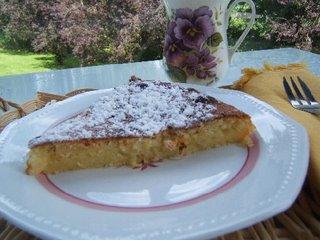
Photo courtesy of Odette de Crecy.

It is about reading labels in supermarkets, about trying to eat natural, if we can, or at least making the best effort we can to put quality products on the table.

Mindful Eating requires us to look at the food we eat, smell it, chew it slowly and appreciate its texture and flavor, and then pause and enjoy the aftertaste.

Mindful Eating is somewhat a way of life, although we mustn’t become obsessive about it. Almost by definition, it moves toward consumption of local products, and thus re-creation of local economies.

It is a way of communing with our environment – our family, our community, local business, producers, nature – and the satisfaction that is derived from this.

Mindful Eating gives concrete, practical results. It can improve our health and help us lose weight; it can help us lower cholesterol and consume more nutritious food.

It can give us a sense of well-being, because we have the feeling we’re doing what is right not only for ourselves and our family, but also for our community and the world.

Photo courtesy of Nikoman.

It can cut down our food budget, since seasonal products bought directly from local farmers will invariably be cheaper. They will also fresher and have more vitamins.

This is Part One of a series of articles exploring the endless possibilities incorporating this approach into our daily lives. Stay tuned for the following segments:

Part Two: Mindful Eating and Farmers
Part Three: Mindful Eating and Health
Part Four: Mindful Eating and the Local Economy
Part Five: Mindful Eating and the Land
 
___________________

Alessandro Guerani is a food and still life photographer in Bologna, Italy. He also has a food photography blog with beautiful food photos, Food-o-Grafia. The pomegranate photo is from his Baroque Food photo album.

Never miss a post
Name: 
Your email address:*
Please enter all required fields
Correct invalid entries

17 ways of eating on a budget without sacrificing your health

Published by Wednesday, October 5, 2011 Permalink 0

by Rosa Mayland

  1. Never shop on an empty stomach.
  2. Buy in bulk.
  3. Visit your supermarket as little as needed and make precise shopping lists.
  4. Don’t buy more than needed. Stick to your shopping lists.
  5. Make a budget, stick to it, and keep track of all expenses.
  6. Know your supermarket well and be wise to supermarket tricks.
  7. Limit your dining out. Eat at home.
  8. Shop seasonally and locally. It’s cheaper and healthier.
  9. Avoid all bagged, fancy packaged, ready-to-eat and processed food/meals (unless it is straightforward canned food). Avoid junk food unless it’s a treat you make at home from time to time.
    Swiss food pyramid.

  10. Eat more frugally (smaller portions) and only when you are hungry.
  11. Eat less meat, but more sustainable fish, cheese and eggs.
  12. Emphasize grains, legumes and vegetables (understand the food pyramid).
  13. Make double batches when you cook — one batch to eat straight away and one to freeze.
  14. Recycle leftovers and don’t waste food.
  15. Always stock your freezer with a selection of ice-friendly food, your kitchen pantry with imperishable and your spice cupboards with lots of condiments.
  16. Drink lots of tap water. Limit your consumption of alcohol, coffee, tea, sodas cut out most bought beverages. They represent a large expense.
  17. Take an interest in foreign and exotic culinary dishes, as they use bargain ingredients and small quantities of costlier ingredients.
Related articles


Never miss a post
Name: 
Your email address:*
Please enter all required fields
Correct invalid entries

Rosa’s Musings: A Good Old British Dessert With A Modern Flair: Spicy Damson Plum Roly Poly

Published by Tuesday, October 4, 2011 Permalink 0

by Rosa Mayland


Summer fades; the first cold, Northern air
Sweeps, like hatred, through still days –
The August heat now gone elsewhere,
To Southern, bird-filled coasts and bays;
Amid constricting vales of cloud,
A pale and liquid Autumn sun
That once beat down on an empty plain
And may again. And may again.
— Trever Howard, Autum

Lately, I’ve been in an unusually nostalgic, and in a rather morose state of mind. No matter how much I love autumn and look forward to cooler weather, seasonal mood swings always hit me hard when the summer ends. I guess it is something natural/biologic which each of us experiences to a certain degree. This time though, the “blahs” hit me a little harder than usual and I guess this is partly because last week, on the 13th of September, my English grandmother would have celebrated her 85th birthday, that is if she had not passed away last March…

Continue Reading…

Never miss a post
Name: 
Your email address:*
Please enter all required fields
Correct invalid entries

And here are the winners of the 6 Kuhn Rikon knives at our Expat Expo drawing

Published by Tuesday, October 4, 2011 Permalink 0

by Jonell Galloway

Husband Peter and I and Rosa Mayland, author of our column “Rosa’s Musings,” had a great time at the Expat Expo Geneva on Sunday. It’s a great way to make contacts in Geneva.

Jonell Galloway at The Rambling Epicure’s stand at Expat Expo Geneva 2011


We had a drawing for 6 red polka-dot Kuhn Rikon knives.


Kuhn Rikon Knives Drawing, The Rambling Epicure, Expat Expo Geneva

Here are the winners:

Paula Davies-Smith
M. Rowe
Peter Zornow
Sayjel
Alison Farley
Michelle Arevalo-Carpenter

Congratulations. You are now the proud owner of knives made by one of the most reputable brands of cookware in the world, and they’re made in Switzerland!

Related articles


Never miss a post
Name: 
Your email address:*
Please enter all required fields
Correct invalid entries

Brisket and Love: A Tribute to Beatrice Beckenstein Levine, or “Granny Bea”

Published by Monday, October 3, 2011 Permalink 0

by Jonell Galloway

Rosh Hashanah beef brisket brings back so many fond memories. It makes me think of how by mother-in-law would start preparing the brisket and the feast days before we arrived. The children were accustomed to eating European food, and in their earlier years had serious misgivings about brisket.

Granny Bea’s brisket was saucy like this one, but the sauce was not beer. It was made with carrots and onions that had been slow-cooked to the point that they formed a sweet sauce, “making it healthier,” she would say.

It was all made with such love and we felt that love in the air as we ate; it created a bond so strong that it will stay with us forever. Every time I hear the word “brisket” I remember the good old days, when she was alive, when we received all her love through her food and her loving, gracious manner, and tried to give it back to her as nobly as we could. Now we can only do that in our thoughts and prayers.

And now when the children hear “brisket”, I can see on their faces that they too feel that love, that bond.

Food made with love and shared in a spirit of love does that to you. Food helps you transmit your love; it also teaches you how to receive love.

This is dedicated to my mother-in-law, Beatrice Beckenstein Levine, the apple of my eye. I love(d) you, and I think of you every day and my heart still gets all warm and I shed a tear or two, and a taste of your brisket comes to my mouth. I’m going to ask for Granny Bea’s brisket once a week when I get the heaven.

Click here to read Mark Bittman and Daniel Meyer’s version of an up-to-date beef brisket.

  • Braising Brisket – Perfect for Fall and Rosh Hashanah
  • Eat: Mark Bittman: Bye, Bye, American Pie, The New York Times
  • Mark Bittman Explains ‘How To Cook Everything’
  • Central Texas Dry-Rub Brisket
Never miss a post
Name: 
Your email address:*
Please enter all required fields
Correct invalid entries

Simon Says: Daily Food Quote, October 3, 2011

Published by Monday, October 3, 2011 Permalink 0

by Simón de Swaan

No lyric poems live long or please many people which are written by drinkers of water.–Horace, 20 B.C.

Quintus Horatius Flaccus (8 December 65 BCE – 27 November 8 BCE), known in the English-speaking world as Horace, was the leading Roman lyric poet during the time of Augustus. Horace is generally considered to stand alongside Virgil and Ovid as one of the greatest poets of the Augustan Age.


Never miss a post
Name: 
Your email address:*
Please enter all required fields
Correct invalid entries

Switzerland: Rosa’s Musings: Butterzopf, The History Of A National Sunday Bread

Published by Saturday, October 1, 2011 Permalink 0

by Rosa Mayland

Switzerland (also known as “Confoederatio Helvetica” or “die Schweiz”, “la Suisse”, “Svizzera”, “Svizra”) is a federal republic composed of 26 cantons and 4 different linguistic and cultural areas (German, French, Italian and Romansch). It’s therefore not surprising if its cuisine reflects its rich heritage and highly diverse cultures. It is rather like an island in the middle of Europe, like a tiny kingdom.

Each region and canton has its very own traditional dishes and specialties as well as produce, and they defend and even protect it fiercely, because there are dishes, cheeses, wines, breads, and many more food items that are now protected by AOCs in Switzerland.

Even if this tiny piece of land stuck between Germany, Austria, France, Italy has its own highly diverse culinary identity, one cannot refute that each part of the Swiss Confederation has, to a certain extent, been influenced by its neighbors, and vice versa. For example, a sausage resembling the anise-flavored Geneva sausage called Longeole can also be found in Chablais (Haute-Savoie); a cheese similar to Valais raclette is made in Savoie too; the Swiss German spätzli seem to be of Swabian (German) origin. Then there is polenta or risotto which evoke the Apennine Penninsula, and are often found in Ticino, and, well, the list goes on. As it is the case with every place that is not in total isolation, the borders are quite permeable, so it is pretty understandable that ideas, information, arts and science cross back and forth across the borders.

Continue Reading…

Never miss a post
Name: 
Your email address:*
Please enter all required fields
Correct invalid entries

Simon Says: Daily Food Quote, September 30, 2011

Published by Friday, September 30, 2011 Permalink 0

by Simón de Swaan

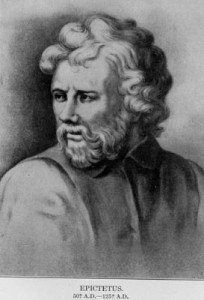
Remember that you ought to behave in life as you would at a banquet. As something is being passed around, it comes to you; stretch out your hand, take a portion of it politely. It passes on; do not detain it. Or it has not come to you yet; do not project your desire to meet it, but wait until it comes in front of you.–Epictetus, c. 135

Epictetus was a Greek sage and Stoic philosopher. The major compilation of Epictetus’ teachings are the four-volume work standardly referred to in English as the Discourses.

Chapter 1, page 1, of the Enchiridion of Epict...


Never miss a post
Name: 
Your email address:*
Please enter all required fields
Correct invalid entries

Switzerland: Coop’s Pro Montagna Label: 5 Years of Protecting Traditional Swiss Food Products

Published by Friday, September 30, 2011 Permalink 0

Switzerland: Coop’s Pro Montagna Label: 5 Years of Protecting Traditional Swiss Food Products

Please join us on Sunday, October 2nd, at the Expat Expo Geneva, from 11 a.m. to 5 p.m. in Palexpo, Hall 7. We’d love to meet our readers and make our contact more personal.

We’ll have booth No. B8 against the well, and one of our most popular authors, Rosa Mayland of the column Rosa’s Musings,will be present.

Click here for all the details.

Hope to see you there!

Jonell Galloway, Editor of The Rambling Epicure


Never miss a post
Name: 
Your email address:*
Please enter all required fields
Correct invalid entries

It’s apple season: Matefin à la pomme / apple pancakes/pie

Published by Thursday, September 29, 2011 Permalink 0

by Jonell Galloway

O Délices discovered this recipe on blog de Guillemette.

This is a traditional recipe from the Savoy, so it’s not so far from us in Switzerland.

The original name comes from the French mâte faim. Peasants prepared these potato pancakes in the morning before going to work in the fields. It was meant to keep them going until lunchtime.

This version uses apples instead of potatoes, and is perfect for the apple season, which has just started here in Switzerland.

Continue Reading…

Never miss a post
Name: 
Your email address:*
Please enter all required fields
Correct invalid entries