French Food Quotes: Daily Food Quotes, July 28, 2011

Published by Thursday, July 28, 2011 Permalink 0

by curry

“…..an ignorant and pretentious bunch try to improve on what is already the finest….. The improviser sets himself up at the stove just as he does anywhere else. With his eyes turned to heaven instead of on his saucepans, he drops in a pinch of Sidonie-Gabrielle Colette powder here, a spoonful of brandy there, and somewhere else, something even worse — a few drops of custard! He uses any old stuffing, he dribbles in some frightful additive. . .. Old words, classic terms, and traditions are all flouted by these priests of improvisation — it seems that we are a long way removed from the discreet combinations of flavors, thought out at length, that were once the basis of French gourmandise. . . “.–Colette (Sidonie Gabrielle), French novelist, in Prisons et Paradis, 1933

Known as Colette, Sidonie-Gabrielle Colette, born into an upper middle class family, in France. She spent most of her childhood in Burgundy, and also maintained her taste for the freedom that country life lent. In Paris, she lived the Bohemian life and frequented the salons of the period. She started by writing for musical halls, signed by her first husband, and even showed up at the Moulin Rouge dressed as a man, but went on to journalism and literature. Her books remained in the spirit of music halls, often shocking the public with their explicit descriptions of sex and the senses.

Never miss a post
Name: 
Your email address:*
Please enter all required fields
Correct invalid entries

French Food Quotes: Daily Food Quote, July 26, 2011

Published by Wednesday, July 27, 2011 Permalink 0

by Jonell Galloway

This is my invariable advice to people: Learn how to cook — try new recipes, learn from your mistakes, be fearless, and above all have fun!–Julia Child

Julia Child brought French food to post-war America. When her husband Paul was posted to Paris, she studied at L’Ecole du Cordon Bleu, and went on to form her own cooking school with fellow students Simone Beck and Louisette Bertholle. The threesome went on to write the 2-volume classic Mastering the Art of French Cooking, which covered all the basic techniques and dishes of classic French cuisine.

Never miss a post
Name: 
Your email address:*
Please enter all required fields
Correct invalid entries

Cross-Continental Cuisine / Cocina Transcontinental: Paté al cava y sangría de jengibre

Published by Tuesday, July 26, 2011 Permalink 0

por SandeeA y Tricia Martin

Click here to read English version

Pate al cava / Giger sangria
Me pasé toda la infancia soñando con probar la comida de la que hablaban en los libros… me parecía tan exótica y apetecible! Los emparedados, los pasteles de carne y manzana, la cerveza de jengibre de los libros de Enyd Blyton, … y quién no ha soñado con comerse uno (o dos) jabalíes con Astérix y Obélix… y ya puestos darles unos mamporros a esos “malditos romanos” y decirle al pescadero del pueblo galo que su pescado no está fresco para que se organice una buena :P?

Este mes el ingrediente elegido para nuestro Cross-Continental Cooking project fue el cava… y gracias a este proyecto conjunto que tengo con Tricia de Eating is Art voy a poder preparar mi propia cerveza de jengibre, simplemente mezclando sirope de jengibre con agua con gas… De los sueños gastronómicos infantiles ya solo me queda pendiente la pelea a besugazos (o pangazos, según como esté la economía :P) No dejéis de visitar la receta de Tricia: sangría de cava que, como todas las anteriores, está traducida al español. Además Tricia se ha embarcado en un nuevo proyecto: su propio estudio fotográfico Studio Tricia Martin. No dejéis de visitarlo, os dejará sin palabras… En cuanto a mi receta, tenéis que probarla, de verdad, y no volveréis a comprar uno de esos “blocs de foie” con ingredientes dudosos por los que te piden un riñón

Pate al cava / Ginger sangria

Continue Reading…

Never miss a post
Name: 
Your email address:*
Please enter all required fields
Correct invalid entries

David Downie: Guanciale: An Obituary and a Homage to Rome’s Jowl Bacon, Part 2

Published by Tuesday, July 26, 2011 Permalink 0

by David Downie

Click here to read Part 1

For centuries, Rome’s demand for cured hog jowl was met by hundreds of specialized pork butchers and salami makers. The first are called norcini and are both butchers and salted-pork product makers. The second, salumieri or salsamentari, do not usually get involved in the butchering of the pigs. Norcia, the mountain town in Umbria famed for its black truffles, gave its name to norcini, such as the Carilli brothers were: they came from the area. It has been the heartland of great pork and wild boar for millennia. Both animals feed on acorns from the forests that gave Umbria its name. (Umbre and variants originally meant “shady” or “dark,” as in a dark forest of oaks.)

Continue Reading…

Never miss a post
Name: 
Your email address:*
Please enter all required fields
Correct invalid entries

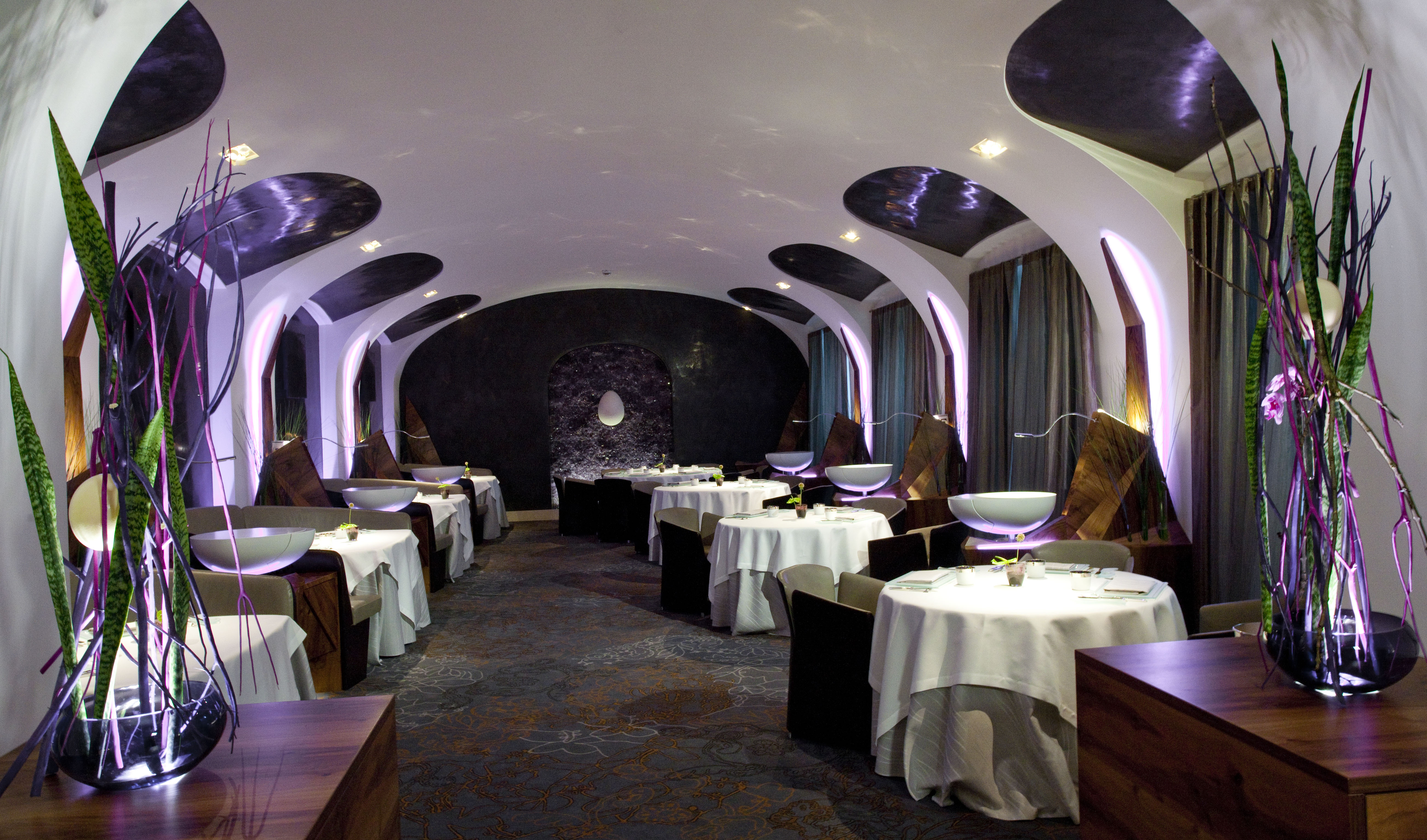
Restaurant Silvio Nickol im Hotel Relais & Châteaux Palais Coburg

Published by Tuesday, July 26, 2011 Permalink 0

by André Cis

Click here to read this article in English

Als logischen oder zumindest Konsequenten Schritt kann man Silvio Nickol‘s Wechsel vom Wörthersee in die Österreichische Hauptstadt nennen. Nachdem sich die Zeichen mehrten, dass das einstige Flaggschiff der mit Fanfahren ins Leben gerufenen “Capella-Hotelgruppe” im Sinken begriffen ist, war es nur eine Frage der Zeit, bis Nickol zu neuen Herden aufbrechen würde.

Palais Coburg. Eigner Peter Pühringer schien nach dem jähen Abgang des begnadeten österreichischen Paradekochs Christian Petz – just nach der Vergabe der 4. Haube im Herbst 2008 – keine Intention mehr zu haben, einen 2. Versuch ob eines Gourmet-Restaurants zu starten. Im Gegenteil, schien es doch gar ins Bild der so trüben Wirtschaftslage zu passen, dünnte sich in den vergangenen Jahren die Wiener Spitzengastronomie sukzessive aus – unlängst mit dem unerwarteten Paukenschlags der Nicht-Eröffnung des Shangri-La Hotels und dem somit arbeitslosen Spitzenkoch Joachim Gradwohl.

Continue Reading…

Never miss a post
Name: 
Your email address:*
Please enter all required fields
Correct invalid entries

Simon Eats: Simon de Swaan Eats his Way through Spain, a Documentary Photo Show, Part 1

Published by Monday, July 25, 2011 Permalink 0
Never miss a post
Name: 
Your email address:*
Please enter all required fields
Correct invalid entries

Silvio Nickol’s Restaurant in Palais Coburg Relais & Châteaux Hotel in Austria

Published by Monday, July 25, 2011 Permalink 0

by André Cis

Click here to read the original German version

You may consider Silvio Nickol‘s move from Lake Wörth to the Austrian capital as a rather logical step, or in any case a significant one. After more and more signs emerged showing that the luxury hotel chain Capella’s flagship was sinking, it had only been a question of time when chef Nickol would accept the chance for a new challenge.

It seemed that Palais Coburg owner Peter Pühringer had no intention of revitalizing the gourmet restaurant in his luxurious Viennese hotel venue after the sudden departure of Austrian master chef Christian Petz at the end of 2008, right after the restaurant was awarded its 4th toque by the GaultMillau restaurant guide. Far from it, the situation fit the economic crisis well, due to a considerable drop in fine dining in Vienna over the past few years. This recently culminated in the cancellation of the new Shangri-La Hotel,leaving master chef Joachim Gradwohl unemployed.

Try the new kitchen at Coburgbastei Nr. 4 — and let’s be honest: One of the world’s best wine collections deserves a fine restaurant as companion.

Continue Reading…

Never miss a post
Name: 
Your email address:*
Please enter all required fields
Correct invalid entries

Simon Says: Daily Food Quote, July 21, 2011

Published by Friday, July 22, 2011 Permalink 0

Good bread is the most fundamentally satisfying of all foods; and good bread with fresh butter, the greatest of feasts.–James Beard

James Beard (1903-1985) was an American chef and food writer who authored 20 books and was instrumental in bringing French cooking to America in the 1950s. World Culinary Institute gives a brief biography. His legacy lives on through the James Beard Foundation.

Never miss a post
Name: 
Your email address:*
Please enter all required fields
Correct invalid entries

Simon Says: Daily Food Quote, July 21, 2011

Published by Thursday, July 21, 2011 Permalink 0

by Simon de Swaan

The whole Mediterranean, the sculpture, the palm, the gold beads, the bearded heroes, the wine, the ideas, the ships, the moonlight, the winged gorgons, the bronze men, the philosophers -all of it seems to rise in the sour, pungent taste of these black olives between the teeth. A taste older than meat, older than wine. A taste as old as cold water.–Lawrence Durell

Lawrence Durrell (1912-1990), who wrote the modern classic Prospero’s Cell (1945) about time spent in Corfu, was born in India but spent most of his life abroad. Though educated in Britain, he resisted affiliation with Britain and preferred to be considered cosmopolitan. He was a novelist, poet, dramatist, and travel writer.


Never miss a post
Name: 
Your email address:*
Please enter all required fields
Correct invalid entries

Wild Woman on Feral Acres: Backyard Poultry Skills; from chick to plate in mere weeks

Published by Wednesday, July 20, 2011 Permalink 0

by Esmaa Self

Insulted by misleading labeling U.S. laws that allow “free range” to mean the chickens had limited outdoor access, while “natural” meat can include a percentage of injected saline, for after all, salt is natural, and “fresh” chicken can be sold as such even if it has been kept at 30 degrees, we decided it was time to take matters related to the quality of the meat we consumed into our own hands.

Which is a wordy introduction to the following fact: this year we raised and butchered our own meat chickens.

Cornish chicks. Photo courtesy Wiki Commons.

Our goal was not to simply eat cheaply. If price per serving was the only consideration, we’d shop Sam’s Club and save the trouble of raising our own food. No, as always, our goal is to grow excellent food while reducing overall costs (shipping, packaging, additives, bacterial contamination, supporting factory farming). We hoped to produce this higher caliber meat for less than we could buy a locally produced ‘natural’ chicken. And we did. In 11 weeks we raised a baker’s dozen of Cornish roasters, realized 77 pounds (about 35 kilograms) of meat at an amazingly low $1.43 cost per pound. This figure includes butcher paper and freezer bags, feed and lighting, and, of course, the animals. Excluded from the weight are necks, giblets, wing tips, etcetera, reserved for making nutrient rich stock.

Keep in mind that what we produced is not organic meat, for we used a non-medicated, locally produced non-organic feed, however neither is local favorite Red Bird brand organic, and their skinless, boneless chicken breasts sell for $2.99. What we produced is an incredibly tasty, tender and truly farm fresh chicken meat without the factory, the trucking or the non-recyclable packaging.

Our Cornish roasters at 4 weeks

And zero labeling lies.

Continue Reading…

Never miss a post
Name: 
Your email address:*
Please enter all required fields
Correct invalid entries