What to Eat in Switzerland: A Geneva Christmas: Cardoon Gratin Recipe

Published by Wednesday, December 19, 2012 Permalink 0

by Jonell Galloway

From the archives


Cardoon gratin is a classic Geneva Christmas dish, but only brave souls should try to prepare them because they are prickly, and the preparation can be long and tedious. Many farmers markets in Switzerland now sell them prepared sous vide, in plastic vacuum-packed packages, which is probably the best option for those who don’t get a thrill out of getting a few pricks. In any case, it is important to schedule it carefully into your meal preparations, because it is time-consuming any way you go about it.

Cardoon Gratin Recipe

Preparation of Cardoons for Gratin

  1. Throw out any hard stems and any that are wilted.
  2. Peel the cardoons by removing leaves, spines and stringy parts. The exterior will then be covered with a fuzzy layer. Use a cloth to rub stalks gently to remove fuzz.
  3. Cut stems into 8 cm (3 cm) slices. Rub with lemon, or if you intend to use them later, put slices into lemon water so they won’t turn dark.
  4. You now have two choices: you can either cook them in a white vegetable broth you’ve made ahead of time, or you can cook them in the lemon water you soaked them in.
  5. Bring to a boil and boil until tender. It should take about 30 minutes for them to become tender, but if they are larger in diameter it can take up to 2 hours, so allow plenty of time.

Recipe


All these steps can be carried out while the cardoons are cooking. There are actually several ways of doing this. You can either make a Béchamel (white) sauce and sprinkle cheese on the cardoons before you put them in the oven, or you can make a Mornay (cheese) sauce and pour it on the cooked cardoons before putting in the oven to brown. I think it’s tastier to make a Mornay sauce, and then sprinkle a bit of cheese on the top before putting it in the oven. Here’s my recipe.

Ingredients

Click here for British/American/metric recipe converter

Approximately 1 kg of cardoons
30 g of butter
1 tablespoon of flour
2.5 dl of whole milk
1 dl of cream
50 g of cheese, type Gruyère or Swiss (see photo below), grated
Lemon juice, freshly squeezed
Salt and pepper to taste
 

Emmentaler (also known as Swiss Cheese), while...


DIRECTIONS

  1. Make a Béchamel sauce, using the proportions of ingredients above.
  2. When finished and seasoned, add cream and cheese, setting aside a tablespoon of cheese. Set aside.
  3. Preheat oven to 250° C.
  4. Once cardoons are tender, drain, making sure all water is drained off.
  5. In a large bowl, mix cooked cardoons and Mornay sauce.
  6. Pour into a baking dish of the appropriate size, so that there is a layer of about 3 cm high.
  7. Sprinkle evenly with remaining grated cheese and a few knobs of butter.
  8. Put in hot oven for 15 to 20 minutes, or until golden brown.

Notes: It is important to use a hard, Swiss-type cheese. Cheddar cheese would have too strong of a taste. If you can’t find cardoons, the same recipe can be made with Swiss chard, thus eliminating the long, meticulous preparation. Simply cut them as for the cardoons and cook in chicken broth until tender, then follow the other steps in the recipe for making the gratin. Its texture is quite similar to that of cardoons.

Related articles


Never miss a post
Name: 
Your email address:*
Please enter all required fields
Correct invalid entries

A Look at Slow Food’s Salone del Gusto, October 2012, in Turin, Italy

Published by Saturday, November 3, 2012 Permalink 0

by Diana Zahuranec

Salone del Gusto ended on Monday 29, but I can’t stop thinking about it.

Salone del Gusto, held in Turin, Italy, is a Slow Food biannual food fair and conference. To sum it up in these few words undermines everything else it is, too, and its importance as an event that brings together producers from all over the world. These are producers that grow ancient varieties of grain to save genetic biodiversity, that make Slow Food Presidia cheeses or salumi, that pipe their cannoli full of the freshest organic ricotta you’ve ever tasted, and whose principles and values align with your own and, it goes without saying, Slow Food’s – good, clean, and fair food for all.

The Slow Food mascot

For all things Slow Food, here are some links courtesy of Scoop.it and Slow Food. To understand a few of those words in the paragraph above, just look at the end of the article.

This year, Salone del Gusto was a marriage of the original Salone del Gusto, first held in 2006, and Terra Madre, first held in 2004. While both events had food artisans and producers from all over the world, different activities were held at each and were not all accessible to the public. Salone del Gusto focused more on the exposition and sale of high quality foods and products, while Terra Madre was a gathering of a network of food producers from around the world. Having never been to either of these before, I can’t offer judgment on the differences of before and after. What I would love to do is share my first-time impressions of this year’s.

To say Salone is a food fair means that, like your down-home county fair, the place is jumping with activity – with a few notable differences. The funnel cakes are replaced with French butter cookies in 20 different flavors, the groundhog whacking game is replaced with the foodie’s (divisive word, I know) form of fun, that is vertical Barolo wine tastings, and that feeling of riding the Zipper right after you eat your funnel cake is replaced by the feeling of pressing up against crowds right after you drink your Barolo wines.

Continue Reading…

Never miss a post
Name: 
Your email address:*
Please enter all required fields
Correct invalid entries

Weight Loss Challenge: Eat Smaller Portions

Published by Thursday, September 13, 2012 Permalink 0

by Jonell Galloway

Eating smaller portions is not always as easy as it sounds.

In restaurants, they invariably serve portions much larger than you would take if you were serving yourself. I decided a long time ago that I would eat until I felt full, and not feel guilty about leaving the rest. My husband and children often end up eating the rest or taking it home in a doggie bag. I often solve this problem by ordering two starters and no dessert, which is a somewhat less noticeable way to go about it.

Continue Reading…

Never miss a post
Name: 
Your email address:*
Please enter all required fields
Correct invalid entries

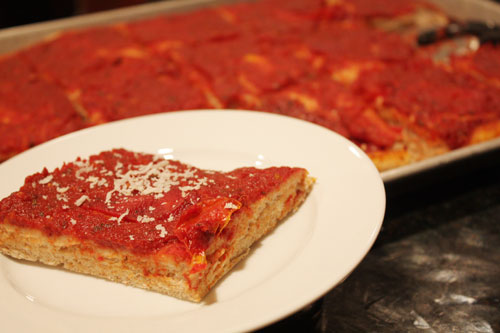
Food Poetry: Tomato Pies, 25 cents

Published by Tuesday, August 21, 2012 Permalink 0

by Grace Cavalieri


Tomato pies are what we called them, those days,
before Pizza came in,
at my Grandmother’s restaurant,
in Trenton New Jersey.
My grandfather is rolling meatballs
in the back. He studied to be a priest in Sicily but
saved his sister Maggie from marrying a bad guy
by coming to America.
Uncle Joey is rolling dough and spooning sauce.
Uncle Joey, is always scrubbed clean,
sobered up, in a white starched shirt, after
cops delivered him home just hours before.
The waitresses are helping
themselves to handfuls of cash out of the drawer,
playing the numbers with Moon Mullin
and Shad, sent in from Broad Street. 1942,
tomato pies with cheese, 25 cents.
With anchovies, large, 50 cents.
A whole dinner is 60 cents (before 6pm.)
How the soldiers, bussed in from Fort Dix,
would stand outside all the way down Warren Street,
waiting for this new taste treat,
young guys in uniform,
lined up and laughing, learning Italian,
before being shipped out to fight the last great war.

Continue Reading…

Never miss a post
Name: 
Your email address:*
Please enter all required fields
Correct invalid entries

Switzerland: Fresh Fruit Séré/Quark Cheese Mousse

Published by Wednesday, August 1, 2012 Permalink 0

by Jonell Galloway

In Switzerland, séré, as it is called in the French-speaking part of the country, or quark, as it is called in the German-speaking part, is a fresh cheese similar to curd cheese or cottage cheese and to ricotta, but the process of making it differs somewhat. Milk is first soured, then warmed until the desired degree of denaturation of milk proteins is met. It is then strained, so that it is smooth in consistency.

It is good eaten simply, with fresh fruit and a touch of sugar, but it can also be used for cooking.

When summer fruit is so abundant, this fresh fruit mousse makes for a different way of eating it.

You can buy either the full-fat version or a low-fat one. The full-fat version will be marked séré de crème in supermarkets; the full-fat version will be marked séré maigre or quark “maigre,” meaning low-fat. For this recipe, it’s best to buy it homemade from the cheesemonger or the full-fat version.

If séré is not available in your area, follow this easy recipe to make it yourself.

Continue Reading…

Never miss a post
Name: 
Your email address:*
Please enter all required fields
Correct invalid entries

Switzerland: Cucumber and Tarragon Salad Recipe

Published by Monday, July 16, 2012 Permalink 0

Jonell Galloway, Editor, The Rambling EpicureSwitzerland: Cucumber and Tarragon Salad Recipe

by Jonell Galloway

Spontaneous Cuisine: A Swiss Recipe

When the days are hot and sultry, few things can be as refreshing as a cold cucumber salad, especially this classic cucumber and tarragon salad. In Switzerland, we make it with sour cream and tarragon, while in France they cook the cucumbers slightly and then add crème fraîche and chives.

This salad goes perfectly with a grilled chicken breast or any white fish. It also goes perfectly with smoked or natural salmon, in which case you might want to replace the tarragon with fresh dill or dill seeds.


Continue Reading…

Never miss a post
Name: 
Your email address:*
Please enter all required fields
Correct invalid entries

Spontaneous Cuisine: Lacquered Pork Tenderloin, Roast Potatoes, Ramp/Ramson Recipe

Published by Tuesday, April 17, 2012 Permalink 0

From the archives

Lacquered Pork Tenderloin, Roast Potatoes & Ramson Recipe

by Jonell Galloway

Ramson and wild garlic leaves, as we call them in Switzerland, are in season, so now is the perfect time to make this recipe. The season doesn’t last long, so don’t tarry. If you don’t have ramson, or Allium ursinum,  in your area, try ramps or Allium tricoccum, which will produce a similar taste.

The sweetness of the lacquer and the tart acidity of the ramps give this recipe a lovely balance of opposing flavors. The roast potatoes serve as a neutral taste that makes the contrasts less shocking.


Spontaneous Cuisine: Lacquered Pork Tenderloin, Roast potatoes & Ramps Recipe

Continue Reading…

Never miss a post
Name: 
Your email address:*
Please enter all required fields
Correct invalid entries

Spontaneous Cuisine: Scallops, Green Asparagus and Strawberry Balsamic Sauce Recipe

Published by Friday, April 13, 2012 Permalink 0

by Jonell Galloway

 
From the archives
 

Spontaneous Cuisine: Scallops, Green Asparagus and Strawberry Balsamic Sauce Recipe

This is another low-fat, high-fiber meal that fits perfectly in to any weight loss plan. All these ingredients are available as of late April in Switzerland.


Continue Reading…

Never miss a post
Name: 
Your email address:*
Please enter all required fields
Correct invalid entries

The Revolution of French Bread Baking (part 1)

Published by Sunday, April 1, 2012 Permalink 1

by Jean-Philippe de Tonnac

Cliquez ici pour la version française.

Translated and adapted by Jonell Galloway

The reinvention of French cuisine: it’s springtime for French cuisine, and it may not all be thanks to French bread bakers, but they are playing a major role

French bread bakers are in the limelight these days, and are considered as much artists as artisans. Marie-Odile Briet recently paid homage to their creativity, unbridled by the French government’s 1993 “bread decree,” defining in very precise terms what could and couldn’t be defined as “bread.” The most illustrious advocates of the art of bread making, which in essence had to be reinvented, were Gontran Cherrier (Paris), Dominique Saibron (Paris), Christophe Vasseur (Paris), Jean-Luc Poujauran (Paris), Basile Kamir (Paris), Eric Kayser (Paris) and Benoît Fradette (Aix-en-Provence).

They merit the name of bread baker, or boulanger, as well as inventors. But we mustn’t leave out the stout-hearted artisans, working quietly in their bakeries in the wee hours of the morning, with no one tooting horns for them, who are nonetheless master bakers. And where there’s smoke, there’s fire, and this is the proof of the true renaissance of the French bread making profession — a renaissance that has spread from a few Parisian arrondissements to the entire country. It is a true phenomenon that has spread its wings far and wide; it is a movement that has started a new chapter in the history of French bread making. In this new paradigm, there is no longer any plausible excuse for bad bread, for flavorless bread, for bread that is too expensive or too anything. The movement is quietly deepening its roots, backed by a history dating back thousands of years, basking in the glow of its established nutritional qualities. But that’s not all: these master bakers are now an integral part of the whole redefinition of French cuisine. Bread is no longer considered a humble food to fill your belly or to sop up your sauce. It is clearly in the public eye.

Continue Reading…

Never miss a post
Name: 
Your email address:*
Please enter all required fields
Correct invalid entries

French Food Fact: What is the true meaning of the word “fondue”?

Published by Saturday, November 19, 2011 Permalink 0

by Jonell Galloway

For most of us, the word “fondue” conjures up images of poking those long skinny forks into a piece of bread and dipping it into a Swiss-style melted cheese fondue on the table in front of us, while sitting in a rustic chalet in the mountains with a beautiful view out over the mountains. Fondue certainly can mean that, but it doesn’t always.


The word literally means “melted” in French and should, if all be told, be used as an adjective. Although the name has been twisted a bit from the original meaning over the years, it still strongly retains traces of the original meaning, since it always includes the sense of something solid like cheese or chocolate melting into a sauce or pulp. The one exception to this is Burgundy fondue, which is basically like a smaller version of the medieval boiling pot of oil that was poured over the heads of invaders, and if spilled on you, it may not kill you, but it is highly possible it will leave you with lifetime scars.

The original fondue originated in Switzerland, and consists of a cheese sauce made with cheese, corn flour, kirsch, garlic and sometimes flavorings, such as wild mushrooms, tomatoes, shallots, depending on the canton.

Eighteenth-century French gastronome Brillat-Savarin also used the term in his Physiologie du goût, or Physiology of Taste, considered one of the great classics of all time on French cuisine. His fondue consisted of scrambled eggs and cheese, and the cheese was melted.

Many vegetable preparations also go by the name fondue. When vegetables are cooked slowly in fat for a very long time, they eventually start to “melt” and form a pulp. They can then be used to make sauces or as constituent elements in other dishes, for example fondue of carrots or fondue of onions.


Never miss a post
Name: 
Your email address:*
Please enter all required fields
Correct invalid entries

UA-21892701-1