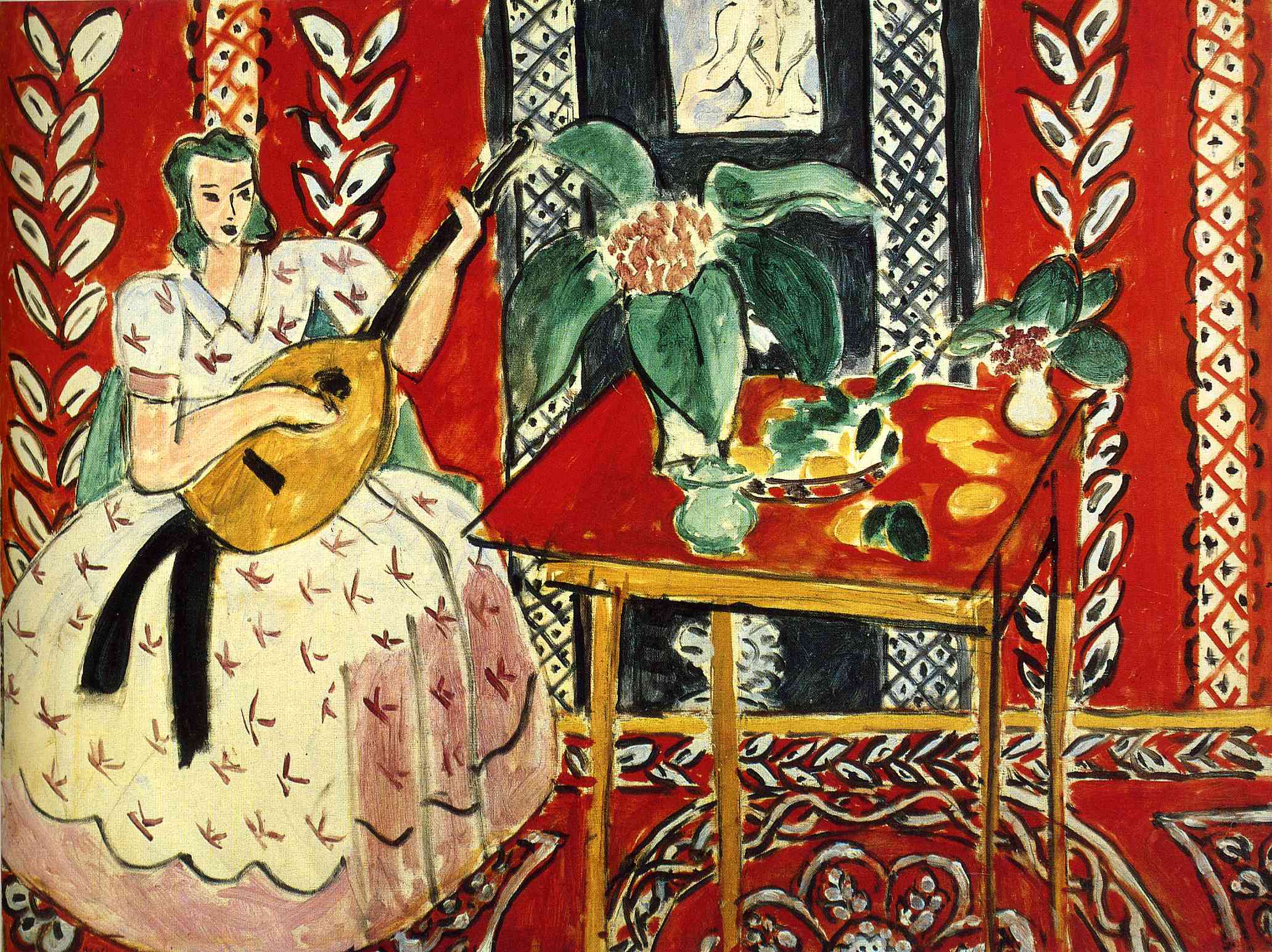
Food Art: Lute and Fruit, by Henri Matisse
Related articles
|
|

A Literary Culinary Journal
|
|
Garzone was one the first women painters to paint still lifes. Collectors loved her work, and she was able to immediately sell all she produced at just about any price she named. Garzone painted on vellum. She worked mainly for aristocratic patrons, such as the Medici family, and often took decorating commissions in their villas and palaces. She was most likely influenced by Jacopo Ligozzi, who was a botanical and zoological painter for the Medici court. Garzoni bequeathed all her work to the painters’ guild in Rome, the Accademia di San Luca, in exchange for the right to be buried there. Source: Getty Museum
|
|
|
|
by Elatia Harris
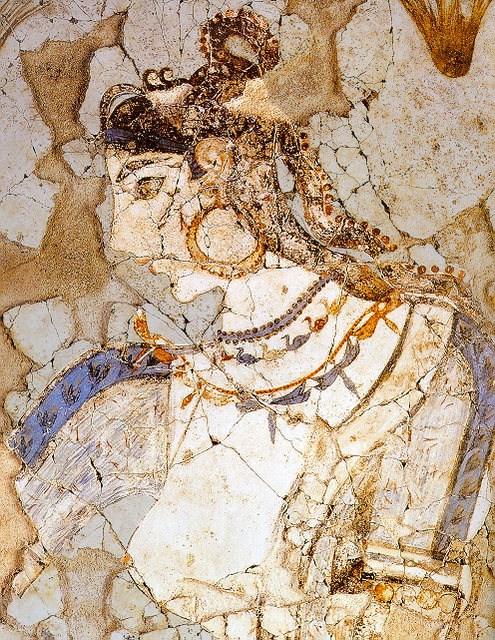
Mistress of the Animals from Xeste 3 on Thera.
Part Two in a series of articles on aspects of saffron. Photos of wall paintings from the excavated areas of Thera (also called Santorini), are taken from a magnificent site that has expired off the Internet, www.therafoundation.org. Other photos credited where possible. Part One examines the origins of saffron culture in Western Asia, with an overview of the saffron-dominated fresco cycle on Santorini, dating to the 17th century B.C.E. The present article looks at saffron in cultic rituals.
It is hard not to look at the goddess on the saffron cushion. Though her state of preservation is less than optimal, she is the focal point of the cycle. In 1996, the archaeologist Paul Rehak undertook a gendered reading of the Xeste 3 fresco cycle – one that pointed up many subtleties in both the organization of society on Thera and the medicinal use of saffron, by and for women. In his monograph, “Myth, Medicine and Matriarchy: Reconstructing a Female Homosocial Environment in the Thera Frescoes,” he raises as well the issue whether the Xeste 3 frescoes were painted by women, for women – a possibility worth considering.
Necklaces with a duck and a dragonfly motif hang in an arc from the throat of the main image. Her blue and white costume is richly embroidered with a saffron crocus motif, the easily recognizable silhouette of the wild-growing C. cartwrightianus that is everywhere represented in Xeste 3 – clinging to rocks, garlanding its gatherers, piled into baskets, and patterning the creamy white field on which all the images are painted.
To us, perhaps the most compelling aspect of the goddess is not her regalia, but her expression.


Drawing from Nanno Marinatos — Wall of Xeste 3, with Mistress of the Animals.
Head turned in profile, her eye is starry with interest, her lips parted as if in speech with the blue monkey to her right offering a handful of saffron. A gryphon flanks her left, present only in paw and wing. She may command girls to gather saffron and bring her tribute, but her companions are animals, on the same platform as herself. We do not know her name on Thera, but she is known to us anyhow. This is the Mistress of the Animals — potnia theron — one of the oldest goddesses of ancient times. And this is not her first or last iteration. As we enter historical times, she often takes the form of Aphrodite.

Elatia Harris is a writer and consulting editor in Cambridge, Mass. She is most often at work on books and articles about food, wine and travel. Contact her at elatiaharrisATgmailDOTcom or via text at 617-599-7159.
|
|

The French Vaudois word raisinée refers to a syrup made of the must of apples and pears. It was originally cooked in grape juice, thus the name — raisin means grape in French. Often called vin cuit, or “cooked wine”, it is in the form of a dark brown, viscous liquid. In still other parts of Switzerland, another concoction similar in consistency to jam and using the same ingredients is called cougnarde and probably dates back to at least the Middle Ages. Raisinée was used as a sweetener in many regions in Europe, and the tradition has lingered in Switzerland, especially in the cantons of Vaud, Fribourg and Neuchâtel. Today, it is mainly used for cakes and pies, and is not fermented, so it not technically a wine.
In the 17th century, raisinée meant a thick fruit jam, generally made of apples and pears, and slow-cooked in concentrated grape juice. According to the Encyclopédie d’Yverdon, published in the 1770s, raisinée was made from the must of very ripe green grapes cooked until reduced by two thirds, then kept in barrels. Drinking it was said to give energy to people of a frail nature.
Raisinée is no longer drunk as a cooked or fortified wine, although in the 18th century one finds recipes for fruit must syrup made from apples and pears (dropping the use of grape juice) and used to replace sugar. Like today, the apple and pear juice was cooked until thick, until a drop on a plate didn’t run anymore. During periods of scarcity and hardship — for example, during and after World War II when sugar was low or not available — it was and still is used as a sweetener.
Cantons like Fribourg and the Vaud have kept up the tradition more than elsewhere, partially because they have a history of orchards. Recipes had been maintained and they were brought back to life in the 1980s.
Traditions similar to this were to be found in Mesopotamia and Ancient Rome.
Use apples and pears not suitable for eating. The fruit shouldn’t be overly ripe. You should be able to crush it and press it, but it mustn’t turn into a purée. The juice is filtered to get rid of hard bits. It is then decanted overnight (no more).
Unlike industrial fruit concentrates, the juice is not clarified. It is simply brought to a boil in a large copper kettle over a wood fire. Try to use up any bits of wood not suitable for a regular fire. A coil-type steam burner can be used to prevent risk of overheating, especially when making large quantities.
|
|
by Elatia Harris
For this list to be coherent, I have to have actually read and truly admired the books on it. Check! If they are cookbooks, I have to have cooked from them with great results. Check! I want to hear what your entries would be – it was a great year for books about food and cooking, and I’ve had to leave many good ones out.


20,000 years of the great movements of history, written with the kitchen at the center. If you want to take a very long view, and think hard about power – getting it, keeping it, getting it back – then the intimate and often surprising relationship between food and power, in Laudan’s telling, will astonish you. The historical counterpart to Harold McGee’s On Food and Cooking, this is a supremely important book that is a great pleasure to read. Don’t be afraid of its bigness, for it’s a truly manageable length. Read it fast, think about it forever.
How did the American Diet evolve? We’re not eating like they did at Plimouth Plantation, or like Thomas Jefferson ate – what ARE we eating like? For a fresh view of what’s uniquely American about our foodways, this book is a treasure.
The activist Wenonah Hauter has written Foodopoly to take on, and urge readers to take on, the dark side of our food systems, and it’s a very dark side indeed. Can there be reclamation? Can the trend towards domination by fewer and bigger companies ever be reversed? “Yes, but…” Hauter tells us, and then she tells us what that would take.
The author is a labor organizer who believes that the maltreatment of food service workers need not be the ugly secret of the US restaurant industry. But right now, it is. What would have to happen, for food service workers to be paid a living wage and given paid sick days? One in every twelve people in the USA works in food service – how should they be treated? In its way, this is a companion volume to Foodopoly, asking all the right questions, answering not a few.
A guide to using other people’s money to finance your socially responsible food business, this is a hard-headed book for mostly young idealists. Brilliantly thorough, if you are on a mission but lack for practical knowledge of the business world. Especially valuable are the ideas for working around a financier’s natural unwillingness to lend money to anyone hoping to do good.
Film maker and painter Zev Robinson could turn Arribes, a DVD, into a commanding book, so I’m counting it in. Arribes is a rural area in northwestern Spain where people are 80% self-sufficient. One of those places where life is both simple and difficult – and movingly sustainable. Robinson’s eye for Spanish classical painting serves beautifully here. If by magic Zurbaran and Murillo could see Arribes, they would recognize their own lineages instantly and with pleasure.
Confused about the world history of mushrooms? Wondering about foraging for them or choosing them or storing them? And what about a few recipes? Culinary historian Cynthia D. Bertelsen has solved all your problems in this tiny, indispensible book, a delight from beginning to end. You will read it in a snowy evening, you will consult it forever after. And if you’re still not satisfied with the mushrooms in your life, you’ll have instructions for growing your own.
Andrea Gray and Adriana Lahl have a winner in this charmingly beautiful cookbook that focuses on the food of Mexico’s festivals. As well as recipes, there is abundant material about history and folklore, much of it highly visual and appealing to children – it’s a perfect family gift. Professional cooks as well as writers, Gray and Lahl know their way around the Mexican kitchen. It’s a labor-intensive cuisine, and the streamlining here is as intelligent as any I have ever seen – no false notes, some truly helpful simplifications. If you want the best ever recipe for Nogada Sauce, one of the signature paradisal items in Like Water for Chocolate, buy the book and turn to page 257.
The Jewish community in Cochin, in the South Indian state of Kerala, was intensely lively for 2000 years. It has dwindled now to a few souls, but its culinary traditions belong to the world, many having partaken of, and been absorbed into, mainstream Indian cooking. Knowing that, soon, the cuisine will have outlived its people, the three authors, all originally Jews of Cochin, wrote this excellent cookbook — full of fascinating history, good recipes and directions for good practice — as a testament.
Travel and food writer nonpareil, David Downie, mounts an interior and a physical struggle against middle age and fading health by walking 750 miles across France – the famous Way of St. James. Well, it’s no saunter. Even the companionship of his wife, the wonderful photographer Alison Harris, whose photos here are a revelation, cannot inure him to the hardships of the pilgrimage route. Readers will ponder how much in this volume is deeply spiritual – to my reading, seeking something you cannot define, yet seeking it body and soul, is a spiritual journey. One that is intermitted, David Downie being David Downie, by some of the most gorgeous repasts I’ve heard tell of.
|
|
Here are all the facts you need to know about how your body uses the calories from junk food in comparison to those from real food. This article is a fascinating read, and a keeper! See Precision Nutrition.
Here’s an excerpt:

Remember:
|
|

SandeeA is a top-notch food photographer and she runs the popular blog La Receta de la Felicidad, where you can find many of the recipes appearing in these photos.
|
|
The eating habits and diets of Kate Middleton, Duchess of Cambridge, spark the interest of many. Here are some reference links.
http://www.cosmopolitan.com/health-fitness/advice/a3557/the-dukan-diet-kate-middleton-weight-loss/
http://www.cosmopolitan.com/health-fitness/advice/a3557/the-dukan-diet-kate-middleton-weight-loss/
http://www.nydailynews.com/life-style/health/kate-middleton-dukan-diet-extreme-pre-wedding-creator-article-1.1954094
http://www.express.co.uk/life-style/diets/487734/Kate-Middleton-diet
http://www.womenshealthmag.com/nutrition/kate-middleton-diet-plan
http://www.ibtimes.com/kate-middleton-pregnant-anorexic-91-pounds-losing-more-weight-report-1624366
http://www.dailymail.co.uk/femail/article-2772507/The-Duchess-Cambridge-Controversial-feminist-Germaine-Greer-launches-scathing-attack-pregnant-Kate-says-royal-family-crushed-personality.html
|
|
 Meet Jonell Galloway, a freelance writer and editor specialized in French cuisine.


